


Case Study: Producing the TOGAF ADM Preliminary Phase Deliverable
Organizational Model for Enterprise Architecture
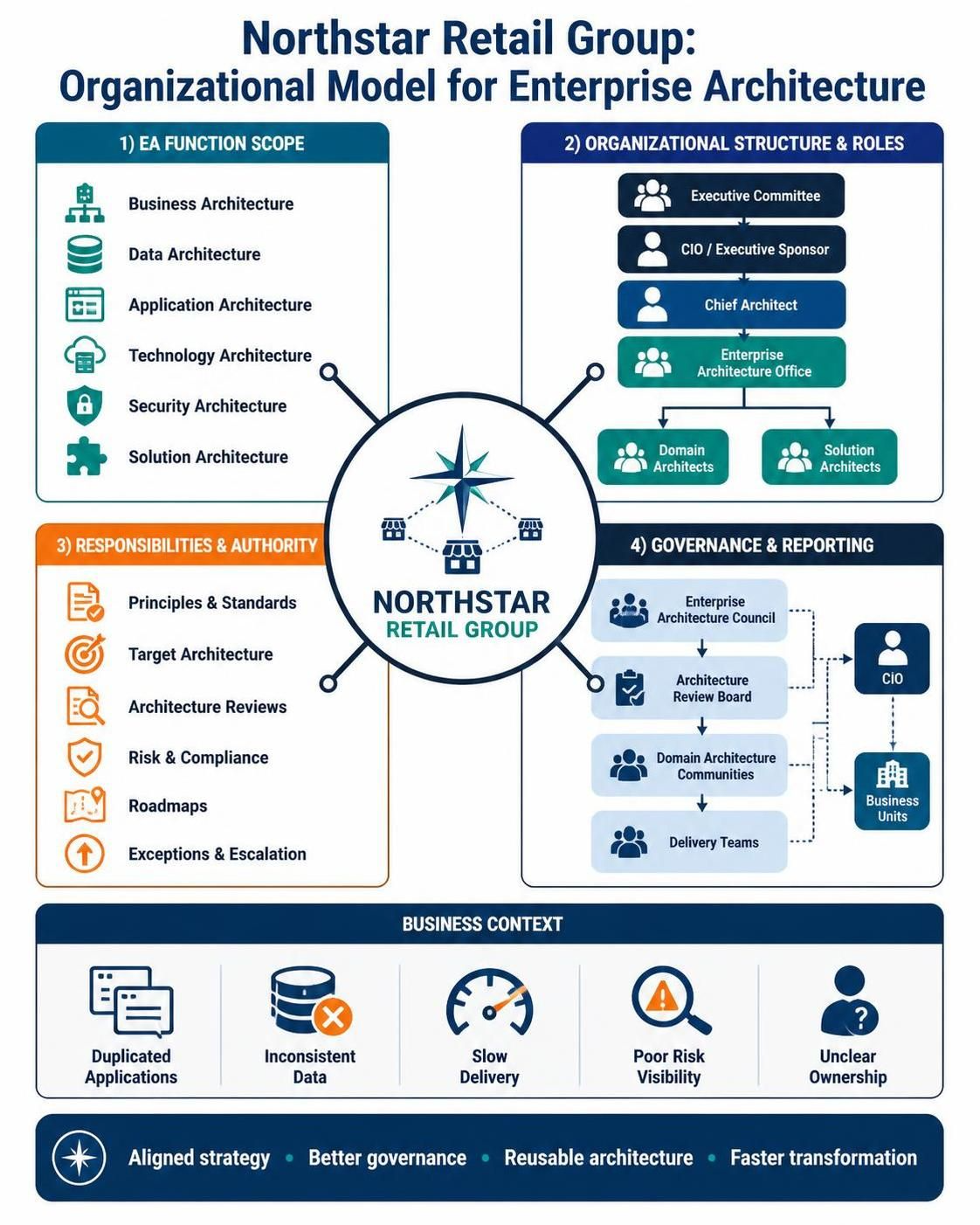
1. Case Study Overview
This case study explains how an organization can produce the Organizational Model for Enterprise Architecture, one of the key deliverables of the TOGAF Architecture Development Method Preliminary Phase.
The case organization is a fictional but realistic company:
Northstar Retail Group, a large omnichannel retailer operating physical stores, e-commerce platforms, warehouses, a customer loyalty program, and regional delivery services.
Northstar has grown through acquisitions and now experiences:
-
Duplicated applications across business units
-
Inconsistent data definitions
-
Slow delivery of strategic technology initiatives
-
Poor visibility of technology risks
-
Unclear ownership of architecture decisions
-
Limited coordination between business, information, technology, security, and project teams
The executive committee decides to establish a formal Enterprise Architecture function using TOGAF.
The required deliverable is an Organizational Model for Enterprise Architecture covering:
-
Scope of the enterprise architecture function
-
Organizational structure and roles
-
Responsibilities and authority
-
Governance structure and reporting relationships
2. Purpose of the Deliverable
The Organizational Model for Enterprise Architecture defines how architecture will operate within the enterprise.
It answers four fundamental questions:
-
What is Enterprise Architecture responsible for?
-
Who performs architecture activities?
-
What authority do architects and governance bodies have?
-
How are architecture decisions governed, communicated, escalated, and reported?
Without this deliverable, an architecture practice may become an informal advisory group with unclear responsibilities. It may produce documents but have little influence over investment decisions, solution delivery, risk management, or business transformation.
The organizational model therefore establishes the architecture function as an operating capability rather than merely a collection of architecture diagrams.
3. Business Context
Northstar Retail Group operates in five major business areas:
| Business area | Main responsibilities |
|---|---|
| Customer and Digital | E-commerce, mobile applications, customer experience, loyalty |
| Stores and Merchandising | Stores, pricing, promotions, product management |
| Supply Chain | Warehousing, logistics, inventory, supplier integration |
| Finance and Corporate Services | Finance, procurement, human resources, legal |
| Technology and Operations | Infrastructure, applications, cybersecurity, service management |
The organization has approximately:
-
18,000 employees
-
450 retail stores
-
Operations in three countries
-
Annual revenue of approximately $4 billion
-
More than 600 business and technology applications
-
Multiple cloud platforms and data centers
-
Several major transformation programs
The Chief Information Officer has previously managed technology architecture informally through the IT department. However, the executive committee now wants architecture to support enterprise-wide decisions, including business operating model changes, data governance, cybersecurity, sourcing, and transformation investment.
The organization therefore needs an architecture function that is:
-
Enterprise-wide rather than IT-only
-
Connected to strategic planning
-
Integrated with portfolio and project governance
-
Independent enough to challenge individual initiatives
-
Practical enough to support delivery teams
4. Objectives of the Architecture Organization
The objectives are agreed during the Preliminary Phase.
The Enterprise Architecture function will:
-
Align business strategy, operating models, information, applications, and technology.
-
Define and maintain the enterprise architecture vision and target states.
-
Identify opportunities for business simplification and standardization.
-
Reduce duplication and unnecessary technology costs.
-
Improve interoperability and reuse.
-
Strengthen information security, privacy, resilience, and regulatory compliance.
-
Support investment prioritization and transformation planning.
-
Provide architecture guidance to programs and solution teams.
-
Establish architecture principles, standards, and reference models.
-
Provide governance over significant architecture decisions.
-
Maintain the architecture repository and architecture knowledge base.
-
Measure the effectiveness of architecture decisions and investments.
5. Method Used to Produce the Deliverable
Northstar uses a structured approach to produce the Organizational Model.
Step 1: Confirm the business drivers
The architecture organization should not be designed in isolation. The team begins by identifying the business pressures that require architecture capability.
Workshops are held with:
-
Chief Executive Officer
-
Chief Information Officer
-
Chief Financial Officer
-
Chief Operating Officer
-
Chief Digital Officer
-
Chief Information Security Officer
-
Business unit leaders
-
Program and portfolio management
-
Procurement
-
Risk and compliance
-
Human resources
The main drivers identified are:
| Business driver | Architecture implication |
|---|---|
| Omnichannel growth | Architecture must cover customer, digital, store, and supply-chain capabilities |
| Acquisitions | Architecture must support integration and rationalization |
| Regulatory pressure | Security, privacy, risk, and compliance must be embedded in architecture governance |
| Rising technology costs | Architecture must influence investment and platform decisions |
| Faster digital delivery | Architecture must provide reusable standards and lightweight decision-making |
| Data quality problems | Data architecture and information governance must be part of the function |
| Cloud adoption | Technology architecture must cover cloud principles, platforms, resilience, and sourcing |
The result is a decision that Enterprise Architecture will be an enterprise capability, not simply an IT design authority.
Step 2: Define the scope of the architecture function
The team then determines what areas are inside and outside the initial scope.
2.1 Scope dimensions
Architecture scope is defined across several dimensions:
-
Organizational scope
-
Geographic scope
-
Business scope
-
Architecture domain scope
-
Lifecycle scope
-
Decision scope
-
Governance scope
-
Repository scope
2.2 Organizational scope
The function will initially cover:
-
Corporate headquarters
-
All retail operations
-
E-commerce and mobile channels
-
Warehousing and logistics
-
Customer loyalty services
-
Shared corporate services
-
Technology platforms used by Northstar
Acquired companies will be incorporated progressively through transition planning.
2.3 Geographic scope
Northstar operates in three countries. Enterprise principles and strategic architectures will apply across the group, while local variations will be allowed where required by:
-
Legal obligations
-
Tax rules
-
Labor regulations
-
Market-specific operating requirements
-
Local customer or supplier practices
2.4 Architecture domains
The architecture function will cover the following domains:
| Architecture domain | Scope |
|---|---|
| Business Architecture | Capabilities, value streams, business processes, organization, operating model |
| Data Architecture | Information concepts, data ownership, data flows, master data, data quality, analytics |
| Application Architecture | Application portfolio, application services, integration, APIs, rationalization |
| Technology Architecture | Infrastructure, networks, platforms, cloud, devices, technical services |
| Security Architecture | Identity, access, cybersecurity, resilience, privacy, security controls |
| Integration Architecture | APIs, events, middleware, interfaces, integration standards |
| Solution Architecture | Architecture of individual initiatives and products within enterprise constraints |
Security Architecture is treated as an integrated cross-cutting domain but is governed through strong collaboration with the CISO organization.
2.5 Lifecycle scope
The architecture function will participate in:
-
Strategy development
-
Business case preparation
-
Portfolio planning
-
Program initiation
-
Solution design
-
Procurement and sourcing
-
Implementation assurance
-
Transition to operations
-
Post-implementation review
-
Architecture compliance and continuous improvement
2.6 Initial exclusions
To avoid overextending the new function, the following are not initially owned by Enterprise Architecture:
-
Detailed project management
-
Day-to-day system administration
-
Detailed software coding standards owned by engineering teams
-
Operational service management
-
Vendor contract management
-
Detailed process documentation below the agreed architecture level
-
Routine low-risk solution design that follows approved standards
These activities may interact with architecture but are owned by other functions.
6. Scope Statement for the Deliverable
Northstar documents the agreed scope in the following formal statement:
The Northstar Enterprise Architecture function defines, governs, and maintains the business, data, application, technology, security, integration, and solution architectures required to achieve the enterprise strategy. Its scope includes all major business units, shared services, strategic technology platforms, significant transformation initiatives, material technology investments, and architecture decisions that may affect enterprise risk, interoperability, information management, resilience, regulatory compliance, or long-term cost.
The function will not replace business ownership, delivery management, product ownership, engineering management, information security operations, or service management. Instead, it will establish architecture direction, decision criteria, constraints, reusable patterns, and governance mechanisms for those areas.
7. Determine the Required Architecture Capability
The next question is not only what architecture should cover, but what level of capability is required.
Northstar assesses itself against five capability dimensions:
| Capability dimension | Current state | Required state |
|---|---|---|
| Governance | Informal and inconsistent | Formal decision rights and escalation |
| People | Small group of technical architects | Multidomain architecture team |
| Processes | Project-specific review | Integrated lifecycle governance |
| Methods | Inconsistent documentation | Standardized architecture method and viewpoints |
| Tools and repository | Scattered documents | Managed architecture repository |
| Measurement | No architecture metrics | Defined performance and compliance measures |
The assessment shows that Northstar does not need a large centralized architecture department immediately. It needs a federated architecture model.
8. Select the Organizational Model
Northstar considers three organizational options.
Option 1: Centralized architecture function
All architects report to a Chief Architect or Enterprise Architecture Director.
Advantages
-
Consistent standards
-
Strong independence
-
Easier capability development
-
Clear architecture accountability
Disadvantages
-
Can become disconnected from business units
-
May create a bottleneck
-
May be perceived as an IT control function
Option 2: Fully decentralized architecture
Architects are embedded entirely within business units or delivery teams.
Advantages
-
Close to business needs
-
Fast local decision-making
-
Strong delivery alignment
Disadvantages
-
Inconsistent standards
-
Duplicated architecture practices
-
Difficult enterprise-wide prioritization
-
Weak independence
Option 3: Federated architecture function
A central Enterprise Architecture Office establishes principles, methods, standards, and enterprise direction. Domain and solution architects remain connected to business units, product teams, and technology groups.
Advantages
-
Enterprise consistency with local responsiveness
-
Better connection to business and delivery
-
Scalable across multiple business units
-
Supports shared governance
Disadvantages
-
Requires clear role definitions
-
Matrix reporting can create conflicts
-
Requires strong communication and escalation mechanisms
Northstar selects the federated model.
9. Proposed Organizational Structure
9.1 High-level structure
The architecture organization is structured as follows:
Board / Executive Committee
          |
    CIO / Executive Sponsor
          |
Enterprise Architecture Council
          |
Chief Architect / Head of Enterprise Architecture
          |
Enterprise Architecture Office
          |
-------------------------------------------------
|          |           |           |              |
Business   Data        Application Technology    Security
Architecture Architecture Architecture Architecture Architecture
          |
   Architecture Review Board
          |
 Solution Architects and Domain Architecture Communities
This structure separates:
-
Strategic architecture direction
-
Architecture standards and methods
-
Domain architecture
-
Solution-level architecture
-
Architecture governance
-
Delivery assurance
9.2 Reporting structure
The recommended reporting relationships are:
-
The Chief Architect reports to the CIO.
-
The Enterprise Architecture Office reports functionally to the Chief Architect.
-
Domain architects report administratively to the Chief Architect or relevant technology/business executive, depending on the domain.
-
Solution architects report administratively to delivery or product organizations but functionally to the architecture community.
-
Security architects maintain a formal relationship with both the Chief Architect and the CISO.
-
Data architects maintain a formal relationship with both the Chief Architect and the Chief Data Officer or equivalent data executive.
-
Architecture governance decisions are made through the Architecture Review Board and escalated to the Enterprise Architecture Council when required.
This model balances organizational practicality with architectural independence.
10. Roles in the Architecture Organization
10.1 Executive Sponsor
The Executive Sponsor is usually a senior executive who supports the architecture capability and removes organizational barriers.
For Northstar, the CIO is the primary Executive Sponsor.
Responsibilities
-
Establish the importance of enterprise architecture
-
Secure executive support and funding
-
Resolve conflicts beyond the authority of the Chief Architect
-
Ensure architecture is connected to enterprise strategy
-
Support enforcement of architecture decisions
-
Sponsor the Architecture Charter
Authority
The Executive Sponsor can:
-
Approve the architecture mandate
-
Escalate noncompliance to the executive committee
-
Approve major exceptions
-
Resolve disputes between business units and architecture governance
10.2 Chief Architect
The Chief Architect is accountable for the architecture capability as a whole.
Responsibilities
-
Define and maintain the architecture operating model
-
Lead development of the Enterprise Architecture Charter
-
Establish architecture principles and standards
-
Chair or coordinate the Architecture Review Board
-
Advise executives on architecture risks and opportunities
-
Ensure architecture is integrated with investment and portfolio governance
-
Manage the architecture roadmap
-
Maintain the architecture capability maturity plan
-
Coordinate domain and solution architecture
-
Report architecture performance to executives
Authority
The Chief Architect can:
-
Require architecture review for initiatives within the defined scope
-
Approve architecture standards and reference patterns within delegated authority
-
Reject or return architecture submissions that do not meet requirements
-
Escalate material architecture risks
-
Require corrective actions for architecture noncompliance
-
Recommend investment or decommissioning decisions
-
Approve low- and medium-risk architecture decisions within the authority matrix
The Chief Architect cannot independently approve business funding, override legal requirements, or replace accountable business owners.
10.3 Enterprise Architecture Office
The Enterprise Architecture Office provides the coordination and administration required to operate the practice.
Responsibilities
-
Maintain the architecture repository
-
Manage architecture processes and templates
-
Maintain the architecture principles catalog
-
Coordinate architecture review meetings
-
Track decisions, actions, risks, waivers, and exceptions
-
Maintain the architecture roadmap
-
Produce reports and dashboards
-
Manage architecture communications
-
Support training and community development
-
Coordinate architecture planning cycles
Authority
The Enterprise Architecture Office can:
-
Request required architecture artifacts
-
Validate submissions for completeness
-
Maintain the official architecture decision record
-
Publish approved architecture standards
-
Track compliance actions
-
Escalate overdue decisions and unresolved risks
10.4 Business Architect
The Business Architect connects enterprise strategy, capabilities, value streams, operating models, and organizational design.
Responsibilities
-
Model business capabilities
-
Define business architecture baselines and targets
-
Analyze business impacts of transformation
-
Identify capability gaps
-
Align business and technology roadmaps
-
Support business case development
-
Clarify business outcomes and measures
-
Ensure architecture reflects business priorities
Authority
The Business Architect can:
-
Recommend capability priorities
-
Challenge technology proposals that lack business value
-
Require clarification of business outcomes
-
Approve business architecture artifacts within delegated authority
Business architects do not own business strategy; they help translate it into architecture.
10.5 Data Architect
The Data Architect is responsible for the enterprise information perspective.
Responsibilities
-
Define data principles and information standards
-
Establish conceptual and logical data models
-
Define data ownership and stewardship requirements
-
Support master data management
-
Identify critical information assets
-
Govern data flows and integration
-
Support privacy, retention, quality, and lineage requirements
-
Align analytical, operational, and reporting data structures
Authority
The Data Architect can:
-
Reject designs that create unacceptable duplication or data quality risk
-
Require data ownership to be assigned
-
Approve data architecture patterns within delegated limits
-
Escalate data policy conflicts to the Data Governance Council
10.6 Application Architect
The Application Architect manages the application landscape and its evolution.
Responsibilities
-
Maintain the application portfolio
-
Define application principles and reference architectures
-
Identify duplication and rationalization opportunities
-
Define application integration patterns
-
Support API and service architecture
-
Assess application lifecycle and technical debt
-
Review solution architecture proposals
-
Support application modernization planning
Authority
The Application Architect can:
-
Challenge proposals that duplicate existing functionality
-
Require reuse of approved platforms where appropriate
-
Approve application architecture within assigned thresholds
-
Recommend application retirement, consolidation, or replacement
10.7 Technology Architect
The Technology Architect defines the technology platforms and infrastructure required by the enterprise.
Responsibilities
-
Define technology standards and reference platforms
-
Establish cloud, network, infrastructure, and hosting principles
-
Assess resilience and scalability
-
Support technology sourcing decisions
-
Define technology lifecycle standards
-
Review platform and infrastructure proposals
-
Identify technical debt and modernization requirements
Authority
The Technology Architect can:
-
Approve or reject technology choices against enterprise standards
-
Require approved platform patterns
-
Escalate unsupported or high-risk technologies
-
Recommend platform consolidation
10.8 Security Architect
The Security Architect ensures that architecture decisions reflect security and resilience requirements.
Responsibilities
-
Define security architecture principles
-
Review identity, access, encryption, network, and application security
-
Support threat modeling
-
Evaluate security risks and controls
-
Ensure alignment with security policies
-
Coordinate with the CISO organization
-
Review exceptions to security standards
-
Support privacy and regulatory requirements
Authority
The Security Architect can:
-
Block designs that create unacceptable security risk
-
Require security controls or remediation
-
Escalate unresolved risks to the CISO
-
Approve security architecture within delegated authority
10.9 Solution Architect
The Solution Architect applies enterprise and domain architecture to a specific initiative, product, or solution.
Responsibilities
-
Develop solution architecture
-
Translate requirements into architecture decisions
-
Identify dependencies and constraints
-
Ensure alignment with principles and standards
-
Coordinate application, data, technology, and security concerns
-
Produce architecture decision records
-
Support delivery teams
-
Monitor architecture during implementation
-
Escalate deviations and risks
Authority
The Solution Architect can:
-
Make solution-level decisions within the approved architecture boundary
-
Recommend alternatives
-
Reject designs that violate mandatory standards
-
Request architecture review when scope or risk changes
-
Approve detailed solution decisions within delegated thresholds
The Solution Architect does not unilaterally change enterprise standards or principles.
10.10 Architecture Review Board
The Architecture Review Board is the primary operational governance body.
Membership
The board includes:
-
Chief Architect, Chair
-
Business Architecture Lead
-
Data Architecture Lead
-
Application Architecture Lead
-
Technology Architecture Lead
-
Security Architecture Lead
-
Relevant business representative
-
Portfolio or program representative
-
Risk, compliance, or legal representative when required
-
Solution architect for the initiative under review
Responsibilities
-
Review architecture proposals
-
Confirm alignment with principles and standards
-
Assess cross-domain impacts
-
Review exceptions and waivers
-
Identify risks and dependencies
-
Confirm architecture readiness for major delivery stages
-
Maintain architecture decisions
-
Escalate material matters to the Enterprise Architecture Council
Authority
The board can:
-
Approve architecture proposals within its delegated limit
-
Approve temporary exceptions
-
Require amendments or further analysis
-
Place conditions on approval
-
Reject proposals that fail mandatory requirements
-
Escalate decisions outside its authority
10.11 Enterprise Architecture Council
The Enterprise Architecture Council is the senior governance body for architecture.
Membership
The council includes:
-
CIO, Chair
-
Chief Architect
-
Chief Digital Officer
-
Chief Data Officer or equivalent
-
Chief Information Security Officer
-
Chief Operating Officer
-
CFO or finance representative
-
Business unit executives
-
Head of Portfolio Management
-
Other executives as required
Responsibilities
-
Approve enterprise architecture direction
-
Approve major principles and standards
-
Resolve cross-business conflicts
-
Approve target architecture and major transition states
-
Prioritize architecture-led initiatives
-
Review significant architecture risks
-
Approve major exceptions
-
Align architecture with business and investment strategy
-
Review architecture performance
Authority
The council can:
-
Approve enterprise architecture principles
-
Approve target-state architecture
-
Approve major deviations
-
Direct business units to comply with mandatory architecture decisions
-
Escalate unresolved issues to the executive committee
-
Require funding or remediation for material architecture risks
11. Responsibility and Authority Matrix
A responsibility matrix makes the model operational.
The following simplified RACI matrix is created for Northstar.
| Activity | Executive Sponsor | Chief Architect | Domain Architect | Solution Architect | Architecture Review Board | Business Owner | CISO/CFO/Other Executive |
|---|---|---|---|---|---|---|---|
| Approve architecture mandate | A | R | C | I | C | C | C |
| Define architecture principles | A | R | C | C | C | C | C |
| Define business architecture | I | A | R | C | C | R | C |
| Define data standards | I | A | R | C | C | C | C |
| Develop solution architecture | I | A | C | R | C | C | C |
| Review major solution | I | A | R | R | C | C | C |
| Approve architecture exception | I | R | C | C | A | C | C |
| Approve major architecture deviation | C | R | C | C | R | C | A |
| Maintain architecture repository | I | A | R | R | C | I | I |
| Report architecture risks | C | A | R | R | C | C | C |
| Approve target architecture | C | R | C | I | C | C | A |
| Enforce architecture compliance | A | R | R | R | A | C | C |
RACI legend:
-
R — Responsible
-
A — Accountable
-
C — Consulted
-
I — Informed
The matrix prevents common problems such as:
-
A solution architect being held accountable for enterprise standards
-
A business owner being excluded from architecture decisions
-
Security being treated as an afterthought
-
The Architecture Review Board making decisions without executive authority
-
The Chief Architect becoming responsible for every detailed technical decision
12. Decision Rights and Authority Levels
Northstar defines decision authority according to the potential impact of a decision.
| Decision category | Example | Normal authority |
|---|---|---|
| Team-level | Detailed implementation choice within an approved pattern | Delivery team or solution architect |
| Solution-level | Selection of application components for a project | Solution Architect / Architecture Review Board |
| Domain-level | Data model, integration pattern, platform selection | Domain Architect / Architecture Review Board |
| Enterprise-level | Enterprise principle, strategic platform, target architecture | Enterprise Architecture Council |
| Executive-level | Major funding, risk acceptance, strategic exception | Executive Committee |
12.1 Authority thresholds
An architecture decision must be escalated when it involves one or more of the following:
-
More than one business unit
-
A material security or privacy risk
-
A material regulatory risk
-
A new strategic platform
-
Significant vendor or sourcing commitment
-
Major duplication of existing capability
-
Long-term lock-in
-
Significant change to the target architecture
-
Major exception to an enterprise principle
-
Impact on enterprise resilience or business continuity
-
A financial impact above an agreed threshold
For example:
-
A project team may choose between two approved database configurations.
-
The Architecture Review Board may approve a new integration pattern for one business domain.
-
The Enterprise Architecture Council must approve adoption of a new enterprise-wide cloud platform.
-
The executive committee must approve acceptance of a critical unresolved cybersecurity risk.
13. Governance Structure
Northstar establishes a layered architecture governance model.
13.1 Enterprise governance layer
Enterprise Architecture Council
Meets monthly or when major decisions are required.
Typical agenda:
-
Review strategic architecture matters
-
Approve target states and principles
-
Review major exceptions
-
Review significant architecture risks
-
Resolve conflicts between business units
-
Review architecture performance
-
Align architecture priorities with investment planning
13.2 Operational governance layer
Architecture Review Board
Meets weekly or biweekly.
Typical agenda:
-
Review new architecture submissions
-
Review solution designs
-
Assess exceptions
-
Track open conditions
-
Review architecture risks and dependencies
-
Confirm compliance with standards
-
Escalate unresolved matters
13.3 Domain governance layer
Domain Architecture Communities
Separate communities may exist for:
-
Business Architecture
-
Data Architecture
-
Application Architecture
-
Technology Architecture
-
Security Architecture
-
Integration Architecture
These communities develop standards, patterns, models, and guidance.
13.4 Delivery governance layer
Architecture is integrated into the project and product lifecycle.
Architecture checkpoints occur at:
-
Opportunity identification
-
Business case
-
Initiation
-
Solution design
-
Procurement
-
Build readiness
-
Implementation readiness
-
Transition to operations
-
Post-implementation review
14. Reporting Relationships
The reporting model is documented explicitly.
14.1 Formal reporting
| Role | Administrative reporting | Functional reporting |
|---|---|---|
| Chief Architect | CIO | Enterprise Architecture Council |
| Enterprise Architecture Office | Chief Architect | Chief Architect |
| Business Architect | Chief Architect or business transformation executive | Chief Architect |
| Data Architect | Chief Data Officer or Chief Architect | Chief Architect |
| Application Architect | Chief Architect or CTO | Chief Architect |
| Technology Architect | CTO or Chief Architect | Chief Architect |
| Security Architect | CISO | Chief Architect for architecture matters |
| Solution Architect | Program, product, or technology leader | Domain Architect and Chief Architect |
| Architecture analyst | Enterprise Architecture Office | Relevant architecture lead |
This arrangement ensures that architects remain connected to delivery while preserving architecture consistency.
14.2 Escalation relationships
A solution architect escalates:
-
Technical disagreement to the relevant Domain Architect
-
Cross-domain disagreement to the Chief Architect
-
Material risk or unresolved exception to the Architecture Review Board
-
Enterprise-wide conflict to the Enterprise Architecture Council
-
Risk beyond council authority to the executive committee
15. Architecture Governance Process
The Organizational Model should include a practical governance process.
Step 1: Initiation
A business unit or delivery team identifies a new initiative.
The initiative owner completes an initial architecture impact assessment covering:
-
Business capability affected
-
Data affected
-
Applications involved
-
Technology and cloud requirements
-
Security and privacy impact
-
Integration requirements
-
Estimated cost and duration
-
Potential reuse of existing capabilities
Step 2: Classification
The initiative is classified as:
-
Low architecture impact
-
Moderate architecture impact
-
High architecture impact
-
Strategic or enterprise impact
Classification determines the level of review required.
Step 3: Architecture assignment
The Chief Architect or Enterprise Architecture Office assigns:
-
A solution architect
-
Relevant domain architects
-
Security and data specialists where necessary
-
A review route and expected decision date
Step 4: Architecture development
The solution architect develops the required artifacts, which may include:
-
Architecture Definition Document
-
Context diagram
-
Capability impact assessment
-
Application and technology view
-
Data flow model
-
Security architecture
-
Integration design
-
Architecture decision records
-
Risks and assumptions
-
Transition dependencies
Step 5: Architecture review
The Architecture Review Board assesses:
-
Alignment with principles
-
Alignment with target architecture
-
Reuse and duplication
-
Security and compliance
-
Cost and complexity
-
Interoperability
-
Operational supportability
-
Resilience
-
Vendor and technology risk
-
Delivery feasibility
Step 6: Decision
The board issues one of the following decisions:
-
Approved
-
Approved with conditions
-
Returned for revision
-
Rejected
-
Escalated
-
Approved as an exception
Step 7: Compliance monitoring
During implementation, the solution architect monitors whether the delivered solution remains aligned with the approved architecture.
Material changes require reassessment.
Step 8: Closure and learning
After implementation:
-
Architecture decisions are captured
-
Deviations are recorded
-
Lessons learned are documented
-
The repository is updated
-
Architecture debt is recorded
-
Reusable patterns are identified
16. Architecture Principles and Their Relationship to the Organization
The organizational model must show how principles are created, approved, and enforced.
Northstar establishes the following initial principles:
| Principle | Meaning | Primary owner |
|---|---|---|
| Business value first | Architecture decisions must support measurable business outcomes | Business Architecture |
| Enterprise reuse | Existing capabilities should be reused where practical | Chief Architect |
| Data is an enterprise asset | Data should have clear ownership, quality rules, and lifecycle controls | Data Architecture |
| Secure by design | Security and privacy must be incorporated from the beginning | Security Architecture |
| Cloud and platform pragmatism | Platforms should be selected based on business, risk, cost, and operational needs | Technology Architecture |
| Interoperability by design | Systems should use approved integration patterns and standards | Application and Integration Architecture |
| Simplicity before customization | Standard capabilities should be preferred over unnecessary customization | Application Architecture |
| Resilience is mandatory | Critical services must meet agreed availability and recovery requirements | Technology and Security Architecture |
| Decisions must be traceable | Significant architecture decisions must be recorded and reviewable | Enterprise Architecture Office |
The organizational model assigns responsibility for maintaining each principle and defines who can approve changes.
17. Architecture Repository Responsibilities
A functioning architecture organization requires a controlled repository.
Northstar’s repository includes:
-
Architecture principles
-
Business capability maps
-
Value streams
-
Organization and operating models
-
Information and data models
-
Application portfolio
-
Technology standards
-
Reference architectures
-
Solution architectures
-
Integration patterns
-
Security patterns
-
Architecture decision records
-
Exceptions and waivers
-
Architecture roadmaps
-
Technology lifecycle information
-
Risks, dependencies, and technical debt
Repository ownership
| Repository content | Owner |
|---|---|
| Business architecture | Business Architecture Lead |
| Data models and standards | Data Architecture Lead |
| Application portfolio | Application Architecture Lead |
| Technology standards | Technology Architecture Lead |
| Security patterns | Security Architecture Lead |
| Solution architecture records | Solution Architect |
| Governance decisions and exceptions | Enterprise Architecture Office |
| Enterprise repository | Chief Architect |
The repository must distinguish between:
-
Approved content
-
Draft content
-
Superseded content
-
Restricted content
-
Work-in-progress material
18. Deliverables Produced by the Architecture Organization
The Organizational Model identifies the key outputs of the Enterprise Architecture function.
Strategic outputs
-
Enterprise Architecture Charter
-
Architecture principles
-
Enterprise architecture vision
-
Target architecture
-
Architecture capability roadmap
-
Enterprise architecture roadmap
-
Architecture maturity assessment
Domain outputs
-
Business capability maps
-
Data architecture models
-
Application portfolio and rationalization roadmap
-
Technology reference models
-
Security architecture principles
-
Integration standards
-
Domain roadmaps
Initiative outputs
-
Architecture impact assessment
-
Solution architecture
-
Architecture decision records
-
Security architecture assessment
-
Data impact assessment
-
Exception request
-
Architecture compliance assessment
-
Transition architecture
-
Implementation governance report
Governance outputs
-
Architecture Review Board decisions
-
Architecture Council decisions
-
Standards and patterns
-
Exception register
-
Architecture risk register
-
Compliance dashboard
-
Architecture performance report
19. Interfaces with Other Organizational Functions
Enterprise Architecture cannot operate independently. The organizational model defines its relationships with other governance and management functions.
19.1 Strategy and planning
Enterprise Architecture receives:
-
Strategic goals
-
Business operating model changes
-
Growth plans
-
Market and regulatory requirements
Enterprise Architecture provides:
-
Capability assessments
-
Target architectures
-
Transformation options
-
Technology implications
-
Strategic risks
-
Roadmaps
19.2 Portfolio management
Portfolio management uses architecture input to:
-
Prioritize investments
-
Identify dependencies
-
Avoid duplication
-
Assess technology risk
-
Sequence transformation initiatives
-
Identify opportunities for shared platforms
Architecture does not replace portfolio governance. It provides structured architectural analysis to improve investment decisions.
19.3 Finance
Finance works with Enterprise Architecture to assess:
-
Total cost of ownership
-
Cost of technical debt
-
Platform consolidation
-
Investment options
-
Business case assumptions
-
Benefits realization
19.4 Procurement
Procurement consults architecture before:
-
Selecting strategic vendors
-
Procuring enterprise platforms
-
Renewing major technology contracts
-
Entering long-term outsourcing arrangements
-
Introducing new technology categories
19.5 Information security and risk
Security and risk organizations work with architecture to:
-
Identify architecture risks
-
Define mandatory security controls
-
Assess exceptions
-
Support regulatory compliance
-
Review resilience requirements
-
Monitor remediation
19.6 Project and product delivery
Architecture supports delivery by:
-
Providing reusable patterns
-
Reviewing solution designs
-
Clarifying constraints
-
Identifying dependencies
-
Reducing rework
-
Monitoring material deviations
The objective is to integrate architecture into delivery rather than create a separate approval bureaucracy.
20. Example: Applying the Organizational Model to a Business Initiative
Northstar launches a program called One Customer Experience.
The objective is to provide customers with:
-
A unified loyalty profile
-
Consistent pricing and promotions
-
Cross-channel order visibility
-
Personalized offers
-
A common customer service experience
The initiative affects:
-
E-commerce
-
Mobile applications
-
Stores
-
Loyalty
-
Customer service
-
Marketing
-
Data platforms
-
Cybersecurity
-
Integration services
20.1 Initial assessment
The initiative is classified as strategic and high architecture impact because it:
-
Spans multiple business units
-
Introduces shared customer data
-
Requires cross-channel integration
-
Affects privacy and consent
-
Requires major application changes
-
Involves a new customer data platform
20.2 Architecture involvement
The Chief Architect assigns:
-
Business Architect
-
Data Architect
-
Application Architect
-
Technology Architect
-
Security Architect
-
Integration Architect
-
Lead Solution Architect
20.3 Architecture questions
The team addresses:
-
What is the enterprise definition of a customer?
-
Who owns the customer master record?
-
Which systems remain authoritative for customer data?
-
How will consent be captured and managed?
-
Which applications will be replaced or integrated?
-
Should the solution use APIs, events, or batch integration?
-
What customer data may be shared across countries?
-
What availability and recovery objectives are required?
-
Which cloud and data platform standards apply?
-
What capabilities should be centralized versus embedded?
20.4 Governance outcome
The Architecture Review Board approves the solution subject to conditions:
-
A single enterprise customer data definition must be adopted.
-
All new customer integrations must use approved APIs or event patterns.
-
Customer consent and privacy controls must be documented.
-
The solution must use the approved identity platform.
-
A transition plan must be created for retiring duplicated loyalty capabilities.
-
Data ownership must be assigned to the Customer and Marketing business functions.
-
Any deviation from the approved architecture must return to the board.
The Enterprise Architecture Council approves the target architecture because the initiative changes the enterprise operating model and introduces a strategic data platform.
This example demonstrates how the organizational model converts architecture from documentation into governed decision-making.
21. Performance Measures for the Architecture Function
The organizational model should define how success will be measured.
Northstar adopts the following measures:
| Measure | Example target |
|---|---|
| Major initiatives receiving architecture review | 100% |
| Architecture decisions completed within agreed service level | At least 90% |
| Projects using approved reference patterns | At least 80% |
| Exceptions with documented risk acceptance | 100% |
| Duplicate applications retired | Annual improvement target |
| Reuse of shared services and platforms | Year-on-year improvement |
| Material architecture risks without owner | Zero |
| Architecture artifacts stored in the repository | At least 95% |
| Architecture review rework rate | Declining trend |
| Technology standards with lifecycle owner | 100% |
| Security issues identified before implementation | Increasing initially, then stabilizing |
| Business satisfaction with architecture support | Measured through surveys |
Metrics should not encourage architecture teams to approve everything quickly. They should measure decision quality, business value, risk reduction, reuse, and delivery support.
22. Implementation Roadmap
Northstar implements the organizational model over twelve months.
Phase 1: Establish the mandate — Months 1–2
Activities:
-
Approve the Enterprise Architecture Charter
-
Appoint the Chief Architect
-
Confirm executive sponsorship
-
Define initial scope
-
Establish the Architecture Review Board
-
Identify key stakeholders
-
Publish the architecture operating model
Outputs:
-
Approved charter
-
Initial organizational model
-
Governance calendar
-
Role descriptions
-
Initial authority matrix
Phase 2: Build the core capability — Months 3–5
Activities:
-
Recruit or assign domain architects
-
Create the Enterprise Architecture Office
-
Define architecture principles
-
Establish templates and review criteria
-
Build the initial repository
-
Define the architecture intake process
-
Train project and portfolio teams
Outputs:
-
Architecture team
-
Principles catalog
-
Review process
-
Repository
-
Architecture templates
-
Initial capability map
Phase 3: Integrate with planning and delivery — Months 6–8
Activities:
-
Connect architecture to portfolio planning
-
Add architecture gates to the delivery lifecycle
-
Establish architecture impact assessment
-
Define exception management
-
Start domain architecture communities
-
Publish reference architectures
Outputs:
-
Integrated lifecycle
-
Architecture review dashboard
-
Exception register
-
Reference architectures
-
Domain roadmaps
Phase 4: Improve and scale — Months 9–12
Activities:
-
Evaluate architecture performance
-
Review reporting relationships
-
Refine decision thresholds
-
Extend the model to acquired companies
-
Improve repository quality
-
Establish architecture training
-
Conduct maturity assessment
Outputs:
-
Capability improvement plan
-
Revised organization model
-
Architecture maturity assessment
-
Enterprise architecture roadmap
-
Continuous improvement backlog
23. Risks and Mitigations
Risk 1: Architecture becomes an IT-only function
Impact: Business leaders do not recognize its value.
Mitigation:
-
Include business architecture
-
Assign business representatives to governance bodies
-
Link architecture outcomes to business measures
-
Require business ownership of capabilities and outcomes
Risk 2: Architecture becomes a bottleneck
Impact: Projects experience delays.
Mitigation:
-
Use risk-based review
-
Delegate low-risk decisions
-
Publish standards and reusable patterns
-
Define service levels
-
Use lightweight architecture review for small initiatives
Risk 3: Roles are unclear
Impact: Conflicts and duplicated work.
Mitigation:
-
Publish role descriptions
-
Maintain a RACI matrix
-
Define authority thresholds
-
Use decision records
Risk 4: Architects lack authority
Impact: Architecture recommendations are ignored.
Mitigation:
-
Obtain executive sponsorship
-
Link architecture approval to portfolio and funding processes
-
Establish escalation procedures
-
Track and report exceptions
Risk 5: Architecture is disconnected from delivery
Impact: Target architectures remain theoretical.
Mitigation:
-
Assign solution architects to major initiatives
-
Include architecture checkpoints in delivery
-
Monitor implementation compliance
-
Maintain transition architectures
Risk 6: Security and data are treated as separate reviews
Impact: Late discovery of significant risks.
Mitigation:
-
Include security and data architects early
-
Integrate security and data checkpoints into architecture review
-
Define mandatory requirements
-
Establish joint exception management
Risk 7: The architecture repository becomes outdated
Impact: Decisions are based on inaccurate information.
Mitigation:
-
Assign content owners
-
Include repository updates in delivery closure
-
Record architecture lifecycle dates
-
Conduct periodic content reviews
-
Link repository data to portfolio and service management systems where possible
24. Example Deliverable Structure
Northstar’s final Organizational Model for Enterprise Architecture is issued as a controlled document with the following structure:
1. Document purpose
Explains why the organizational model exists and how it supports the Enterprise Architecture Charter.
2. Business context
Describes organizational drivers, strategic goals, and architecture challenges.
3. Architecture objectives
Defines the outcomes expected from the architecture function.
4. Scope
Defines:
-
Organizational scope
-
Geographic scope
-
Business scope
-
Domain scope
-
Lifecycle scope
-
Decision scope
-
Exclusions
5. Architecture operating model
Describes the selected federated architecture model and how centralized and distributed responsibilities interact.
6. Organization structure
Includes:
-
Organization chart
-
Reporting relationships
-
Architecture communities
-
Governance bodies
-
Administrative and functional reporting
7. Roles and responsibilities
Defines each role, expected competencies, responsibilities, and authority.
8. Governance model
Defines:
-
Enterprise Architecture Council
-
Architecture Review Board
-
Domain architecture communities
-
Delivery checkpoints
-
Escalation paths
9. Decision rights
Defines authority thresholds, approval rights, exceptions, and escalation.
10. Responsibility matrix
Contains RACI assignments for key architecture activities.
11. Interfaces
Describes relationships with:
-
Strategy
-
Portfolio management
-
Finance
-
Procurement
-
Security
-
Risk
-
Data governance
-
Project and product delivery
-
Operations
12. Processes and lifecycle
Defines architecture intake, review, approval, compliance, exception, and closure processes.
13. Repository and information management
Defines ownership, maintenance, access, and lifecycle of architecture content.
14. Performance management
Defines metrics, reporting, maturity assessment, and continuous improvement.
15. Implementation roadmap
Describes how the architecture organization will be introduced and matured.
16. Appendices
May include:
-
Organization chart
-
RACI matrix
-
Authority matrix
-
Role profiles
-
Governance calendar
-
Architecture review form
-
Exception form
-
Decision record template
-
Initial stakeholder map
25. Example Executive Summary for the Final Deliverable
The following is an example of the executive summary Northstar could include.
Northstar Retail Group will establish a federated Enterprise Architecture function responsible for aligning business strategy, operating models, information, applications, technology, security, and transformation initiatives. The function will operate across all Northstar business units and countries, with local variations permitted where required by legal, regulatory, or operational conditions.
The Chief Architect will lead the function and report to the CIO. The Enterprise Architecture Office will coordinate methods, standards, repository management, governance administration, and reporting. Domain architects will provide expertise across business, data, application, technology, security, and integration architecture. Solution architects will support programs and products while maintaining functional alignment with enterprise architecture standards.
The Enterprise Architecture Council will provide executive-level governance and approve enterprise principles, target architectures, major exceptions, and strategic architecture decisions. The Architecture Review Board will govern operational architecture decisions, review solution architectures, assess compliance, and escalate matters beyond its delegated authority.
Enterprise Architecture will have authority to require architecture review for initiatives within the agreed scope, approve architecture decisions within defined thresholds, require remediation of noncompliant designs, and escalate material risks and exceptions. It will not replace business ownership, project management, product ownership, engineering management, security operations, or service management.
The organizational model will be implemented incrementally over twelve months, beginning with the architecture mandate and governance structure, followed by capability development, integration with portfolio and delivery processes, and continuous improvement.
26. Quality Criteria for the Deliverable
Before approval, Northstar evaluates the deliverable against the following criteria.
The organizational model should:
-
Have explicit executive sponsorship
-
Define a clear enterprise architecture mandate
-
Clearly state what is in and out of scope
-
Cover business, data, application, technology, security, and solution architecture
-
Define roles and responsibilities
-
Distinguish accountability from responsibility
-
Establish decision rights
-
Define governance bodies and their authority
-
Explain reporting relationships
-
Define escalation routes
-
Integrate architecture with strategy, funding, procurement, security, and delivery
-
Include a practical review and exception process
-
Identify repository ownership
-
Define performance measures
-
Provide an implementation roadmap
-
Be understandable to executives, architects, delivery teams, and business stakeholders
27. Final Outcome
At the end of the Preliminary Phase, Northstar has more than an organization chart. It has an agreed architecture operating model that defines:
-
The purpose and boundaries of Enterprise Architecture
-
The architecture domains it covers
-
The people and roles required
-
The authority of architects and governance bodies
-
The way architecture decisions are made
-
The relationship between architecture and delivery
-
The process for handling exceptions and risks
-
The reporting and escalation mechanisms
-
The measures used to assess architecture effectiveness
The deliverable provides the foundation for the next phases of the TOGAF ADM. It enables Northstar to proceed into architecture vision and subsequent architecture development with a clear understanding of who will participate, how decisions will be governed, and how architecture will influence enterprise transformation.
In practical terms, a successful Organizational Model for Enterprise Architecture ensures that Enterprise Architecture is not merely a documentation function. It becomes a recognized management capability that connects strategy, business change, information, technology, governance, investment, and delivery.