


TOGAF 10 Deliverables, Artifacts, and Building Blocks: What Architects Need to Know
TOGAF® 10 distinguishes among deliverables, artifacts, and building blocks—three related but different types of architecture work products.
Understanding the difference matters because these terms describe different levels of formality, abstraction, reuse, and governance. Confusing them can lead to poorly controlled architecture documentation, duplicated work, unclear approvals, and difficulty communicating with stakeholders.
This guide explains what each term means, how the concepts relate to one another, where they appear in the Architecture Development Method (ADM), and how architects can use them effectively.
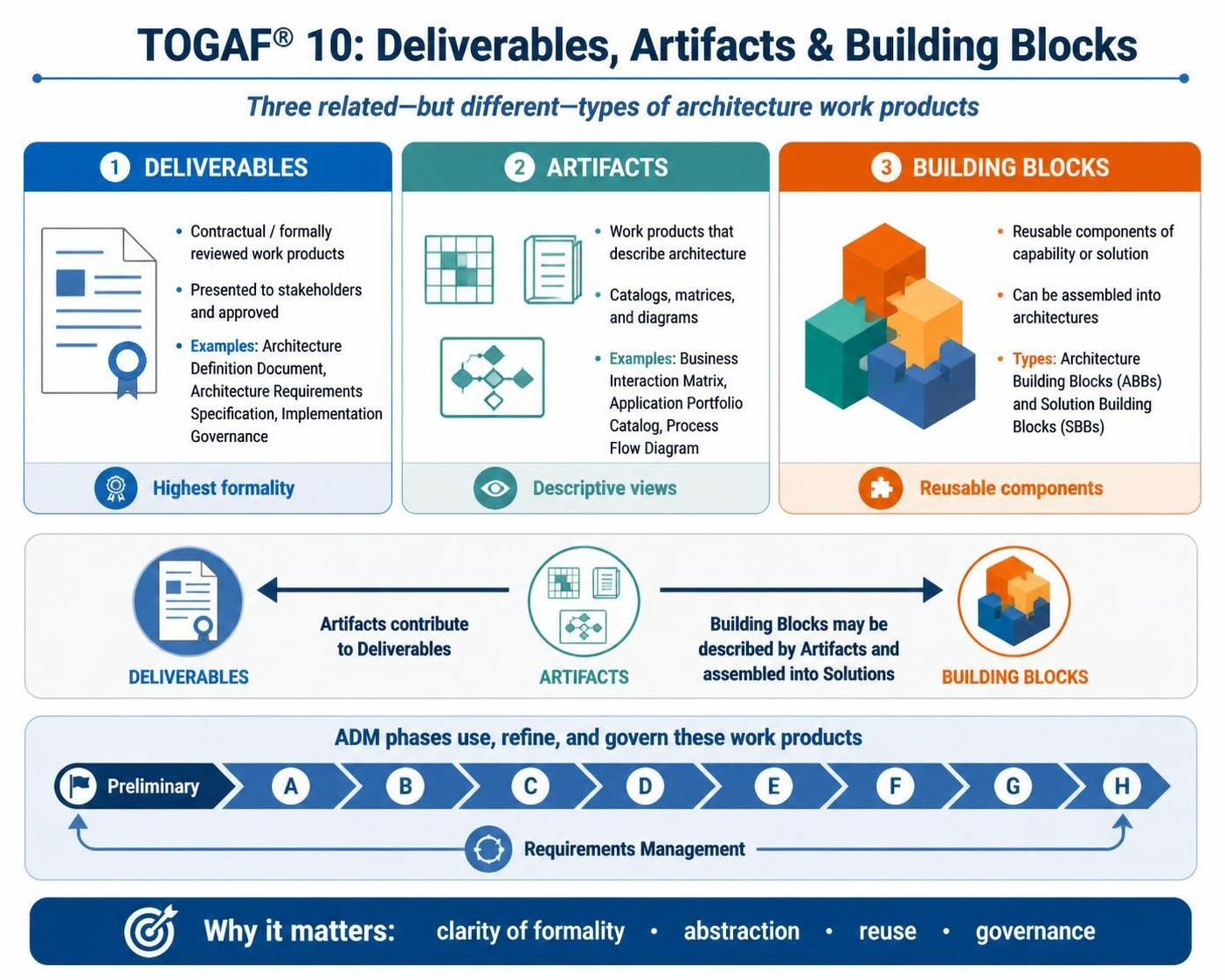
1. The Three Concepts at a Glance
| Concept | What it is | Primary purpose | Typical examples |
|---|---|---|---|
| Deliverable | A formally reviewed and agreed work product | Demonstrate that a contractual, governance, or project obligation has been met | Architecture Definition Document, Architecture Requirements Specification, Implementation Governance Report |
| Artifact | A work product that describes an aspect of the architecture | Communicate, analyze, or specify architecture content | Catalog, matrix, diagram, principles, gap analysis |
| Building block | A reusable capability or component that can be combined with others | Support architecture design, standardization, and implementation | Identity management service, customer data service, API gateway, business capability |
A useful summary is:
Deliverables are governed packages, artifacts are their contents or supporting views, and building blocks are reusable architectural components.
This is not a strict one-to-one relationship. A deliverable can contain multiple artifacts, and artifacts can describe or identify building blocks.
2. What Is a TOGAF Deliverable?
A deliverable is a formally specified work product that is reviewed, agreed upon, and typically approved by stakeholders or a governance body.
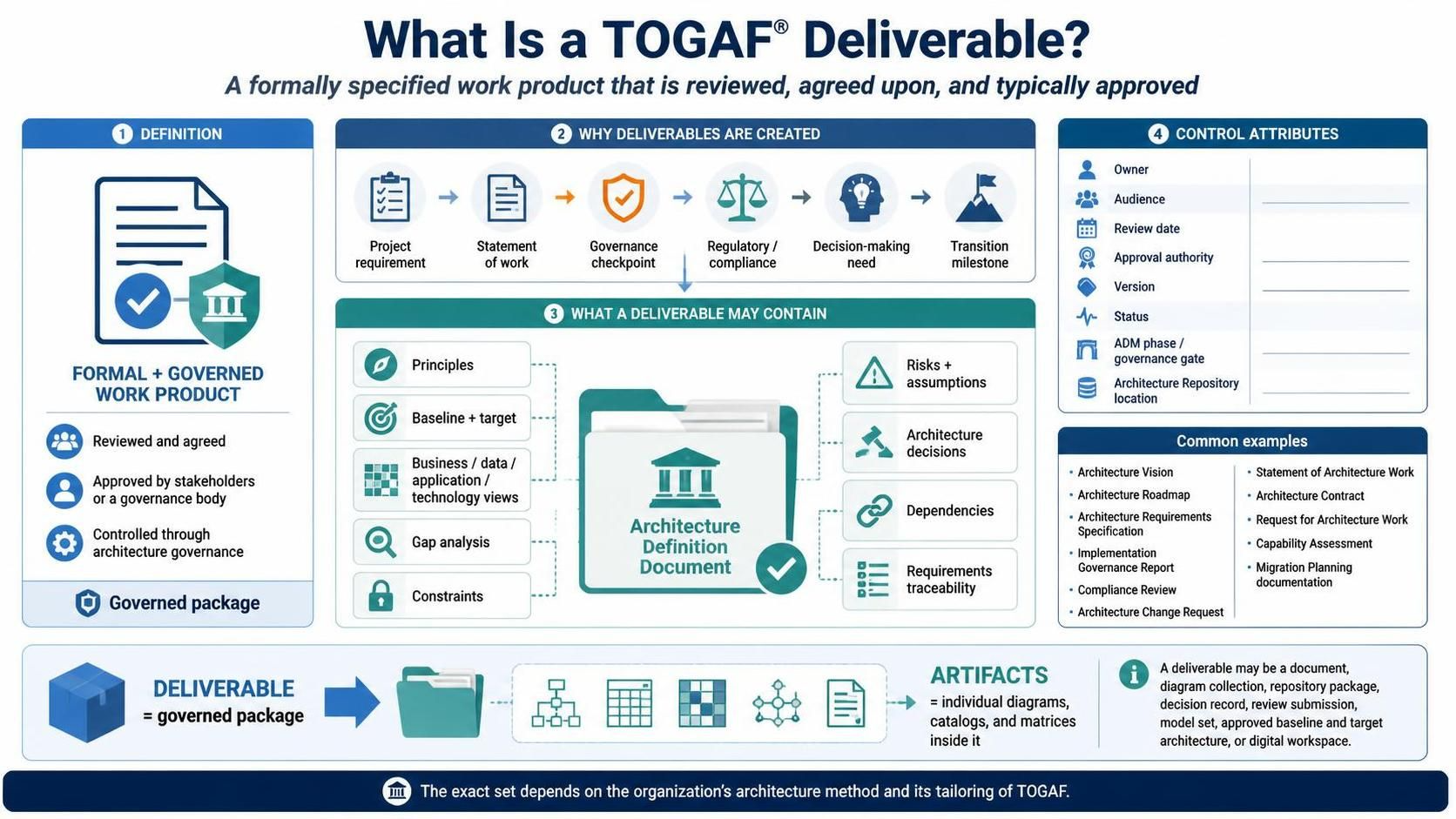
Deliverables are often created to satisfy:
-
A project requirement
-
A statement of work
-
An architecture governance checkpoint
-
A regulatory or compliance obligation
-
A decision-making need
-
A transition or implementation milestone
Deliverables are usually controlled through the organization’s architecture governance process. They may have:
-
An owner
-
A defined audience
-
A review date
-
An approval authority
-
A version number
-
A status
-
A relationship to an ADM phase or governance gate
-
A location in the Architecture Repository
Common TOGAF deliverables
Examples include:
-
Architecture Definition Document
-
Architecture Requirements Specification
-
Architecture Roadmap
-
Architecture Vision
-
Implementation Governance Report
-
Compliance Review
-
Architecture Change Requests
-
Statement of Architecture Work
-
Architecture Contract
-
Request for Architecture Work
-
Capability Assessment
-
Migration Planning documentation
The exact set of deliverables depends on the organization’s architecture method and the way it tailors TOGAF.
Deliverables are not necessarily single documents
A deliverable may be:
-
A document
-
A collection of diagrams
-
A repository package
-
A decision record
-
A review submission
-
A set of models
-
A formally approved baseline and target architecture
-
A digital workspace containing related information
For example, an Architecture Definition Document may include:
-
Architecture principles
-
Baseline architecture descriptions
-
Target architecture descriptions
-
Business, data, application, and technology views
-
Gap analysis
-
Constraints
-
Risks and assumptions
-
Architecture decisions
-
Dependencies
-
Traceability to requirements
The deliverable is the governed package. The individual diagrams, catalogs, and matrices inside it are artifacts.
3. Characteristics of a Deliverable
A well-managed deliverable generally has the following characteristics.
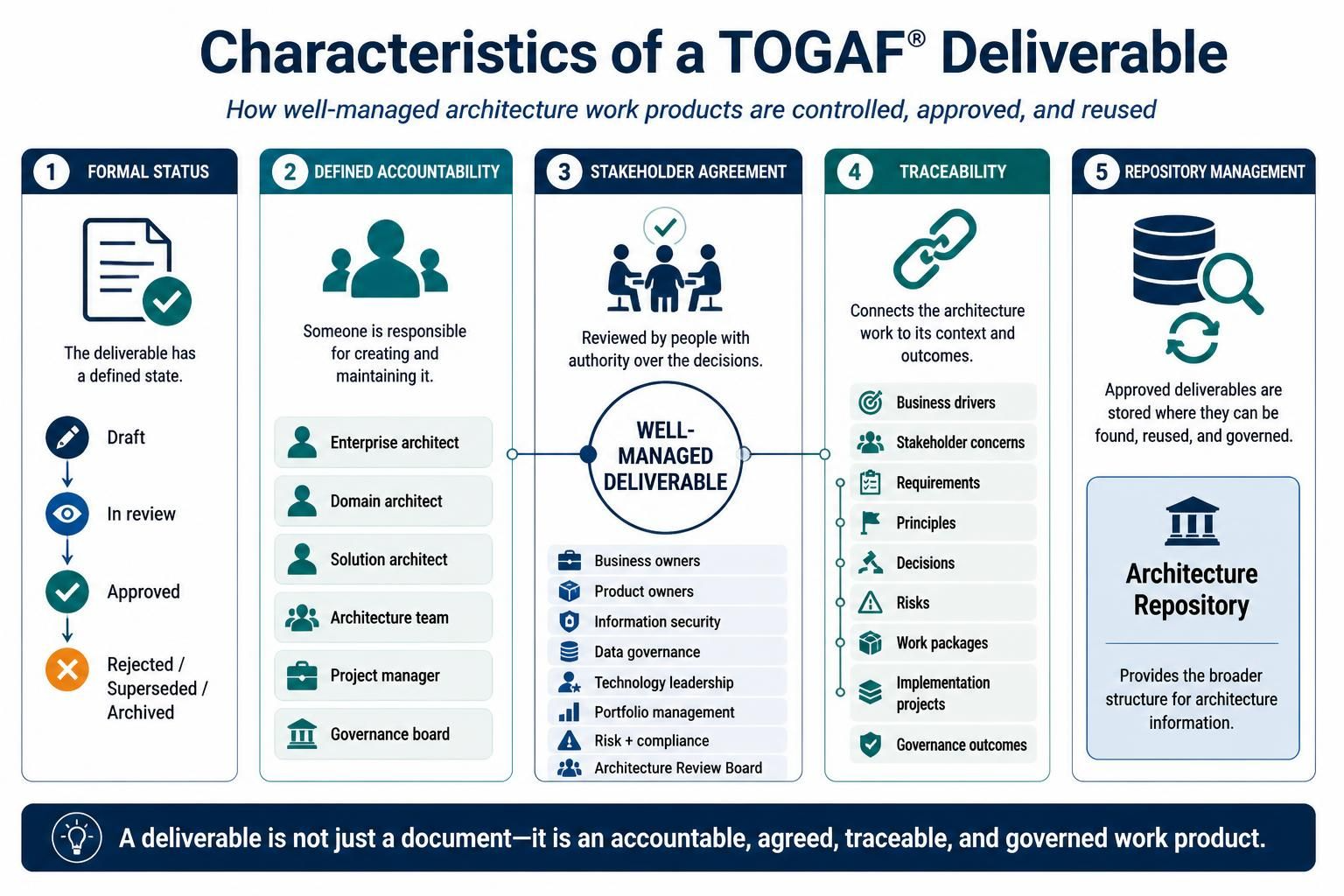
Formal status
It has a defined state, such as:
-
Draft
-
In review
-
Approved
-
Rejected
-
Superseded
-
Archived
Defined accountability
Someone is responsible for creating and maintaining it. Responsibility may be assigned to:
-
An enterprise architect
-
A domain architect
-
A solution architect
-
An architecture team
-
A project manager
-
An architecture governance board
Stakeholder agreement
Deliverables are reviewed by the people who have authority over the decisions involved. Depending on the organization, this could include:
-
Business owners
-
Product owners
-
Information security
-
Data governance
-
Technology leadership
-
Portfolio management
-
Risk and compliance
-
Architecture Review Board
Traceability
A deliverable should connect to:
-
Business drivers
-
Stakeholder concerns
-
Requirements
-
Architecture principles
-
Decisions
-
Risks
-
Work packages
-
Implementation projects
-
Governance outcomes
Repository management
Approved deliverables should be stored where they can be found, reused, and governed. The TOGAF Architecture Repository can provide the broader structure for this information.
4. What Is a TOGAF Artifact?
An artifact is a work product that describes a specific aspect of an architecture.
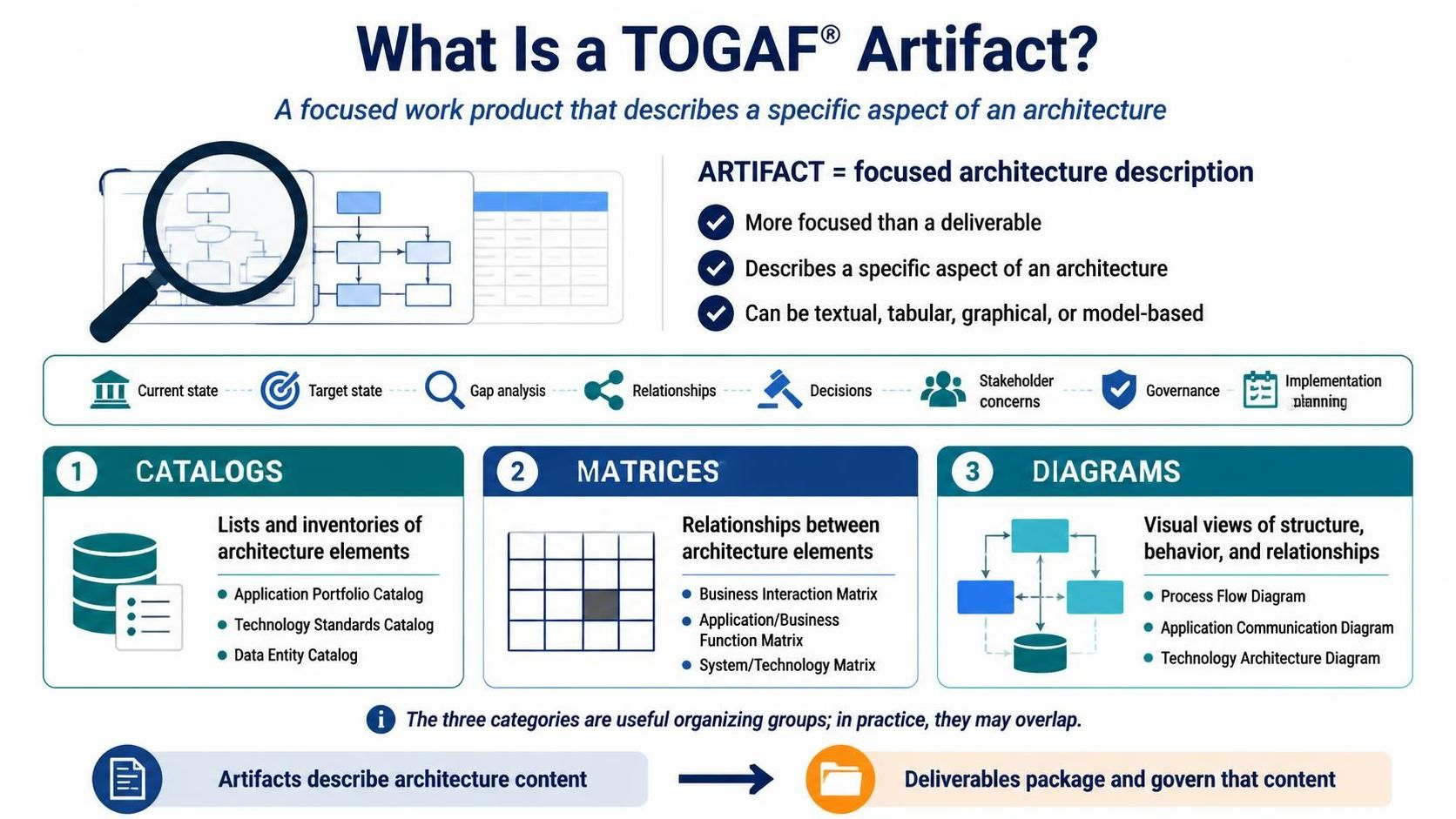
Artifacts are usually more focused than deliverables. They are used to:
-
Describe the current state
-
Define a target state
-
Analyze gaps
-
Show relationships
-
Communicate decisions
-
Support stakeholder concerns
-
Enable architecture governance
-
Provide input to implementation planning
Artifacts can be textual, tabular, graphical, or model-based.
Three broad artifact categories
TOGAF commonly groups artifacts into three categories:
-
Catalogs
-
Matrices
-
Diagrams
These categories are not mutually exclusive in every architecture practice, but they provide a useful way to organize architecture content.
5. Catalogs
A catalog is a structured inventory of architecture elements.
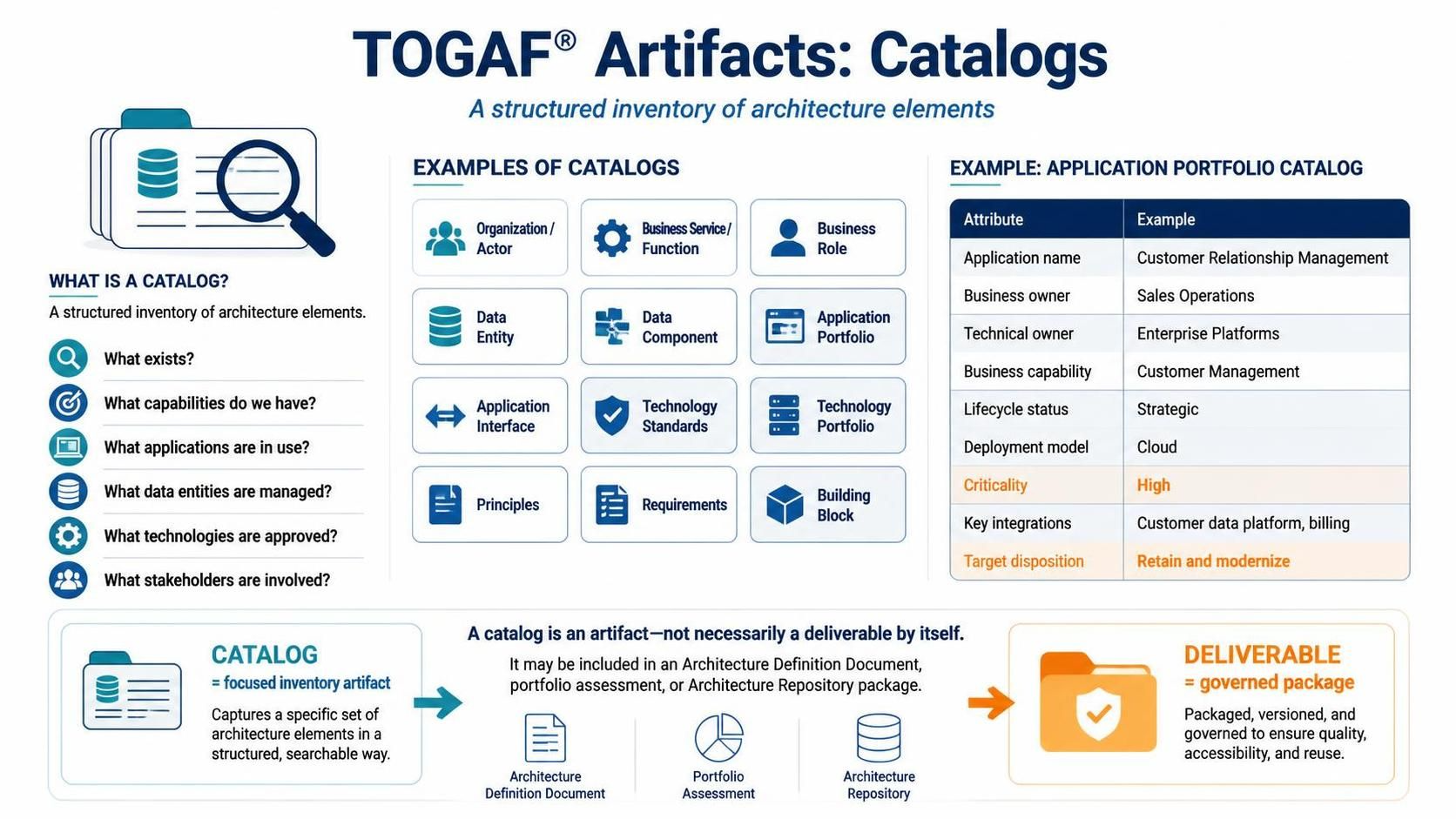
Catalogs answer questions such as:
-
What exists?
-
What capabilities do we have?
-
What applications are in use?
-
What data entities are managed?
-
What technologies are approved?
-
What stakeholders are involved?
Examples of catalogs
-
Organization/Actor Catalog
-
Business Service/Function Catalog
-
Business Role Catalog
-
Data Entity Catalog
-
Data Component Catalog
-
Application Portfolio Catalog
-
Application Interface Catalog
-
Technology Standards Catalog
-
Technology Portfolio Catalog
-
Principles Catalog
-
Requirements Catalog
-
Building Block Catalog
Example: Application Portfolio Catalog
An application catalog might contain:
| Attribute | Example |
|---|---|
| Application name | Customer Relationship Management |
| Business owner | Sales Operations |
| Technical owner | Enterprise Platforms |
| Business capability | Customer Management |
| Lifecycle status | Strategic |
| Deployment model | Cloud |
| Criticality | High |
| Key integrations | Customer data platform, billing |
| Target disposition | Retain and modernize |
The catalog is not necessarily a deliverable by itself. It may be one artifact included in an Architecture Definition Document, portfolio assessment, or architecture repository package.
6. Matrices
A matrix shows relationships between two or more sets of architecture elements.
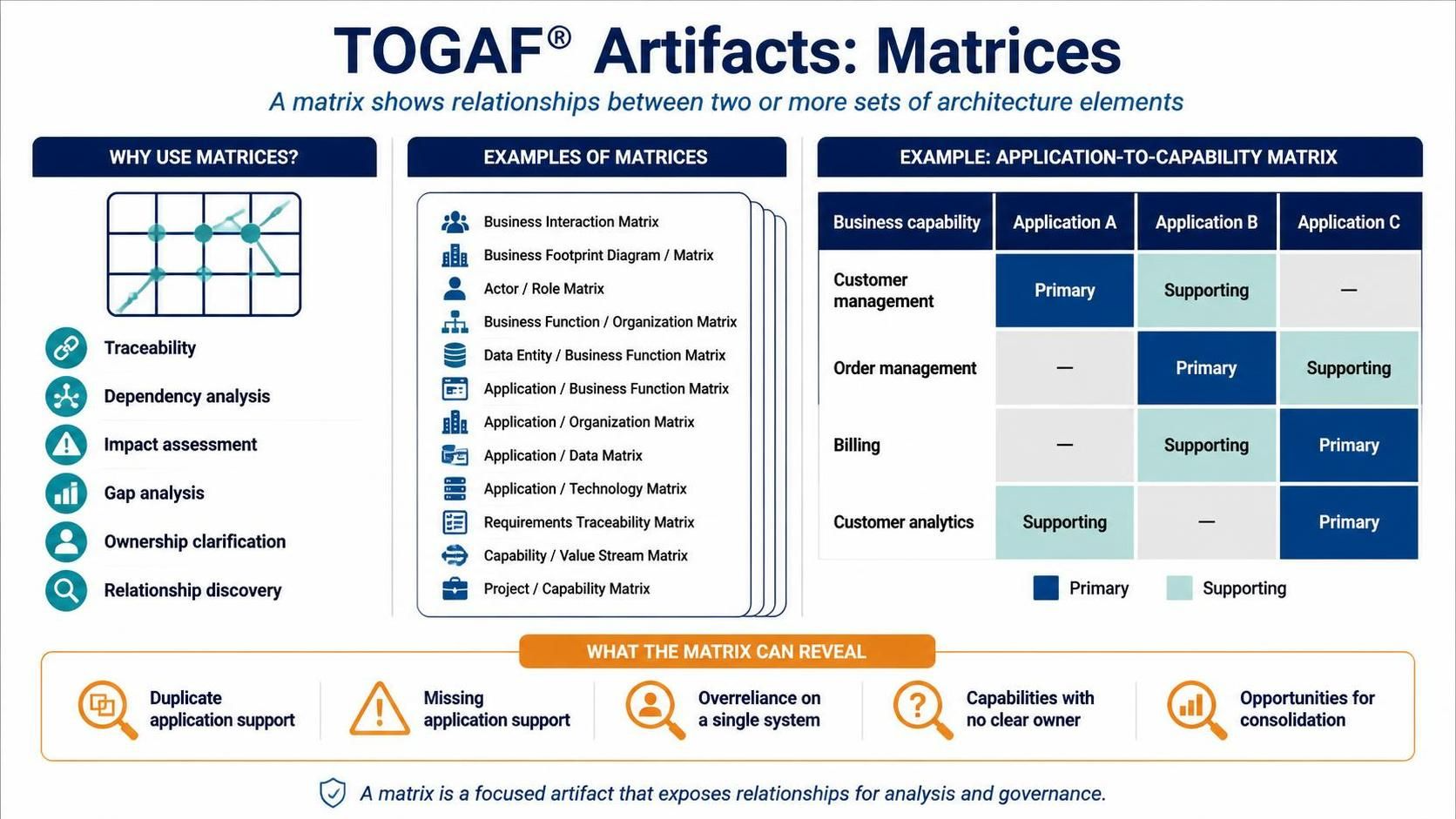
Matrices are useful for:
-
Traceability
-
Dependency analysis
-
Impact assessment
-
Gap analysis
-
Ownership clarification
-
Relationship discovery
Examples of matrices
-
Business Interaction Matrix
-
Business Footprint Diagram or matrix
-
Actor/Role Matrix
-
Business Function/Organization Matrix
-
Data Entity/Business Function Matrix
-
Application/Business Function Matrix
-
Application/Organization Matrix
-
Application/Data Matrix
-
Application/Technology Matrix
-
Requirements Traceability Matrix
-
Capability/Value Stream Matrix
-
Project/Capability Matrix
Example: Application-to-Capability Matrix
| Business capability | Application A | Application B | Application C |
|---|---|---|---|
| Customer management | Primary | Supporting | — |
| Order management | — | Primary | Supporting |
| Billing | — | Supporting | Primary |
| Customer analytics | Supporting | — | Primary |
This type of artifact can reveal:
-
Duplicate application support
-
Missing application support
-
Overreliance on a single system
-
Capabilities with no clear owner
-
Opportunities for consolidation
7. Diagrams
A diagram presents architecture information visually.
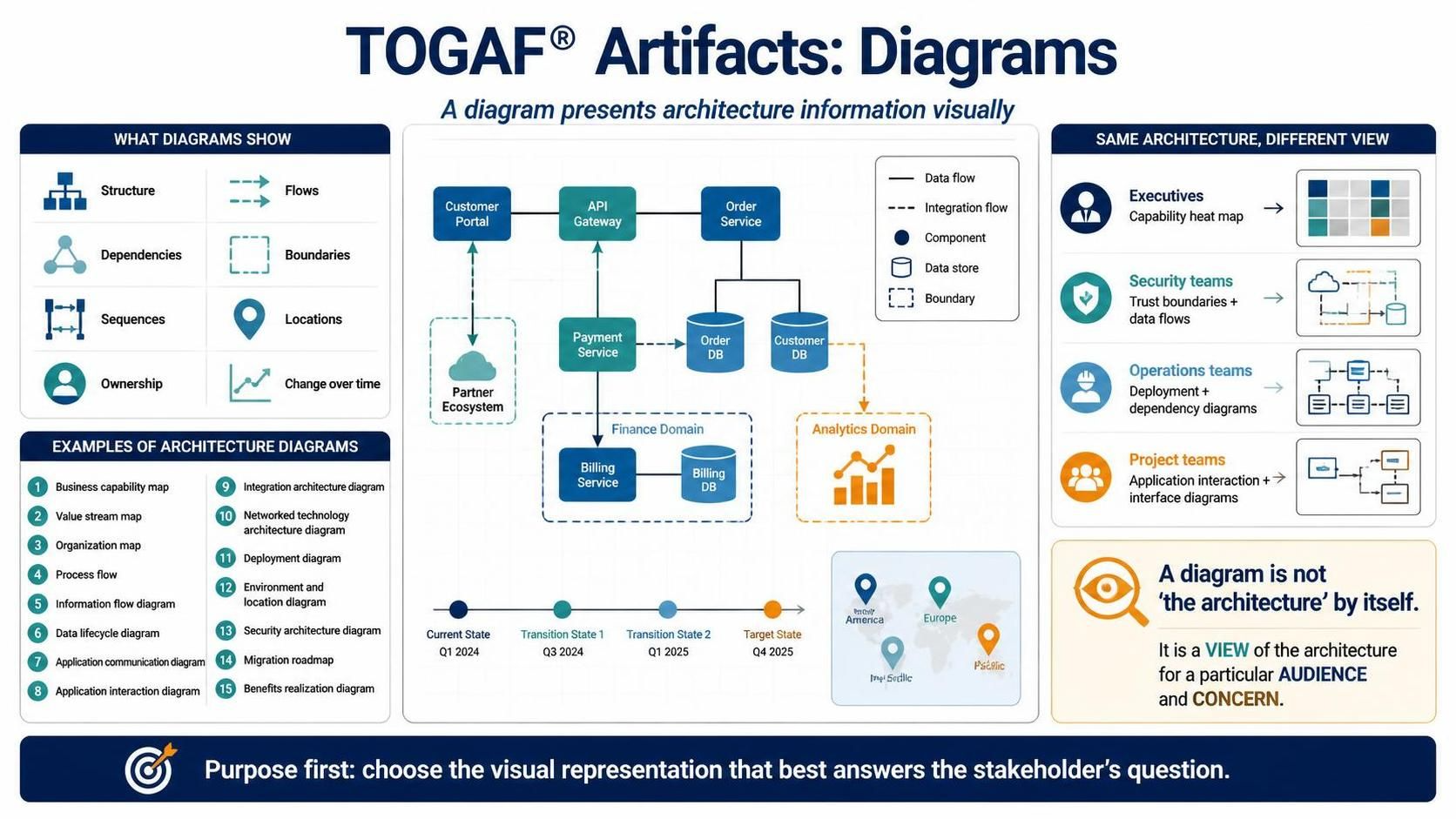
Diagrams are particularly valuable when stakeholders need to understand:
-
Structure
-
Flows
-
Dependencies
-
Boundaries
-
Sequences
-
Locations
-
Ownership
-
Change over time
Examples of architecture diagrams
-
Business capability map
-
Value stream map
-
Organization map
-
Process flow
-
Information flow diagram
-
Data lifecycle diagram
-
Application communication diagram
-
Application interaction diagram
-
Integration architecture diagram
-
Networked technology architecture diagram
-
Deployment diagram
-
Environment and location diagram
-
Security architecture diagram
-
Migration roadmap
-
Benefits realization diagram
A diagram should have a clear purpose. The same architecture can be represented differently depending on the stakeholder concern.
For example:
-
Executives may need a capability heat map.
-
Security teams may need trust boundaries and data flows.
-
Operations teams may need deployment and dependency diagrams.
-
Project teams may need application interaction and interface diagrams.
A diagram is therefore not “the architecture” by itself. It is a view of the architecture for a particular audience and concern.
8. What Is a TOGAF Building Block?
A building block represents a potentially reusable component of business, information, application, or technology capability.
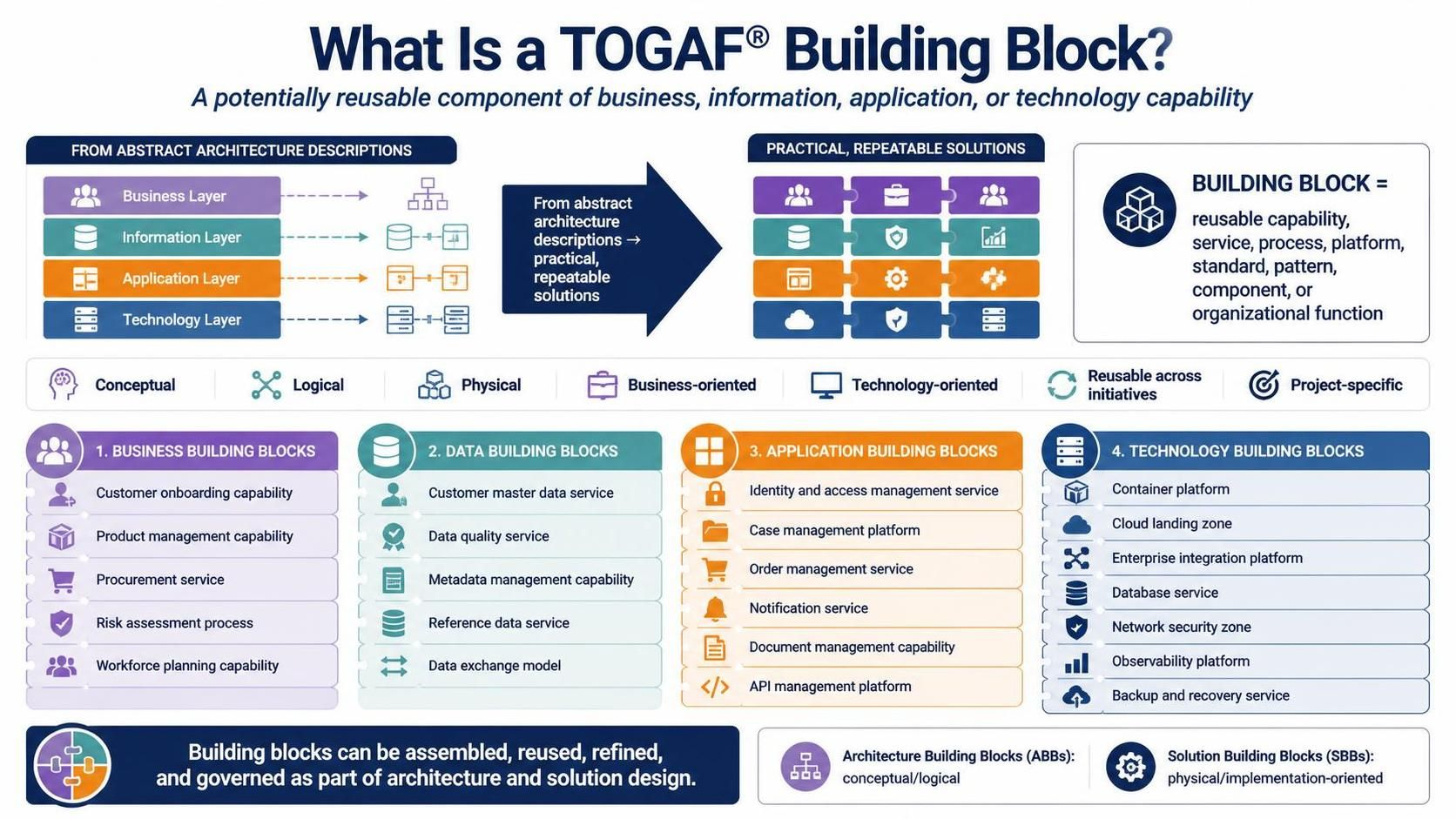
Building blocks help architects move from abstract architecture descriptions to practical, repeatable solutions.
A building block may be:
-
Conceptual
-
Logical
-
Physical
-
Business-oriented
-
Technology-oriented
-
Reusable across many initiatives
-
Specific to one project or solution
Building blocks can represent capabilities, services, processes, platforms, standards, patterns, components, or organizational functions.
Examples of building blocks
Business building blocks:
-
Customer onboarding capability
-
Product management capability
-
Procurement service
-
Risk assessment process
-
Workforce planning capability
Data building blocks:
-
Customer master data service
-
Data quality service
-
Metadata management capability
-
Reference data service
-
Data exchange model
Application building blocks:
-
Identity and access management service
-
Case management platform
-
Order management service
-
Notification service
-
Document management capability
-
API management platform
Technology building blocks:
-
Container platform
-
Cloud landing zone
-
Enterprise integration platform
-
Database service
-
Network security zone
-
Observability platform
-
Backup and recovery service
9. Architecture Building Blocks and Solution Building Blocks
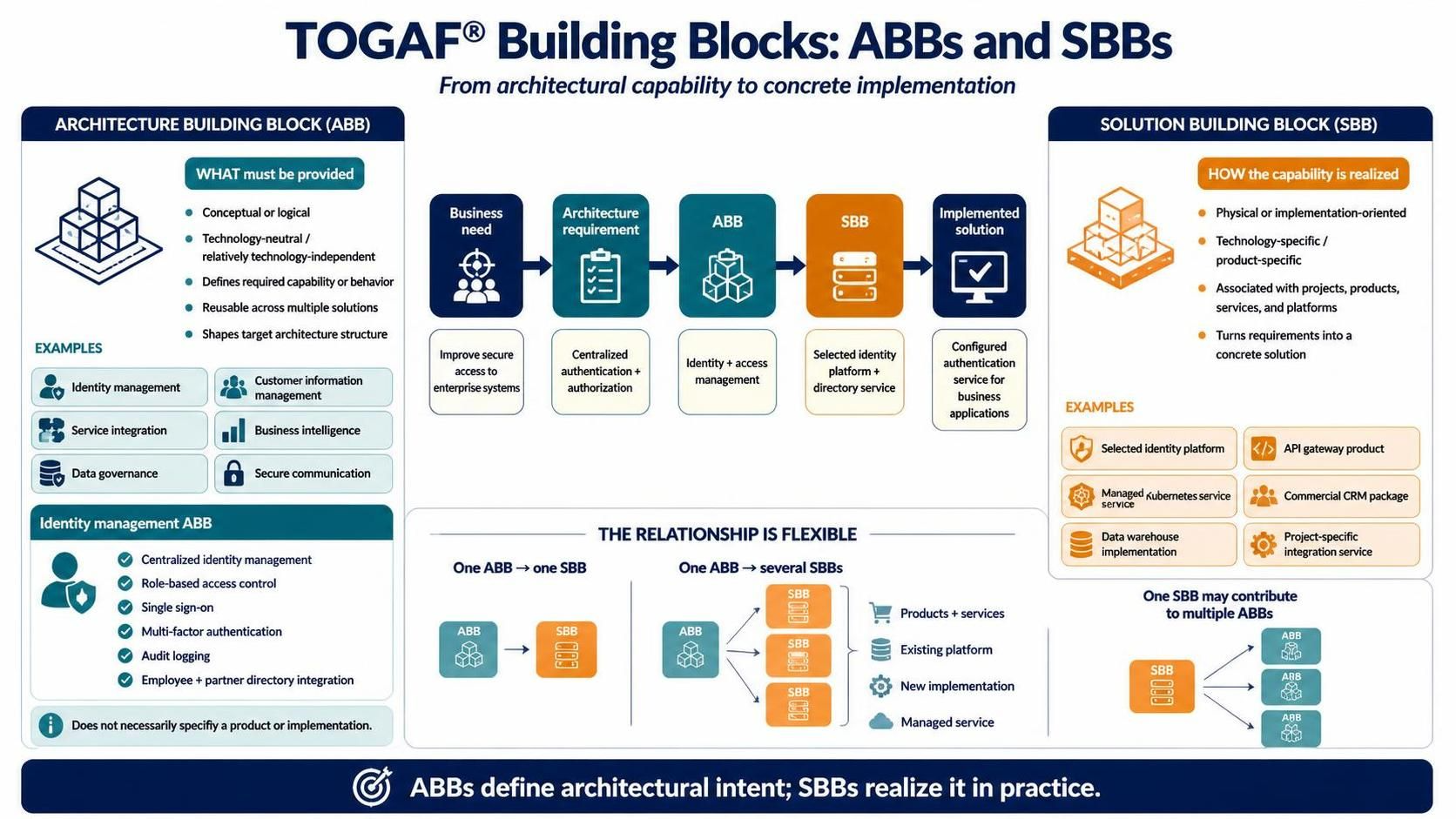
A key distinction in TOGAF is between Architecture Building Blocks and Solution Building Blocks.
Architecture Building Blocks
Architecture Building Blocks, often abbreviated as ABBs, describe the required capability or behavior at an architectural level.
They are generally:
-
Conceptual or logical
-
Technology-neutral or relatively technology-independent
-
Concerned with what must be provided
-
Reusable across multiple solutions
-
Used to define target architecture structure
Examples:
-
Identity management
-
Customer information management
-
Service integration
-
Business intelligence
-
Data governance
-
Secure communication
An ABB might state that the enterprise needs:
-
Centralized identity management
-
Role-based access control
-
Single sign-on
-
Multi-factor authentication
-
Audit logging
-
Integration with employee and partner directories
It does not necessarily specify the exact product or implementation.
Solution Building Blocks
Solution Building Blocks, or SBBs, describe the concrete implementation of one or more architectural requirements.
They are generally:
-
Physical or implementation-oriented
-
Technology-specific or product-specific
-
Concerned with how a capability is realized
-
Associated with projects, products, services, and platforms
Examples:
-
A particular identity platform
-
A selected API gateway product
-
A managed Kubernetes service
-
A commercial CRM package
-
A specific data warehouse implementation
-
A project-specific integration service
ABB-to-SBB relationship
The relationship can be expressed as:
[
\text{Architecture Requirement} \rightarrow \text{ABB} \rightarrow \text{SBB} \rightarrow \text{Implemented Solution}
]
For example:
| Level | Example |
|---|---|
| Business need | Improve secure access to enterprise systems |
| Architecture requirement | Provide centralized authentication and authorization |
| ABB | Identity and access management |
| SBB | Selected identity platform and directory service |
| Implementation | Configured authentication service deployed for business applications |
An ABB may be realized by:
-
One SBB
-
Several SBBs
-
A combination of products and services
-
An existing enterprise platform
-
A new implementation
-
A managed service
Similarly, one SBB may contribute to multiple ABBs.
10. Deliverables, Artifacts, and Building Blocks: How They Relate
These concepts operate at different levels.
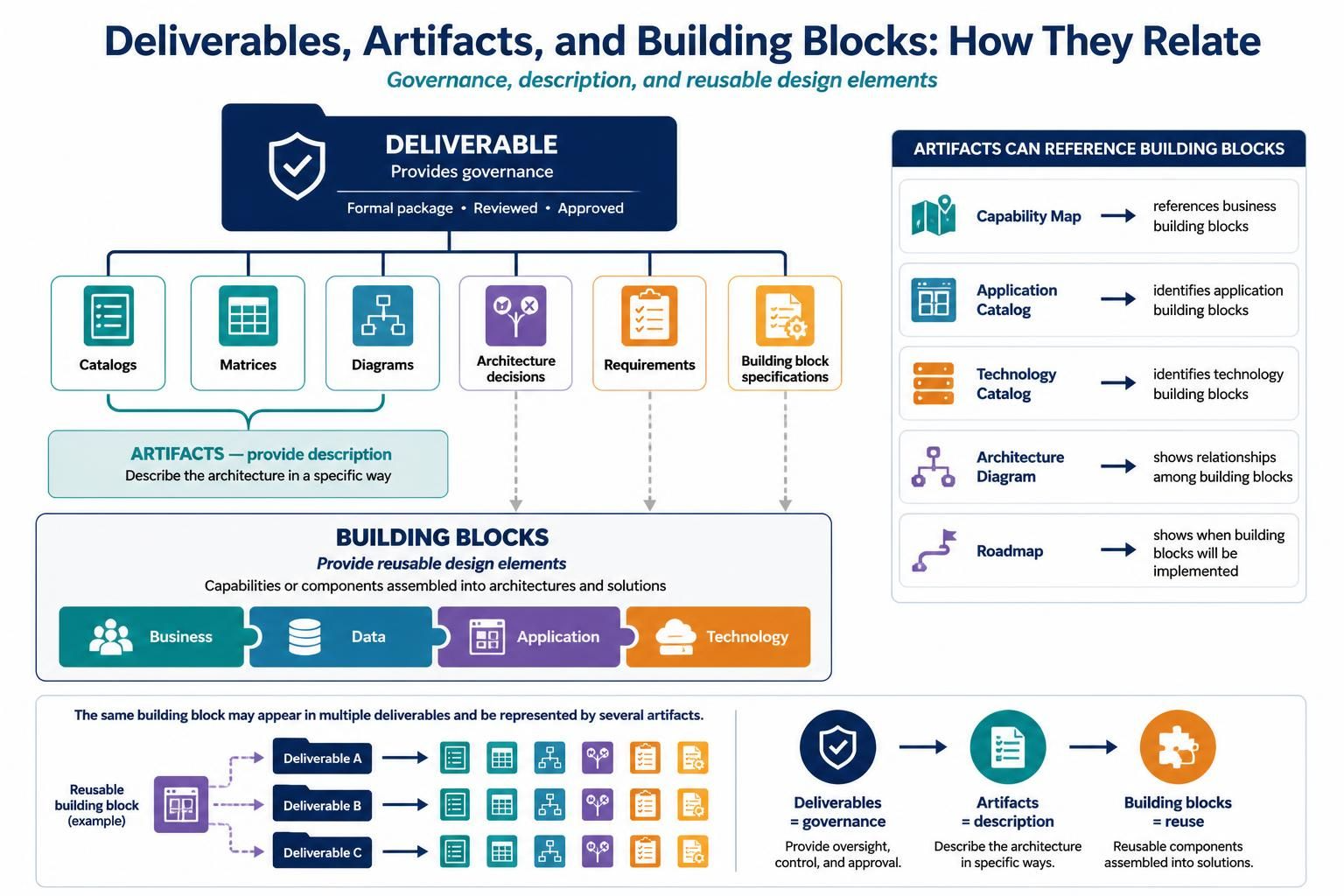
Deliverables provide governance
Deliverables are formal packages that are reviewed and approved.
Artifacts provide description
Artifacts describe the architecture in a specific way.
Building blocks provide reusable design elements
Building blocks represent capabilities or components that can be assembled into architectures and solutions.
A simplified relationship looks like this:
Deliverable
├── Catalogs
├── Matrices
├── Diagrams
├── Architecture decisions
├── Requirements
└── Building block specifications
Building blocks may also be referenced by artifacts:
Capability Map ─────── references business building blocks
Application Catalog ── identifies application building blocks
Technology Catalog ─── identifies technology building blocks
Architecture Diagram ─ shows relationships among building blocks
Roadmap ────────────── shows when building blocks will be implemented
The same building block may appear in multiple deliverables and be represented by several artifacts.
11. Where They Appear in the TOGAF ADM
The ADM provides a lifecycle for developing and governing enterprise architecture. Deliverables, artifacts, and building blocks support different activities throughout the ADM.
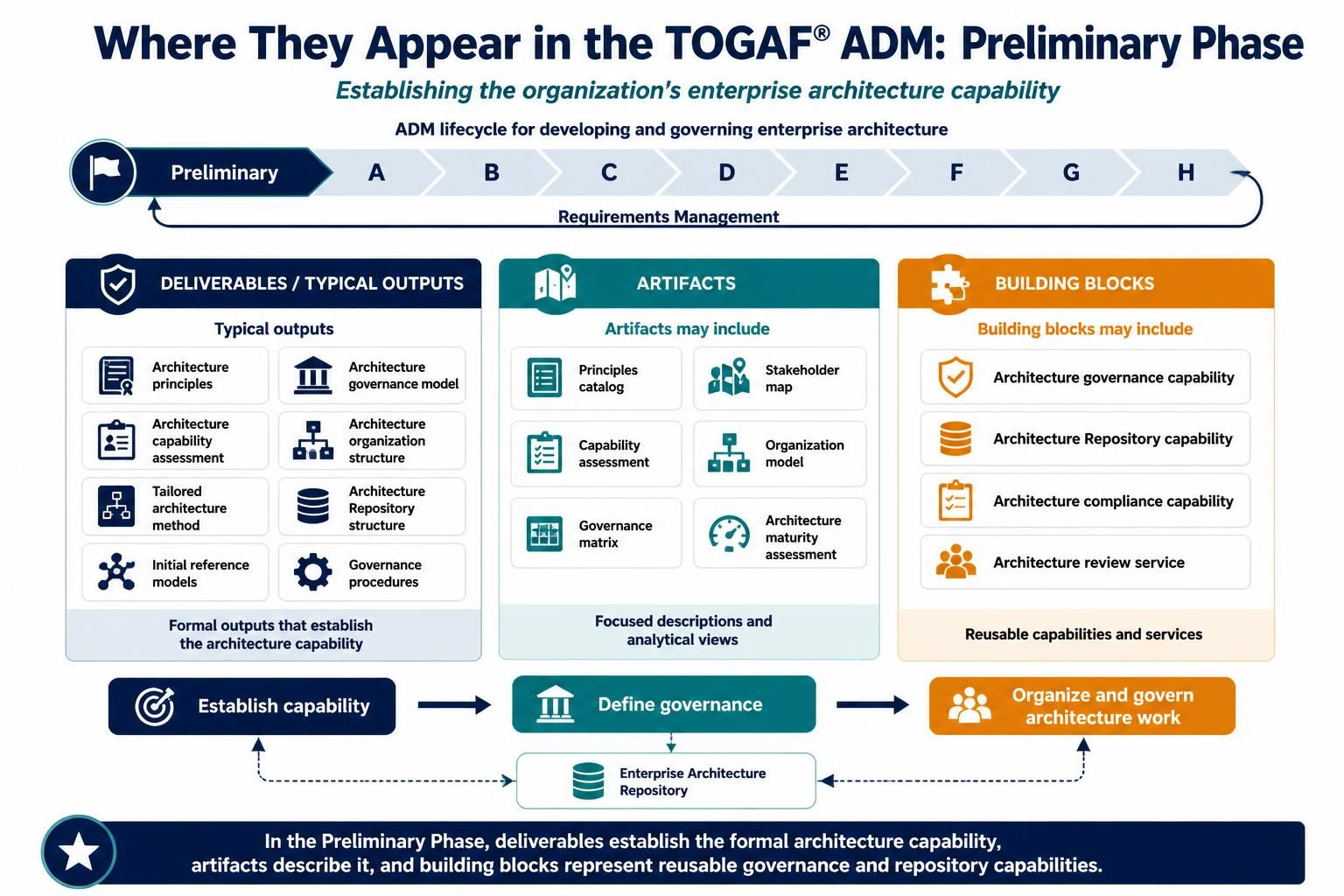
Preliminary Phase
The Preliminary Phase establishes the organization’s architecture capability.
Typical outputs may include:
-
Architecture principles
-
Architecture governance model
-
Architecture capability assessment
-
Architecture organization structure
-
Tailored architecture method
-
Architecture repository structure
-
Initial reference models
-
Governance procedures
Artifacts may include:
-
Principles catalog
-
Stakeholder map
-
Capability assessment
-
Organization model
-
Governance matrix
-
Architecture maturity assessment
Building blocks may include:
-
Architecture governance capability
-
Architecture repository capability
-
Architecture compliance capability
-
Architecture review service
Phase A: Architecture Vision
Phase A establishes the scope, purpose, stakeholders, and expected outcomes of the architecture effort.
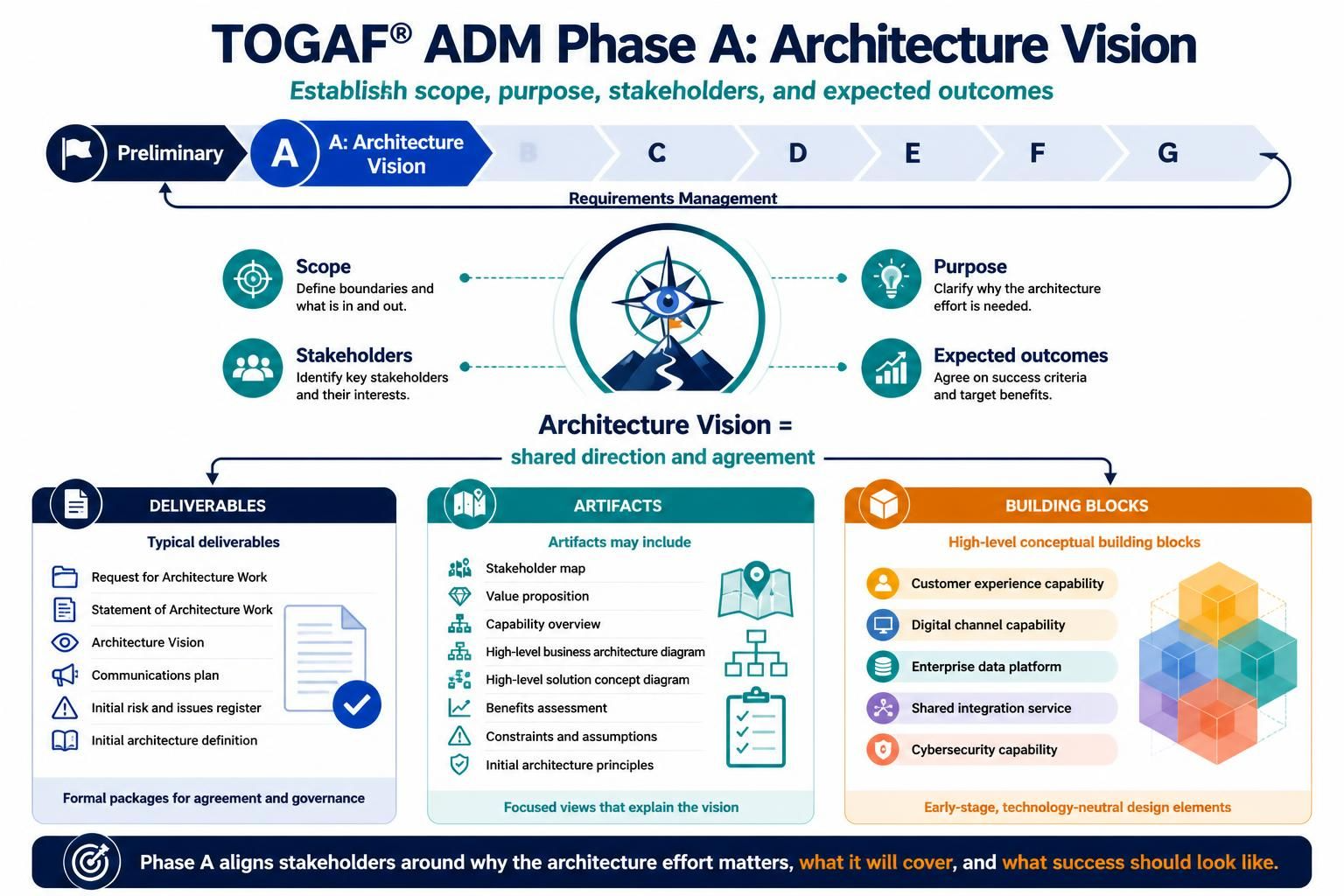
Typical deliverables include:
-
Request for Architecture Work
-
Statement of Architecture Work
-
Architecture Vision
-
Communications plan
-
Initial risk and issues register
-
Initial architecture definition
Artifacts may include:
-
Stakeholder map
-
Value proposition
-
Capability overview
-
High-level business architecture diagram
-
High-level solution concept diagram
-
Benefits assessment
-
Constraints and assumptions
-
Initial architecture principles
Building blocks at this stage are often high-level and conceptual. Examples include:
-
Customer experience capability
-
Digital channel capability
-
Enterprise data platform
-
Shared integration service
-
Cybersecurity capability
Phase B: Business Architecture
Phase B develops the business architecture.
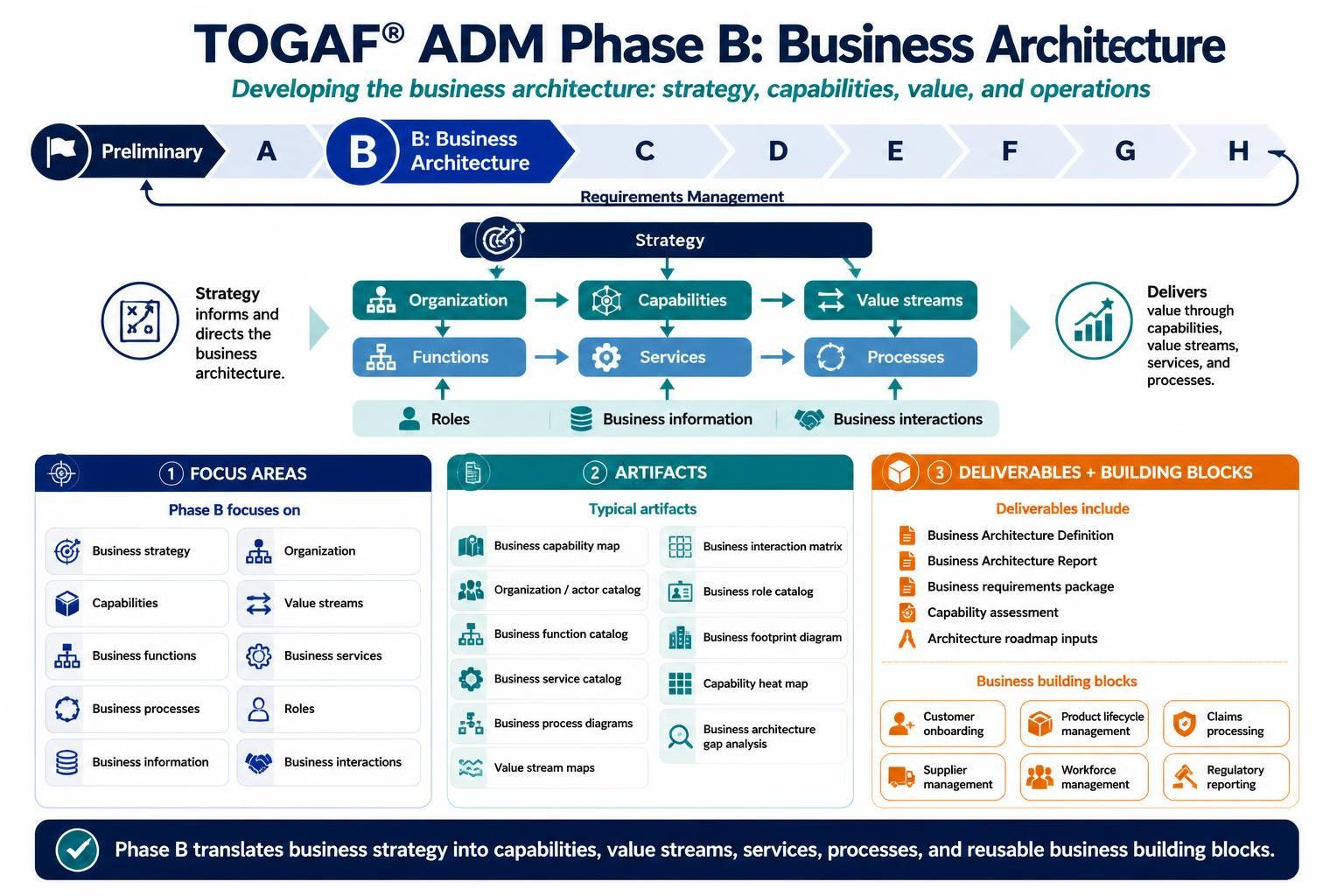
It focuses on:
-
Business strategy
-
Organization
-
Capabilities
-
Value streams
-
Business functions
-
Business services
-
Business processes
-
Roles
-
Business information
-
Business interactions
Typical artifacts include:
-
Business capability map
-
Organization/actor catalog
-
Business function catalog
-
Business service catalog
-
Business process diagrams
-
Value stream maps
-
Business interaction matrix
-
Business role catalog
-
Business footprint diagram
-
Capability heat map
-
Business architecture gap analysis
Potential deliverables include:
-
Business Architecture Definition
-
Business Architecture Report
-
Business requirements package
-
Capability assessment
-
Architecture roadmap inputs
Business building blocks may include:
-
Customer onboarding
-
Product lifecycle management
-
Claims processing
-
Supplier management
-
Workforce management
-
Regulatory reporting
Phase C: Information Systems Architectures
Phase C covers:
-
Data Architecture
-
Application Architecture
These are often treated as related but distinct architecture domains.
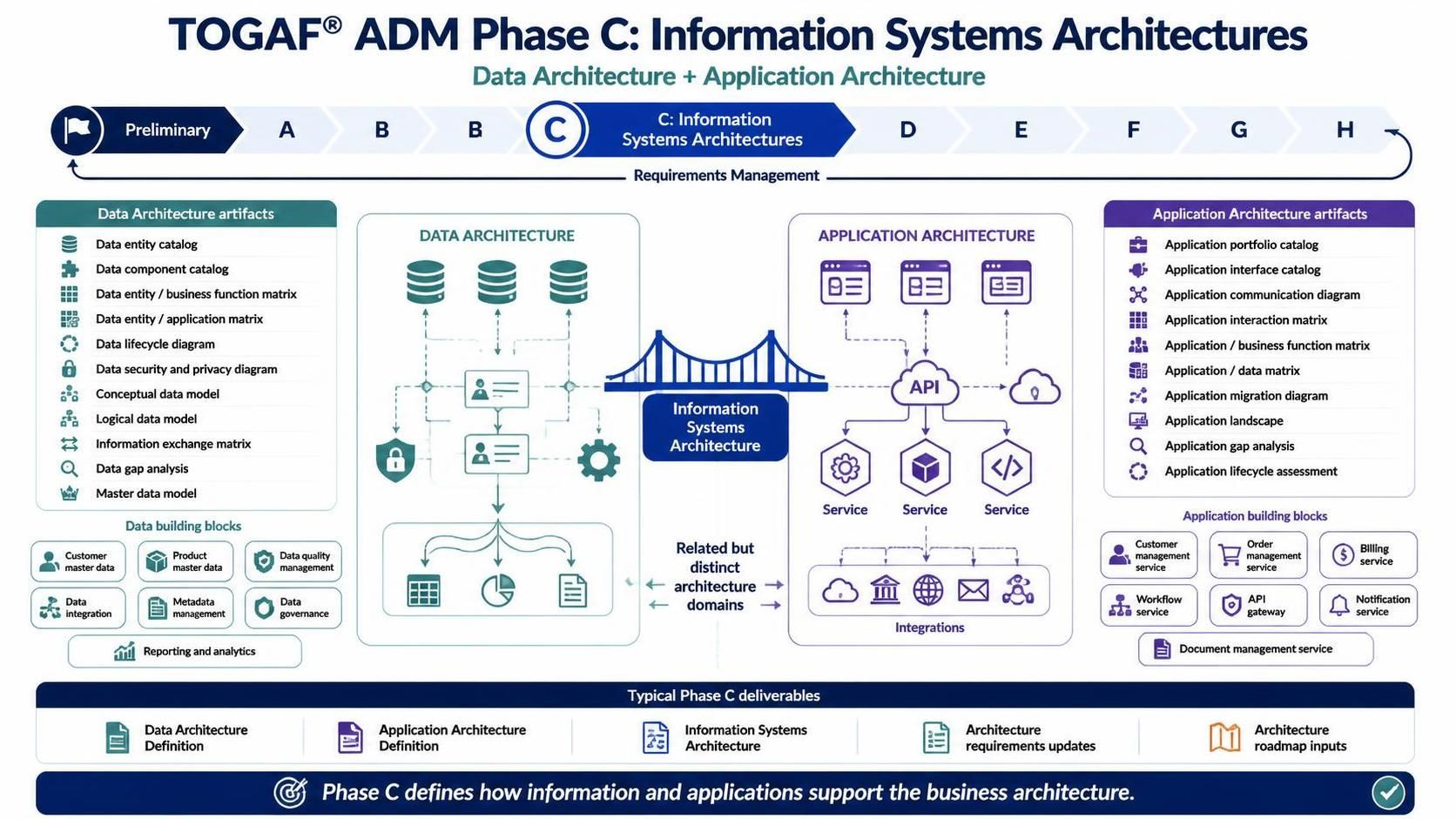
Data Architecture artifacts
Examples include:
-
Data entity catalog
-
Data component catalog
-
Data entity/business function matrix
-
Data entity/application matrix
-
Data lifecycle diagram
-
Data security and privacy diagram
-
Conceptual data model
-
Logical data model
-
Information exchange matrix
-
Data gap analysis
-
Master data model
Data building blocks may include:
-
Customer master data
-
Product master data
-
Data quality management
-
Data integration
-
Metadata management
-
Data governance
-
Reporting and analytics
Application Architecture artifacts
Examples include:
-
Application portfolio catalog
-
Application interface catalog
-
Application communication diagram
-
Application interaction matrix
-
Application/business function matrix
-
Application/data matrix
-
Application migration diagram
-
Application landscape
-
Application gap analysis
-
Application lifecycle assessment
Application building blocks may include:
-
Customer management service
-
Order management service
-
Billing service
-
Workflow service
-
API gateway
-
Notification service
-
Document management service
Typical Phase C deliverables may include:
-
Data Architecture Definition
-
Application Architecture Definition
-
Information Systems Architecture
-
Architecture requirements updates
-
Architecture roadmap inputs
Phase D: Technology Architecture
Phase D develops the Technology Architecture required to support the business, data, and application architectures.
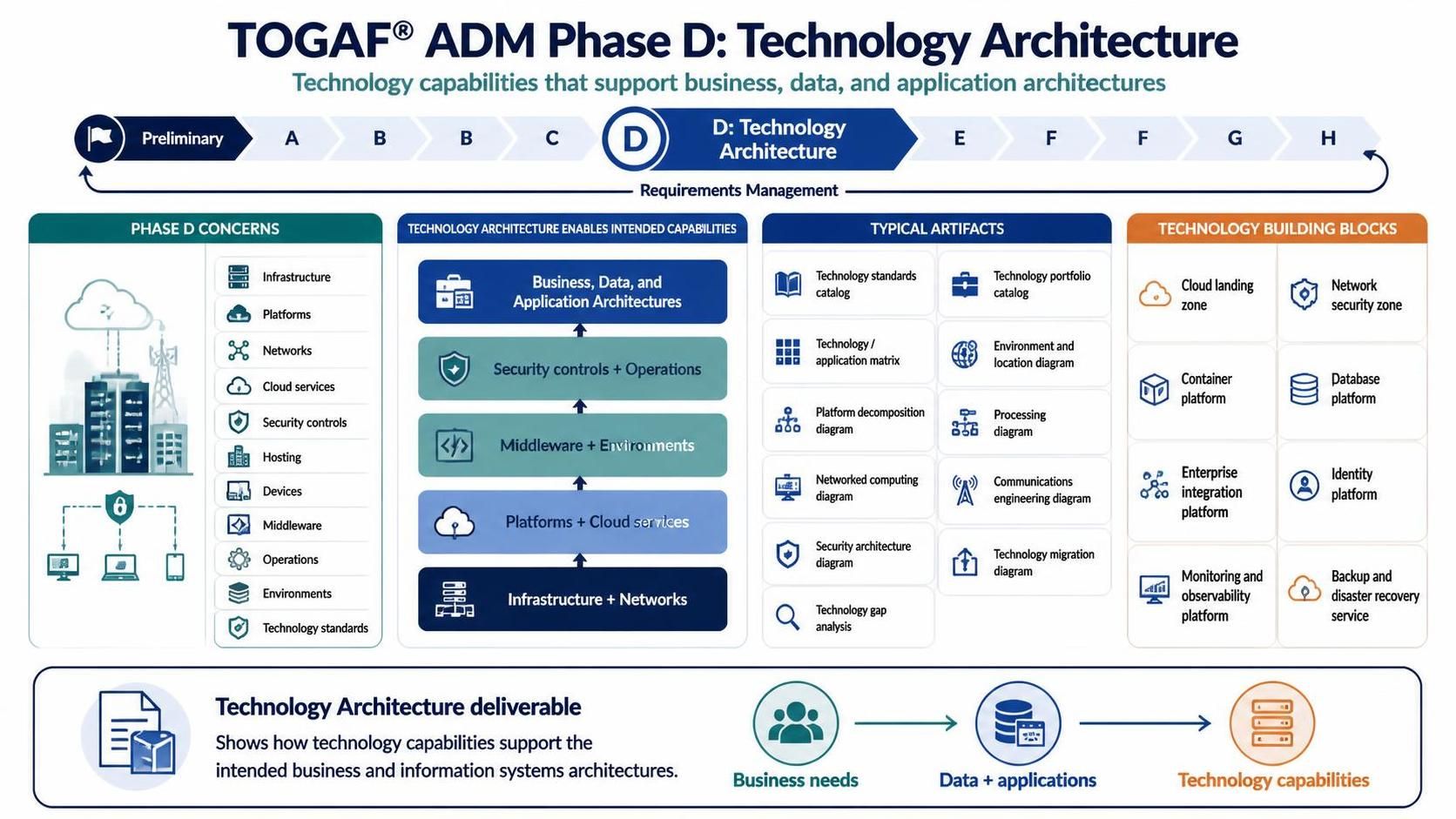
Typical concerns include:
-
Infrastructure
-
Platforms
-
Networks
-
Cloud services
-
Security controls
-
Hosting
-
Devices
-
Middleware
-
Operations
-
Environments
-
Technology standards
Artifacts may include:
-
Technology standards catalog
-
Technology portfolio catalog
-
Technology/ application matrix
-
Environment and location diagram
-
Platform decomposition diagram
-
Processing diagram
-
Networked computing diagram
-
Communications engineering diagram
-
Security architecture diagram
-
Technology gap analysis
-
Technology migration diagram
Technology building blocks may include:
-
Cloud landing zone
-
Network security zone
-
Container platform
-
Database platform
-
Enterprise integration platform
-
Identity platform
-
Monitoring and observability platform
-
Backup and disaster recovery service
A Technology Architecture deliverable should show how technology capabilities support the intended business and information systems architectures.
Phase E: Opportunities and Solutions
Phase E moves from architecture definition toward implementation planning.
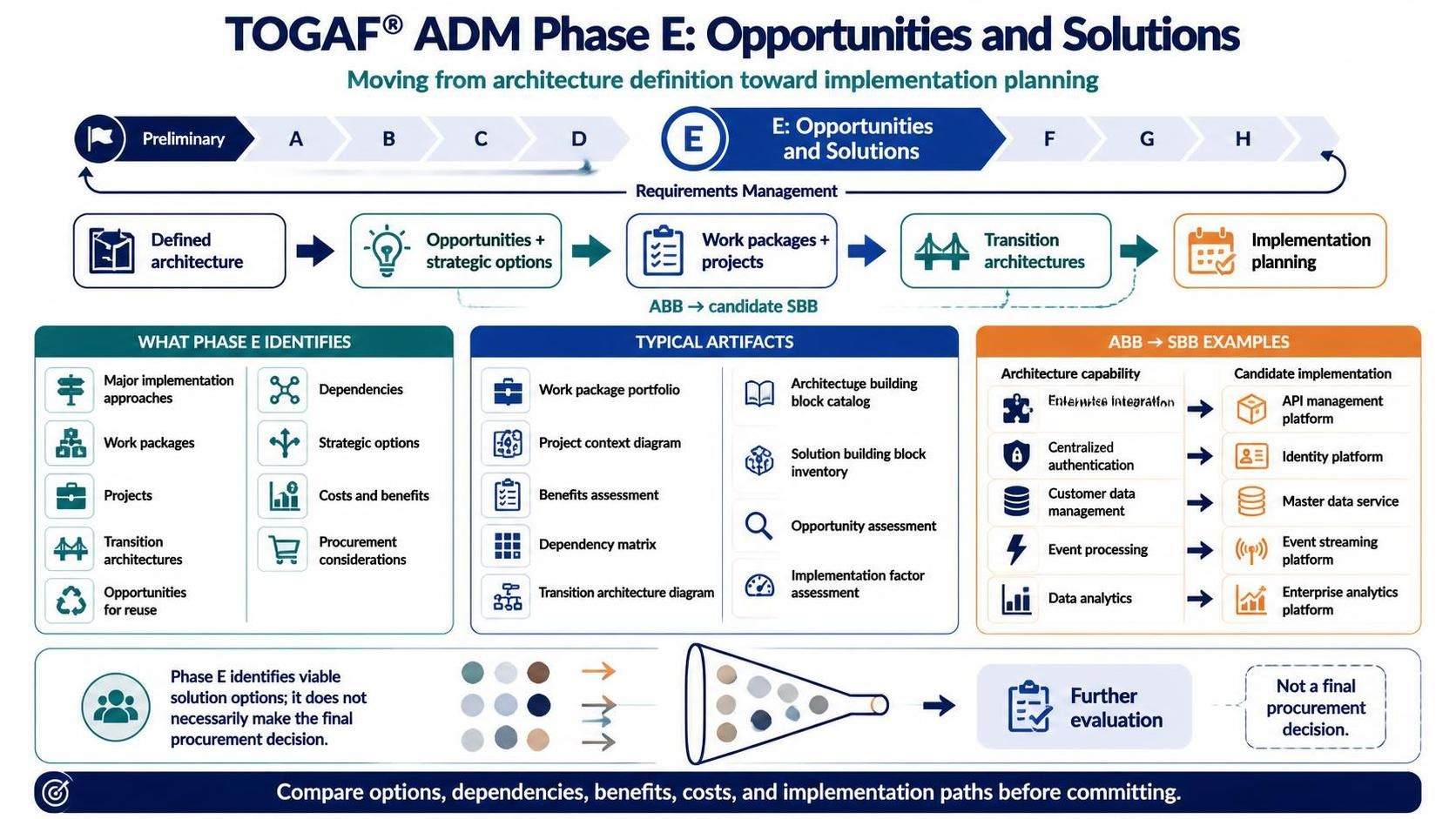
It identifies:
-
Major implementation approaches
-
Work packages
-
Projects
-
Transition architectures
-
Opportunities for reuse
-
Dependencies
-
Strategic options
-
Costs and benefits
-
Procurement considerations
Artifacts may include:
-
Work package portfolio
-
Project context diagram
-
Benefits assessment
-
Dependency matrix
-
Transition architecture diagram
-
Architecture building block catalog
-
Solution building block inventory
-
Opportunity assessment
-
Implementation factor assessment
This phase is where ABBs are often mapped to concrete SBBs.
For example:
| Architecture capability | Candidate implementation |
|---|---|
| Enterprise integration | API management platform |
| Centralized authentication | Identity platform |
| Customer data management | Master data service |
| Event processing | Event streaming platform |
| Data analytics | Enterprise analytics platform |
The output is not necessarily a final procurement decision. It may instead identify viable solution options that require further evaluation.
Phase F: Migration Planning
Phase F develops a detailed implementation and migration plan.
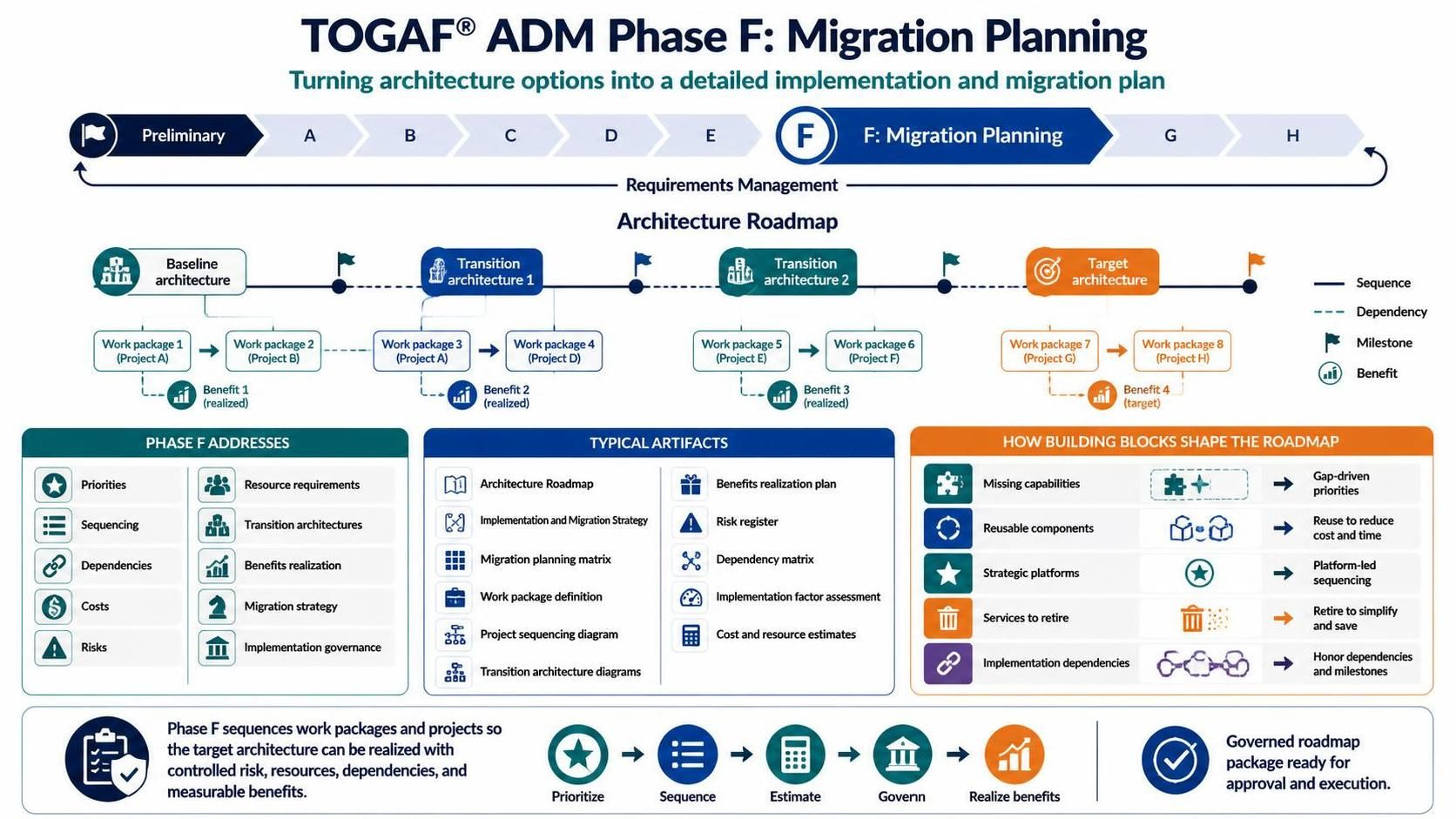
It addresses:
-
Priorities
-
Sequencing
-
Dependencies
-
Costs
-
Risks
-
Resource requirements
-
Transition architectures
-
Benefits realization
-
Migration strategy
-
Implementation governance
Typical artifacts include:
-
Architecture Roadmap
-
Implementation and Migration Strategy
-
Migration planning matrix
-
Work package definition
-
Project sequencing diagram
-
Transition architecture diagrams
-
Benefits realization plan
-
Risk register
-
Dependency matrix
-
Implementation factor assessment
-
Cost and resource estimates
Building blocks help create the roadmap by showing:
-
Which capabilities are missing
-
Which components can be reused
-
Which platforms are strategic
-
Which services should be retired
-
Which implementations depend on others
Phase G: Implementation Governance
Phase G ensures that implementation projects conform to the approved architecture.
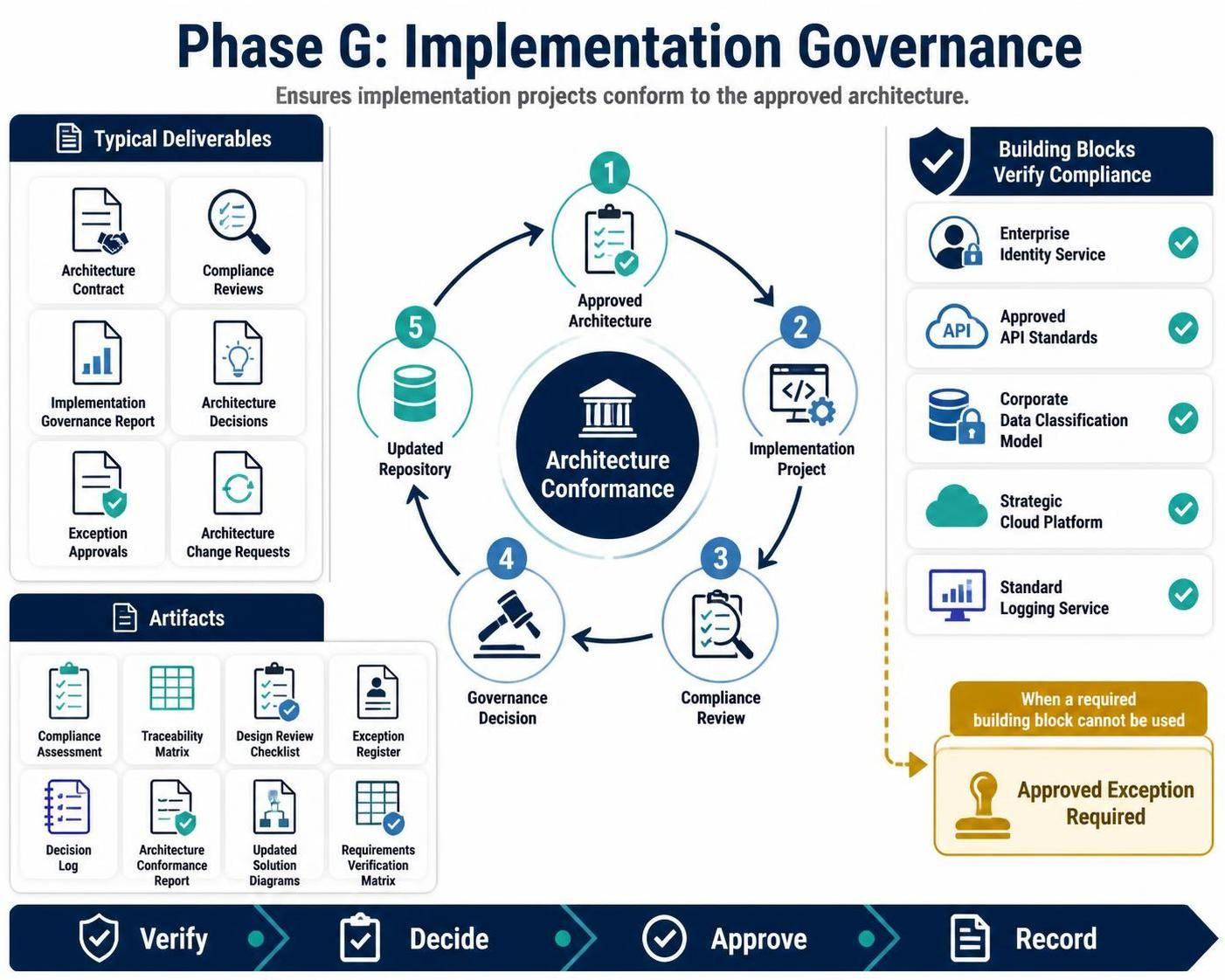
Typical deliverables include:
-
Architecture Contract
-
Compliance reviews
-
Implementation Governance Report
-
Architecture decisions
-
Exception approvals
-
Architecture change requests
-
Updated architecture repository content
Artifacts may include:
-
Compliance assessment
-
Traceability matrix
-
Design review checklist
-
Exception register
-
Decision log
-
Architecture conformance report
-
Updated solution diagrams
-
Requirements verification matrix
Building blocks are used to verify whether the implementation uses approved or required components.
For example, a project may be required to use:
-
The enterprise identity service
-
Approved API standards
-
The corporate data classification model
-
The strategic cloud platform
-
The standard logging service
Where a project cannot use the required building block, it may need an approved exception.
Phase H: Architecture Change Management
Phase H manages changes to the architecture over time.
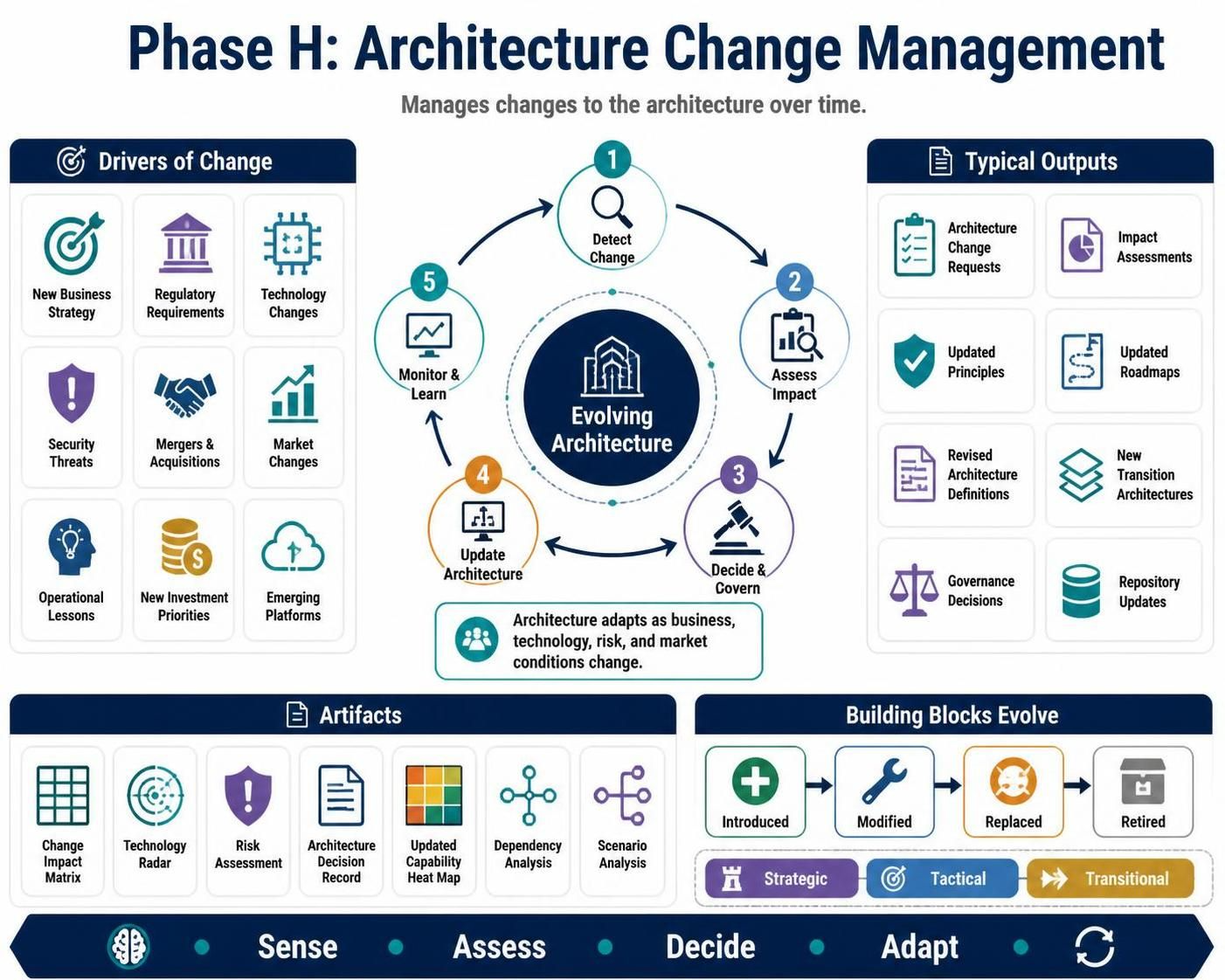
Changes may be caused by:
-
New business strategy
-
Regulatory requirements
-
Technology changes
-
Security threats
-
Mergers and acquisitions
-
Market changes
-
Operational lessons
-
New investment priorities
-
Emerging platforms
Typical outputs include:
-
Architecture Change Requests
-
Impact assessments
-
Updated principles
-
Updated roadmaps
-
Revised architecture definitions
-
New transition architectures
-
Governance decisions
-
Repository updates
Artifacts may include:
-
Change impact matrix
-
Technology radar
-
Risk assessment
-
Architecture decision record
-
Updated capability heat map
-
Dependency analysis
-
Scenario analysis
Building blocks may be:
-
Introduced
-
Modified
-
Replaced
-
Retired
-
Reclassified as strategic, tactical, or transitional
Requirements Management Across the ADM
Requirements Management operates continuously across the ADM.
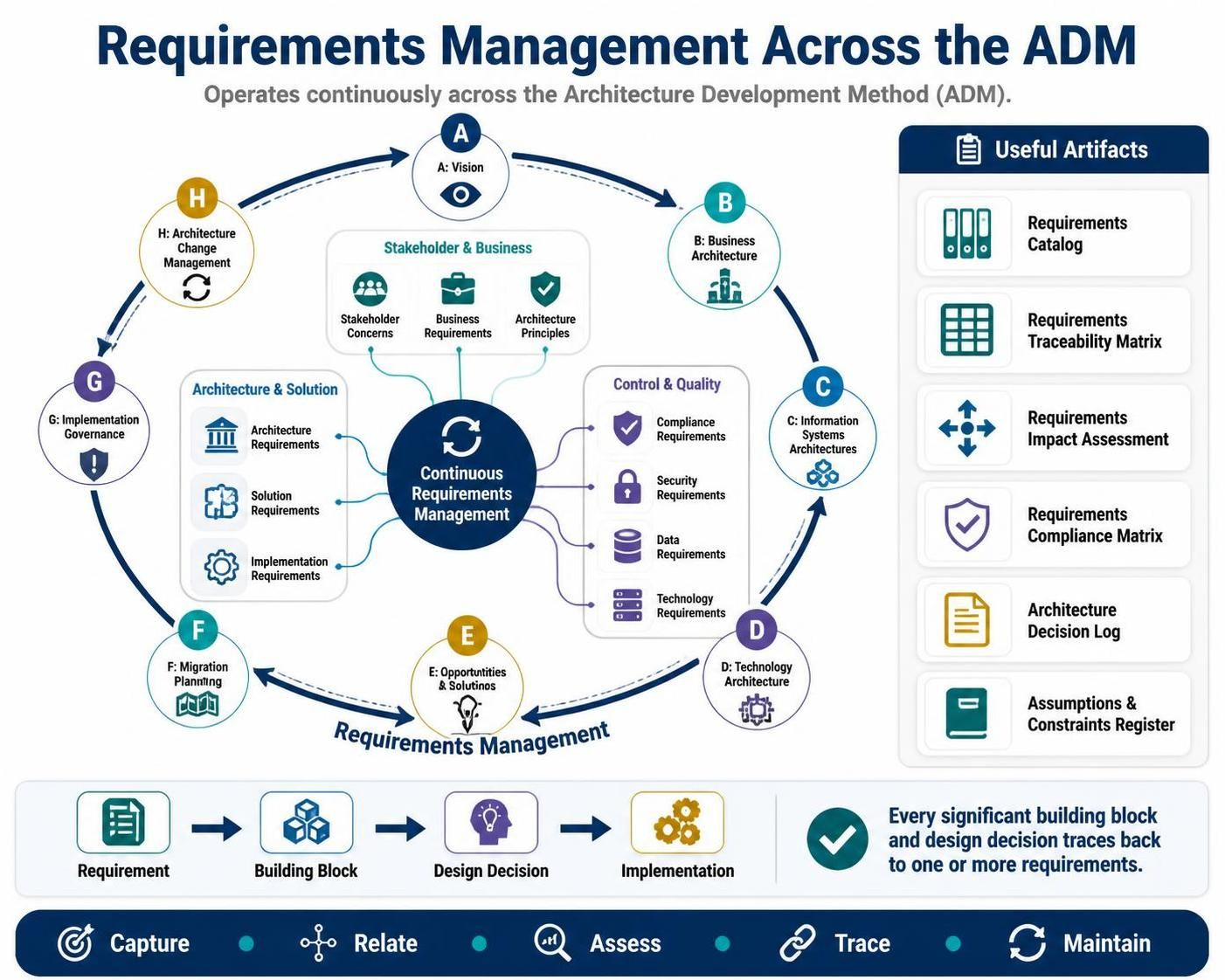
It captures and maintains relationships among:
-
Stakeholder concerns
-
Business requirements
-
Architecture principles
-
Architecture requirements
-
Solution requirements
-
Compliance requirements
-
Security requirements
-
Data requirements
-
Technology requirements
-
Implementation requirements
Useful artifacts include:
-
Requirements catalog
-
Requirements traceability matrix
-
Requirements impact assessment
-
Requirements compliance matrix
-
Architecture decision log
-
Assumptions and constraints register
A strong architecture practice ensures that every significant building block and design decision can be traced back to one or more requirements.
12. The Architecture Repository
The Architecture Repository provides a structured way to store, classify, govern, and reuse architecture content.
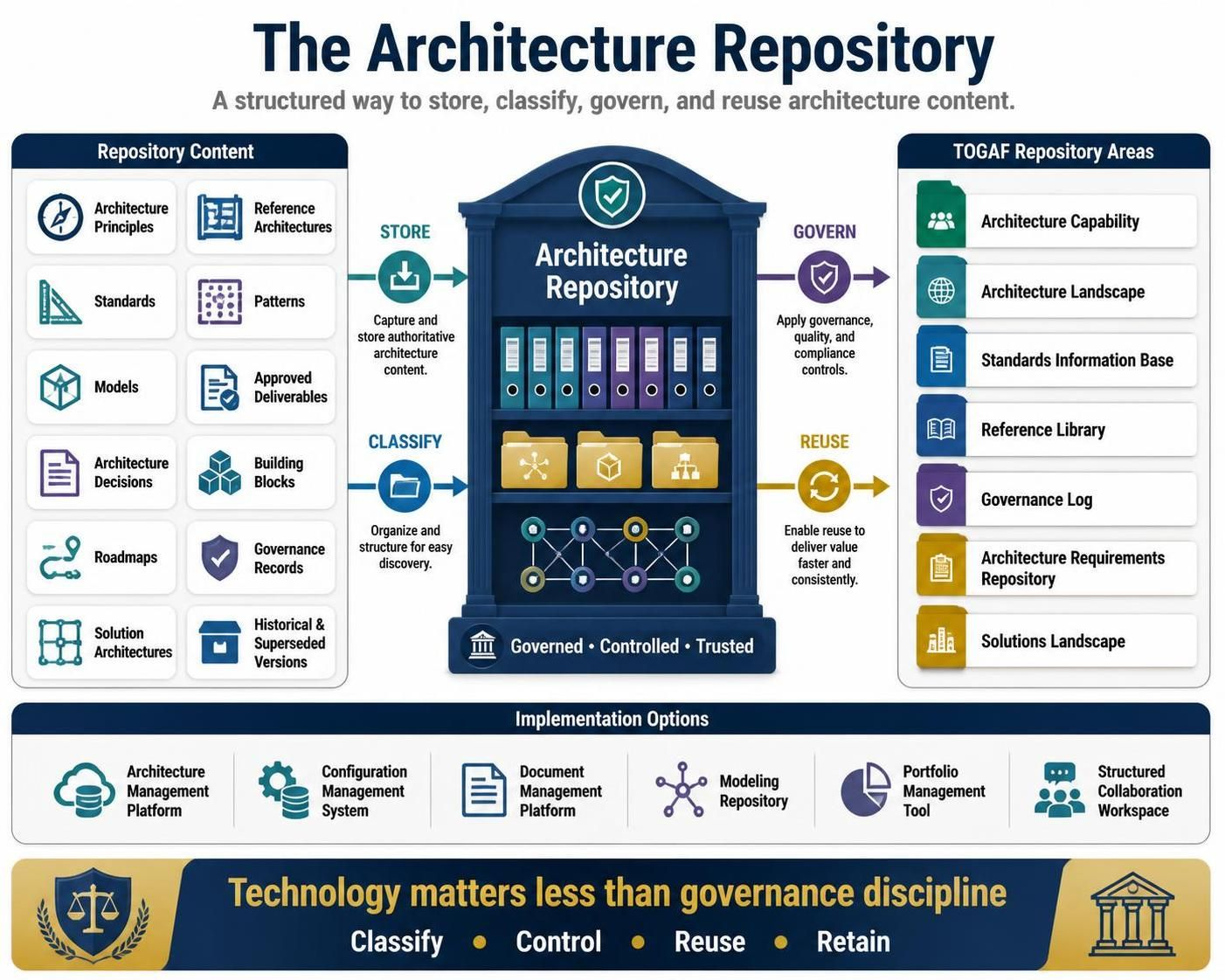
A repository may contain:
-
Architecture principles
-
Reference architectures
-
Standards
-
Patterns
-
Models
-
Approved deliverables
-
Architecture decisions
-
Building blocks
-
Roadmaps
-
Governance records
-
Solution architectures
-
Historical and superseded versions
TOGAF commonly describes repository areas such as:
-
Architecture Capability
-
Architecture Landscape
-
Standards Information Base
-
Reference Library
-
Governance Log
-
Architecture Requirements Repository
-
Solutions Landscape
Organizations may implement these areas using:
-
An architecture management platform
-
A configuration management system
-
A document management platform
-
A modeling repository
-
A portfolio management tool
-
A structured collaboration workspace
The implementation technology is less important than the governance discipline.
13. Architecture Landscape, Reference Library, and Standards
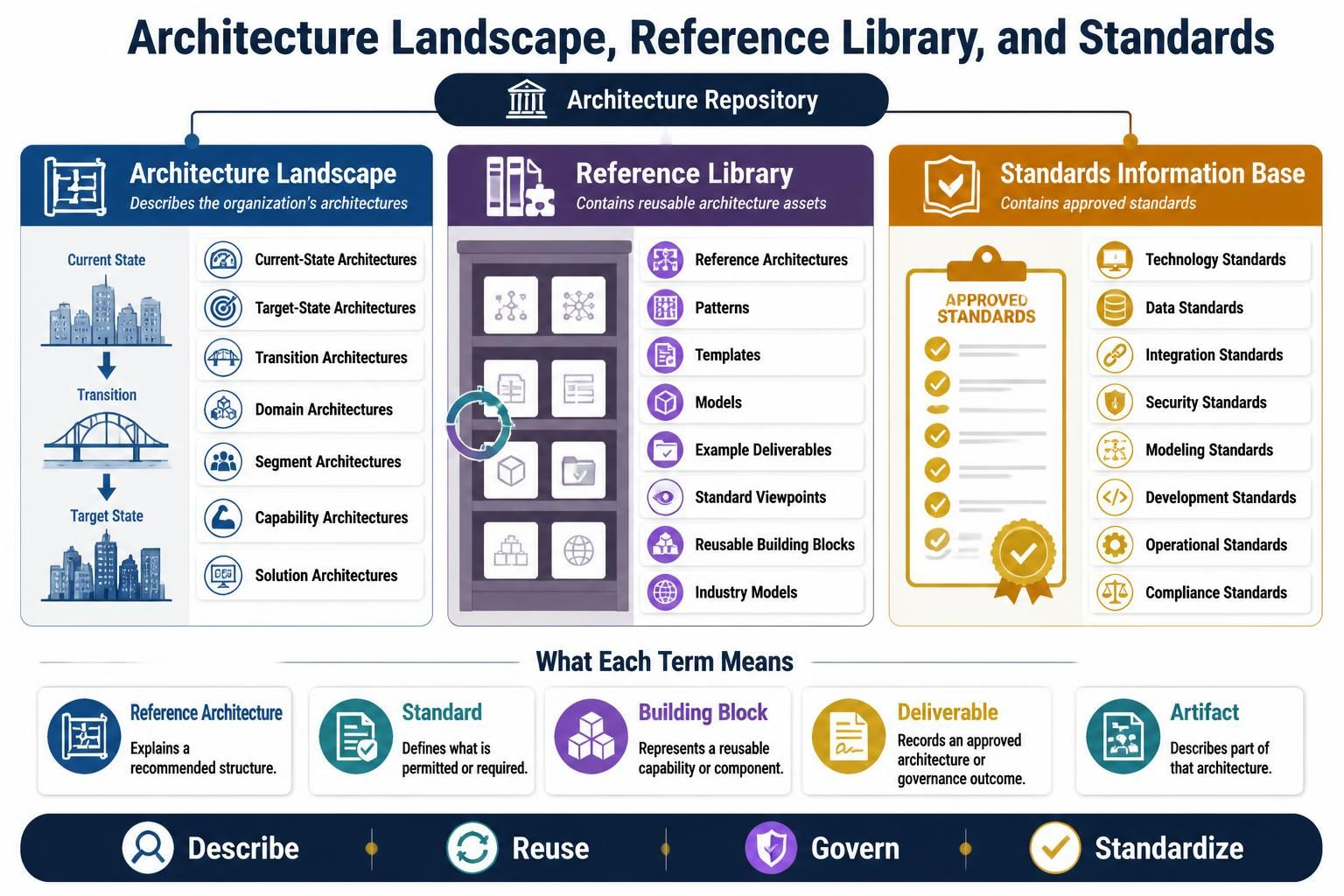
The repository should distinguish between architecture content that serves different purposes.
Architecture Landscape
The Architecture Landscape contains descriptions of the organization’s architectures, including:
-
Current-state architectures
-
Target-state architectures
-
Transition architectures
-
Domain architectures
-
Segment architectures
-
Capability architectures
-
Solution architectures
Reference Library
The Reference Library contains reusable architecture assets, such as:
-
Reference architectures
-
Patterns
-
Templates
-
Models
-
Example deliverables
-
Standard viewpoints
-
Reusable building blocks
-
Industry models
Standards Information Base
The Standards Information Base contains approved standards, including:
-
Technology standards
-
Data standards
-
Integration standards
-
Security standards
-
Modeling standards
-
Development standards
-
Operational standards
-
Compliance standards
The distinction is important:
-
A reference architecture explains a recommended structure.
-
A standard defines what is permitted or required.
-
A building block represents a reusable capability or component.
-
A deliverable records an approved architecture or governance outcome.
-
An artifact describes part of that architecture.
14. Architecture Views and Viewpoints
Artifacts should be designed for a particular concern and audience.
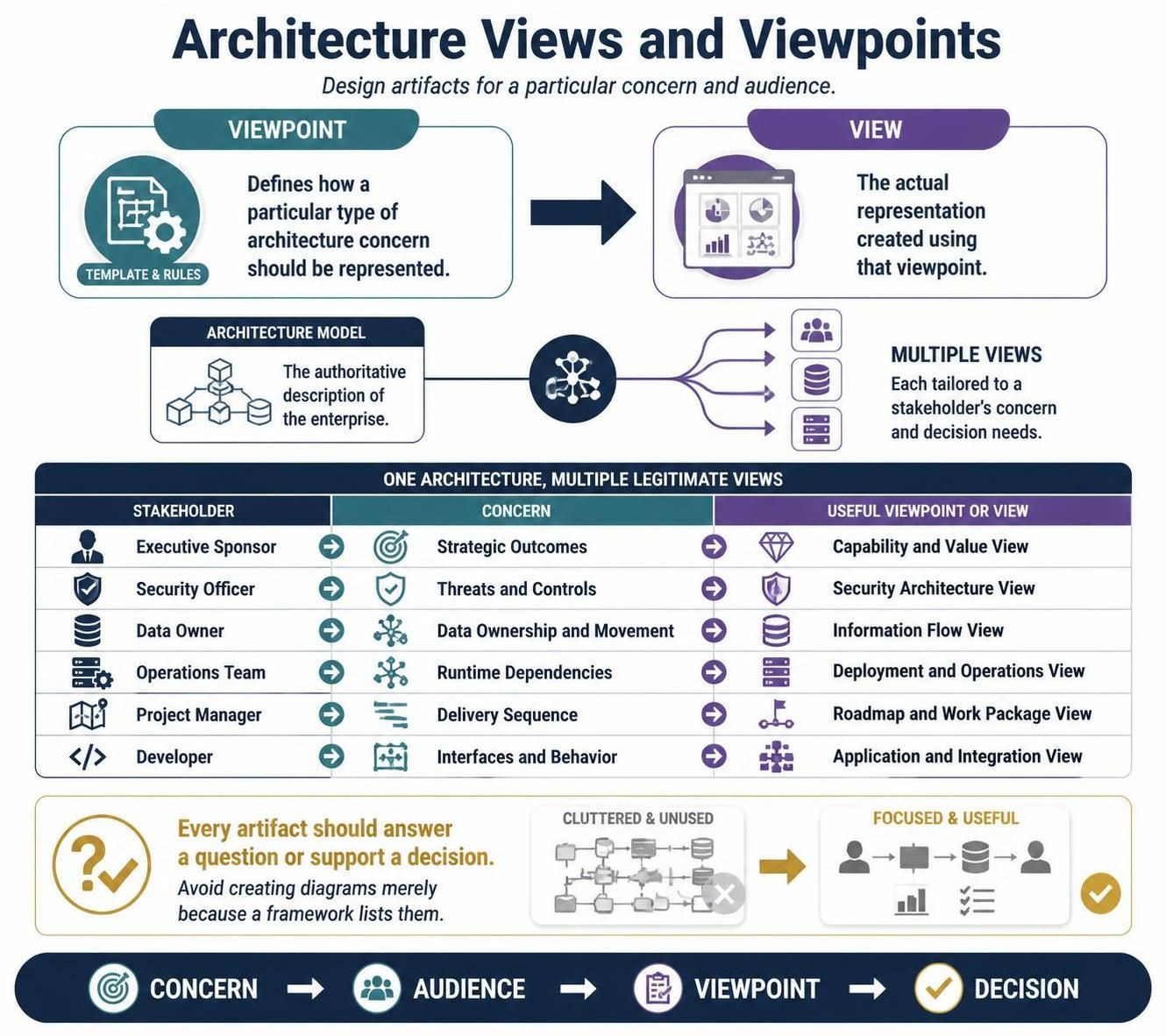
A viewpoint defines how a particular type of architecture concern should be represented. A view is the actual representation created using that viewpoint.
For example:
| Stakeholder | Concern | Useful viewpoint or view |
|---|---|---|
| Executive sponsor | Strategic outcomes | Capability and value view |
| Security officer | Threats and controls | Security architecture view |
| Data owner | Data ownership and movement | Information flow view |
| Operations team | Runtime dependencies | Deployment and operations view |
| Project manager | Delivery sequence | Roadmap and work package view |
| Developer | Interfaces and behavior | Application and integration view |
A single architecture can therefore have multiple legitimate representations.
Architects should avoid creating diagrams merely because a framework lists them. Every artifact should answer a question or support a decision.
15. How to Decide Whether Something Is a Deliverable, Artifact, or Building Block
Use the following questions.
Is it formally submitted for approval?
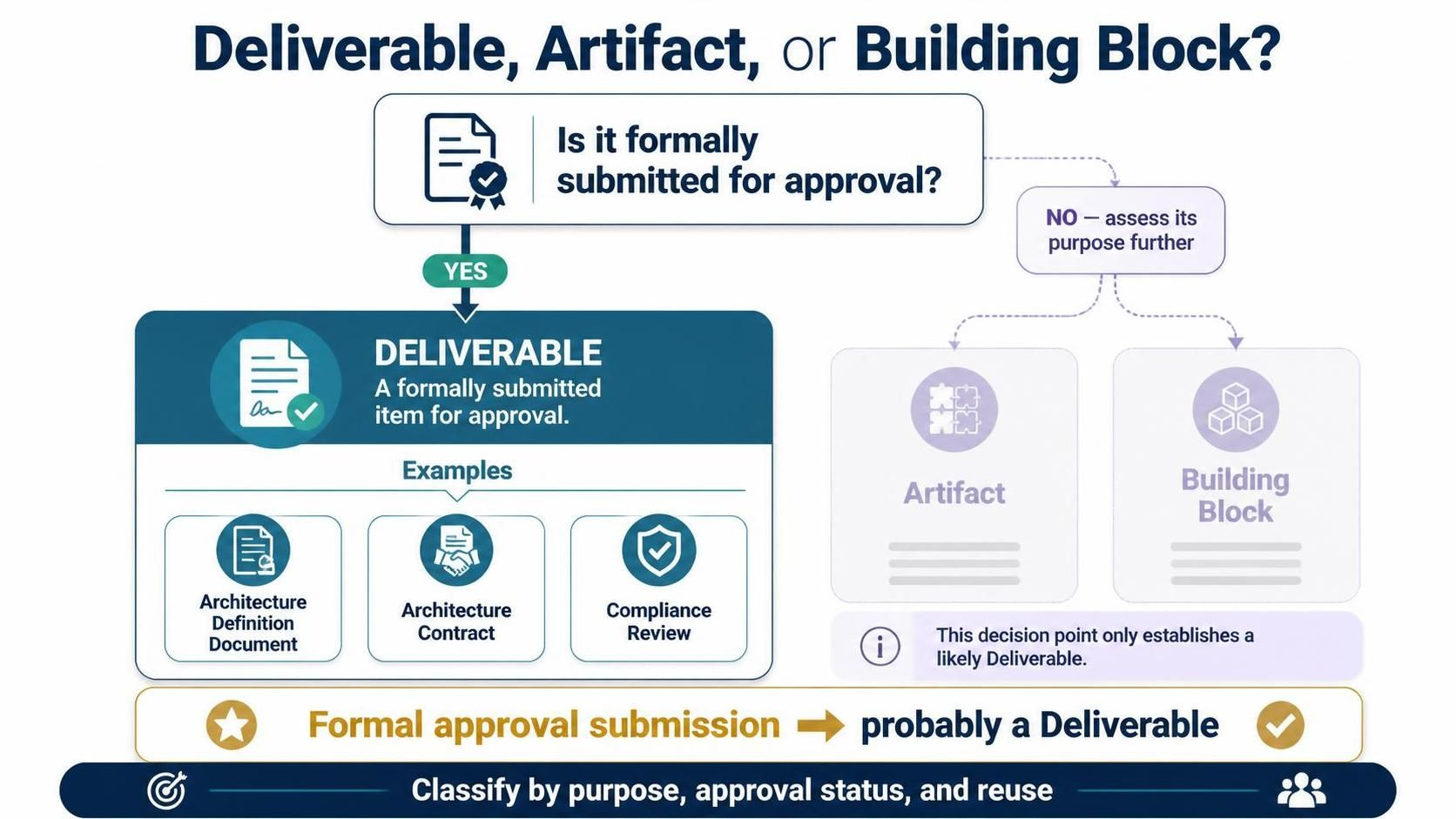
If yes, it is probably a deliverable.
Example:
-
Architecture Definition Document
-
Architecture Contract
-
Compliance Review
Does it describe a specific aspect of the architecture?
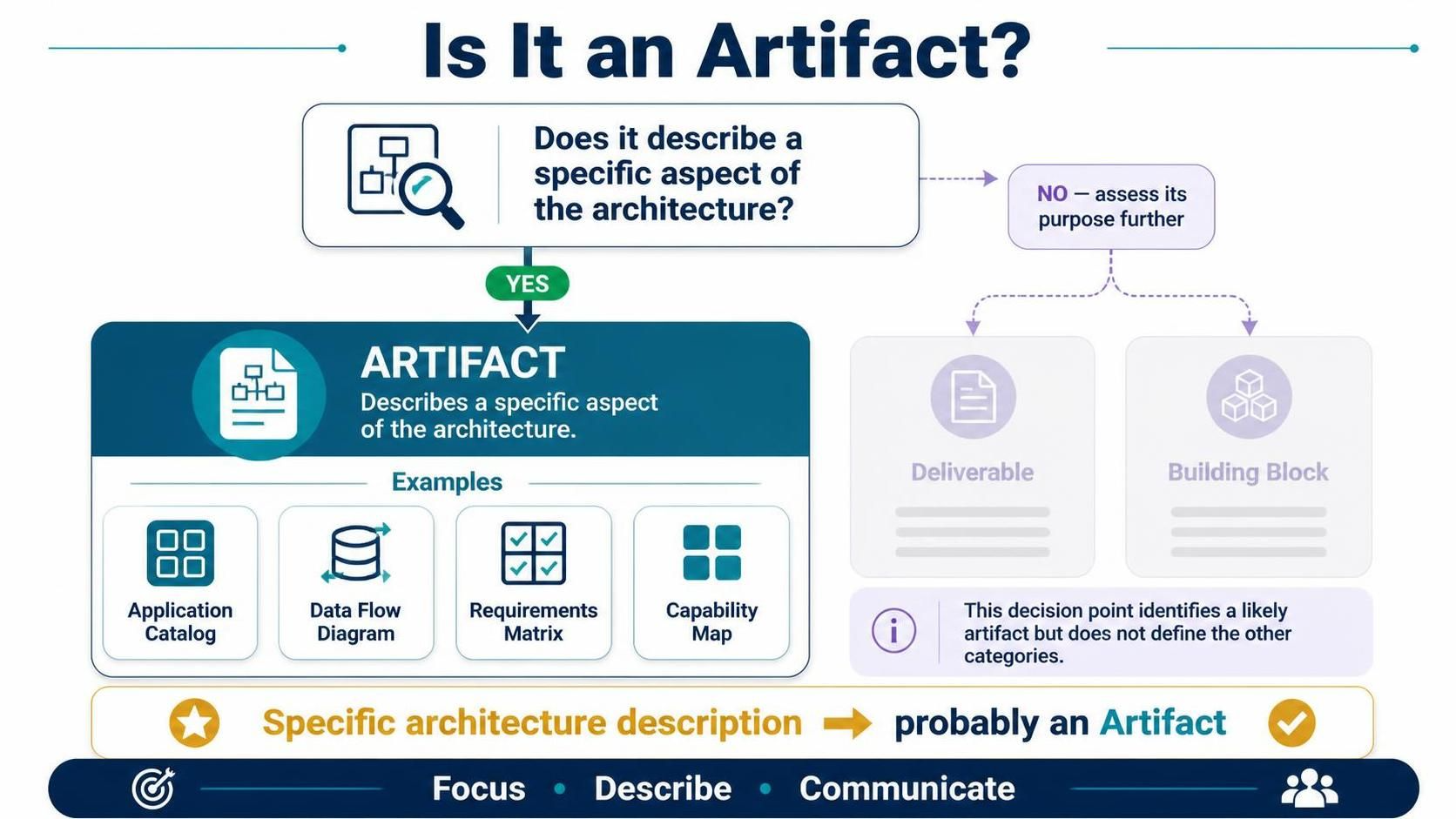
If yes, it is probably an artifact.
Example:
-
Application catalog
-
Data flow diagram
-
Requirements matrix
-
Capability map
Is it reusable as a capability or implementation component?
If yes, it is probably a building block.
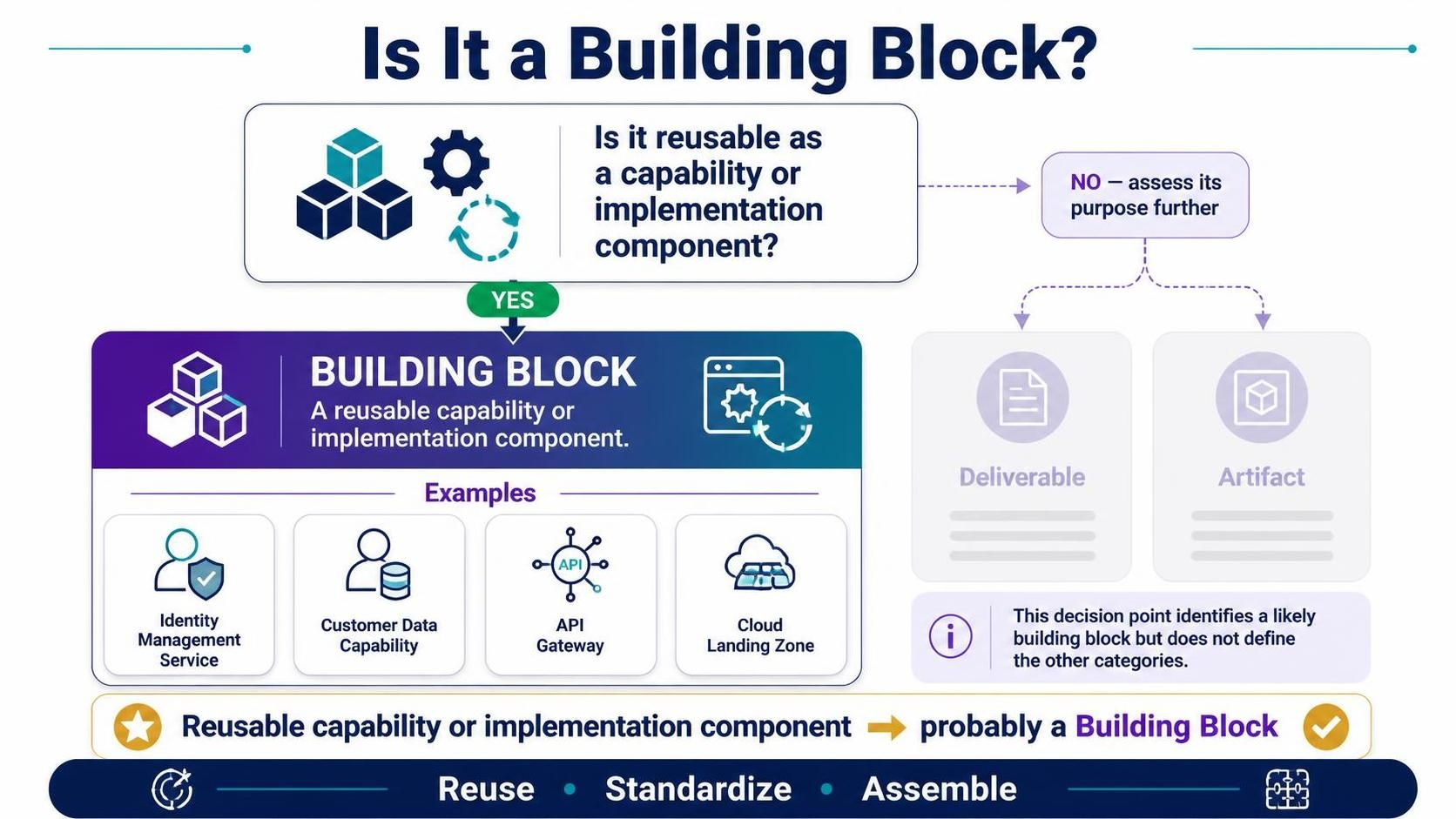
Example:
-
Identity management service
-
Customer data capability
-
API gateway
-
Cloud landing zone
Can one item belong to more than one category?
Yes, depending on how it is used.
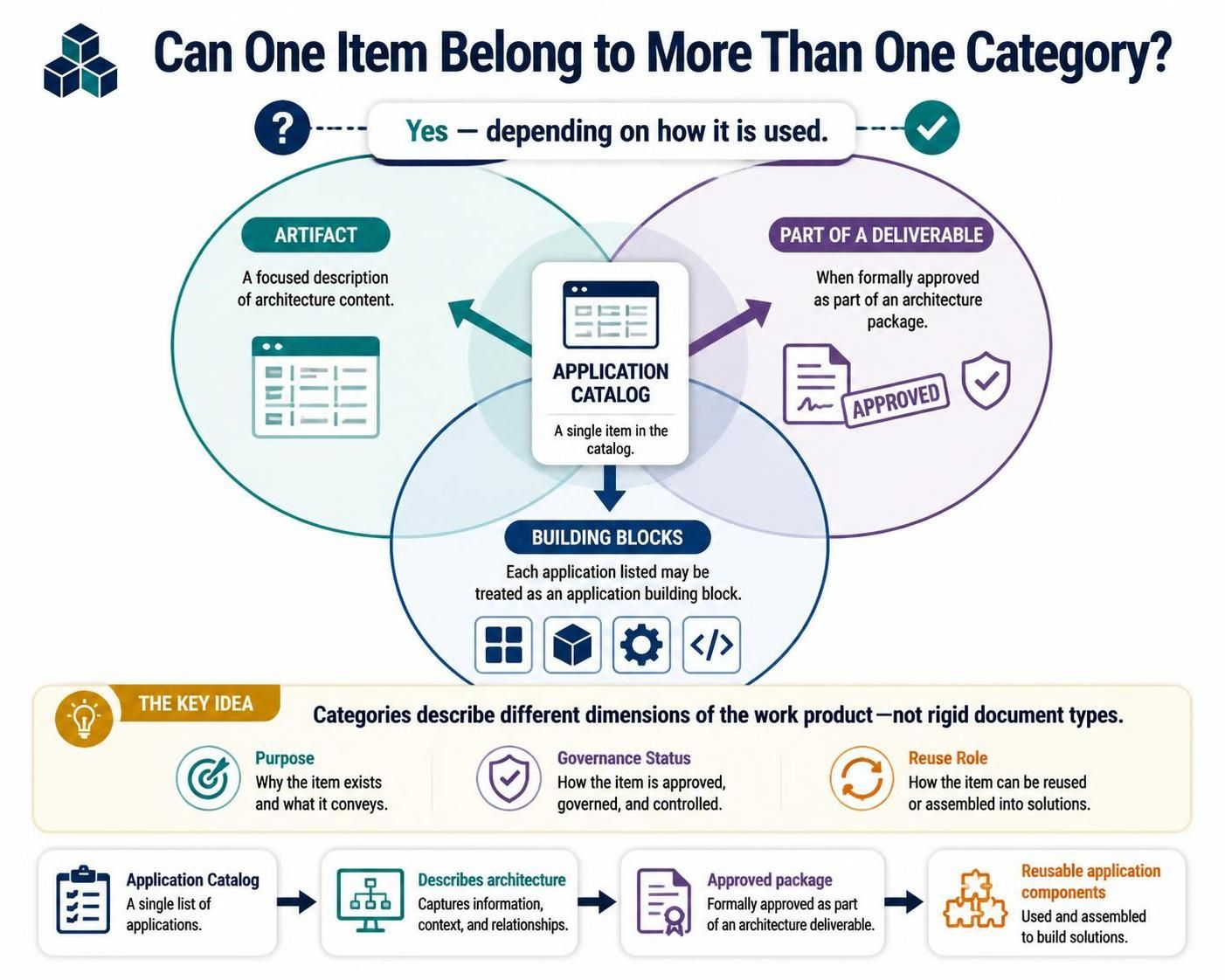
For example:
-
An application catalog is an artifact.
-
If formally approved as part of an architecture package, it contributes to a deliverable.
-
Each application listed in the catalog may be treated as an application building block.
The categories describe different dimensions of the work product rather than rigid document types.
16. Example: Designing a Customer Onboarding Architecture
Suppose an organization wants to improve customer onboarding.
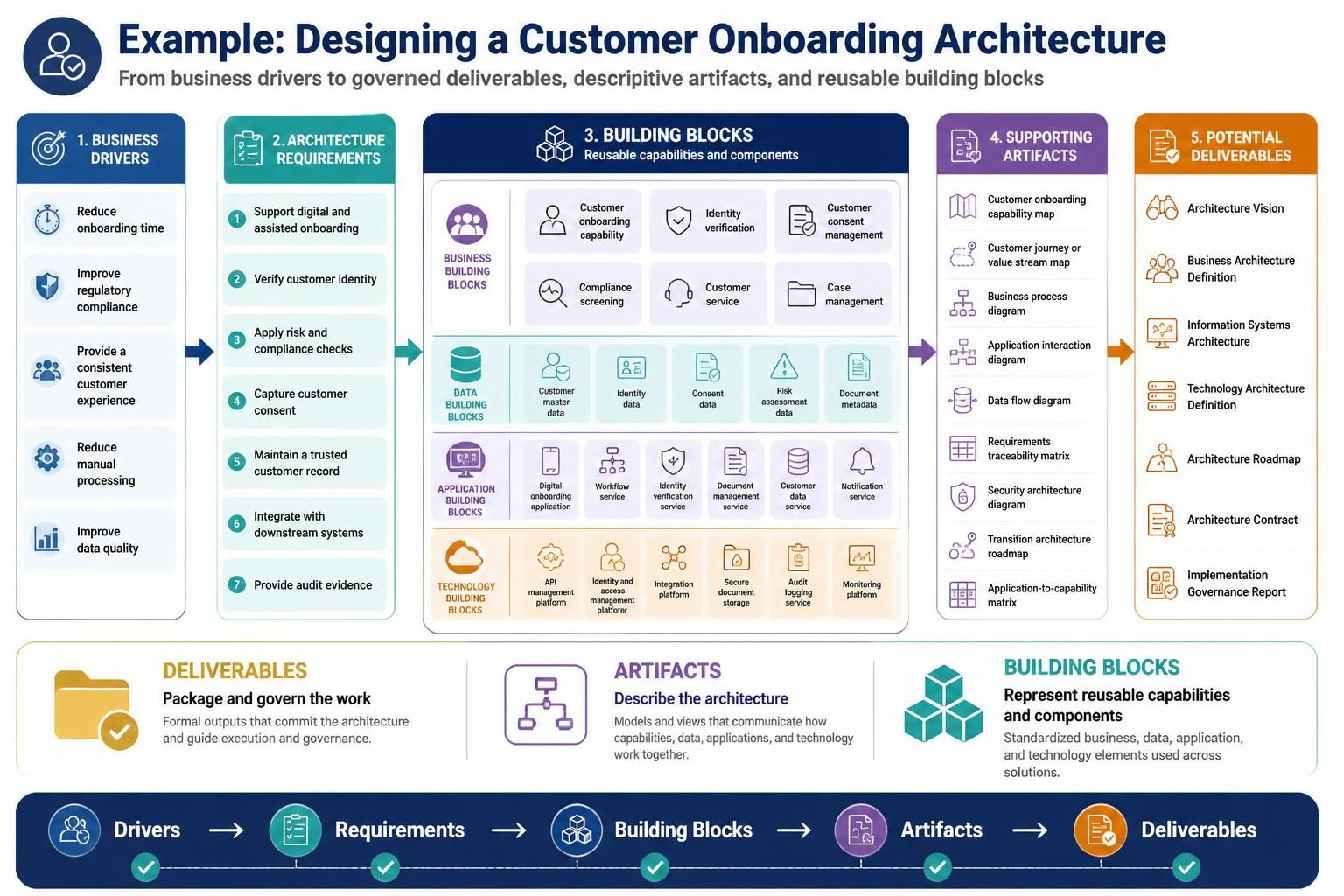
Business drivers
-
Reduce onboarding time
-
Improve regulatory compliance
-
Provide a consistent customer experience
-
Reduce manual processing
-
Improve data quality
Potential architecture requirements
-
Support digital and assisted onboarding
-
Verify customer identity
-
Apply risk and compliance checks
-
Capture customer consent
-
Maintain a trusted customer record
-
Integrate with downstream systems
-
Provide audit evidence
Potential business building blocks
-
Customer onboarding capability
-
Identity verification
-
Customer consent management
-
Compliance screening
-
Customer service
-
Case management
Potential data building blocks
-
Customer master data
-
Identity data
-
Consent data
-
Risk assessment data
-
Document metadata
Potential application building blocks
-
Digital onboarding application
-
Workflow service
-
Identity verification service
-
Document management service
-
Customer data service
-
Notification service
Potential technology building blocks
-
API management platform
-
Identity and access management platform
-
Integration platform
-
Secure document storage
-
Audit logging service
-
Monitoring platform
Supporting artifacts
-
Customer onboarding capability map
-
Customer journey or value stream map
-
Business process diagram
-
Application interaction diagram
-
Data flow diagram
-
Requirements traceability matrix
-
Security architecture diagram
-
Transition architecture roadmap
-
Application-to-capability matrix
Potential deliverables
-
Architecture Vision
-
Business Architecture Definition
-
Information Systems Architecture
-
Technology Architecture Definition
-
Architecture Roadmap
-
Architecture Contract
-
Implementation Governance Report
This example shows the relationship clearly:
-
The deliverables package and govern the work.
-
The artifacts describe the architecture.
-
The building blocks represent reusable capabilities and components.
17. Building Block Specifications
A building block becomes much more useful when it is documented consistently.
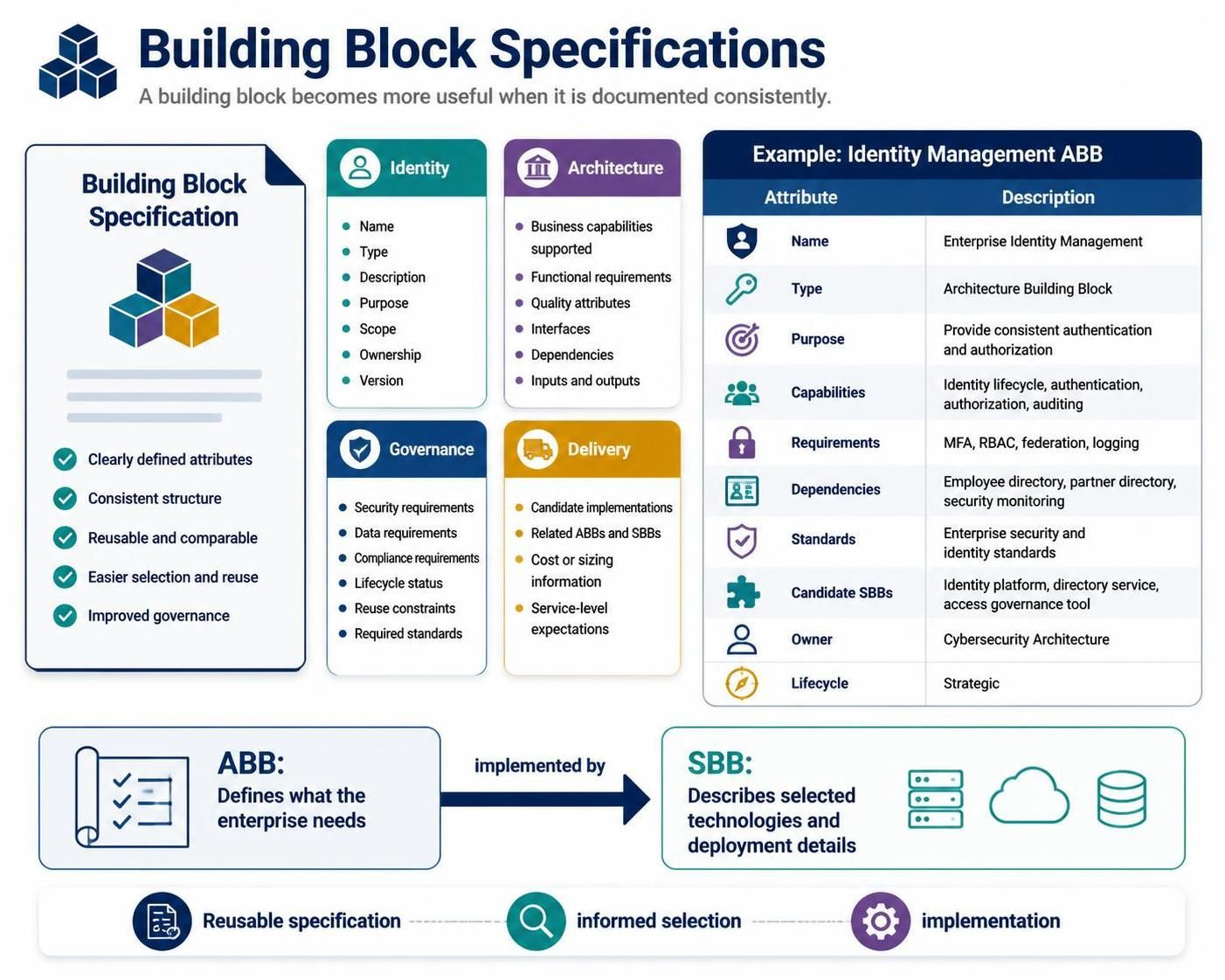
A building block specification may include:
-
Name
-
Type
-
Description
-
Purpose
-
Scope
-
Business capabilities supported
-
Functional requirements
-
Quality attributes
-
Interfaces
-
Dependencies
-
Inputs and outputs
-
Security requirements
-
Data requirements
-
Compliance requirements
-
Ownership
-
Lifecycle status
-
Reuse constraints
-
Required standards
-
Candidate implementations
-
Related ABBs and SBBs
-
Cost or sizing information
-
Service-level expectations
-
Version
Example: Identity Management ABB
| Attribute | Description |
|---|---|
| Name | Enterprise Identity Management |
| Type | Architecture Building Block |
| Purpose | Provide consistent authentication and authorization |
| Capabilities | Identity lifecycle, authentication, authorization, auditing |
| Requirements | MFA, RBAC, federation, logging |
| Dependencies | Employee directory, partner directory, security monitoring |
| Standards | Enterprise security and identity standards |
| Candidate SBBs | Identity platform, directory service, access governance tool |
| Owner | Cybersecurity Architecture |
| Lifecycle | Strategic |
The ABB defines what the enterprise needs. The SBB specification would describe the selected technologies and deployment details.
18. Baseline, Target, and Transition Architecture
Deliverables, artifacts, and building blocks can describe different points in time.
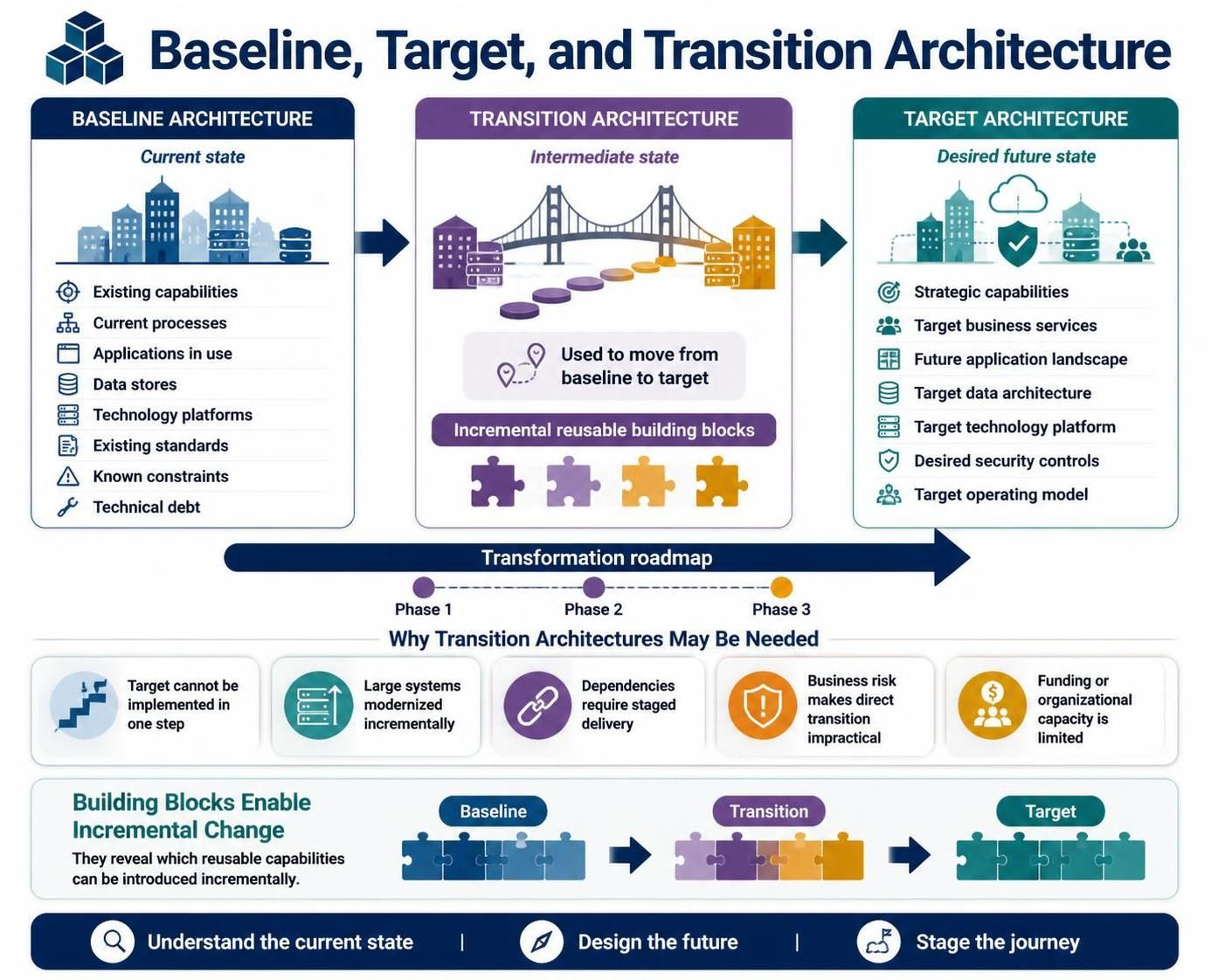
Baseline architecture
The baseline describes the current state.
It may include:
-
Existing capabilities
-
Current processes
-
Applications in use
-
Data stores
-
Technology platforms
-
Existing standards
-
Known constraints
-
Technical debt
Target architecture
The target describes the desired future state.
It may include:
-
Strategic capabilities
-
Target business services
-
Future application landscape
-
Target data architecture
-
Target technology platform
-
Desired security controls
-
Target operating model
Transition architecture
A transition architecture is an intermediate state used to move from baseline to target.
It may be necessary when:
-
The target state cannot be implemented in one step
-
Large systems must be modernized incrementally
-
Dependencies require staged delivery
-
Business risk makes a direct transition impractical
-
Funding or organizational capacity is limited
Building blocks are especially useful for transition planning because they reveal which reusable capabilities can be introduced incrementally.
19. Common Mistakes
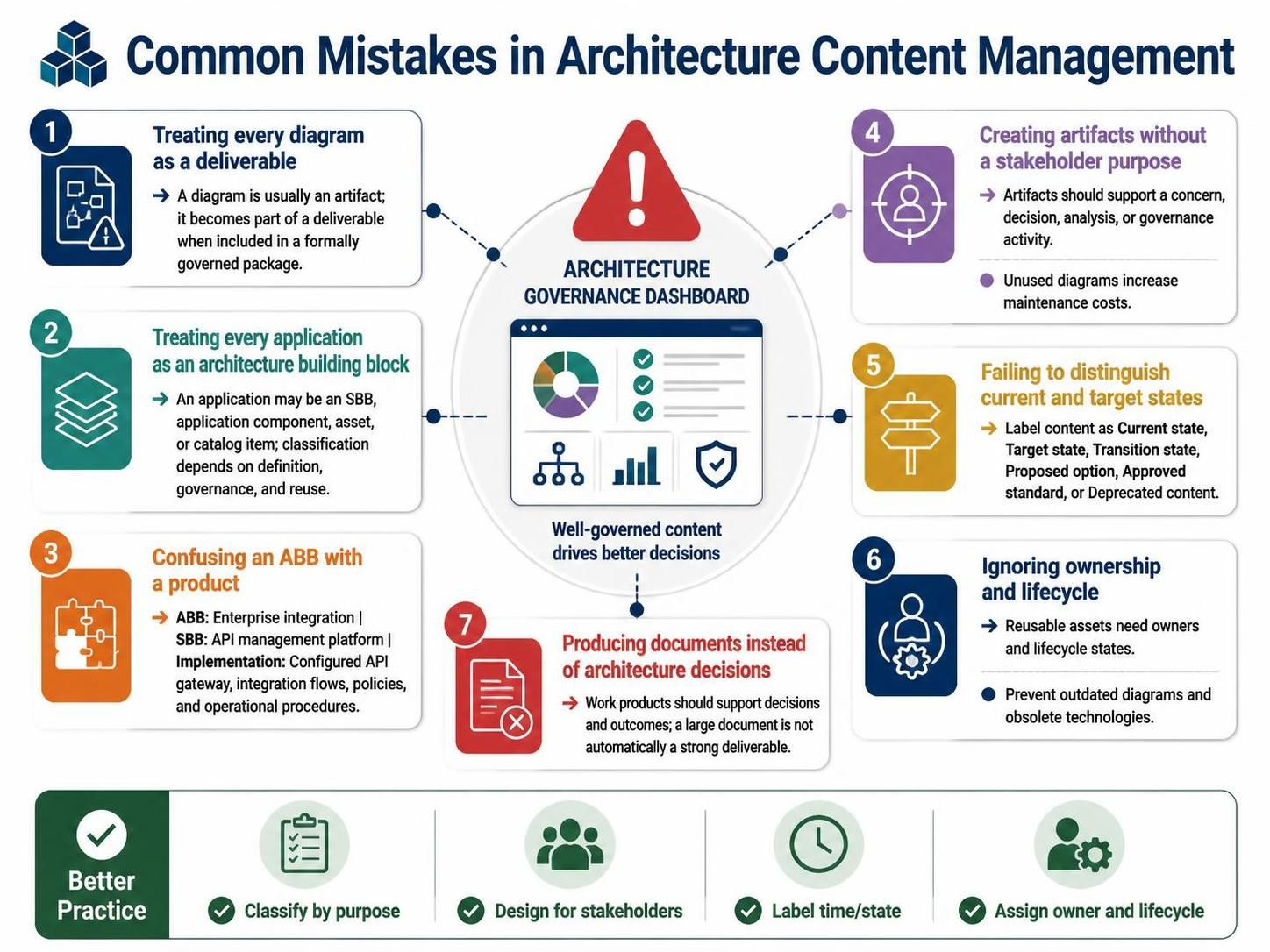
Treating every diagram as a deliverable
A diagram is usually an artifact. It becomes part of a deliverable when it is included in a formally governed package.
Treating every application as an architecture building block
An application can be an SBB, an application component, an asset, or simply an item in a catalog. Whether it is a building block depends on how it is defined, governed, and reused.
Confusing an ABB with a product
An ABB describes a required architectural capability. A vendor product is generally an SBB or part of an SBB.
For example:
-
ABB: Enterprise integration
-
SBB: API management platform
-
Implementation: Configured API gateway, integration flows, policies, and operational procedures
Creating artifacts without a stakeholder purpose
Artifacts should support a concern, decision, analysis, or governance activity. Unused diagrams increase maintenance costs without improving architecture quality.
Failing to distinguish current and target states
A catalog or diagram should make clear whether it describes:
-
Current state
-
Target state
-
Transition state
-
Proposed option
-
Approved standard
-
Deprecated content
Ignoring ownership and lifecycle
Reusable assets need owners and lifecycle states. Otherwise, building block libraries become collections of outdated diagrams and obsolete technologies.
Producing documents instead of architecture decisions
TOGAF work products should support decisions and outcomes. A large document is not automatically a strong architecture deliverable.
20. Practical Governance for Architecture Work Products
Organizations should define a lightweight governance model for work products.
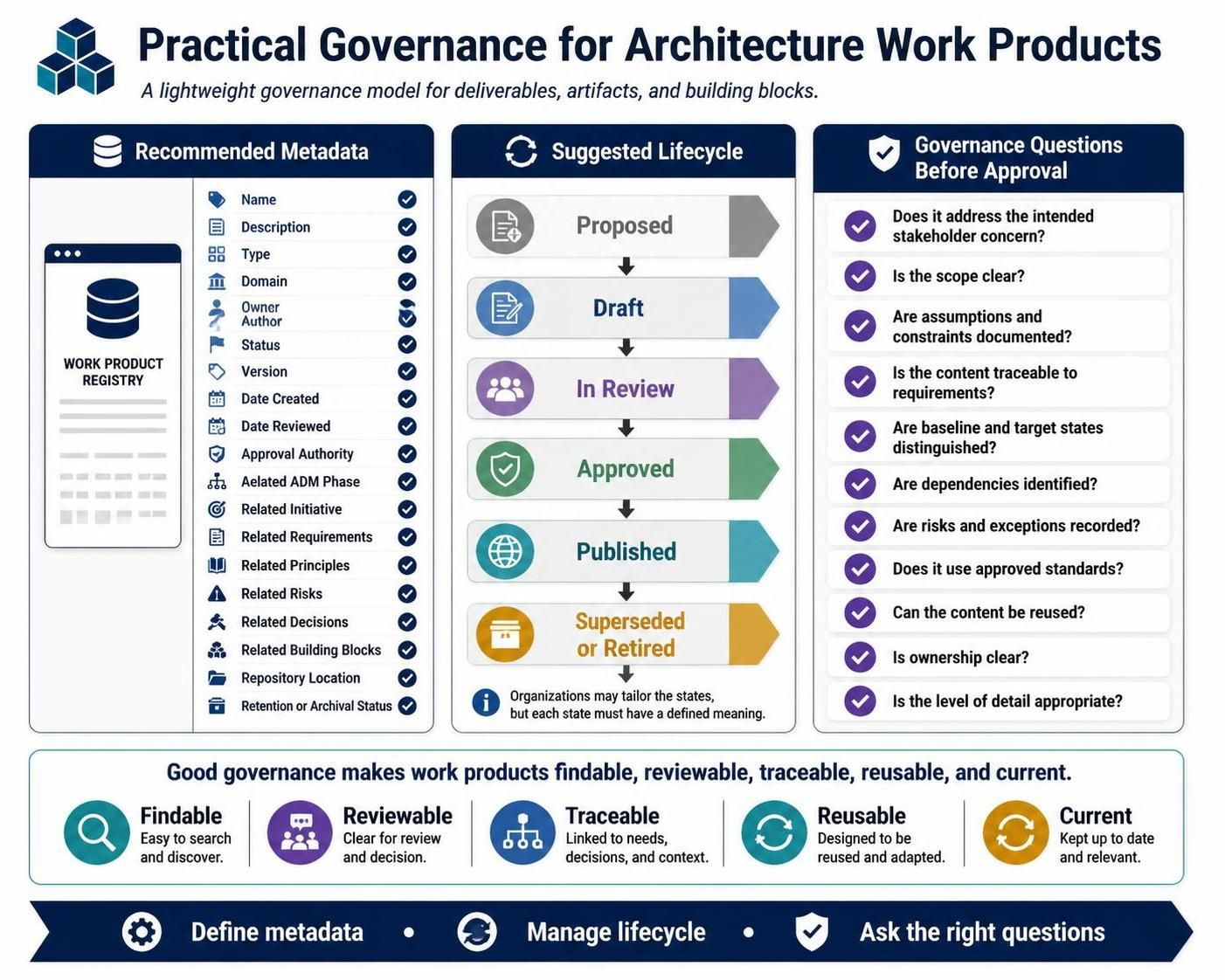
Recommended metadata
For each deliverable, artifact, and building block, record:
-
Name
-
Description
-
Type
-
Domain
-
Owner
-
Author
-
Status
-
Version
-
Date created
-
Date reviewed
-
Approval authority
-
Related ADM phase
-
Related initiative
-
Related requirements
-
Related principles
-
Related risks
-
Related decisions
-
Related building blocks
-
Repository location
-
Retention or archival status
Suggested lifecycle
Proposed
   ↓
Draft
   ↓
In Review
   ↓
Approved
   ↓
Published
   ↓
Superseded or Retired
Not every organization needs all these states, but every organization should define what its states mean.
Governance questions
Before approving a work product, ask:
-
Does it address the intended stakeholder concern?
-
Is the scope clear?
-
Are assumptions and constraints documented?
-
Is the content traceable to requirements?
-
Are baseline and target states distinguished?
-
Are dependencies identified?
-
Are risks and exceptions recorded?
-
Does it use approved standards?
-
Can the content be reused?
-
Is ownership clear?
-
Is the level of detail appropriate?
21. Tailoring TOGAF Deliverables and Artifacts
TOGAF is not intended to require every organization to produce every possible artifact.
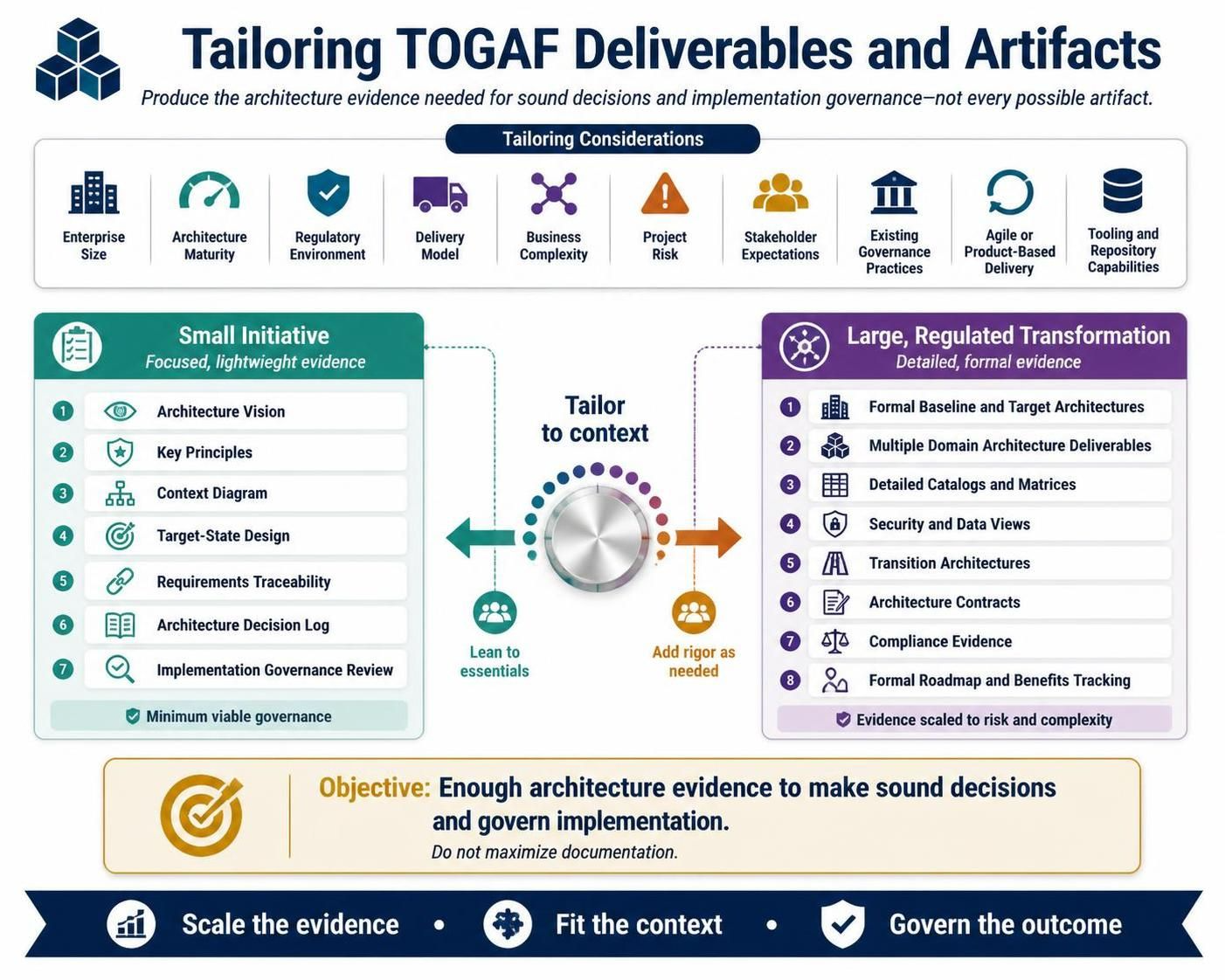
Tailoring should consider:
-
Enterprise size
-
Architecture maturity
-
Regulatory environment
-
Delivery model
-
Business complexity
-
Project risk
-
Stakeholder expectations
-
Existing governance practices
-
Agile or product-based delivery
-
Tooling and repository capabilities
A small initiative may need only:
-
Architecture Vision
-
Key principles
-
Context diagram
-
Target-state design
-
Requirements traceability
-
Architecture decision log
-
Implementation governance review
A large, regulated transformation may need:
-
Formal baseline and target architectures
-
Multiple domain architecture deliverables
-
Detailed catalogs and matrices
-
Security and data views
-
Transition architectures
-
Architecture contracts
-
Compliance evidence
-
Formal roadmap and benefits tracking
The objective is not to maximize documentation. It is to provide enough architecture evidence to make sound decisions and govern implementation.
22. Agile and Product-Oriented Use
TOGAF concepts can be used in agile environments without producing large, static documents.
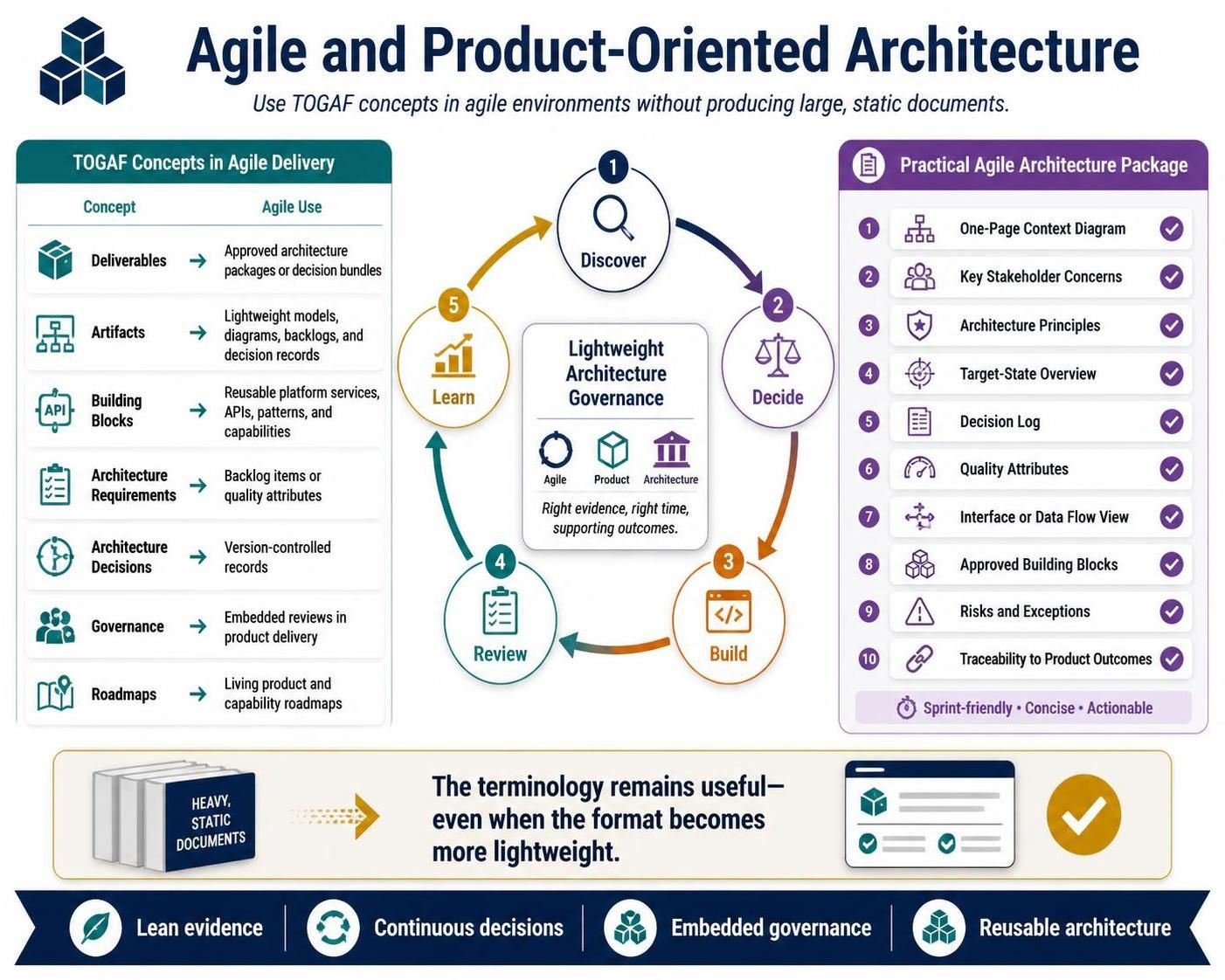
Agile and Product-Oriented Use
TOGAF concepts can be used in agile environments without producing large, static documents.
Examples include:
-
Deliverables as approved architecture packages or decision bundles
-
Artifacts as lightweight models, diagrams, backlogs, and decision records
-
Building blocks as reusable platform services, APIs, patterns, and capabilities
-
Architecture requirements as backlog items or quality attributes
-
Architecture decisions as version-controlled records
-
Governance as embedded reviews in product delivery
-
Roadmaps as living product and capability roadmaps
A practical agile architecture package might contain:
-
One-page context diagram
-
Key stakeholder concerns
-
Architecture principles
-
Target-state overview
-
Decision log
-
Quality attributes
-
Interface or data flow view
-
Approved building blocks
-
Risks and exceptions
-
Traceability to product outcomes
The terminology remains useful even when the format becomes more lightweight.
Agile and Product-Oriented Use
TOGAF concepts can be used in agile environments without producing large, static documents.
Examples include:
-
Deliverables as approved architecture packages or decision bundles
-
Artifacts as lightweight models, diagrams, backlogs, and decision records
-
Building blocks as reusable platform services, APIs, patterns, and capabilities
-
Architecture requirements as backlog items or quality attributes
-
Architecture decisions as version-controlled records
-
Governance as embedded reviews in product delivery
-
Roadmaps as living product and capability roadmaps
A practical agile architecture package might contain:
-
One-page context diagram
-
Key stakeholder concerns
-
Architecture principles
-
Target-state overview
-
Decision log
-
Quality attributes
-
Interface or data flow view
-
Approved building blocks
-
Risks and exceptions
-
Traceability to product outcomes
The terminology remains useful even when the format becomes more lightweight.
Examples include:
-
Deliverables as approved architecture packages or decision bundles
-
Artifacts as lightweight models, diagrams, backlogs, and decision records
-
Building blocks as reusable platform services, APIs, patterns, and capabilities
-
Architecture requirements as backlog items or quality attributes
-
Architecture decisions as version-controlled records
-
Governance as embedded reviews in product delivery
-
Roadmaps as living product and capability roadmaps
A practical agile architecture package might contain:
-
One-page context diagram
-
Key stakeholder concerns
-
Architecture principles
-
Target-state overview
-
Decision log
-
Quality attributes
-
Interface or data flow view
-
Approved building blocks
-
Risks and exceptions
-
Traceability to product outcomes
The terminology remains useful even when the format becomes more lightweight.
23. A Practical Template for an Architecture Deliverable
A general-purpose architecture deliverable can use the following structure:
-
Purpose and scope
-
Stakeholders and concerns
-
Business drivers
-
Requirements
-
Principles and constraints
-
Baseline architecture
-
Target architecture
-
Architecture views
-
Building blocks
-
Gap analysis
-
Options and trade-offs
-
Risks and assumptions
-
Dependencies
-
Roadmap and transition architectures
-
Governance and compliance
-
Decisions and approvals
-
Traceability
-
Appendices and supporting artifacts
Not every deliverable needs every section. The structure should be adapted to the audience and purpose.
24. A Practical Template for an Artifact
Each artifact should have enough metadata to explain why it exists.
Artifact name:
Artifact type: Catalog / Matrix / Diagram / Model / Record
Purpose:
Stakeholder concern:
Audience:
Architecture domain:
ADM phase:
Baseline, target, or transition:
Inputs:
Outputs:
Notation or modeling standard:
Owner:
Review status:
Related requirements:
Related decisions:
Related building blocks:
Repository location:
This prevents artifacts from becoming disconnected diagrams with no clear meaning or ownership.
25. A Practical Template for a Building Block
Building block name:
Type: ABB / SBB
Domain: Business / Data / Application / Technology
Purpose:
Description:
Capabilities provided:
Requirements addressed:
Functional characteristics:
Quality attributes:
Interfaces:
Inputs and outputs:
Dependencies:
Applicable standards:
Security considerations:
Data considerations:
Candidate implementations:
Owner:
Lifecycle status:
Reuse guidance:
Related artifacts:
Related deliverables:
The distinction between ABB and SBB should be explicitly recorded.
26. Key Takeaways
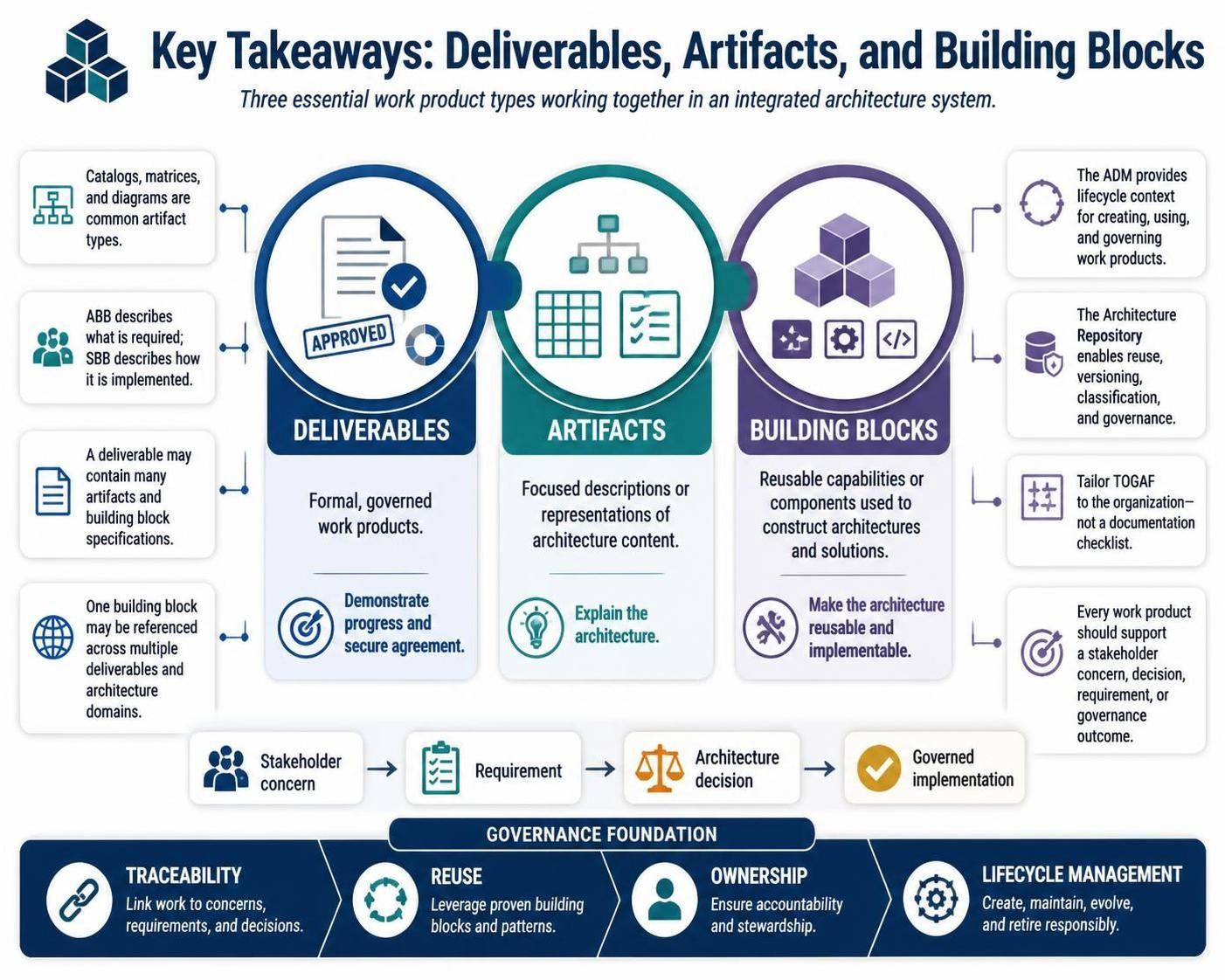
The most important points are:
-
Deliverables are formal, governed work products.
-
Artifacts are focused descriptions or representations of architecture content.
-
Building blocks are reusable capabilities or components used to construct architectures and solutions.
-
Catalogs, matrices, and diagrams are common artifact types.
-
Architecture Building Blocks describe what is required; Solution Building Blocks describe how it is implemented.
-
A deliverable may contain many artifacts and building block specifications.
-
The same building block may be referenced across multiple deliverables and architecture domains.
-
The ADM provides the lifecycle context for creating, using, and governing these work products.
-
The Architecture Repository enables reuse, versioning, classification, and governance.
-
TOGAF should be tailored to the organization rather than applied as a documentation checklist.
-
Every work product should support a stakeholder concern, decision, requirement, or governance outcome.
-
Good architecture practice emphasizes traceability, reuse, ownership, and lifecycle management.
In practical terms, architects should think of the three concepts this way:
Deliverables demonstrate progress and secure agreement. Artifacts explain the architecture. Building blocks make the architecture reusable and implementable.