


The TOGAF Architecture Development Method: A Step-by-Step Overview
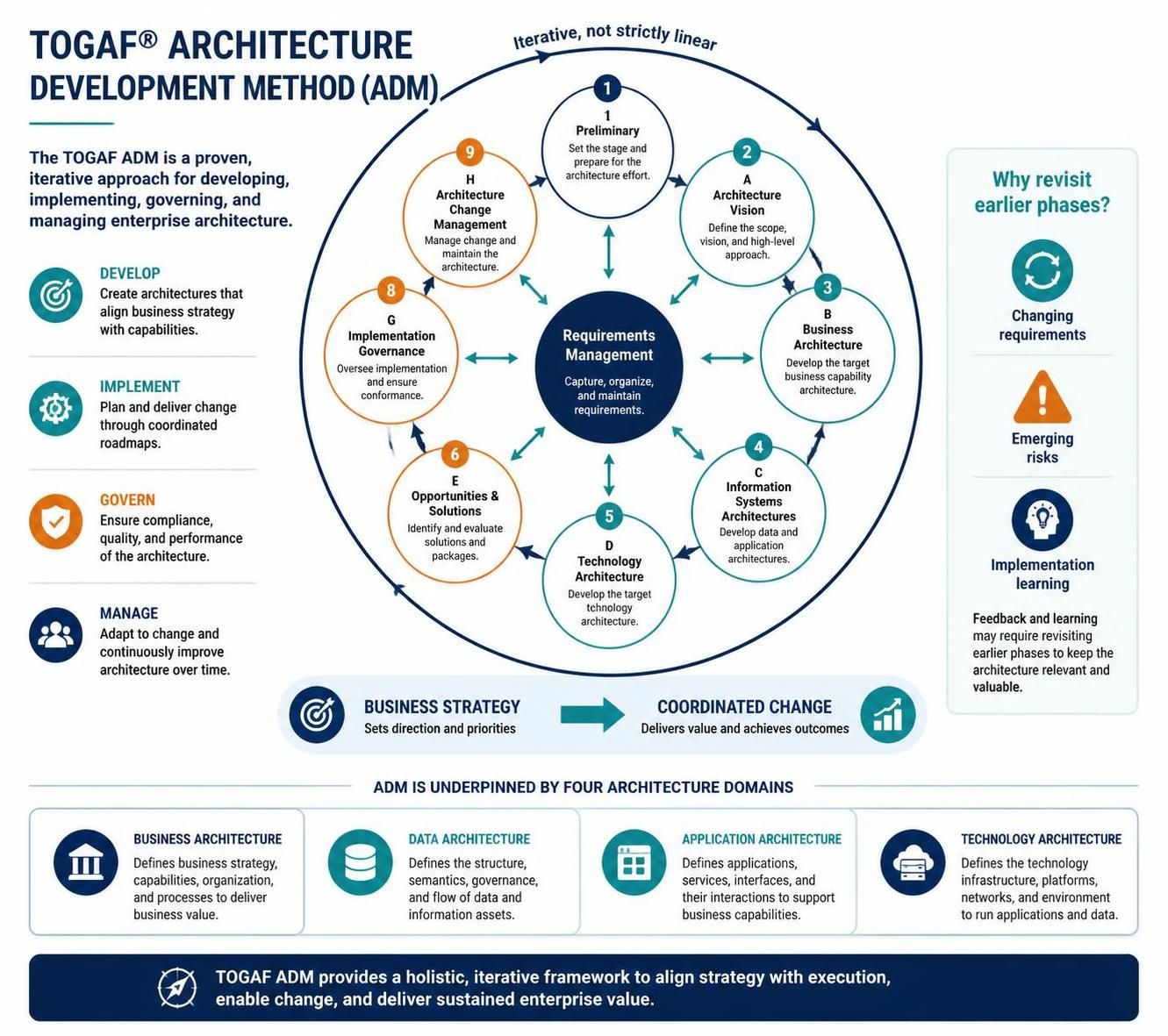
The TOGAF Architecture Development Method (ADM) is a structured process for developing, implementing, governing, and managing enterprise architecture. It helps organizations move from business strategy to coordinated change by defining the required business, data, application, and technology architectures.
The ADM is iterative rather than strictly linear. An organization may revisit earlier phases when requirements change, new risks emerge, or implementation experience reveals the need for architectural adjustments.
1. What the TOGAF ADM Is
The ADM provides a repeatable approach for:
-
Understanding business goals and strategic drivers
-
Defining the current and target architecture
-
Identifying gaps between the two
-
Designing a practical transition roadmap
-
Governing implementation
-
Managing architectural change over time
The ADM is commonly represented as a cycle:
-
Preliminary activities
-
Phase A: Architecture Vision
-
Phase B: Business Architecture
-
Phase C: Information Systems Architectures
-
Phase D: Technology Architecture
-
Phase E: Opportunities and Solutions
-
Phase F: Migration Planning
-
Phase G: Implementation Governance
-
Phase H: Architecture Change Management
-
Requirements Management, which operates continuously throughout the cycle
The architecture domains developed during the ADM are:
-
Business Architecture: Strategy, governance, organization, capabilities, and business processes
-
Data Architecture: Data assets, entities, flows, ownership, and management
-
Application Architecture: Applications, services, interfaces, and their relationships
-
Technology Architecture: Infrastructure, platforms, networks, security technologies, and technical services
2. Core Concepts Behind the ADM
Before examining each phase, several concepts are important.
Baseline architecture
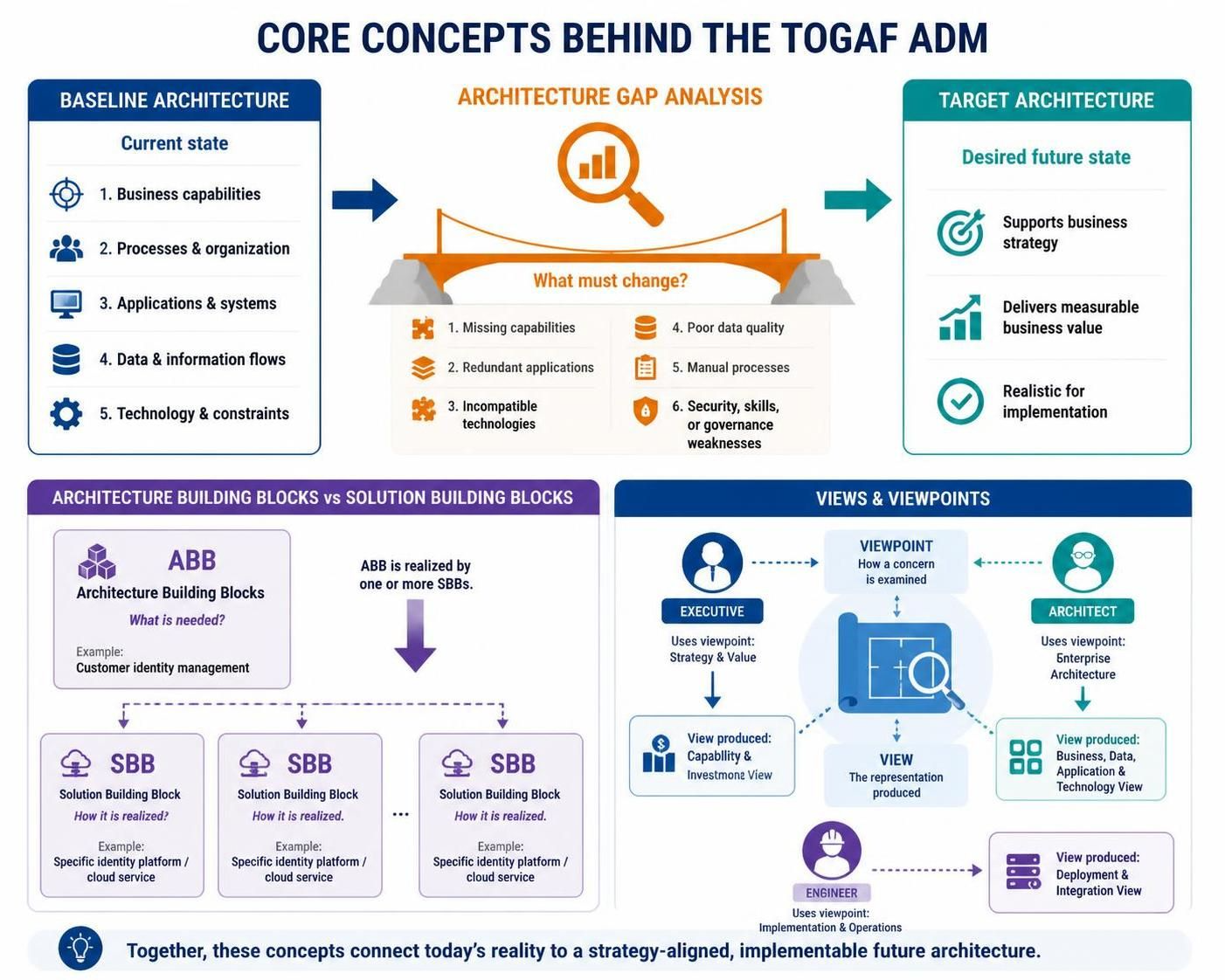
The baseline architecture describes the organization’s current state. It may include:
-
Existing business capabilities
-
Current processes and organizational structures
-
Existing applications and systems
-
Data stores and information flows
-
Technology platforms and infrastructure
-
Existing standards, policies, and constraints
Target architecture
The target architecture describes the desired future state. It should directly support business strategy and provide a realistic foundation for implementation.
Architecture gap
A gap is the difference between the baseline and target architectures. Gap analysis identifies what must change, such as:
-
Missing capabilities
-
Redundant applications
-
Incompatible technologies
-
Poor data quality
-
Manual processes
-
Security weaknesses
-
Skills or governance deficiencies
Architecture building blocks
TOGAF commonly distinguishes between:
-
Architecture Building Blocks (ABBs): What capabilities or architectural functions are needed
-
Solution Building Blocks (SBBs): Specific products, systems, components, or services used to realize those capabilities
For example, an ABB might be “customer identity management,” while an SBB might be a particular identity platform or cloud service.
Views and viewpoints
Different stakeholders require different architectural perspectives. An executive may need a capability and investment view, while an engineer may need a deployment or integration view.
-
A viewpoint defines how a concern should be examined.
-
A view is the actual representation produced using that viewpoint.
3. Preliminary Phase: Establish the Architecture Capability
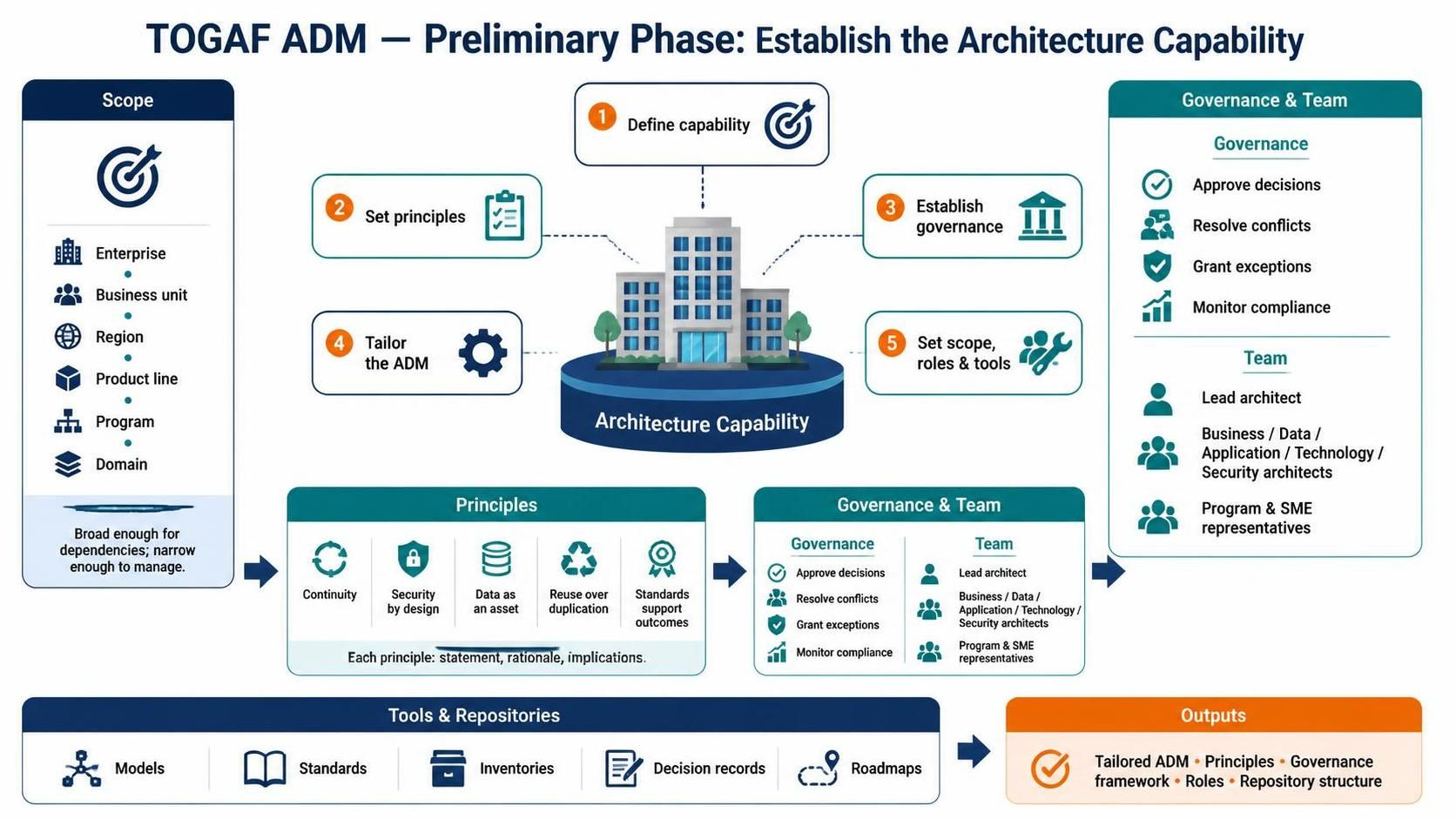
The Preliminary Phase prepares the organization to conduct architecture work effectively. It establishes the people, processes, principles, governance, and tools needed before a specific architecture initiative begins.
Objectives
The main objectives are to:
-
Define the organization’s architecture capability
-
Establish architecture principles
-
Identify governance structures
-
Select or tailor the ADM
-
Determine the scope of architecture work
-
Define roles and responsibilities
-
Set up architecture repositories and tools
Key activities
Define organizational scope
Determine where architecture will be applied:
-
The entire enterprise
-
A business unit
-
A region
-
A product line
-
A transformation program
-
A specific capability or domain
The scope should be broad enough to address dependencies but narrow enough to remain manageable.
Establish architecture principles
Architecture principles guide decisions throughout the ADM. Typical principles include:
-
Business continuity is essential
-
Security is designed into solutions
-
Data is treated as a strategic asset
-
Reuse is preferred over duplication
-
Standards are preferred over proprietary dependencies
-
Technology decisions must support business outcomes
-
Architecture decisions must be traceable to approved strategies
A useful principle includes:
-
Name
-
Statement
-
Rationale
-
Implications
Define governance
Establish who will:
-
Approve architecture decisions
-
Resolve conflicts
-
Grant exceptions
-
Monitor compliance
-
Manage standards
-
Accept residual risks
This may involve an architecture board, review forums, security governance, data governance, and portfolio governance.
Establish the architecture team
Typical roles include:
-
Chief or lead architect
-
Business architect
-
Data architect
-
Application architect
-
Technology architect
-
Security architect
-
Enterprise architecture manager
-
Program and project representatives
-
Business and technical subject-matter experts
Select tools and repositories
The organization may need:
-
Architecture modeling tools
-
Standards catalogs
-
Reference architectures
-
Application and technology inventories
-
Principles repositories
-
Architecture decision records
-
Roadmap and dependency management tools
Typical outputs
-
Tailored ADM
-
Architecture principles
-
Architecture governance framework
-
Architecture organization and roles
-
Architecture capability assessment
-
Architecture repository structure
-
Initial reference models and standards
4. Phase A: Architecture Vision
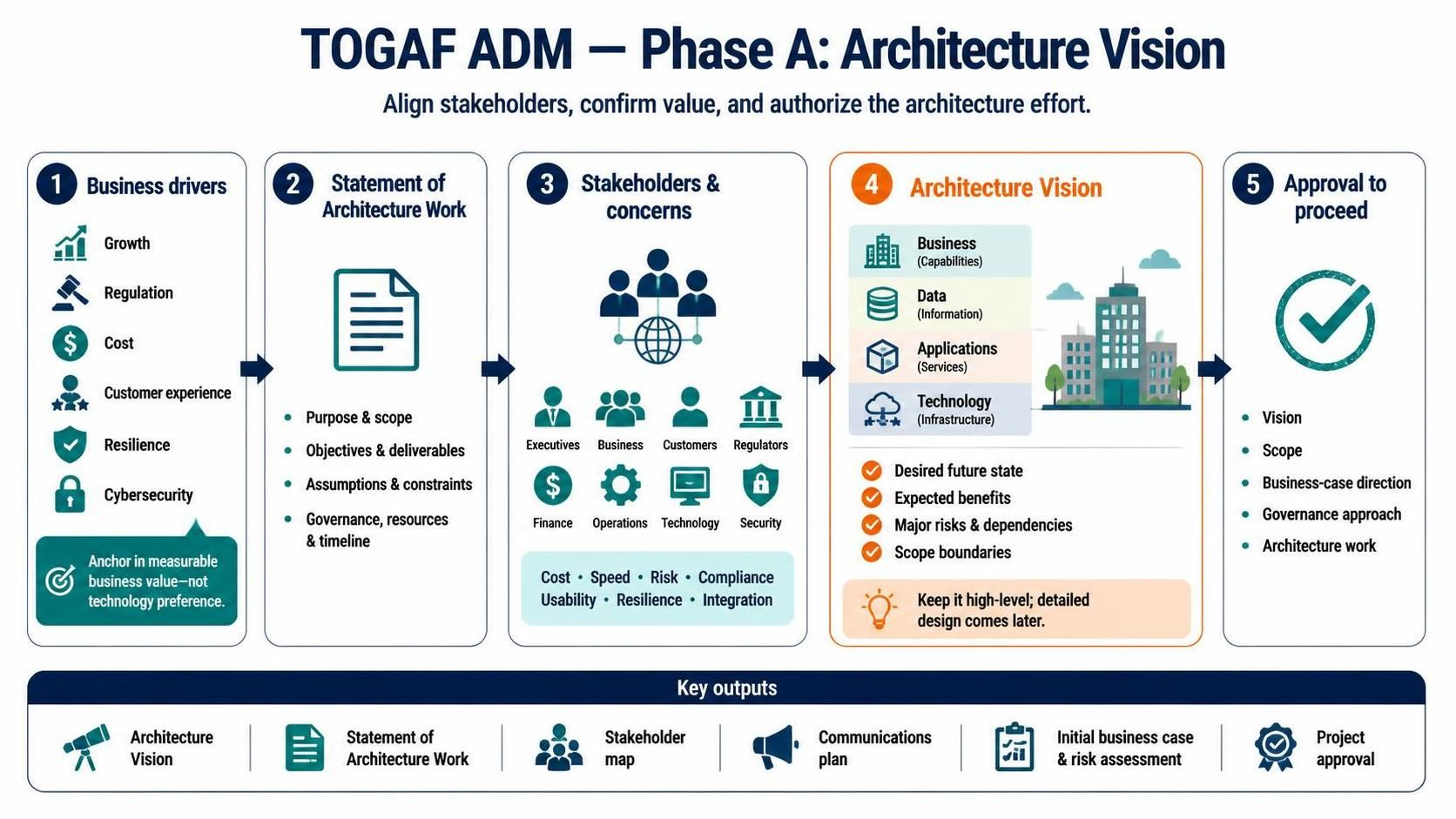
Phase A defines the overall direction of the architecture effort. It establishes a shared vision, confirms the business value, and secures formal approval to proceed.
Objectives
Phase A aims to:
-
Clarify the business problem or opportunity
-
Define the desired outcomes
-
Identify stakeholders and their concerns
-
Establish the scope of the initiative
-
Create a high-level target architecture
-
Obtain sponsorship and authorization
Step 1: Identify the business drivers
Drivers may include:
-
Market expansion
-
Regulatory obligations
-
Cost reduction
-
Digital transformation
-
Customer experience improvement
-
Operational resilience
-
Mergers and acquisitions
-
Cybersecurity requirements
-
New products or services
-
Legacy system replacement
The architecture initiative should be anchored in measurable business drivers rather than technology preferences.
Step 2: Define the statement of architecture work
The statement of architecture work establishes:
-
Purpose
-
Scope
-
Objectives
-
Deliverables
-
Approach
-
Assumptions
-
Constraints
-
Governance arrangements
-
Resource requirements
-
Estimated timeline
Step 3: Identify stakeholders
Stakeholders may include:
-
Executives
-
Business-unit leaders
-
Process owners
-
Product managers
-
Customers
-
Regulators
-
Risk and compliance teams
-
Finance
-
Operations
-
Developers
-
Infrastructure teams
-
Security teams
-
External partners
Stakeholder concerns should be recorded explicitly. Common concerns include cost, speed, risk, compliance, flexibility, usability, resilience, and integration.
Step 4: Develop the Architecture Vision
The Architecture Vision is a concise description of the desired future state. It may include:
-
Strategic objectives
-
Business capability changes
-
High-level architecture diagrams
-
Expected benefits
-
Major risks
-
Key dependencies
-
Scope boundaries
-
Initial transition states
At this point, the architecture should remain high-level. Detailed design belongs in later phases.
Step 5: Secure approval
The sponsor and relevant governance bodies should approve:
-
The architecture vision
-
The scope
-
The business case direction
-
The architecture work
-
The decision-making and governance approach
Typical outputs
-
Architecture Vision
-
Statement of Architecture Work
-
Stakeholder map
-
Communications plan
-
High-level baseline and target descriptions
-
Initial business case
-
Initial risk assessment
-
Architecture project approval
5. Phase B: Business Architecture
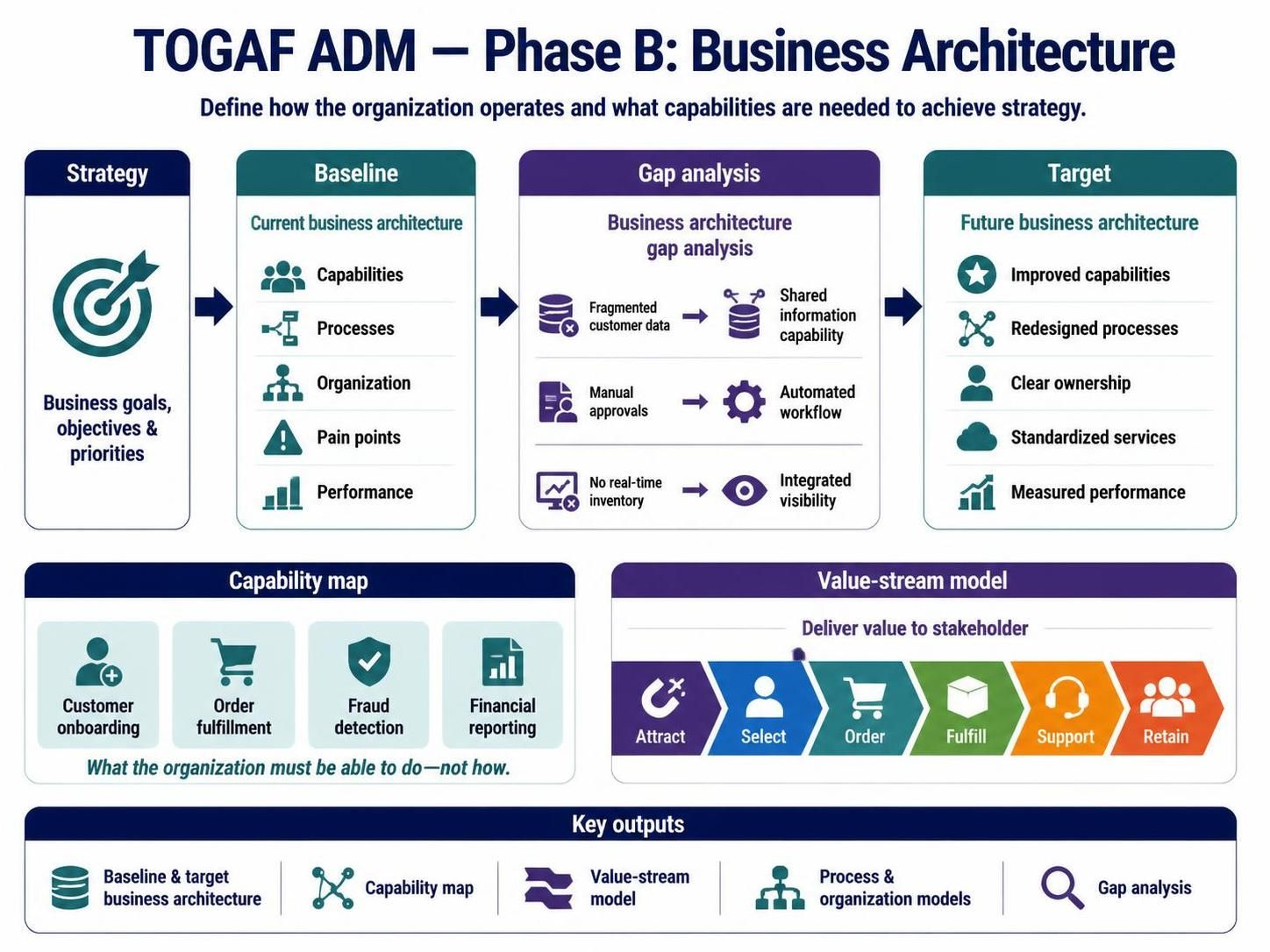
Phase B defines how the organization operates and what business capabilities are required to achieve its strategy.
Objectives
The phase seeks to:
-
Describe the baseline business architecture
-
Define the target business architecture
-
Identify required capability changes
-
Align architecture with business strategy
-
Identify business architecture gaps
Areas examined
Business Architecture commonly covers:
-
Business strategy
-
Organizational structure
-
Business capabilities
-
Value streams
-
Business functions
-
Processes
-
Products and services
-
Roles and responsibilities
-
Business rules
-
Governance
-
Performance measures
-
Locations and operating models
Business capabilities
A capability describes what the organization must be able to do, not how it does it. Examples include:
-
Customer onboarding
-
Product development
-
Order fulfillment
-
Fraud detection
-
Financial reporting
-
Workforce management
-
Supplier management
Capability maps are useful because they provide a relatively stable view of the business, even when processes and systems change.
Value streams
A value stream describes how value is delivered to a stakeholder. For example, a retail value stream might include:
-
Attract customer
-
Select product
-
Place order
-
Fulfill order
-
Provide support
-
Retain customer
Value streams help connect strategy to capabilities, processes, applications, and technology.
Baseline business architecture
The baseline assessment should document:
-
Current capabilities
-
Current processes
-
Organizational responsibilities
-
Existing pain points
-
Performance weaknesses
-
Manual work
-
Duplicated activities
-
Regulatory or policy constraints
Target business architecture
The target state should explain:
-
Which capabilities must be created or improved
-
Which processes should be redesigned
-
Which organizational responsibilities must change
-
Which services should be standardized
-
How performance will be measured
Gap analysis
A business architecture gap analysis may identify:
| Gap | Business impact | Possible response |
|---|---|---|
| Customer data is fragmented | Slow service and inconsistent reporting | Establish shared customer information capabilities |
| Manual approval processes | Long cycle times | Automate workflow and decision rules |
| No real-time inventory capability | Stock-outs and poor customer experience | Introduce integrated inventory visibility |
| Ambiguous ownership of data | Conflicting reports | Assign data ownership and stewardship |
Typical outputs
-
Baseline Business Architecture
-
Target Business Architecture
-
Capability map
-
Value-stream models
-
Business-process models
-
Organization and role models
-
Business architecture gap analysis
-
Updated stakeholder and requirements information
6. Phase C: Information Systems Architectures
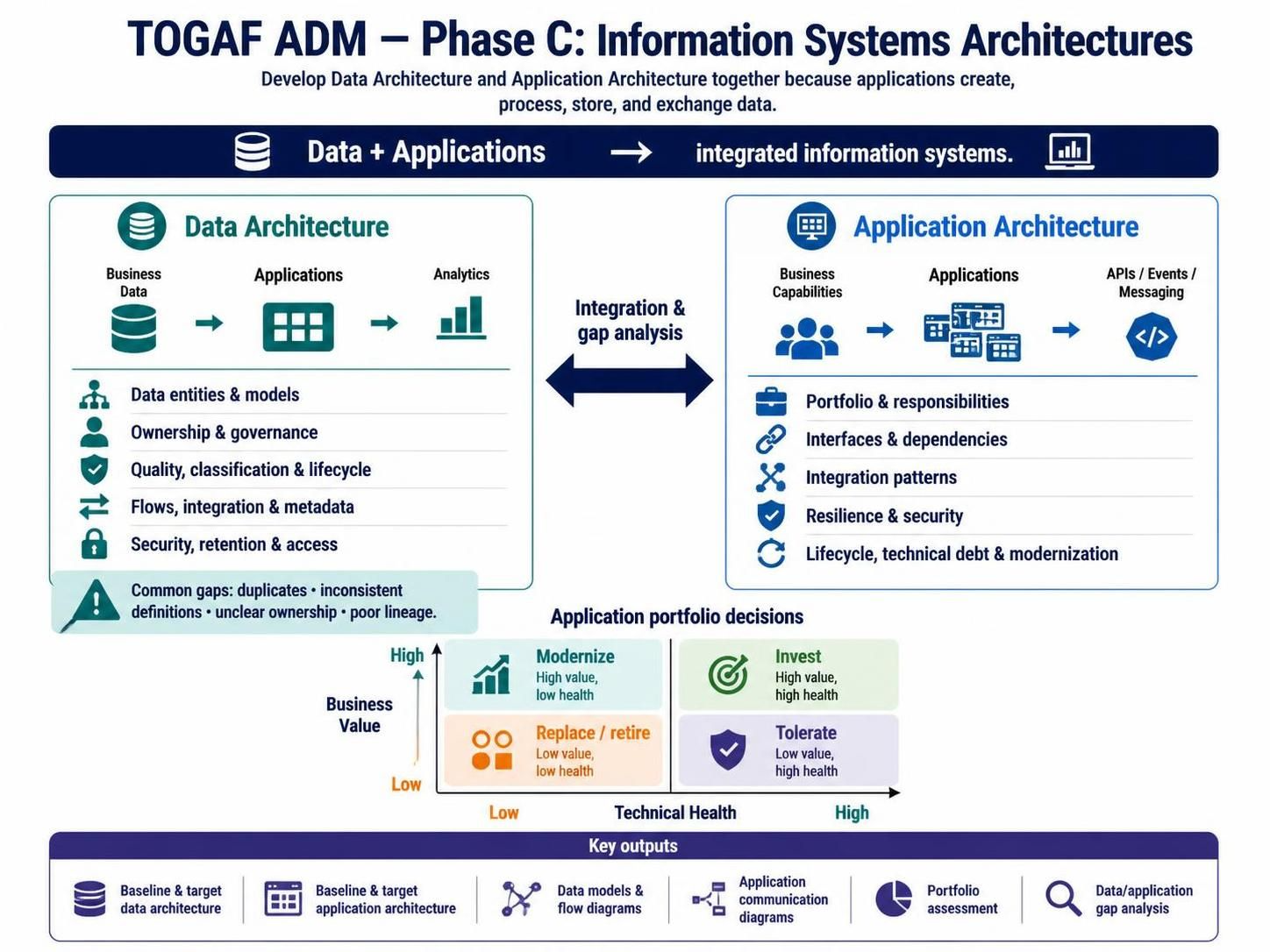
Phase C develops the Data Architecture and Application Architecture. These are often addressed together because applications create, process, store, and exchange data.
6.1 Data Architecture
Data Architecture defines the organization’s information assets and the structures required to manage them.
Objectives
-
Understand current data assets
-
Define target data structures and relationships
-
Improve data quality and accessibility
-
Establish ownership and governance
-
Support integration and analytics
-
Identify data architecture gaps
Areas examined
-
Business data entities
-
Master and reference data
-
Data ownership
-
Data lifecycle
-
Data classification
-
Data quality
-
Data models
-
Data flows
-
Data integration
-
Reporting and analytics
-
Metadata
-
Retention and archival
-
Data security and access
Important data questions
-
What information does the business need?
-
Where is the authoritative source for each data domain?
-
Who owns and maintains the data?
-
Which applications create, modify, or consume it?
-
Is data duplicated across systems?
-
Can data be shared through standard interfaces?
-
What quality, classification, and retention rules apply?
Common data problems
-
Multiple customer records
-
Inconsistent product definitions
-
Unclear data ownership
-
Batch-based data that should be near real time
-
Uncontrolled spreadsheets
-
Incompatible formats
-
Missing metadata
-
Poor lineage and traceability
6.2 Application Architecture
Application Architecture defines the applications and application services required to support the business and manage information.
Objectives
-
Document the application baseline
-
Define the target application landscape
-
Clarify application responsibilities
-
Reduce duplication
-
Improve integration
-
Align applications with business capabilities and data domains
Areas examined
-
Application portfolio
-
Application services
-
System responsibilities
-
Interfaces and dependencies
-
Integration patterns
-
Application ownership
-
Application lifecycle
-
Resilience and availability
-
Security controls
-
Technical debt
-
Replacement or retirement candidates
Application portfolio analysis
Applications can be assessed according to:
-
Business value
-
Technical health
-
Cost
-
Risk
-
Strategic fit
-
User satisfaction
-
Regulatory importance
-
Integration complexity
A common portfolio classification is:
-
Invest: Strategically valuable and technically viable
-
Modernize: Valuable but technically weak
-
Tolerate: Necessary but not a priority for improvement
-
Replace or retire: Low value, high cost, or high risk
Integration architecture
The target application architecture should define how systems communicate, including:
-
APIs
-
Events
-
Messaging
-
File exchange
-
Data replication
-
Integration platforms
-
Service orchestration
-
Identity and access mechanisms
Gap analysis
Data and application gaps may include:
-
A required business capability has no supporting application
-
Several applications perform the same function
-
Critical data is trapped in a legacy system
-
Applications lack usable APIs
-
An application cannot meet availability requirements
-
Reporting depends on manually consolidated data
Typical outputs
-
Baseline Data Architecture
-
Target Data Architecture
-
Baseline Application Architecture
-
Target Application Architecture
-
Data models and information-flow diagrams
-
Application communication diagrams
-
Application portfolio assessment
-
Data and application gap analysis
-
Updated requirements and risks
7. Phase D: Technology Architecture
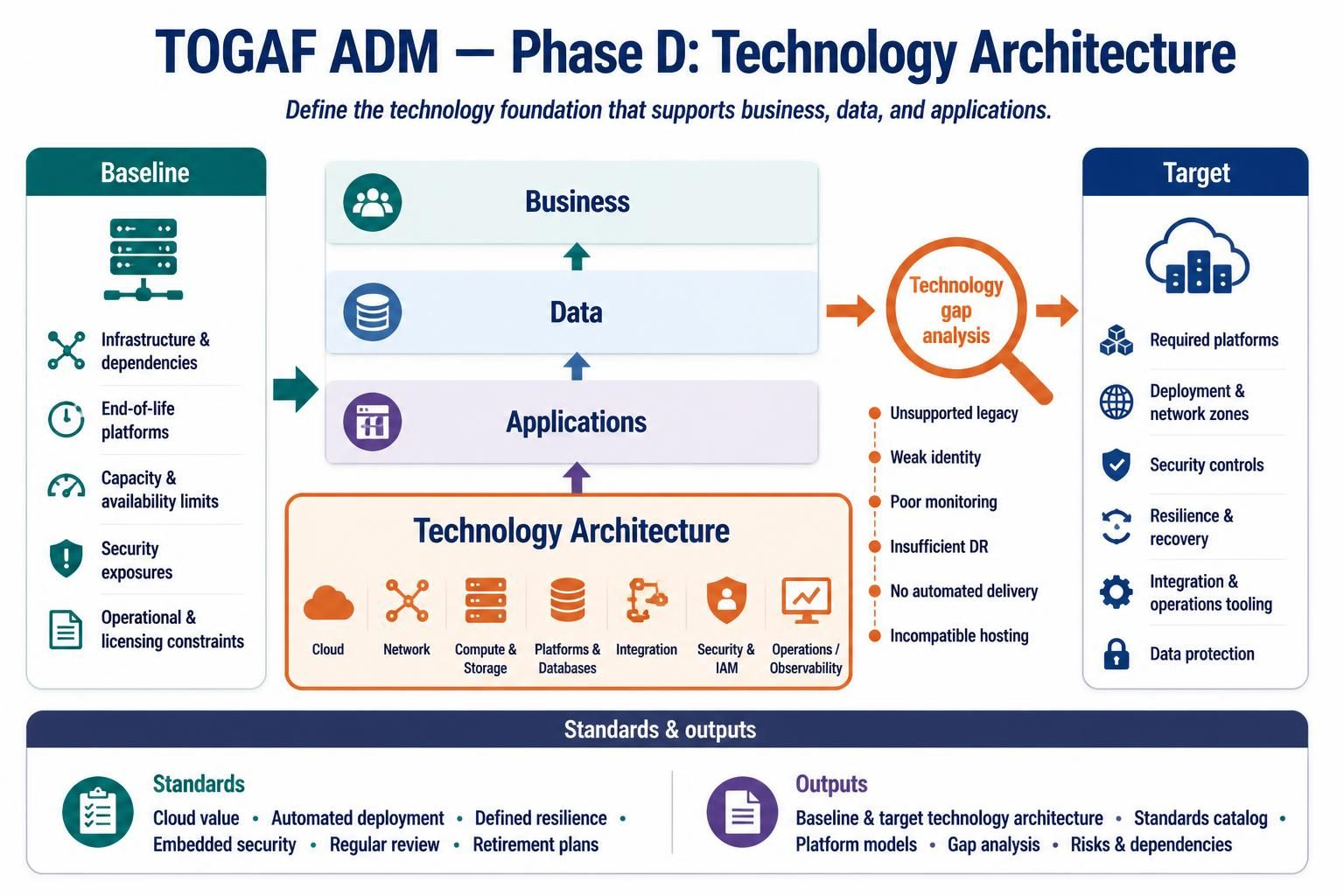
Phase D defines the technology infrastructure needed to support the business, data, and application architectures.
Objectives
-
Document the current technology environment
-
Define the target technology platform
-
Establish technical standards
-
Support scalability, resilience, and security
-
Identify technology gaps and dependencies
Areas examined
-
Infrastructure
-
Networks
-
Cloud platforms
-
Compute and storage
-
Operating systems
-
Databases
-
Middleware
-
Integration platforms
-
End-user computing
-
DevOps toolchains
-
Monitoring and observability
-
Identity and access management
-
Cybersecurity technologies
-
Backup and disaster recovery
-
Technical standards
Technology principles
Examples include:
-
Cloud services are used where they provide measurable value
-
Platforms must support automated deployment
-
Critical services require defined resilience levels
-
Security controls are embedded throughout the technology stack
-
Technology standards are reviewed regularly
-
Unsupported platforms must have a retirement or remediation plan
Baseline technology architecture
The baseline should identify:
-
Existing infrastructure
-
Technology dependencies
-
End-of-life components
-
Capacity limitations
-
Availability weaknesses
-
Security exposures
-
Operational constraints
-
Licensing and support issues
Target technology architecture
The target should specify:
-
Required platforms
-
Deployment models
-
Network zones
-
Security architecture
-
Integration infrastructure
-
Resilience patterns
-
Operational tooling
-
Data protection mechanisms
-
Platform standards
The target architecture should be technology-specific enough to guide implementation while avoiding unnecessary product-level detail unless a product decision is required.
Gap analysis
Typical technology gaps include:
-
Infrastructure cannot support expected growth
-
Legacy platforms are no longer supported
-
Inadequate disaster recovery
-
Weak identity controls
-
Inconsistent monitoring
-
Insufficient network segmentation
-
Lack of automated testing and deployment
-
Incompatible hosting environments
Typical outputs
-
Baseline Technology Architecture
-
Target Technology Architecture
-
Technology standards catalog
-
Platform and infrastructure models
-
Technology gap analysis
-
Updated risk and dependency information
8. Phase E: Opportunities and Solutions
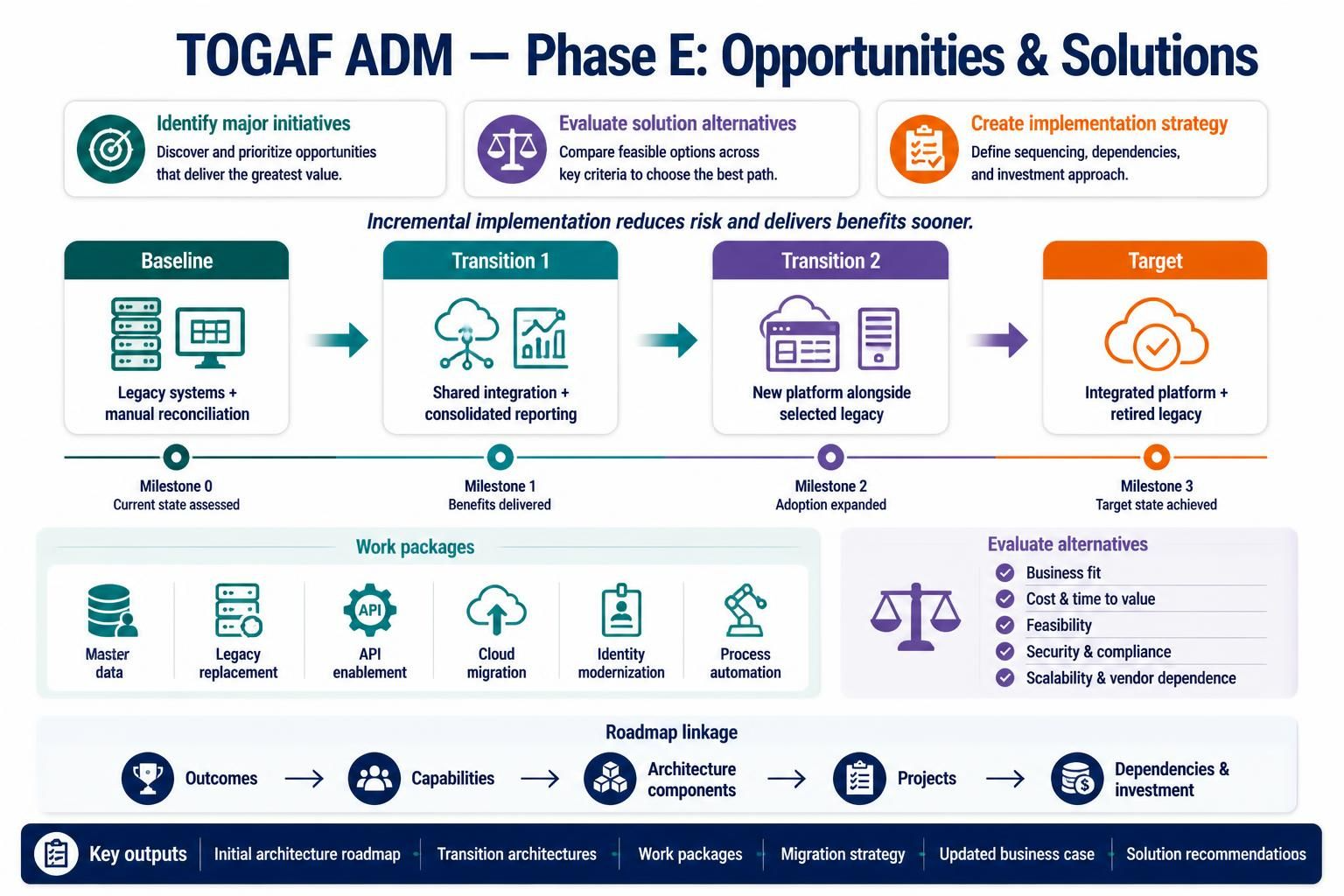
Phase E turns the target architectures into candidate implementation approaches. It identifies major initiatives, solution building blocks, transition architectures, and delivery opportunities.
Objectives
-
Identify major implementation projects
-
Group related changes into work packages
-
Evaluate solution alternatives
-
Define transition architectures
-
Create an initial implementation strategy
-
Confirm feasibility and constraints
Identify work packages
A work package is a coherent set of changes that can be planned and delivered. Examples include:
-
Customer master-data implementation
-
Legacy application replacement
-
API enablement
-
Cloud migration
-
Data-quality improvement
-
Identity modernization
-
Process automation
-
Analytics platform implementation
Define transition architectures
Many organizations cannot move directly from the baseline to the target state. Transition architectures provide intermediate states.
For example:
-
Baseline: Separate legacy systems and manually reconciled data
-
Transition 1: Shared integration layer and consolidated reporting
-
Transition 2: New customer platform operating alongside selected legacy systems
-
Target: Integrated customer platform with retired legacy components
Transition architectures reduce risk and allow benefits to be delivered incrementally.
Evaluate solution alternatives
Alternatives may be assessed based on:
-
Business fit
-
Strategic alignment
-
Cost
-
Time to value
-
Technical feasibility
-
Security
-
Regulatory compliance
-
Vendor dependence
-
Scalability
-
Operational complexity
-
Reversibility
Build the architecture roadmap
The roadmap links:
-
Business outcomes
-
Capabilities
-
Architecture components
-
Projects
-
Dependencies
-
Investment decisions
-
Transition states
-
Target dates
Confirm the implementation approach
Possible approaches include:
-
Incremental delivery
-
Big-bang replacement
-
Parallel operation
-
Pilot and scale
-
Capability-based delivery
-
Product or platform rollout
-
Region-by-region migration
Typical outputs
-
Initial Architecture Roadmap
-
Transition architectures
-
Opportunities and solutions analysis
-
Candidate work packages
-
High-level implementation and migration strategy
-
Updated business case
-
Project and solution architecture recommendations
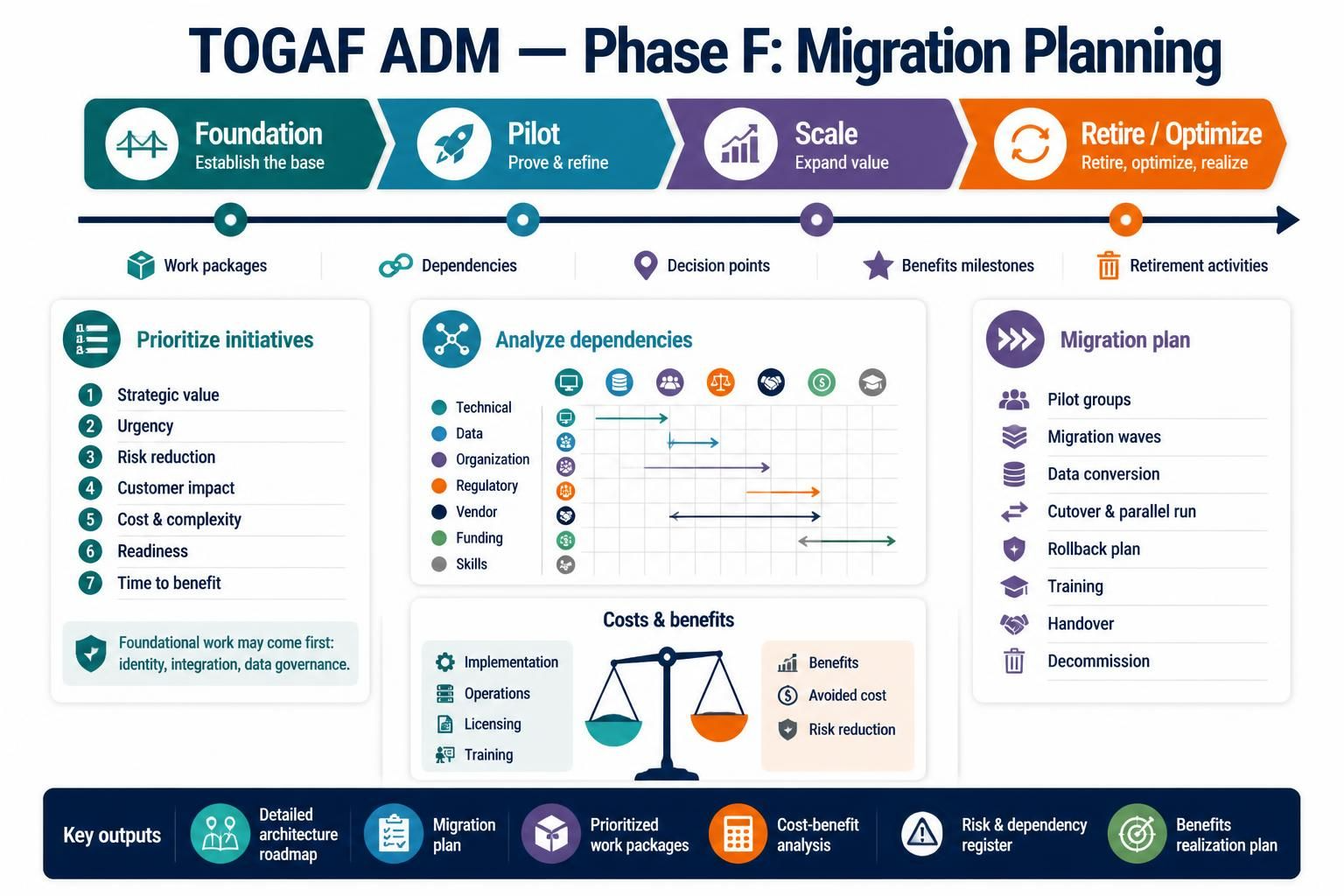
9. Phase F: Migration Planning
Phase F creates a detailed, prioritized implementation and migration plan.
Objectives
-
Prioritize projects
-
Sequence work packages
-
Confirm costs and benefits
-
Manage dependencies
-
Establish a realistic migration schedule
-
Finalize the implementation roadmap
Prioritize initiatives
A practical prioritization model may consider:
-
Strategic value
-
Regulatory urgency
-
Risk reduction
-
Customer impact
-
Cost
-
Complexity
-
Organizational readiness
-
Dependency constraints
-
Time to benefit
An initiative with high business value but substantial dependencies may need to follow foundational work, such as identity, integration, or data governance.
Estimate costs and benefits
The plan should consider:
-
One-time implementation costs
-
Operating costs
-
Licensing
-
Migration and data conversion
-
Training
-
Change management
-
Support and maintenance
-
Benefits realization
-
Avoided costs
-
Risk reduction
Analyze dependencies
Dependencies may be:
-
Technical
-
Data-related
-
Organizational
-
Regulatory
-
Vendor-related
-
Funding-related
-
Skill-related
A dependency matrix can help identify which initiatives must occur first.
Create the implementation roadmap
The roadmap should show:
-
Work packages
-
Start and completion periods
-
Transition architectures
-
Dependencies
-
Decision points
-
Major milestones
-
Retirement activities
-
Benefits milestones
Develop the migration plan
The migration plan may define:
-
Pilot groups
-
Migration waves
-
Cutover strategy
-
Data migration approach
-
Parallel-run periods
-
Rollback plans
-
User training
-
Operational handover
-
Decommissioning activities
Typical outputs
-
Detailed Architecture Roadmap
-
Migration plan
-
Prioritized work packages
-
Implementation project recommendations
-
Cost-benefit analysis
-
Risk and dependency register
-
Benefits realization plan
-
Architecture contract inputs
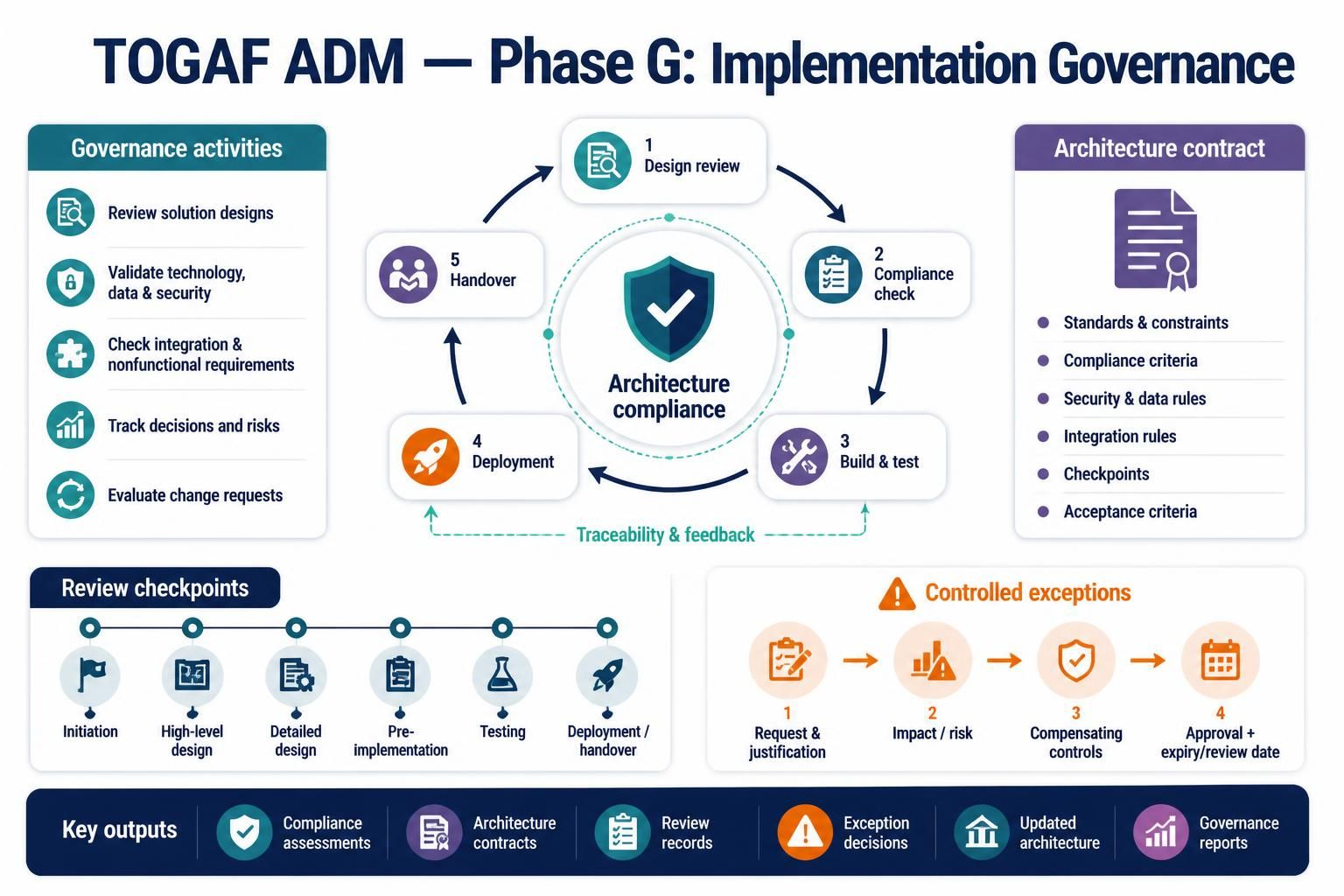
10. Phase G: Implementation Governance
Phase G ensures that implementation projects conform to the approved architecture and that deviations are controlled.
Architecture is not complete when the design documents are approved. It must be governed during delivery to prevent uncontrolled divergence.
Objectives
-
Establish architecture compliance
-
Support project teams
-
Review designs and decisions
-
Manage deviations
-
Confirm that delivered solutions meet architectural requirements
-
Maintain traceability from requirements to implementation
Architecture governance activities
Architects may:
-
Review solution designs
-
Validate technology choices
-
Assess integration patterns
-
Confirm security and data controls
-
Review nonfunctional requirements
-
Participate in design authority meetings
-
Track architecture decisions
-
Evaluate change requests
-
Approve or reject exceptions
-
Monitor implementation risks
Architecture contracts
An architecture contract defines the obligations of implementation teams and governance bodies. It may include:
-
Required standards
-
Design constraints
-
Compliance criteria
-
Security requirements
-
Data requirements
-
Integration rules
-
Review checkpoints
-
Exception procedures
-
Acceptance criteria
Compliance reviews
Reviews may occur at several points:
-
Concept or initiation
-
High-level design
-
Detailed design
-
Pre-implementation
-
Testing
-
Deployment
-
Operational handover
Managing exceptions
Not every deviation is unacceptable. A controlled exception process should document:
-
The requested deviation
-
Business justification
-
Impact
-
Risks
-
Compensating controls
-
Approval authority
-
Expiration or review date
Typical outputs
-
Architecture compliance assessments
-
Architecture contracts
-
Review records
-
Exception decisions
-
Updated architecture documentation
-
Implementation feedback
-
Governance reports
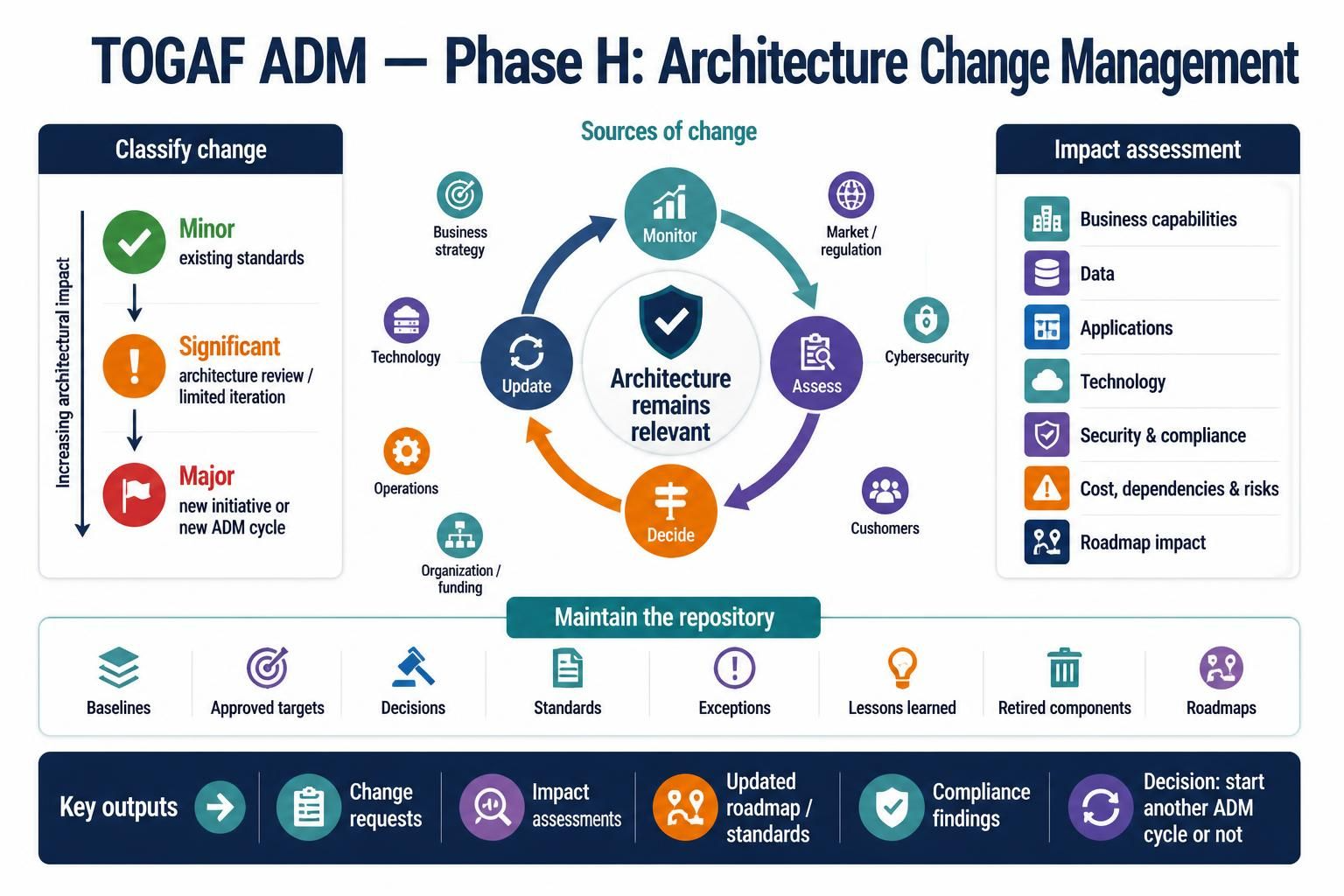
11. Phase H: Architecture Change Management
Phase H manages changes after implementation and ensures that the architecture remains relevant.
Objectives
-
Monitor changes in the business and technology environment
-
Identify new architecture requirements
-
Assess the impact of proposed changes
-
Determine whether a new ADM cycle is needed
-
Maintain architecture integrity
Sources of change
Change may result from:
-
New business strategy
-
Market disruption
-
Regulatory changes
-
Mergers or acquisitions
-
New technology
-
Cybersecurity threats
-
Operational incidents
-
Changing customer expectations
-
Poor performance
-
New data requirements
-
Changes in funding or organizational structure
Classify change requests
Changes can be classified by their architectural impact:
-
Minor change: Can be handled within existing standards and architecture
-
Significant change: Requires architectural review or limited iteration
-
Major change: Requires a new architecture initiative or a new ADM cycle
Architecture impact assessment
Assess:
-
Business capabilities affected
-
Data affected
-
Applications affected
-
Technology affected
-
Security and compliance implications
-
Cost and resource requirements
-
Dependencies
-
Risks
-
Impact on the roadmap
Maintain the architecture
The architecture repository should be updated with:
-
New baseline information
-
Approved target changes
-
Architecture decisions
-
Standards
-
Exceptions
-
Implementation lessons
-
Retired components
-
Updated roadmaps
Typical outputs
-
Architecture change requests
-
Impact assessments
-
Updated architecture roadmap
-
Updated principles and standards
-
Architecture compliance findings
-
Decision to initiate or not initiate another ADM cycle
12. Requirements Management: The Continuous Thread
Requirements Management operates across every ADM phase. It ensures that requirements are captured, analyzed, prioritized, traced, and updated as the architecture evolves.
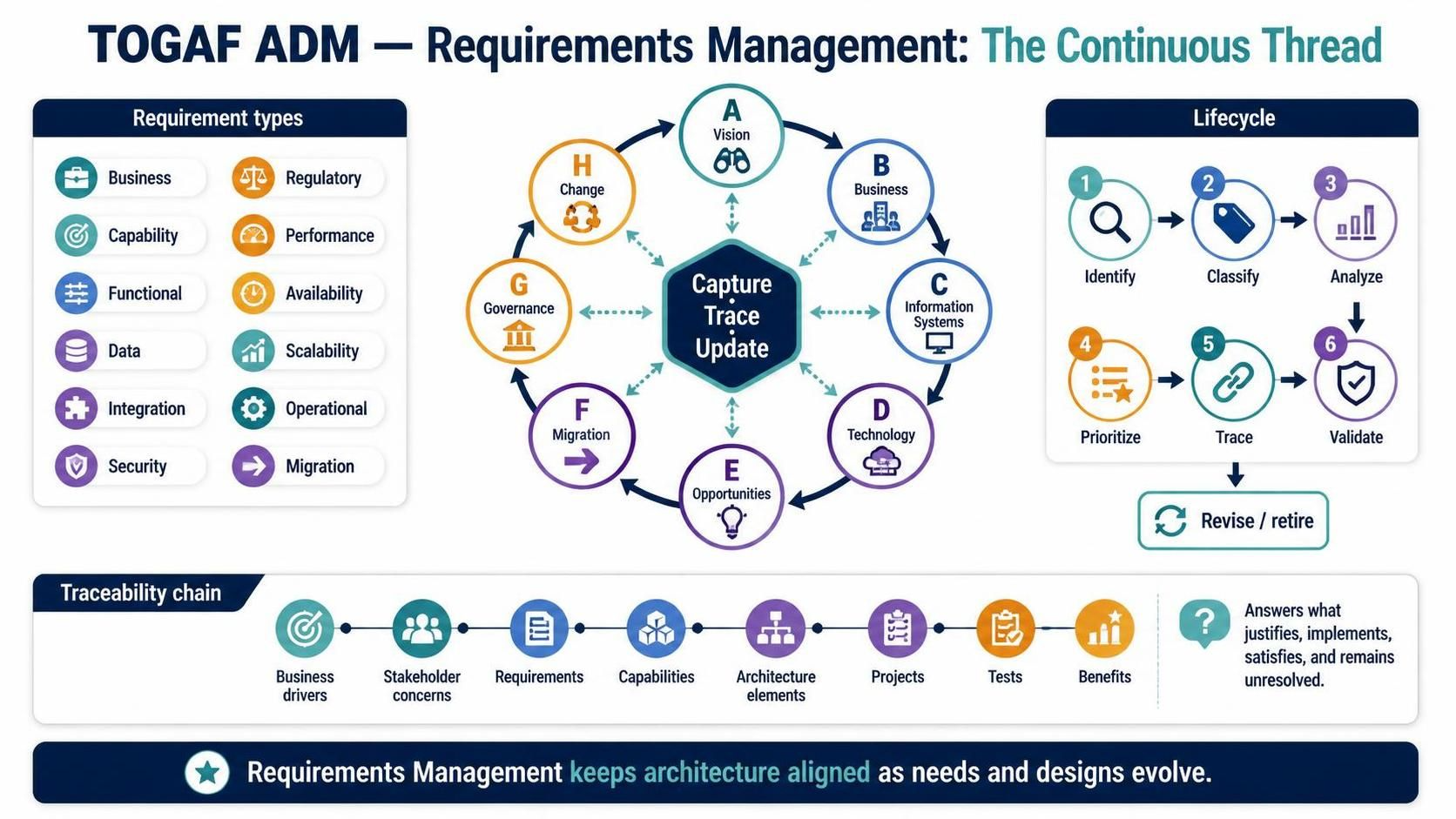
Types of requirements
Requirements may include:
-
Business requirements
-
Capability requirements
-
Functional requirements
-
Data requirements
-
Integration requirements
-
Security requirements
-
Regulatory requirements
-
Performance requirements
-
Availability requirements
-
Scalability requirements
-
Usability requirements
-
Operational requirements
-
Migration requirements
Requirements lifecycle
A typical lifecycle includes:
-
Identify requirements
-
Record and classify them
-
Analyze conflicts and dependencies
-
Prioritize requirements
-
Map requirements to architecture elements
-
Assess their impact on each ADM phase
-
Approve or reject changes
-
Track implementation
-
Validate fulfillment
-
Retire or revise requirements
Requirements traceability
Traceability connects:
-
Business drivers
-
Stakeholder concerns
-
Requirements
-
Capabilities
-
Architecture elements
-
Projects
-
Test cases
-
Benefits
This makes it possible to answer questions such as:
-
Which business objective justifies this system?
-
Which requirements are addressed by this capability?
-
Which projects implement this architecture component?
-
Which requirements remain unresolved?
-
What is the impact of changing a requirement?
13. How the ADM Phases Work Together
The ADM can be understood as a chain of decisions:
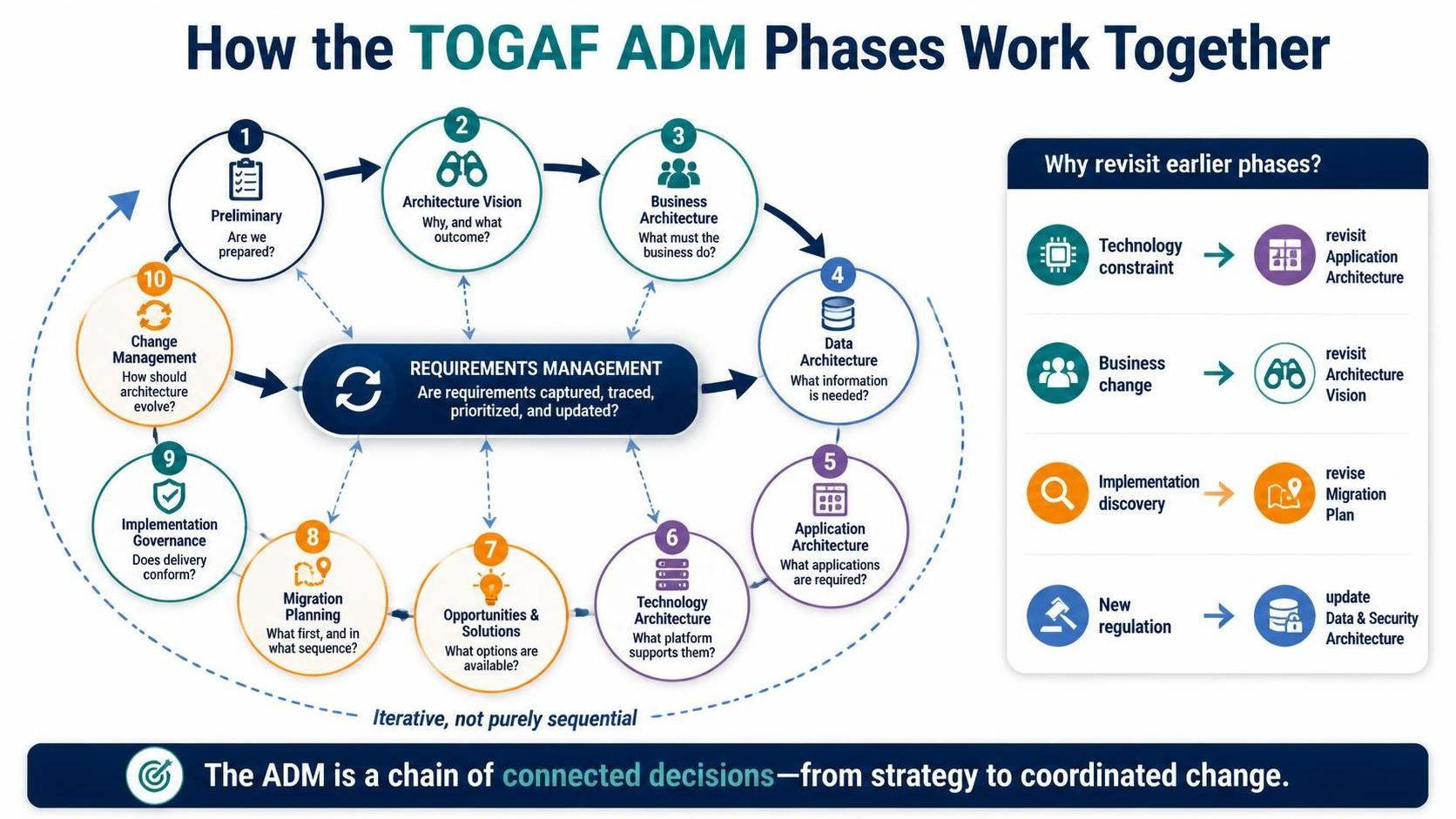
| ADM area | Primary question |
|---|---|
| Preliminary | Are we prepared to perform architecture work? |
| Architecture Vision | Why are we doing this, and what outcome do we seek? |
| Business Architecture | What must the business be able to do? |
| Data Architecture | What information is needed and how should it be managed? |
| Application Architecture | What applications and services are required? |
| Technology Architecture | What technology platform will support them? |
| Opportunities and Solutions | What implementation options are available? |
| Migration Planning | What should be delivered first, and in what sequence? |
| Implementation Governance | Is delivery conforming to the architecture? |
| Change Management | How should the architecture evolve? |
| Requirements Management | Are requirements being managed throughout the process? |
The phases are related, but the process is not purely sequential. For example:
-
A technology constraint may cause the team to revisit the application architecture.
-
A business change may require a new Architecture Vision.
-
Implementation discoveries may alter the migration plan.
-
A new regulatory requirement may update data and security architectures.
14. Example: Modernizing Customer Onboarding
Consider a financial services company whose customer onboarding process is slow, manual, and dependent on several legacy applications.
Architecture drivers
-
Reduce onboarding time
-
Improve customer experience
-
Meet regulatory requirements
-
Reduce manual processing
-
Improve fraud detection
Phase A: Architecture Vision
The organization defines a vision for digital onboarding through a unified customer experience, automated verification, centralized customer data, and real-time risk assessment.
Phase B: Business Architecture
The target business architecture introduces:
-
A standardized onboarding process
-
Clear ownership of customer verification
-
Automated decision points
-
A new customer-service capability
-
Defined operational performance measures
Phase C: Data and Application Architectures
The target includes:
-
A trusted customer information service
-
Shared identity and verification data
-
APIs for legacy-system integration
-
A workflow application
-
A fraud analytics service
-
Improved data lineage
Phase D: Technology Architecture
The technology target includes:
-
Secure cloud hosting
-
API management
-
Event-based integration
-
Centralized identity management
-
Monitoring and audit logging
-
High-availability services
Phase E: Opportunities and Solutions
Work packages are identified:
-
Establish data governance
-
Implement API management
-
Introduce digital onboarding workflow
-
Integrate identity verification
-
Implement fraud analytics
-
Retire redundant onboarding tools
Phase F: Migration Planning
A staged roadmap is created:
-
Pilot with one product
-
Expand to additional products
-
Migrate selected customer segments
-
Decommission redundant tools
-
Introduce advanced analytics
Phase G: Implementation Governance
Architects review:
-
API designs
-
Security controls
-
Data models
-
Service-level requirements
-
Integration with legacy systems
-
Compliance evidence
Phase H: Change Management
After implementation, the organization assesses new regulatory requirements and determines whether they can be handled through a minor change or require another ADM cycle.
15. Key Deliverables Across the ADM
The exact deliverables should be tailored to the organization, but a typical set includes:
-
Architecture principles
-
Architecture governance framework
-
Architecture Vision
-
Statement of Architecture Work
-
Stakeholder map
-
Baseline architectures
-
Target architectures
-
Capability maps
-
Value-stream models
-
Data and application inventories
-
Technology standards catalog
-
Gap analyses
-
Architecture roadmap
-
Transition architectures
-
Migration plan
-
Architecture contract
-
Compliance assessments
-
Requirements repository
-
Architecture change requests
-
Architecture decision records
The goal is not to produce documents for their own sake. Each deliverable should support a decision, reduce uncertainty, guide implementation, or provide governance evidence.
16. Common Challenges When Applying the ADM
Treating the ADM as a rigid waterfall
The ADM is iterative. Teams should revisit phases as assumptions, requirements, and external conditions change.
Starting with technology
Architecture should begin with business drivers and outcomes. Starting with a preferred technology can produce solutions that are technically impressive but strategically irrelevant.
Making the scope too broad
An enterprise-wide initiative may become too abstract to deliver. Define a manageable scope while accounting for important cross-domain dependencies.
Making the scope too narrow
A project may ignore shared data, security, integration, or business-process dependencies. This often creates local optimization and future rework.
Producing excessive documentation
Documentation should be proportionate to risk, complexity, and governance needs. A small initiative does not require the same level of detail as a major transformation.
Ignoring stakeholders
Architectures fail when they satisfy technical concerns but do not address executive, operational, customer, regulatory, or user needs.
Failing to plan transition states
The target architecture may be desirable but unrealistic as an immediate destination. Transition architectures make change achievable.
Weak implementation governance
Without governance, projects may introduce duplicate systems, incompatible interfaces, inconsistent security controls, and deviations from strategic direction.
Neglecting organizational change
New processes and technologies often require:
-
New roles
-
Training
-
Updated incentives
-
Revised policies
-
New support models
-
Communications
-
Adoption measurement
17. Practical Guidance for Using the ADM Effectively
Start with measurable outcomes
Define success in terms such as:
-
Reduced processing time
-
Lower operating cost
-
Improved availability
-
Fewer security incidents
-
Higher data quality
-
Faster product delivery
-
Increased customer satisfaction
Tailor the method
Adjust the ADM according to:
-
Organization size
-
Architecture maturity
-
Delivery method
-
Regulatory environment
-
Risk level
-
Project complexity
-
Existing governance
Use iterative delivery
Architecture should provide enough direction to guide delivery without attempting to predict every detail years in advance.
Integrate with delivery methods
The ADM can work with:
-
Agile delivery
-
Product management
-
DevOps
-
Portfolio management
-
Program management
-
Enterprise risk management
-
Security governance
-
Data governance
Architecture may be developed at multiple levels:
-
Enterprise
-
Segment
-
Capability
-
Solution
Make decisions explicit
Use architecture decision records to capture:
-
Decision
-
Context
-
Options considered
-
Chosen option
-
Rationale
-
Consequences
-
Decision owner
-
Date
-
Review conditions
Track technical debt
The architecture roadmap should include technical debt, not just new capabilities. Debt may include:
-
Unsupported platforms
-
Duplicated functionality
-
Fragile integrations
-
Poor data quality
-
Manual operational work
-
Inadequate test automation
-
Security weaknesses
Link architecture to investment
Architecture has greater influence when it is connected to:
-
Funding decisions
-
Portfolio prioritization
-
Benefits management
-
Risk management
-
Procurement
-
Performance measurement
18. A Simple ADM Checklist
Before starting
-
Are the business drivers clear?
-
Is the scope defined?
-
Are stakeholders identified?
-
Are architecture principles established?
-
Is governance in place?
-
Are decision rights clear?
During architecture development
-
Is the baseline understood?
-
Is the target state connected to business outcomes?
-
Are requirements traceable?
-
Have data, applications, technology, and business concerns been addressed?
-
Are gaps and dependencies documented?
-
Are transition states realistic?
Before implementation
-
Are projects and work packages prioritized?
-
Are costs, benefits, risks, and dependencies understood?
-
Is the migration approach approved?
-
Are governance checkpoints defined?
-
Are exceptions controlled?
During implementation
-
Are solutions aligned with the architecture?
-
Are architecture decisions recorded?
-
Are security and nonfunctional requirements being tested?
-
Are deviations assessed and approved?
-
Is the roadmap being updated?
After implementation
-
Were expected benefits achieved?
-
Are the delivered systems reflected in the baseline?
-
Have obsolete components been retired?
-
Are new changes being monitored?
-
Is another ADM cycle required?
Conclusion
The TOGAF ADM provides a disciplined way to connect business strategy with architectural design and practical implementation. Its value comes from the relationship between the phases:
-
The Preliminary Phase establishes the architecture capability.
-
Phase A creates the vision and secures sponsorship.
-
Phases B through D define the business, information systems, and technology architectures.
-
Phases E and F turn architecture into solutions and an actionable migration plan.
-
Phase G governs implementation.
-
Phase H manages architectural change.
-
Requirements Management maintains continuity across the entire cycle.
Used effectively, the ADM helps organizations make better investment decisions, reduce duplication, manage complexity, control architectural risk, and deliver change in a coordinated way. It should be treated as a flexible management and decision-making method rather than a rigid documentation exercise.