


The Comprehensive Beginner’s Guide to TOGAF 10
For Enterprise Architects and EA Teams
1. Introduction: What is TOGAF 10?
TOGAF (The Open Group Architecture Framework) is the world’s most widely used enterprise architecture framework. TOGAF 10, released in 2022, represents a significant evolution from previous versions, designed to be more modular, flexible, and aligned with modern digital transformation needs.
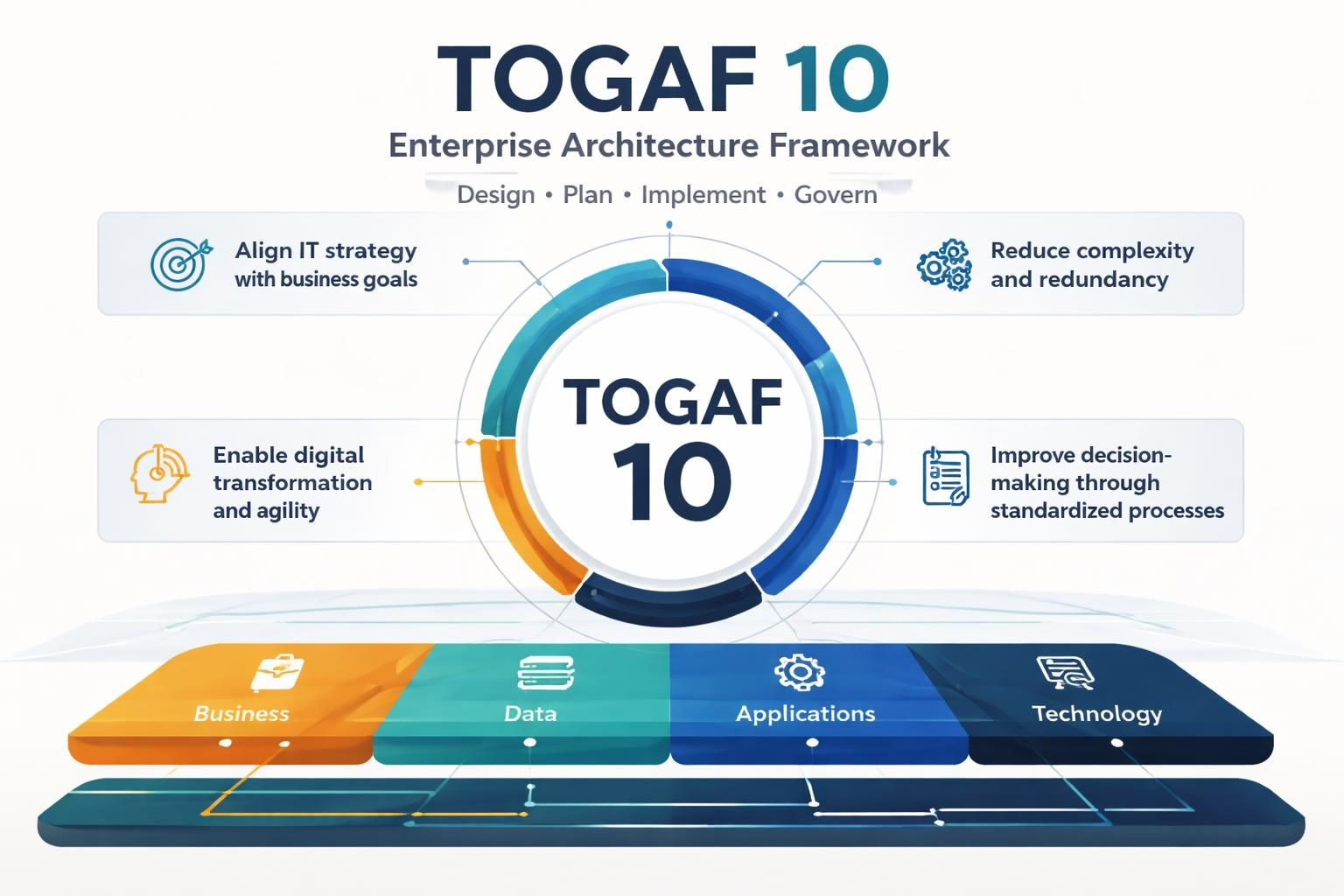
Core Purpose
TOGAF provides a comprehensive approach to designing, planning, implementing, and governing enterprise information architecture. It helps organizations:
-
Align IT strategy with business goals
-
Reduce complexity and redundancy
-
Improve decision-making through standardized processes
-
Enable digital transformation and agility
Who Is This Guide For?
-
Beginners: Those new to enterprise architecture or TOGAF
-
EA Teams: Practitioners looking to implement or refine their TOGAF practice
-
Stakeholders: Business leaders who need to understand EA value
2. Why TOGAF 10 Matters
Business Benefits
-
Strategic Alignment: Ensures technology investments support business objectives
-
Risk Reduction: Provides structured governance and compliance frameworks
-
Cost Efficiency: Identifies redundancies and optimizes resource allocation
-
Agility: Enables faster response to market changes through modular architecture
Industry Recognition
-
Vendor-neutral and globally recognized
-
Supported by major consulting firms and technology providers
-
Integrates with other frameworks (Agile, DevOps, ITIL, COBIT)
3. Key Changes from TOGAF 9.2 to TOGAF 10
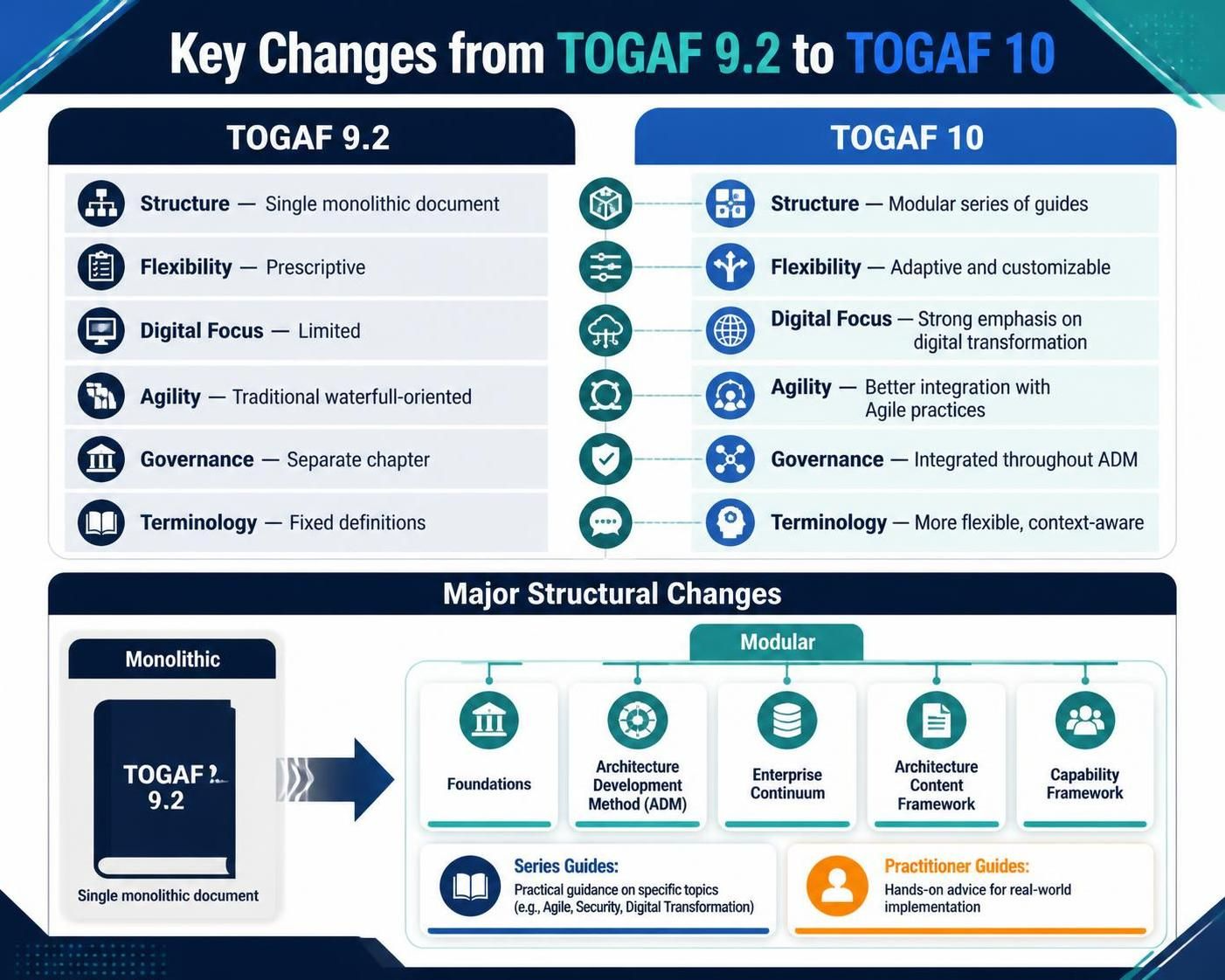
TOGAF 10 introduces a modular structure that makes it easier to adopt and customize:
| Aspect | TOGAF 9.2 | TOGAF 10 |
|---|---|---|
| Structure | Single monolithic document | Modular series of guides |
| Flexibility | Prescriptive | Adaptive and customizable |
| Digital Focus | Limited | Strong emphasis on digital transformation |
| Agility | Traditional waterfall-oriented | Better integration with Agile practices |
| Governance | Separate chapter | Integrated throughout ADM |
| Terminology | Fixed definitions | More flexible, context-aware |
Major Structural Changes
-
The TOGAF Standard split into multiple documents:
-
Foundations
-
Architecture Development Method (ADM)
-
Enterprise Continuum
-
Architecture Content Framework
-
Capability Framework
-
-
Series Guides: Practical guidance on specific topics (e.g., Agile, Security, Digital Transformation)
-
Practitioner Guides: Hands-on advice for real-world implementation
4. The TOGAF Standard Structure
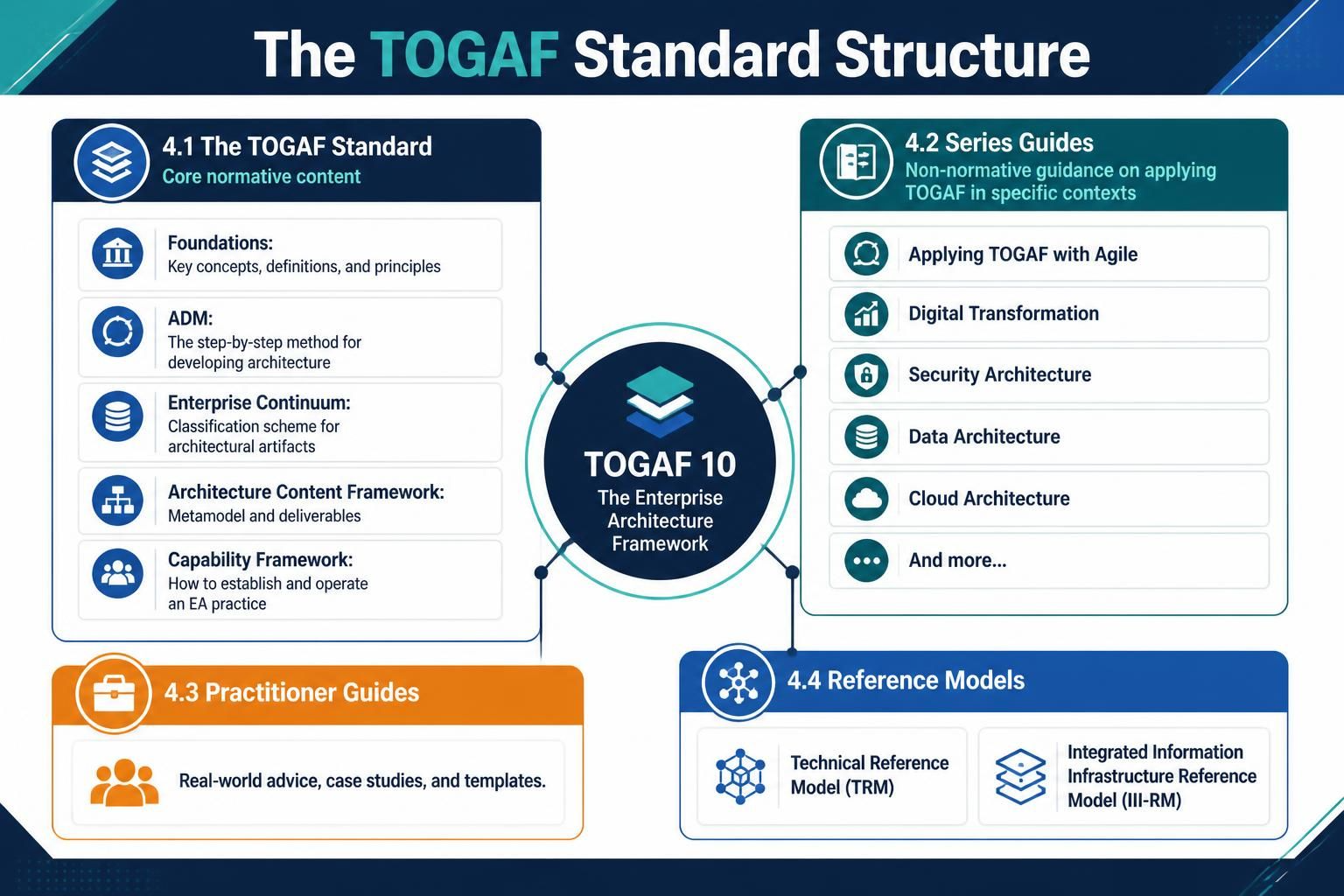
TOGAF 10 is organized into four main components:
4.1 The TOGAF Standard
The core normative content that defines the framework:
-
Foundations: Key concepts, definitions, and principles
-
ADM: The step-by-step method for developing architecture
-
Enterprise Continuum: Classification scheme for architectural artifacts
-
Architecture Content Framework: Metamodel and deliverables
-
Capability Framework: How to establish and operate an EA practice
4.2 Series Guides
Non-normative guidance on applying TOGAF in specific contexts:
-
Applying TOGAF with Agile
-
Digital Transformation
-
Security Architecture
-
Data Architecture
-
Cloud Architecture
-
And more…
4.3 Practitioner Guides
Real-world advice, case studies, and templates
4.4 Reference Models
-
Technical Reference Model (TRM)
-
Integrated Information Infrastructure Reference Model (III-RM)
5. The Architecture Development Method (ADM)
The ADM is the heart of TOGAF—a iterative, cyclical process for developing enterprise architecture.
The ADM Cycle

Phase-by-Phase Breakdown
Preliminary Phase
-
Purpose: Define “where, what, why, who, and how” of EA
-
Key Activities:
-
Define EA framework principles
-
Establish EA team structure
-
Select tools and methods
-
Define scope and constraints
-
-
Outputs: EA framework, governance structure, tool selection
Phase A: Architecture Vision
-
Purpose: Define scope, stakeholders, and high-level vision
-
Key Activities:
-
Identify stakeholders and concerns
-
Define architecture scope
-
Create Architecture Vision document
-
Obtain stakeholder approval
-
-
Outputs: Statement of Architecture Work, Architecture Vision, Stakeholder Map
Phase B: Business Architecture
-
Purpose: Describe baseline and target business architecture
-
Key Activities:
-
Model current business processes, organization, and capabilities
-
Define target business architecture
-
Perform gap analysis
-
-
Outputs: Business Architecture models, Gap Analysis report
Phase C: Information Systems Architectures
-
Purpose: Develop Data and Application architectures
-
Sub-phases:
-
C1: Data Architecture: Define data entities, relationships, and management
-
C2: Application Architecture: Define application portfolio and interactions
-
-
Outputs: Data models, Application portfolio, Interface specifications
Phase D: Technology Architecture
-
Purpose: Define technology infrastructure supporting applications
-
Key Activities:
-
Model current technology landscape
-
Define target technology architecture
-
Identify gaps and migration requirements
-
-
Outputs: Technology standards, Infrastructure models, Platform specifications
Phase E: Opportunities and Solutions
-
Purpose: Identify delivery vehicles and transition architectures
-
Key Activities:
-
Consolidate gaps from Phases B-D
-
Identify work packages
-
Define transition architectures
-
Conduct cost/benefit analysis
-
-
Outputs: Implementation and Migration Plan, Work Package definitions
Phase F: Migration Planning
-
Purpose: Prioritize projects and create detailed migration plan
-
Key Activities:
-
Prioritize work packages
-
Estimate resources and costs
-
Create detailed implementation plan
-
Confirm stakeholder buy-in
-
-
Outputs: Detailed Migration Plan, Project portfolio, Resource allocation
Phase G: Implementation Governance
-
Purpose: Ensure implementation conforms to architecture
-
Key Activities:
-
Provide architectural oversight
-
Review implementation projects
-
Manage architecture contracts
-
Address compliance issues
-
-
Outputs: Compliance assessments, Architecture contracts, Change requests
Phase H: Architecture Change Management
-
Purpose: Manage changes to architecture over time
-
Key Activities:
-
Monitor technology and business changes
-
Assess impact on architecture
-
Determine if new architecture cycle is needed
-
Update architecture repository
-
-
Outputs: Change requests, Updated architecture, Lessons learned
Requirements Management
-
Purpose: Central hub managing requirements throughout ADM
-
Key Activities:
-
Capture and prioritize requirements
-
Trace requirements to architecture elements
-
Manage requirement changes
-
-
Outputs: Requirements repository, Traceability matrix
6. The Enterprise Continuum & Repository
The Enterprise Continuum
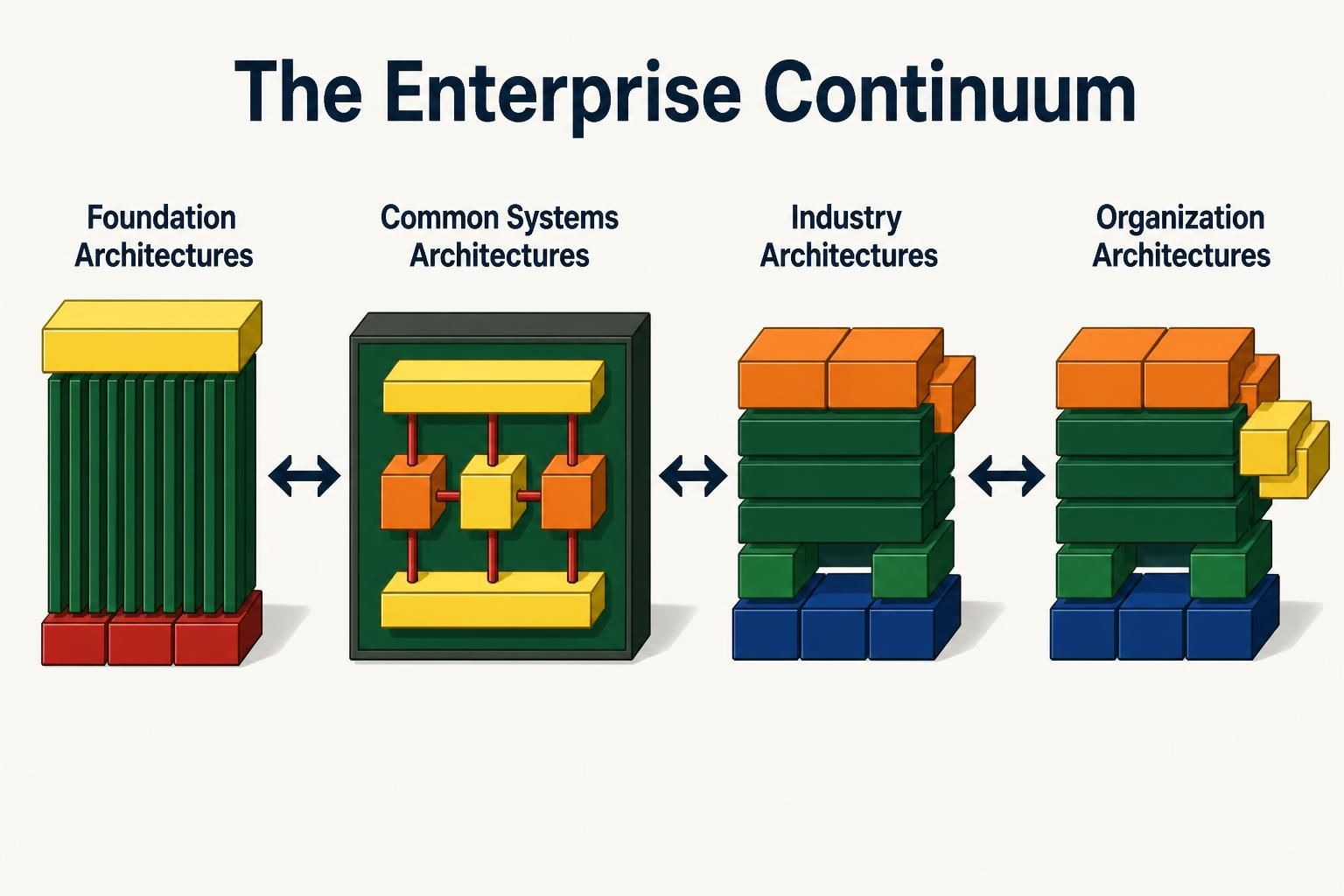
A classification scheme for organizing architectural assets:
-
Foundation Architectures: Generic building blocks (e.g., TOGAF TRM)
-
Common Systems Architectures: Reusable solutions (e.g., security, HR systems)
-
Industry Architectures: Sector-specific patterns (e.g., banking, healthcare)
-
Organization-Specific Architectures: Tailored to your enterprise
The Architecture Repository
A structured storage system for architectural artifacts:
-
Architecture Metamodel: Defines structure of architectural content
-
Architecture Capability: Governance and processes
-
Architecture Landscape: Current state views at different levels
-
Standards Information Base: Standards and guidelines
-
Reference Library: Patterns, templates, best practices
-
Governance Log: Decisions, compliance records
7. Architecture Content Framework
Defines what architects produce—the deliverables, artifacts, and building blocks.
Key Components
Deliverables
Formal outputs reviewed and approved by stakeholders:
-
Architecture Definition Document
-
Architecture Requirements Specification
-
Implementation and Migration Plan
-
Architecture Contract
Artifacts
Detailed views of architecture:
-
Catalogs: Lists of items (e.g., application catalog)
-
Matrices: Relationships between items (e.g., actor-role matrix)
-
Diagrams: Visual representations (e.g., process flows, component diagrams)
Building Blocks
Reusable components:
-
Architecture Building Blocks (ABBs): Logical components (e.g., “Customer Management Service”)
-
Solution Building Blocks (SBBs): Physical implementations (e.g., “Salesforce CRM”)
The Content Metamodel
Defines relationships between architectural elements across domains:
-
Business: Actors, roles, processes, services
-
Data: Data entities, attributes, relationships
-
Application: Applications, interfaces, services
-
Technology: Nodes, devices, networks, platforms
8. Capability Framework
Defines how to establish and operate an effective EA practice.
Key Elements
1. EA Team Structure
-
Chief Architect
-
Domain Architects (Business, Data, Application, Technology)
-
EA Analysts
-
Governance Board
2. Skills and Competencies
-
Analytical thinking
-
Communication and stakeholder management
-
Technical depth and breadth
-
Business acumen
-
Leadership and influence
3. Processes
-
Architecture development (ADM)
-
Architecture governance
-
Architecture compliance
-
Risk management
4. Tools
-
Modeling tools (e.g., Visual Paradigm)
-
Repository platforms
-
Collaboration tools
-
Analytics and reporting
5. Maturity Model
Assess and improve EA capability:
-
Level 1: Initial (ad-hoc)
-
Level 2: Managed (processes defined)
-
Level 3: Defined (standardized)
-
Level 4: Quantitatively Managed (measured)
-
Level 5: Optimizing (continuous improvement)
9. Getting Started: A Practical Roadmap for EA Teams
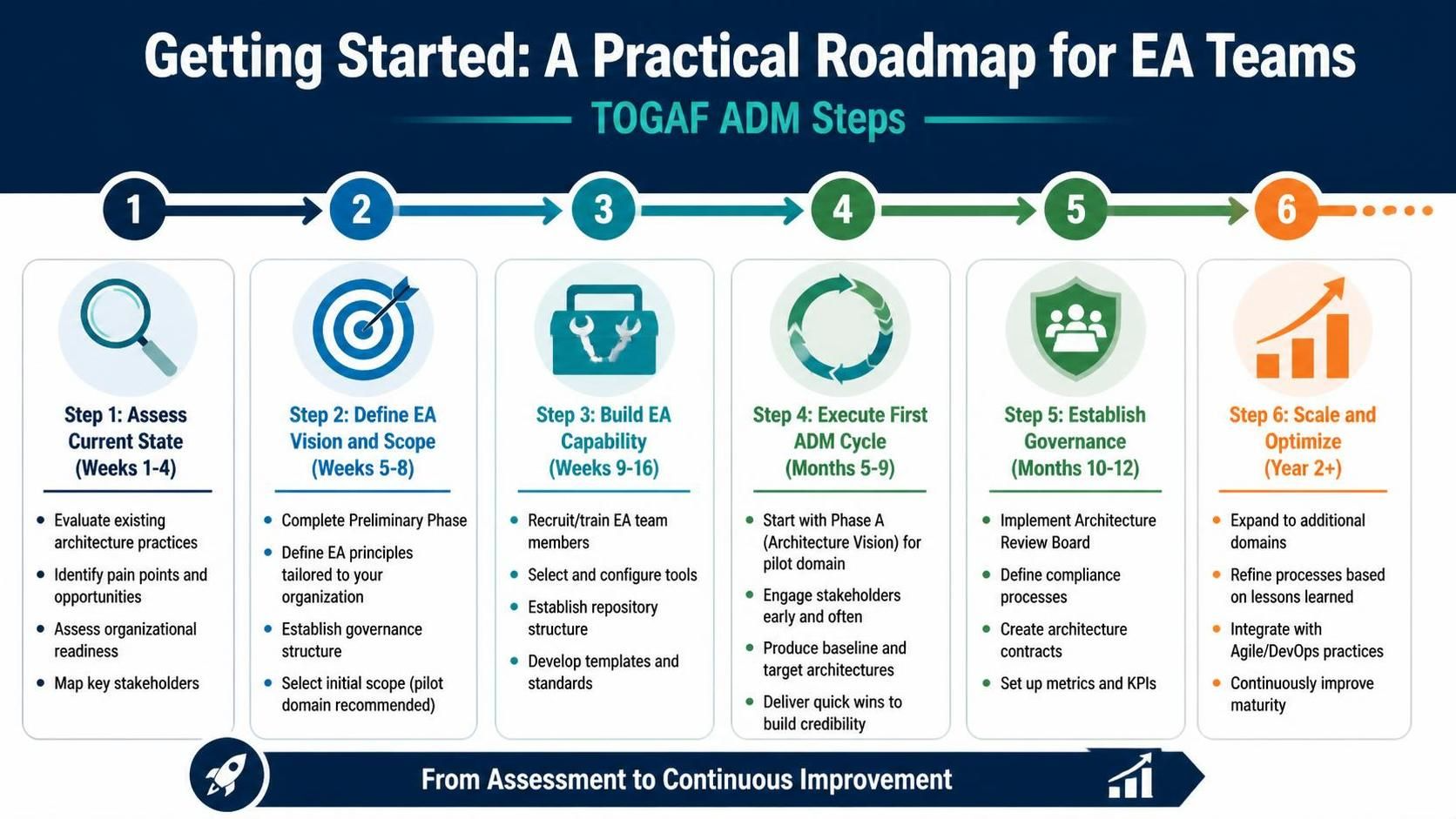
Step 1: Assess Current State (Weeks 1-4)
-
Evaluate existing architecture practices
-
Identify pain points and opportunities
-
Assess organizational readiness
-
Map key stakeholders
Step 2: Define EA Vision and Scope (Weeks 5-8)
-
Complete Preliminary Phase
-
Define EA principles tailored to your organization
-
Establish governance structure
-
Select initial scope (pilot domain recommended)
Step 3: Build EA Capability (Weeks 9-16)
-
Recruit/train EA team members
-
Select and configure tools
-
Establish repository structure
-
Develop templates and standards
Step 4: Execute First ADM Cycle (Months 5-9)
-
Start with Phase A (Architecture Vision) for pilot domain
-
Engage stakeholders early and often
-
Produce baseline and target architectures
-
Deliver quick wins to build credibility
Step 5: Establish Governance (Months 10-12)
-
Implement Architecture Review Board
-
Define compliance processes
-
Create architecture contracts
-
Set up metrics and KPIs
Step 6: Scale and Optimize (Year 2+)
-
Expand to additional domains
-
Refine processes based on lessons learned
-
Integrate with Agile/DevOps practices
-
Continuously improve maturity
10. Best Practices & Common Pitfalls
✅ Best Practices
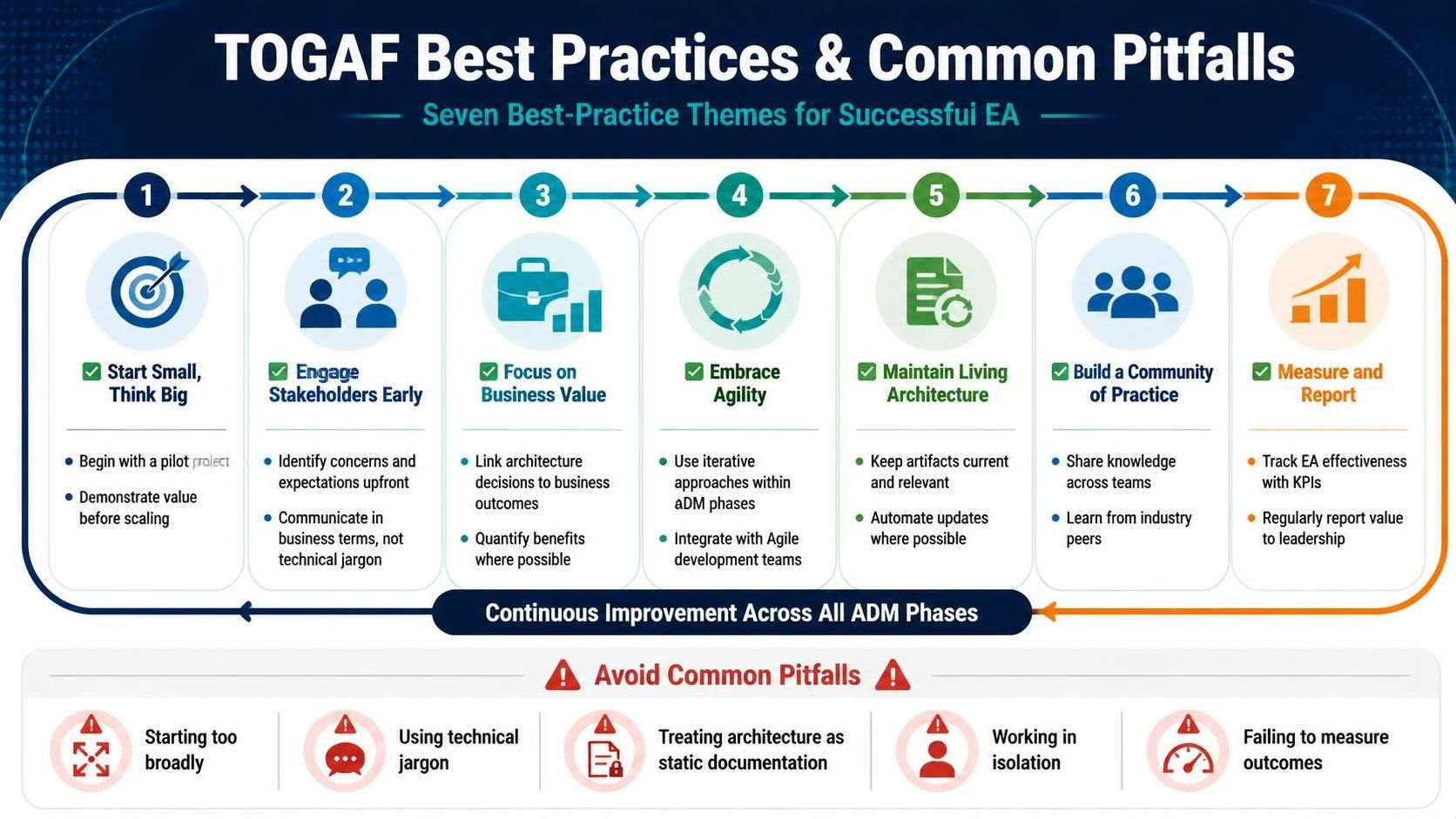
-
Start Small, Think Big
-
Begin with a pilot project
-
Demonstrate value before scaling
-
-
Engage Stakeholders Early
-
Identify concerns and expectations upfront
-
Communicate in business terms, not technical jargon
-
-
Focus on Business Value
-
Link architecture decisions to business outcomes
-
Quantify benefits where possible
-
-
Embrace Agility
-
Use iterative approaches within ADM phases
-
Integrate with Agile development teams
-
-
Maintain Living Architecture
-
Keep artifacts current and relevant
-
Automate updates where possible
-
-
Build a Community of Practice
-
Share knowledge across teams
-
Learn from industry peers
-
-
Measure and Report
-
Track EA effectiveness with KPIs
-
Regularly report value to leadership
-
❌ Common Pitfalls
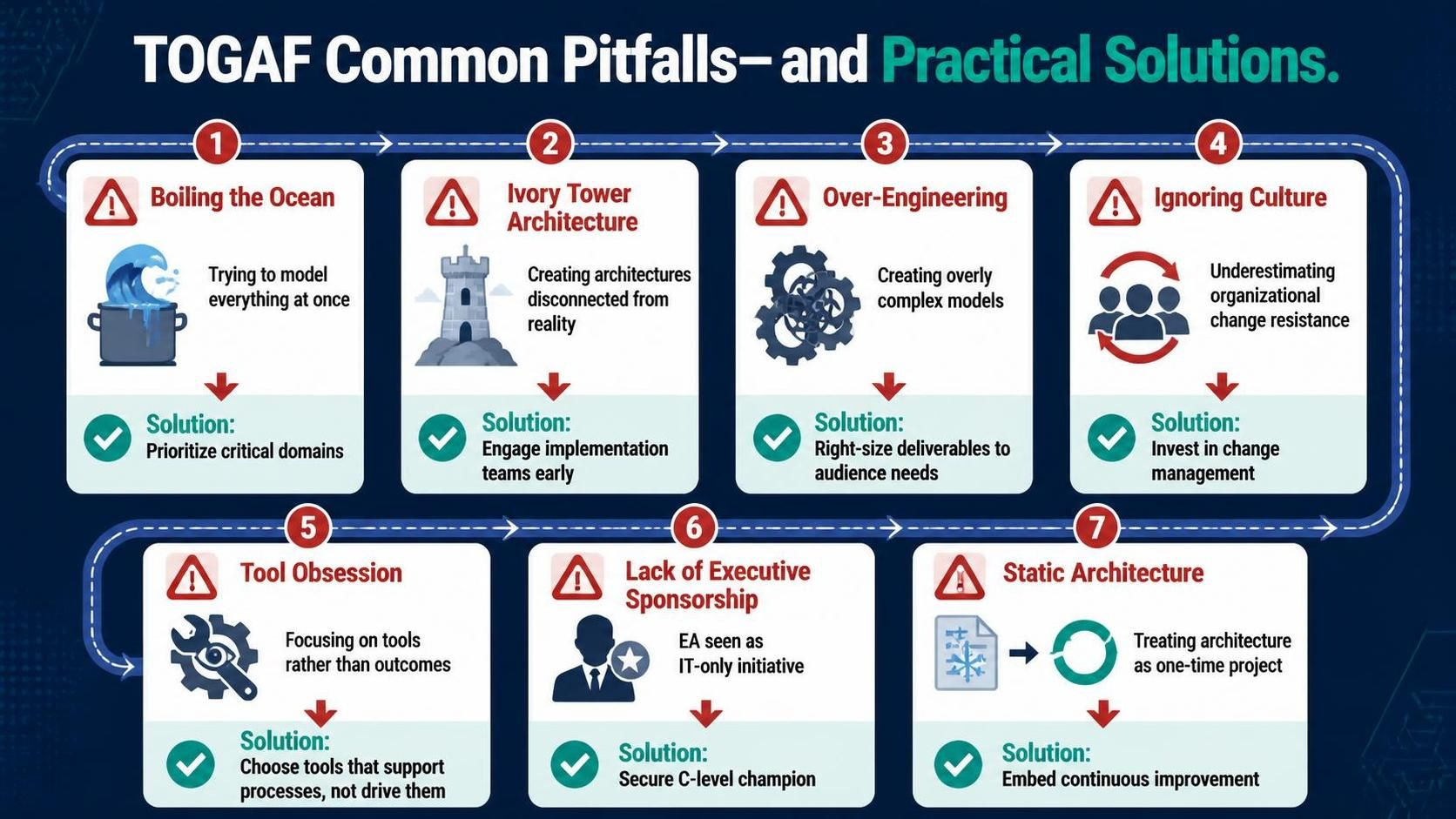
-
Boiling the Ocean
-
Trying to model everything at once
-
Solution: Prioritize critical domains
-
-
Ivory Tower Architecture
-
Creating architectures disconnected from reality
-
Solution: Engage implementation teams early
-
-
Over-Engineering
-
Creating overly complex models
-
Solution: Right-size deliverables to audience needs
-
-
Ignoring Culture
-
Underestimating organizational change resistance
-
Solution: Invest in change management
-
-
Tool Obsession
-
Focusing on tools rather than outcomes
-
Solution: Choose tools that support processes, not drive them
-
-
Lack of Executive Sponsorship
-
EA seen as IT-only initiative
-
Solution: Secure C-level champion
-
-
Static Architecture
-
Treating architecture as one-time project
-
Solution: Embed continuous improvement
-
11. Resources & Certification
Official TOGAF Resources
-
The TOGAF Standard, 10th Edition: Available from The Open Group
-
TOGAF Website: www.opengroup.org/togaf
-
Certification Path:
-
TOGAF Enterprise Architecture Foundation
-
TOGAF Enterprise Architecture Practitioner
-
TOGAF Enterprise Architecture Specialist (various specializations)
-
Recommended Tools
-
Visual Paradigm TOGAF ADM Tool: EA & AI Assisted modeling tool
Books & Learning
-
TOGAF® Version 10 Pocket Guide – The Open Group
-
Doing Enterprise Architecture – Mark Smalley
-
Enterprise Architecture as Strategy – Jeanne Ross et al.
Communities
-
The Open Group Forums
-
LinkedIn EA Groups
-
Local EA meetups and conferences
Quick Reference: ADM Phase Inputs & Outputs
| Phase | Key Inputs | Key Outputs |
|---|---|---|
| Preliminary | Organizational context | EA framework, Principles |
| A: Vision | Business strategy, Stakeholders | Architecture Vision, SoAW |
| B: Business | Business strategy, Baseline | Business Architecture, Gaps |
| C: IS | Business Architecture | Data & Application Architectures |
| D: Tech | IS Architectures | Technology Architecture |
| E: Solutions | Gap analysis | Work Packages, Transition Arch. |
| F: Migration | Work Packages | Migration Plan, Portfolio |
| G: Governance | Migration Plan | Compliance assessments |
| H: Change | Implementation feedback | Change requests, Updates |
Final Thoughts
TOGAF 10 is not a rigid prescription but a flexible framework that should be adapted to your organization’s needs. Success comes from:
-
Understanding the principles, not just memorizing phases
-
Tailoring the approach to your context
-
Demonstrating value through tangible outcomes
-
Building relationships across the organization
-
Continuously learning and improving
Remember: Enterprise Architecture is a journey, not a destination. Start where you are, use what you have, and do what you can. The framework is there to serve you—not the other way around.
Good luck on your TOGAF journey! Feel free to reach out with specific questions as you implement these practices.