


Comprehensive Guide to Stakeholder Management in TOGAF 10
TOGAF® Series Guide: Stakeholder Management
1. Introduction and Purpose
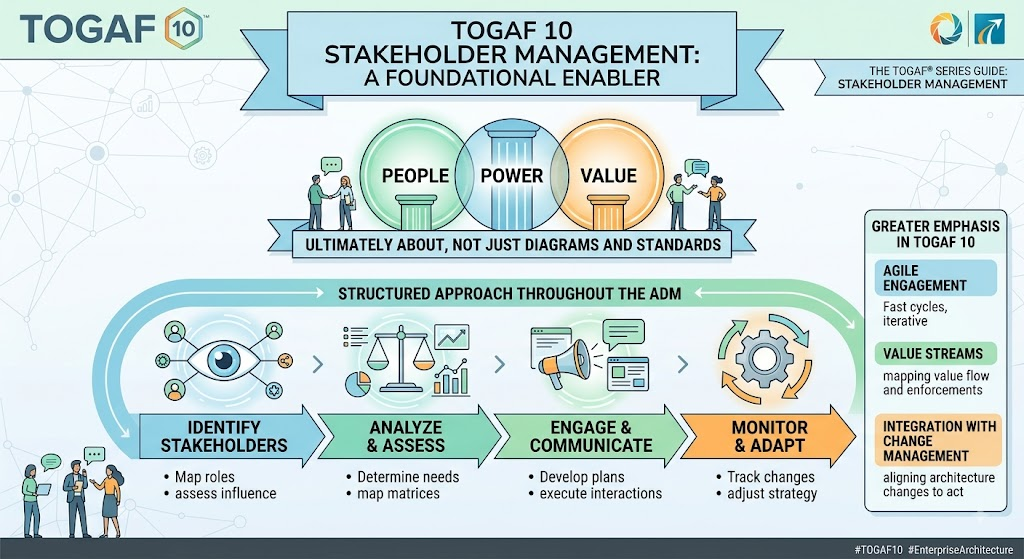
In TOGAF 10, Stakeholder Management is not merely a communication task; it is a foundational enabler of Enterprise Architecture (EA) success. The TOGAF Series Guide: Stakeholder Management emphasizes that architecture is ultimately about people, power, and value, not just diagrams and standards.
This guide provides a structured approach to identifying, analyzing, and engaging stakeholders throughout the Architecture Development Method (ADM). Unlike previous versions, TOGAF 10 places greater emphasis on agile engagement, value streams, and integrating stakeholder management with Change Management.
2. Key Concepts
2.1 Definition of a Stakeholder
In TOGAF 10, a stakeholder is defined as:
“An individual, team, or organization who has an interest in a system, or who can affect or be affected by the system.”
Key Shift in TOGAF 10: Stakeholders are no longer viewed statically. They are viewed through the lens of Value Streams and Capabilities. A stakeholder’s relevance is tied to their role in delivering value, not just their job title.
2.2 The Stakeholder Management Process
The Series Guide outlines a continuous four-step cycle that runs parallel to the ADM:
-
Identify: Determine who matters.
-
Analyze & Classify: Understand power, interest, and attitude.
-
Plan Engagement: Define tailored strategies.
-
Engage & Monitor: Execute and adapt based on feedback.
2.3 Integration with the ADM
Stakeholder Management is most visible in Phase A (Architecture Vision), but it is active in every phase:
-
Preliminary Phase: Identifying key sponsors and establishing the EA team’s mandate.
-
Phase A: Securing formal approval and defining scope via stakeholder consensus.
-
Phases B-D: Eliciting requirements and validating models.
-
Phase E-F: Negotiating solutions and securing implementation buy-in.
-
Phase G-H: Governance, compliance, and measuring realized value.
2.4 Power/Interest vs. Attitude Matrices
TOGAF 10 recommends using multiple classification dimensions:
-
Power/Interest Grid: Classic Mendelow matrix for prioritization.
-
Attitude Assessment: Evaluating whether a stakeholder is a Champion, Supporter, Neutral, Resistor, or Blocker. This is critical for Change Management alignment.
-
Influence/Impact: Distinguishing between those who can stop the project (Influence) and those who will feel the pain/gain (Impact).
3. Detailed Examples and Scenarios
The following examples illustrate how to apply these concepts practically within an enterprise architecture context.
Example 1: Identifying Hidden Stakeholders via Value Streams
Scenario: A retail bank is architecting a new “Instant Loan Approval” capability. The EA team initially lists the CIO, Head of Retail Banking, and IT Security.
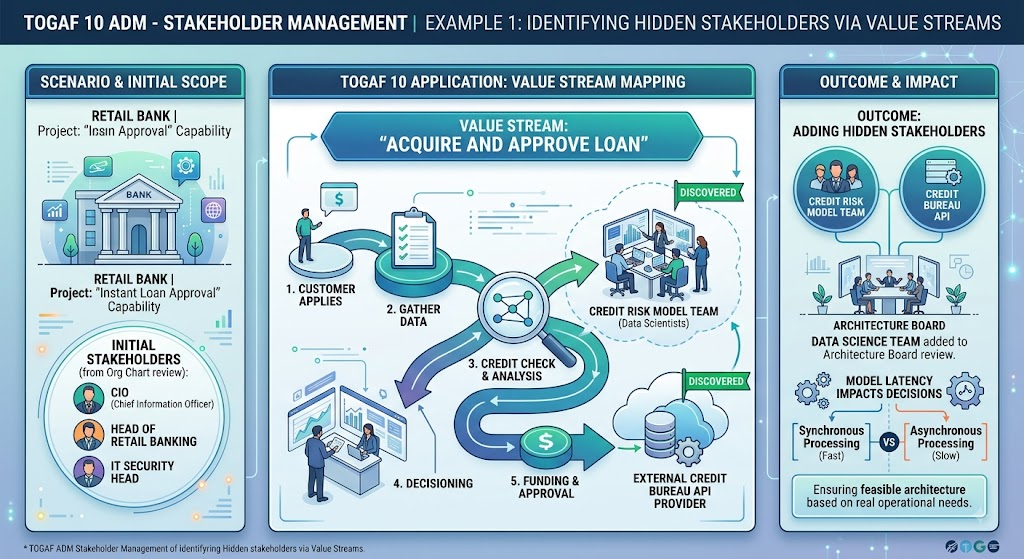
TOGAF 10 Application: Instead of stopping at titles, the team maps the Value Stream for “Acquire and Approve Loan.”
-
Discovery: They realize the Credit Risk Model Team (Data Scientists) and the External Credit Bureau API Provider are critical stakeholders missed in the org chart review.
-
Outcome: The Data Science team is added to the Architecture Board review because their model latency directly impacts the architectural decision between synchronous vs. asynchronous processing.
Example 2: Managing a High-Power / Low-Interest Blocker
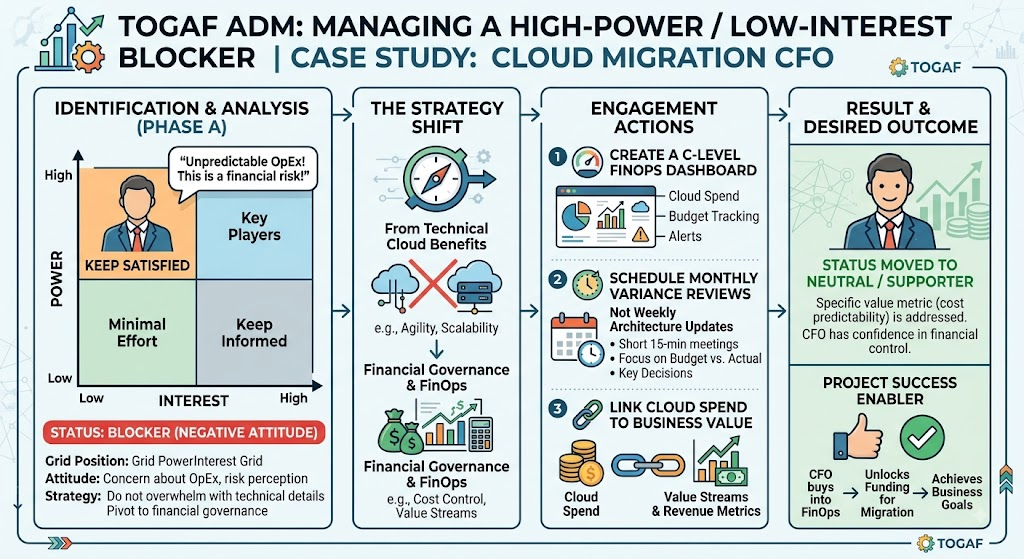
Scenario: The CFO is identified as High Power but Low Interest regarding a cloud migration. However, during Phase A, the CFO expresses concern about “unpredictable OpEx,” signaling a negative attitude.
Analysis:
-
Grid Position: High Power / Low Interest (Keep Satisfied).
-
Attitude: Potential Blocker due to financial risk perception.
-
Strategy: Do not overwhelm with technical cloud benefits. Pivot to financial governance.
Engagement Action:
-
Create a specific FinOps Dashboard view for the CFO.
-
Schedule monthly 15-minute budget variance reviews rather than weekly architecture updates.
-
Link cloud spend directly to business revenue metrics (Value Stream cost).
-
Result: CFO moves from Blocker to Neutral/Supporter because their specific value metric (cost predictability) is addressed.
Example 3: Tailoring Communication Artifacts (Phase B/C/D)
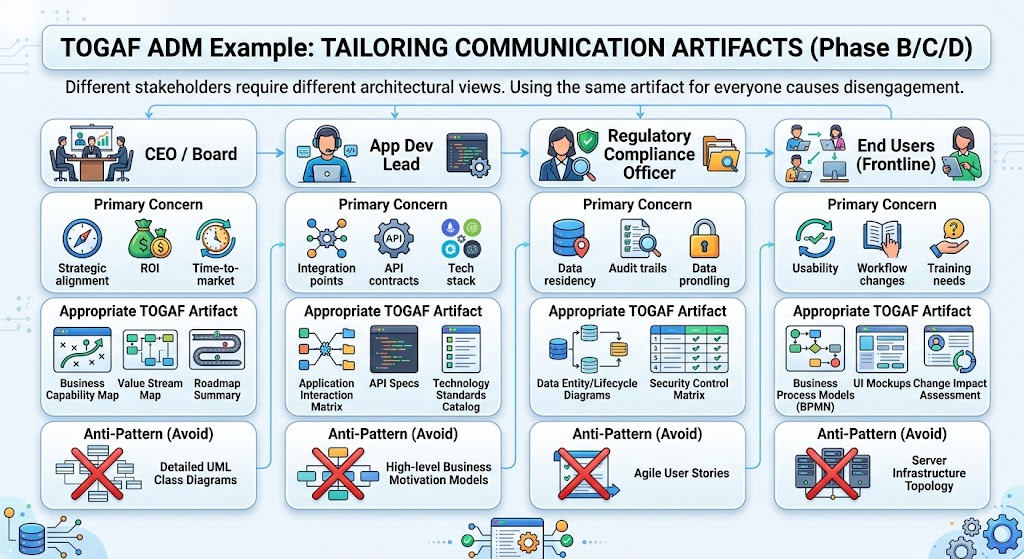
Different stakeholders require different architectural views. Using the same artifact for everyone causes disengagement.
| Stakeholder | Primary Concern | Appropriate TOGAF Artifact | Anti-Pattern (Avoid) |
|---|---|---|---|
| CEO / Board | Strategic alignment, ROI, Time-to-market | Business Capability Map, Value Stream Map, Roadmap Summary | Detailed UML Class Diagrams |
| App Dev Lead | Integration points, API contracts, Tech stack | Application Interaction Matrix, API Specs, Technology Standards Catalog | High-level Business Motivation Models |
| Regulatory Compliance Officer | Data residency, Audit trails, PII handling | Data Entity/Lifecycle Diagrams, Security Control Matrix | Agile User Stories |
| End Users (Frontline) | Usability, Workflow changes, Training needs | Business Process Models (BPMN), UI Mockups, Change Impact Assessment | Server Infrastructure Topology |
Example 4: Stakeholder Management in Agile/Iterative Architecture
Scenario: An insurance company uses SAFe (Scaled Agile Framework) alongside TOGAF. Traditional quarterly stakeholder reviews are too slow.
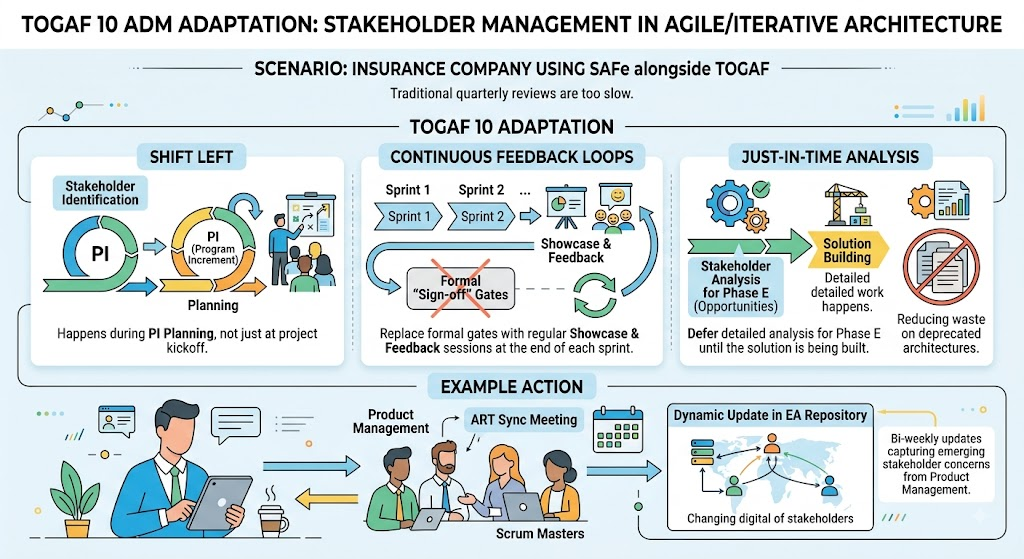
TOGAF 10 Adaptation:
-
Shift Left: Stakeholder identification happens during PI (Program Increment) Planning, not just at project kickoff.
-
Continuous Feedback Loops: Replace formal “Sign-off” gates with “Showcase & Feedback” sessions at the end of each sprint.
-
Just-in-Time Analysis: Detailed stakeholder analysis for Phase E (Opportunities) is deferred until the solution is actually being built, reducing waste on deprecated architectures.
-
Example Action: The Enterprise Architect attends the ART (Agile Release Train) Sync meeting bi-weekly to capture emerging stakeholder concerns from Product Management, updating the Stakeholder Map dynamically in the EA Repository.
Example 5: Handling Organizational Politics and Shadow IT
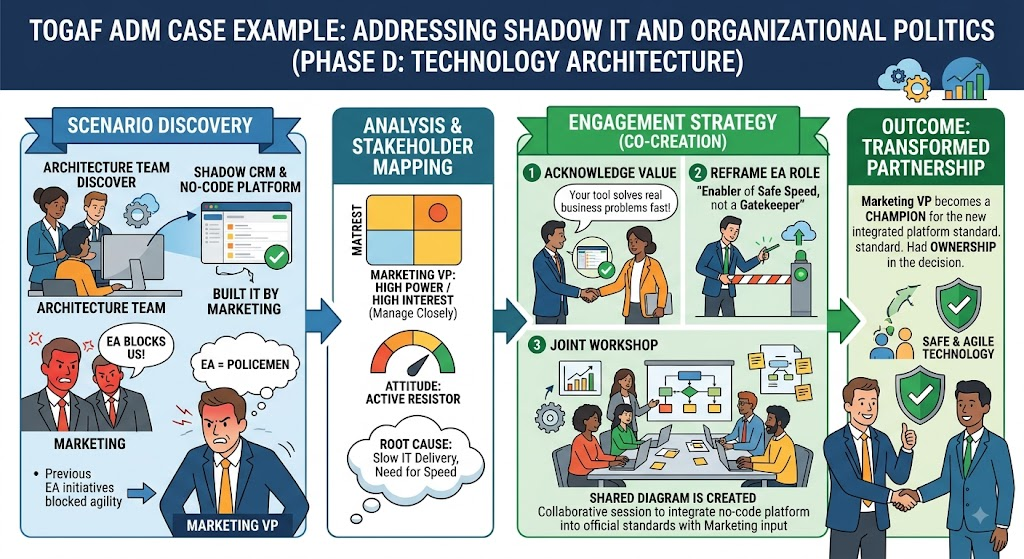
Scenario: During Phase D (Technology Architecture), the EA team discovers a marketing department has built a shadow CRM on a no-code platform. The Marketing VP is hostile toward EA, viewing them as “policemen.”
 =
=
Analysis:
-
Power/Interest: High Power / High Interest (Manage Closely).
-
Attitude: Active Resistor.
-
Root Cause: Previous EA initiatives blocked marketing agility.
Engagement Strategy (Co-Creation):
-
Acknowledge Value: Validate that the shadow CRM solved a real business problem faster than IT could.
-
Reframe EA Role: Position EA as an “Enabler of Safe Speed” rather than a gatekeeper.
-
Joint Workshop: Facilitate a session to integrate the no-code platform into the official technology standards with Marketing leading the evaluation.
-
Outcome: Marketing VP becomes a Champion for the new integrated platform standard because they had ownership in the decision.
4. Best Practices Checklist
When applying the Stakeholder Management Series Guide, ensure you:
-
Link to Value: Always articulate stakeholder engagement in terms of value streams and capabilities, not just project deliverables.
-
Update Dynamically: Treat the Stakeholder Map as a living artifact. Re-assess at every ADM phase transition.
-
Segment Communications: Never send a “one-size-fits-all” newsletter. Use targeted briefings based on the Power/Interest/Attitude assessment.
-
Integrate Change Management: Align EA stakeholder activities with organizational Change Management plans. EA identifies who is impacted; Change Management defines how to transition them.
-
Measure Engagement: Track metrics such as stakeholder attendance, feedback quality, approval cycle times, and sentiment shifts over time.
-
Document Rationale: Record why certain stakeholders were prioritized or deprioritized. This provides auditability and institutional memory.
5. Common Pitfalls to Avoid
| Pitfall | Consequence | TOGAF 10 Correction |
|---|---|---|
| Treating Stakeholder Mgmt as a Phase A activity only | Loss of buy-in during implementation; late-stage resistance. | Embed stakeholder checkpoints in Phases E, F, G, and H. |
| Focusing only on supportive stakeholders | Blind spots to risks; blockers derail projects unexpectedly. | Actively seek out and engage resistors; their feedback often reveals architectural flaws. |
| Confusing “Communication” with “Engagement” | One-way broadcasting creates illusion of alignment without actual consensus. | Use interactive workshops, co-creation sessions, and feedback loops. |
| Ignoring external stakeholders | Regulatory fines, partner integration failures, customer churn. | Extend boundary analysis to include regulators, partners, customers, and suppliers. |
| Using outdated stakeholder data | Engaging the wrong people; missing newly appointed decision-makers. | Integrate stakeholder data with HR systems and project portfolios for auto-refresh. |
6. Conclusion
Effective Stakeholder Management in TOGAF 10 is the bridge between abstract architecture and tangible business outcomes. By rigorously applying the concepts from the Series Guide—particularly the integration with Value Streams, Agile practices, and Change Management—architects can transform stakeholder management from a bureaucratic checkbox into a strategic advantage that accelerates transformation and ensures sustainable value delivery.
Note: Always refer to the official TOGAF® Series Guide: Stakeholder Management and the TOGAF Standard, 10th Edition for authoritative definitions, templates, and detailed process descriptions. This guide serves as a practical companion to those official publications.
References
-
Overview of the TOGAF® Standard, 10th Edition: A comprehensive overview of TOGAF 10’s key updates, including expanded guidance, modular structure, and its emphasis on agile and digital transformation .
-
What’s New in the TOGAF® Standard, 10th Edition?: A detailed look at new features like the TOGAF Fundamental Content, Series Guides, and a more configurable framework for enterprise architects .
-
Transforming Enterprise Architecture: A Case Study on Adopting TOGAF® Standard 10th Edition with Visual Paradigm: A case study showing how a financial services firm used Visual Paradigm to implement TOGAF 10, achieving a 45% faster time-to-value for architecture deliverables .
-
Comprehensive Guide to TOGAF 10 for Beginners: An introductory guide covering core EA concepts, the structure of TOGAF documentation, and steps for getting started with the framework .
-
TOGAF ADM: A Quick Tutorial: A practical walkthrough of the TOGAF Architecture Development Method (ADM), explaining its incremental and iterative nature across the Preliminary Phase, Phase A, and beyond .
-
Step-by-Step: Using AI to Generate Artifacts from Descriptions in Visual Paradigm TOGAF Guide-Through: A guide on using AI to generate TOGAF-compliant artifacts like ArchiMate diagrams and gap visualizations from natural language descriptions .
-
Real-World Examples & Use Cases: AI-Enhanced TOGAF in Retail & Finance Transformations: Two anonymized case studies (retail and banking) demonstrating how AI-enhanced TOGAF tools reduced ADM documentation time by 50-80% .
-
Case Study: Business Transformation Readiness Assessment at TechInnovate Solutions: A detailed example of using a maturity model to assess readiness factors like vision, governance, and IT capacity during business transformation planning .
-
Transformando la Arquitectura Empresarial: Un Estudio de Caso sobre la Implementación de TOGAF ADM Mejorada con IA: A Spanish-language case study on a global financial organization using AI-enhanced TOGAF ADM for cloud migration, highlighting automated document generation and capability heatmaps .
-
TOGAF 10: The Next Level of Enterprise Architecture Framework: A summary of TOGAF 10’s enhanced guidance, modular structure, and stronger emphasis on agile methodologies and digital transformation .