


📘 Comprehensive Guide: Skills & Techniques in TOGAF 10
1. The Shift from TOGAF 9 to TOGAF 10
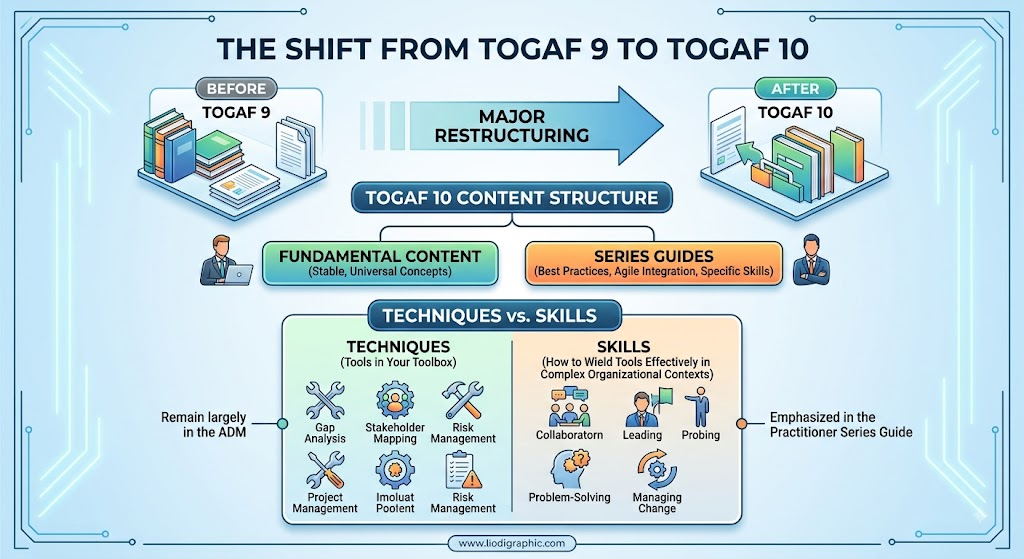
Before diving into specifics, understand that TOGAF 10 restructured content into Fundamental Content (stable, universal concepts) and Series Guides (best practices, agile integration, specific skills).
-
Techniques = Tools in your toolbox (e.g., Gap Analysis, Stakeholder Mapping). These remain largely in the ADM.
-
Skills = How you wield the tools effectively in complex organizational contexts. These are now emphasized in the Practitioner Series Guide.
2. Core EA Techniques (The Toolbox)
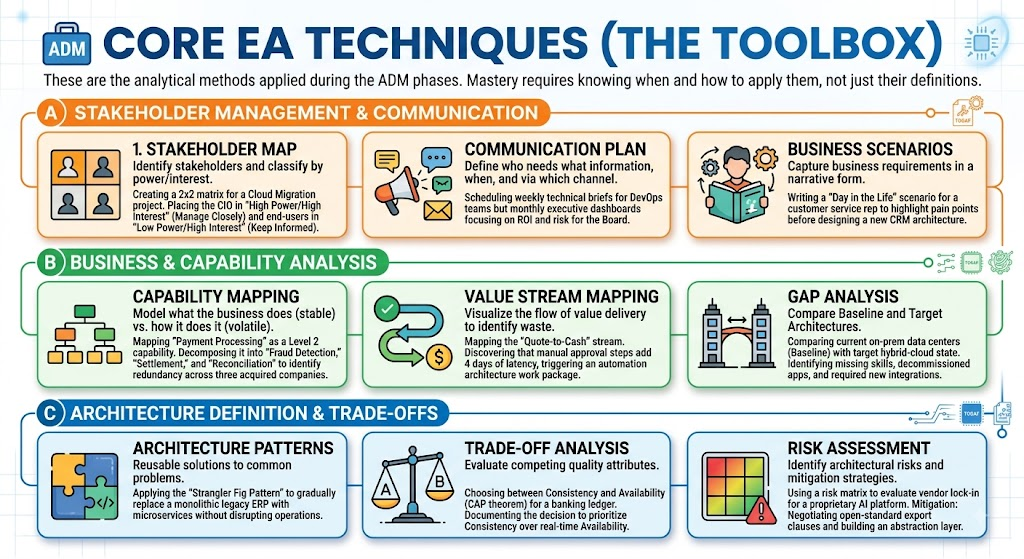
These are the analytical methods applied during the ADM phases. Mastery requires knowing when and how to apply them, not just their definitions.
A. Stakeholder Management & Communication
| Technique | Purpose | Practical Example |
|---|---|---|
| Stakeholder Map | Identify stakeholders and classify by power/interest. | Creating a 2×2 matrix for a Cloud Migration project. Placing the CIO in “High Power/High Interest” (Manage Closely) and end-users in “Low Power/High Interest” (Keep Informed). |
| Communication Plan | Define who needs what information, when, and via which channel. | Scheduling weekly technical briefs for DevOps teams but monthly executive dashboards focusing on ROI and risk for the Board. |
| Business Scenarios | Capture business requirements in a narrative form. | Writing a “Day in the Life” scenario for a customer service rep to highlight pain points before designing a new CRM architecture. |
B. Business & Capability Analysis
| Technique | Purpose | Practical Example |
|---|---|---|
| Capability Mapping | Model what the business does (stable) vs. how it does it (volatile). | Mapping “Payment Processing” as a Level 2 capability. Decomposing it into “Fraud Detection,” “Settlement,” and “Reconciliation” to identify redundancy across three acquired companies. |
| Value Stream Mapping | Visualize the flow of value delivery to identify waste. | Mapping the “Quote-to-Cash” stream. Discovering that manual approval steps add 4 days of latency, triggering an automation architecture work package. |
| Gap Analysis | Compare Baseline and Target Architectures. | Comparing current on-prem data centers (Baseline) with target hybrid-cloud state. Identifying missing skills, decommissioned apps, and required new integrations. |
C. Architecture Definition & Trade-offs
| Technique | Purpose | Practical Example |
|---|---|---|
| Architecture Patterns | Reusable solutions to common problems. | Applying the “Strangler Fig Pattern” to gradually replace a monolithic legacy ERP with microservices without disrupting operations. |
| Trade-off Analysis | Evaluate competing quality attributes. | Choosing between Consistency and Availability (CAP theorem) for a banking ledger. Documenting the decision to prioritize Consistency over real-time Availability. |
| Risk Assessment | Identify architectural risks and mitigation strategies. | Using a risk matrix to evaluate vendor lock-in for a proprietary AI platform. Mitigation: Negotiating open-standard export clauses and building an abstraction layer. |
3. Essential Practitioner Skills (The Artistry)
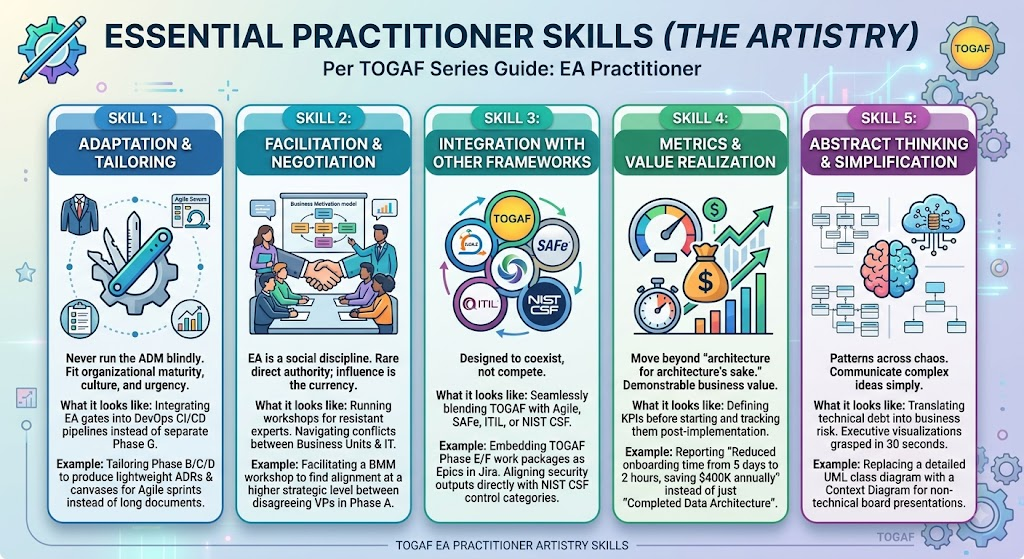
Per the TOGAF Series Guide: EA Practitioner, these skills differentiate a framework follower from a value-driving architect.
🎯 Skill 1: Adaptation & Tailoring
TOGAF 10 explicitly states: “Never run the ADM blindly.” You must tailor the method to fit organizational maturity, culture, and urgency.
-
What it looks like: Skipping Phase G (Implementation Governance) if the organization has mature DevOps pipelines with automated compliance checks, and instead integrating EA gates into CI/CD.
-
Example: A startup adopting TOGAF shouldn’t produce 200-page architecture documents. Instead, tailor Phase B/C/D to produce lightweight ADRs (Architecture Decision Records) and canvas-style artifacts that integrate with Agile sprints.
🤝 Skill 2: Facilitation & Negotiation
EA is a social discipline. Architects rarely have direct authority; influence is the currency.
-
What it looks like: Running workshops that extract tacit knowledge from resistant domain experts. Navigating political conflicts between Business Units and IT.
-
Example: During Phase A, two VPs disagree on the strategic driver. Instead of picking sides, facilitate a Business Motivation Model (BMM) workshop to trace each VP’s goal back to corporate strategy, finding alignment at a higher abstraction level.
🔄 Skill 3: Integration with Other Frameworks
TOGAF 10 is designed to coexist, not compete.
-
What it looks like: Seamlessly blending TOGAF with Agile, SAFe, ITIL, or NIST CSF.
-
Example: Embedding TOGAF Phase E/F work packages as Epics in Jira. Aligning TOGAF security architecture outputs directly with NIST CSF control categories so the CISO sees familiar terminology.
📊 Skill 4: Metrics & Value Realization
Moving beyond “architecture for architecture’s sake” to demonstrable business value.
-
What it looks like: Defining KPIs before starting architecture work and tracking them post-implementation.
-
Example: Instead of reporting “Completed Data Architecture,” report “Reduced customer onboarding time from 5 days to 2 hours through unified data model, saving $400K annually in operational costs.”
🧠 Skill 5: Abstract Thinking & Simplification
The ability to see patterns across chaos and communicate them simply.
-
What it looks like: Translating complex technical debt into business risk language. Creating visualizations that executives can grasp in 30 seconds.
-
Example: Replacing a detailed UML class diagram with a Context Diagram showing system boundaries and external actors when presenting to non-technical board members.
4. Applied Scenario: Putting Skills & Techniques Together
Scenario: A retail bank wants to launch a digital-only subsidiary in 6 months while maintaining legacy core banking stability.
| ADM Phase | Technique Applied | Practitioner Skill Demonstrated | Outcome |
|---|---|---|---|
| Preliminary | Framework Tailoring Assessment | Adaptation | Decided to run a rapid, iterative ADM cycle focused only on Phases A, B, D, and E. Skipped full documentation in favor of working prototypes. |
| Phase A | Business Scenario + Stakeholder Map | Facilitation | Identified that Compliance was the hidden blocker. Ran a joint workshop with RegTech team to embed compliance-by-design early. |
| Phase B | Capability Mapping + Value Streams | Abstract Thinking | Mapped “Digital Account Opening” capability separately from legacy branch capabilities, avoiding contamination of the core banking model. |
| Phase D | API Pattern + Trade-off Analysis | Integration | Chose event-driven architecture over synchronous APIs for resilience. Documented trade-off: increased complexity for improved fault tolerance. |
| Phase E | Work Package Prioritization | Metrics Focus | Defined MVP scope tied directly to regulatory approval milestone. Deferred “nice-to-have” features to post-launch iterations. |
| Phase H | Change Impact Assessment | Negotiation | Legacy core team resisted API changes. Negotiated a phased rollout with rollback guarantees, securing buy-in through risk mitigation. |
5. Developing These Skills: A Practitioner Roadmap
-
Start with Techniques: Master the fundamental techniques first. You cannot adapt what you don’t understand. Use the TOGAF Fundamental Content as your reference.
-
Practice Tailoring Early: On your next engagement, explicitly document what you changed about the ADM and why. This builds the adaptation muscle.
-
Seek Feedback Loops: After delivering architecture artifacts, ask stakeholders: “Was this useful? What would have made it more actionable?” This develops facilitation and value-focus skills.
-
Cross-Train: Learn Agile coaching, design thinking, or financial modeling. The best EA practitioners bring adjacent disciplines into their practice.
-
Build a Personal Pattern Library: Maintain your own repository of reusable techniques, templates, and lessons learned. TOGAF provides the standard; your library provides the contextual wisdom.
6. Key Takeaways
-
Techniques are necessary but insufficient. Knowing Gap Analysis doesn’t make you effective; knowing how to facilitate a Gap Analysis workshop with hostile stakeholders does.
-
TOGAF 10 rewards pragmatism. The Series Guide explicitly validates tailoring, agile integration, and outcome-focus over rigid adherence.
-
Skills are developed through reflection, not just certification. Use real engagements as laboratories for skill development.
-
Value is the north star. Every technique applied and skill exercised should trace back to enabling business outcomes.
💡 Pro Tip for Certification: If studying for the TOGAF 10 Practitioner exam, focus heavily on the application of techniques in context rather than rote memorization. Exam questions test judgment, tailoring decisions, and integration scenarios—not definitions.
This guide serves as both a study companion and a field reference. Bookmark it, annotate it with your own examples, and evolve it as your practice matures.