


Bridging the Divide: A Comprehensive Guide to TOGAF Gap Analysis for Digital Transformation
Introduction
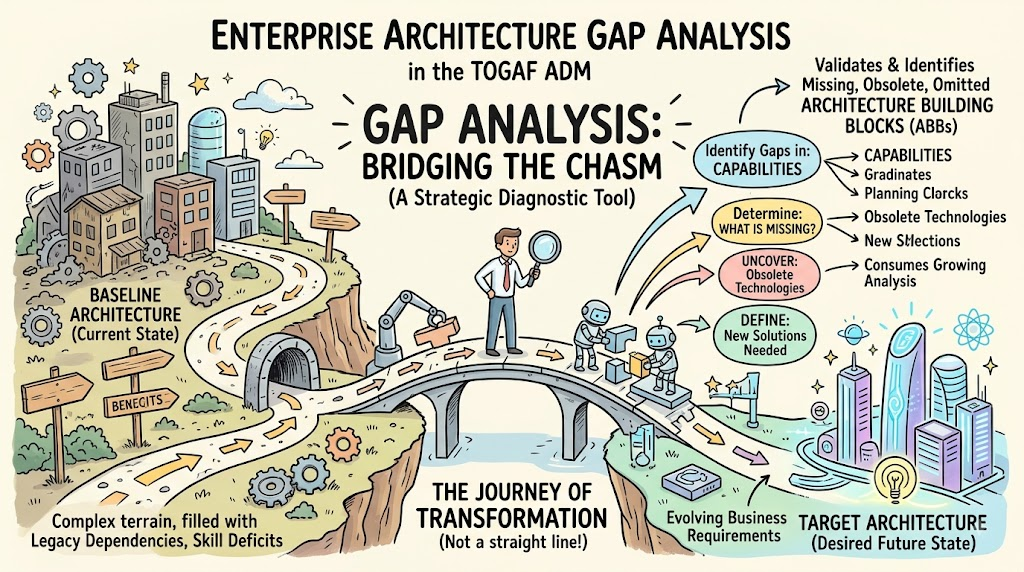
In the realm of Enterprise Architecture, the distance between where an organization is today and where it needs to be tomorrow is rarely a straight line. It is a complex chasm filled with legacy dependencies, skill deficits, and evolving business requirements. Gap Analysis is the pivotal technique within The Open Group Architecture Framework (TOGAF) Architecture Development Method (ADM) designed to navigate this terrain.
At its core, Gap Analysis validates architecture designs by systematically comparing the Baseline Architecture (current state) against the Target Architecture (desired future state). However, it is more than a simple subtraction exercise. It is a strategic diagnostic tool that highlights missing, obsolete, or unintentionally omitted Architecture Building Blocks (ABBs) and identifies the specific capabilities required to bridge the divide.
This guide explores the mechanics of TOGAF Gap Analysis, illustrates its application through a real-world e-commerce transformation scenario, and provides actionable implementation strategies.
Key Concepts and Definitions
Before diving into the ADM phases, it is essential to understand the terminology that underpins effective gap analysis:
-
Baseline Architecture: The documented description of the current enterprise environment, including existing processes, systems, data, and technology infrastructure.
-
Target Architecture: The desired future state aligned with strategic business goals and stakeholder requirements.
-
Architecture Building Block (ABB): A reusable component of business, IT, or architectural capability that can be combined with other building blocks to deliver architectures and solutions.
-
Gap Categories:
-
Included: Components retained from the baseline, potentially with modifications.
-
New: Capabilities required in the target but absent in the baseline.
-
Eliminated: Components present in the baseline that are intentionally removed or accidentally omitted in the target.
-
-
Work Package: A logical grouping of related gaps and activities organized for project management and delivery during transition planning.
1. TOGAF ADM Phases Involved in Gap Analysis
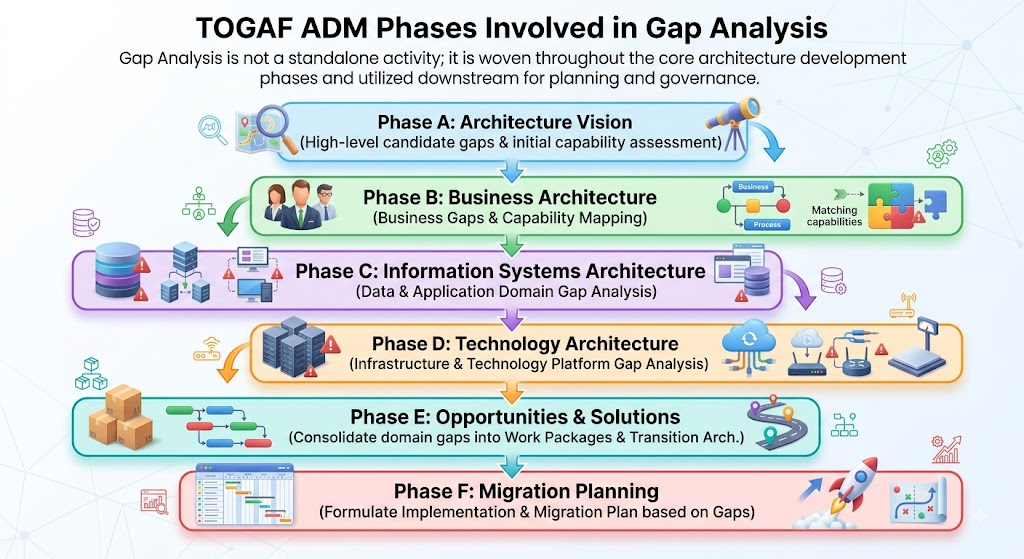
Gap Analysis is not a standalone activity; it is woven throughout the core architecture development phases and utilized downstream for planning and governance.
Core Execution Phases (Where Gaps are Identified)
-
Phase A: Architecture Vision: High-level initial gap identification. Architects analyze business goals vs. current capabilities to establish the scope.
-
Phase B: Business Architecture: Conducts detailed gap analysis on business processes, organization structures, roles, and business capabilities.
-
Phase C: Information Systems Architecture:
-
Data Architecture: Identifies gaps in data models, management, governance, and flows.
-
Application Architecture: Identifies gaps in software applications, APIs, and integration services.
-
-
Phase D: Technology Architecture: Conducts gap analysis on underlying infrastructure, networking, platforms, security tools, and hardware platforms.
Downstream Planning Phases (Where Gaps are Resolved)
-
Phase E: Opportunities & Solutions: Consolidates all domain-level gaps from Phases B, C, and D into logical Work Packages and constructs candidate Transition Architectures.
-
Phase F: Migration Planning: Finalizes the Implementation and Migration Plan, assigning resources, timelines, and budgets to bridge the gaps.
2. Business Scenario: E-Commerce Digital Transformation
To contextualize these concepts, consider RetailCorp, a traditional retailer undergoing a digital transformation.
Baseline Scenario (As-Is State)
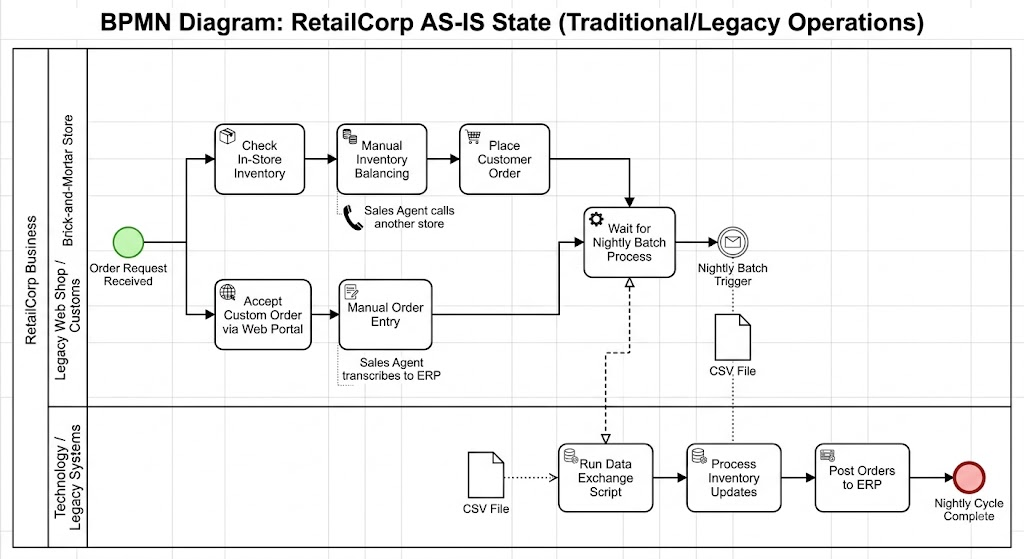
RetailCorp operates traditional brick-and-mortar stores alongside a legacy web shop.
-
Business: Manual order entry for custom orders; sales agents manually balance inventory via phone calls.
-
Application: Monolithic legacy ERP handling CRM, inventory, and order processing; third-party basic web portal.
-
Data: Siloed batch updates sent nightly via CSV files.
-
Technology: On-premises bare-metal servers with self-hosted database engines.
Target Scenario (To-Be State)
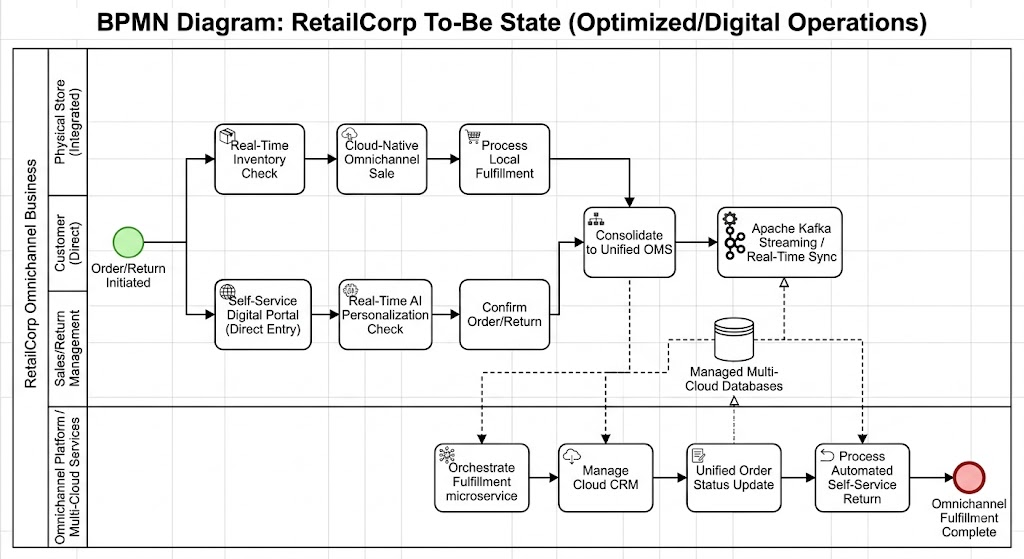
RetailCorp aims to become an omnichannel retail platform with real-time fulfillment and AI-driven personalization.
-
Business: Fully automated, real-time omnichannel order fulfillment and self-service returns.
-
Application: Microservices-based ecommerce application, cloud CRM, unified order management system (OMS), and real-time inventory engine.
-
Data: Streamed real-time event integration (Apache Kafka/Event-driven architecture).
-
Technology: Cloud-native architecture (Kubernetes, Managed Cloud Databases) with automated autoscaling.
3. TOGAF Gap Analysis Matrix
TOGAF uses a structured matrix to map Baseline Building Blocks (rows) against Target Building Blocks (columns). This visual representation ensures no component is overlooked.
| Baseline ABBs / Target ABBs | Legacy Monolith ERP | Cloud Microservices Platform | Real-Time Event Bus | AI Recommendation Engine | Eliminated |
|---|---|---|---|---|---|
| Manual Phone-In Ordering Process | — | — | — | — | Intentional Gap: Eliminated (Replaced by auto-fulfillment) |
| Legacy Monolith ERP | — | — | — | — | Intentional Gap: Decommissioned |
| On-Premises Bare-Metal Infrastructure | — | — | — | — | Intentional Gap: Migrated to cloud |
| Basic Customer Record Database | Included (Migrated) | — | — | — | — |
| NEW | — | New Gap: Procure/Develop OMS Microservices | New Gap: Implement Event Bus | New Gap: Integrate AI Recommender Engine | — |
Note: The “Eliminated” column is critical. Not all gaps represent something to be built; some represent debt to be retired. Documenting intentional elimination prevents scope creep and ensures stakeholders agree on decommissioning.
4. Identified Gaps and Required Capacities
Identifying a gap is only half the battle. The architect must translate that gap into a tangible capacity that the organization must build or acquire.
| Domain | Identified Gap | Required Capacity to Build / Acquire |
|---|---|---|
| Business | Lack of real-time inventory visibility across warehouse and stores. | Real-time Inventory Management: Ability to sync stock levels dynamically across digital and physical stores. |
| Application | Legacy monolithic application cannot scale during flash sales. | Cloud-Native Microservices Architecture: Containerized, decoupled web and ordering modules capable of auto-scaling. |
| Data | Nightly batch updates create data lag; real-time analytics are impossible. | Event-Driven Data Pipeline: Continuous real-time streaming capability for transaction data. |
| People / Skill | IT team only experienced in on-prem Linux/Windows server administration. | DevOps & Cloud Engineering Capacity: Staff trained in Cloud Infrastructure, CI/CD, and Kubernetes orchestration. |
5. Implementation Plan (Transition Architecture Roadmap)
To manage risks and avoid a high-risk “big bang” release, the implementation of identified gaps is organized into progressive Work Packages across two Transition Architectures (Phases E & F).
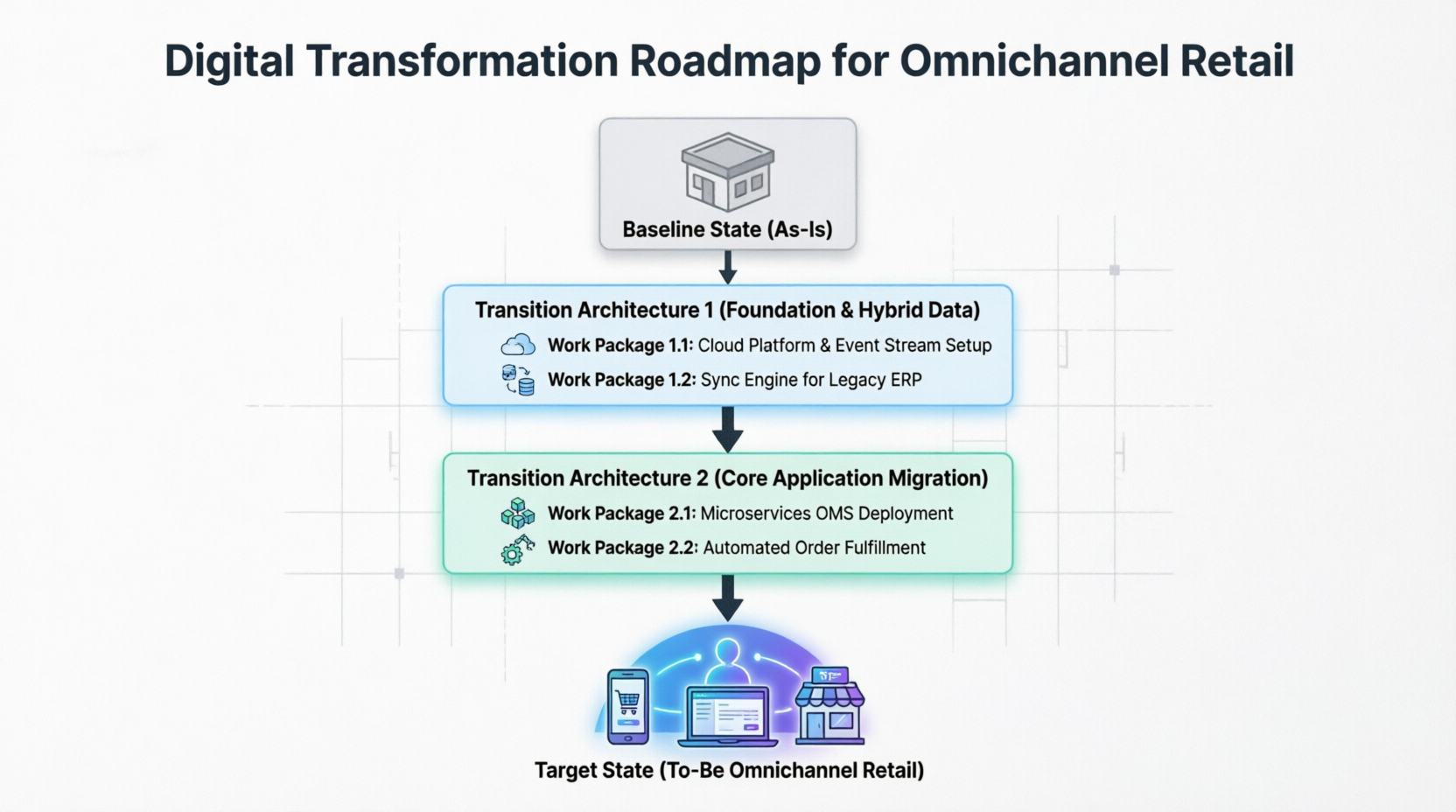
Phase 1: Foundation & Hybrid Architecture (Q1–Q2)
-
Work Package 1.1: Cloud Foundation & DevOps Upskilling
-
Gaps addressed: Cloud infrastructure & staff skill gap.
-
Actions: Provision AWS/Azure landing zones, establish CI/CD pipelines, and certify internal IT teams on cloud operations.
-
-
Work Package 1.2: Event Streaming Infrastructure
-
Gaps addressed: Batch update limitation.
-
Actions: Deploy real-time Event Bus (e.g., Kafka) and build data connectors to mirror legacy ERP data into the cloud in real time.
-
Phase 2: Core Application Modernization (Q3–Q4)
-
Work Package 2.1: Microservices Order Management System (OMS)
-
Gaps addressed: Monolithic ERP bottleneck.
-
Actions: Build and deploy modern Cloud OMS. Route new web portal traffic to the modern backend.
-
-
Work Package 2.2: Automated Fulfillment & Process Re-engineering
-
Gaps addressed: Manual phone-in order fulfillment.
-
Actions: Deploy automated fulfillment workflows and retire legacy manual business procedures.
-
Phase 3: AI Augmentation & Legacy Decommissioning (Q5)
-
Work Package 3.1: AI Personalization Engine
-
Gaps addressed: Lack of personalized online customer experience.
-
Actions: Deploy recommendation models on real-time stream data.
-
-
Work Package 3.2: Legacy Sunset
-
Gaps addressed: On-premises bare-metal servers & legacy monolith.
-
Actions: Fully decommission the on-premise hardware and legacy monolith module after data validation.
-
Conclusion
Gap Analysis is the analytical engine of the TOGAF ADM. Without it, enterprise architecture risks becoming an academic exercise disconnected from the reality of organizational change. By rigorously mapping Baseline to Target, categorizing gaps as Included, New, or Eliminated, and translating those gaps into actionable Work Packages, architects provide leadership with a clear, risk-managed roadmap for transformation.
For organizations like RetailCorp, Gap Analysis transforms vague aspirations of “digital transformation” into concrete engineering tasks, skill development plans, and phased migration schedules. Ultimately, it ensures that the journey from As-Is to To-Be is not just envisioned, but executable.