


TOGAF ADM Series Guide: Business Scenarios
Introduction
In the discipline of Enterprise Architecture, there is a persistent risk of creating elegant theoretical models that fail to address the messy realities of business operations. The TOGAF Architecture Development Method (ADM) mitigates this risk through the disciplined use of Business Scenarios. Far more than simple narratives or user stories, Business Scenarios are a formal technique designed to anchor architectural decisions in verified business needs. They serve as the critical validation mechanism throughout the ADM cycle, ensuring that every capability, application service, and technology component can be traced back to a tangible, real-world situation. This guide provides a comprehensive exploration of Business Scenarios within the TOGAF framework, distinguishing them from Business Capabilities, detailing their structural components, and offering extensive cross-industry examples to demonstrate how they transform abstract strategy into testable, actionable architecture.
Skills and Techniques for Architecture Validation
1. Introduction
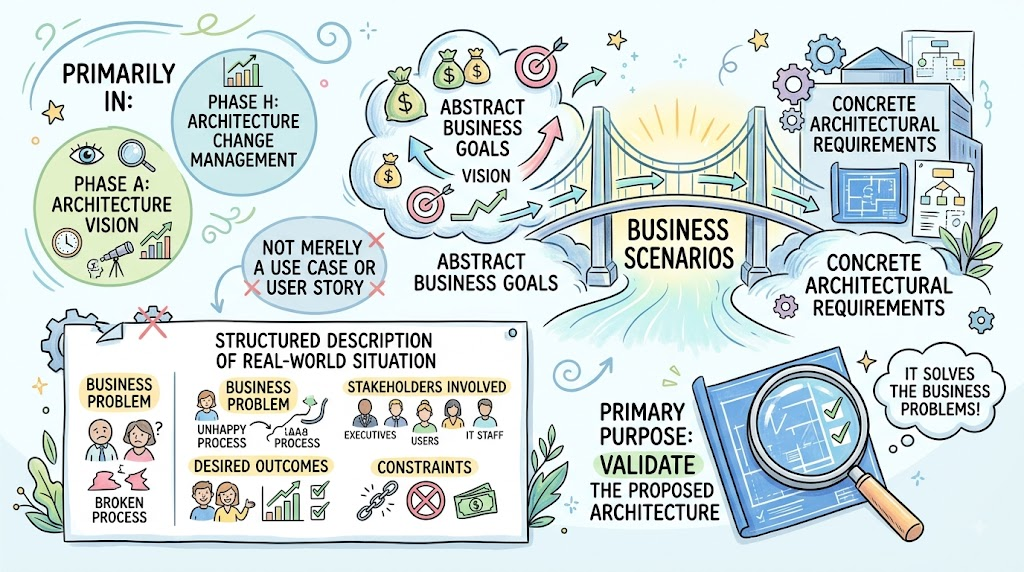
In the TOGAF Architecture Development Method (ADM), Business Scenarios are a critical technique used primarily in Phase A (Architecture Vision) and Phase H (Architecture Change Management). They serve as the bridge between abstract business goals and concrete architectural requirements.
A Business Scenario is not merely a “use case” or a “user story.” It is a structured description of a real-world situation that captures the business problem, the stakeholders involved, the desired outcomes, and the constraints. Its primary purpose is to validate that a proposed architecture actually solves the business problems it was designed to address.
2. Key Concepts
2.1 Definition
A Business Scenario describes:
-
The business environment and context.
-
The actors (people, systems, organizations) involved.
-
The interactions and flows required to achieve a goal.
-
The success criteria and quality attributes.
-
The constraints and assumptions.
2.2 Business Scenarios vs. Business Capabilities
It is vital to distinguish these two concepts, as they are often confused:
| Feature | Business Scenario | Business Capability |
|---|---|---|
| Nature | Dynamic / Temporal | Static / Structural |
| Question Answered | “What happens when…?” | “What does the business do?” |
| Focus | Specific instance, flow, outcome | Abstract function, resource, value |
| Role in TOGAF | Validates architecture; drives requirements | Defines the building blocks of the business |
| Example | “Customer returns defective item via mobile app” | “Returns Management” |
💡 The Relationship: Business Capabilities define what the enterprise needs to be able to do. Business Scenarios describe how those capabilities are orchestrated in specific situations to deliver value. You use Scenarios to test if your Capability Map is sufficient.
2.3 Characteristics of a Good Business Scenario
According to TOGAF standards, effective scenarios must be:
-
Realistic: Based on actual or highly probable situations, not theoretical edge cases.
-
Specific: Contains enough detail to evaluate architectural decisions.
-
Measurable: Has clear success/failure criteria.
-
Stakeholder-Centric: Reflects the perspective of those who experience the problem.
-
Architecture-Relevant: Highlights gaps, risks, or requirements that impact the Target Architecture.
3. The Structure of a Business Scenario
TOGAF recommends a standardized template to ensure consistency. Below is the comprehensive structure:
-
Scenario Name & ID: Unique identifier.
-
Description: Narrative summary of the situation.
-
Business Drivers/Goals: Why does this scenario matter? Link to strategic objectives.
-
Actors/Stakeholders: Who is involved? (Internal, external, systems).
-
Pre-conditions: State of the world before the scenario begins.
-
Flow of Events: Step-by-step interaction (Normal flow + Exception flows).
-
Post-conditions/Outcomes: Desired end state.
-
Quality Attributes: Performance, security, usability requirements specific to this scenario.
-
Constraints: Regulatory, budgetary, technical, or temporal limits.
-
Assumptions: Things believed to be true but not verified.
-
Architecture Implications: What does this mean for the architecture? (Gap analysis trigger).
4. Comprehensive Examples
Below are three detailed examples spanning different industries and ADM phases to illustrate practical application.
Example 1: Retail – Omnichannel Returns
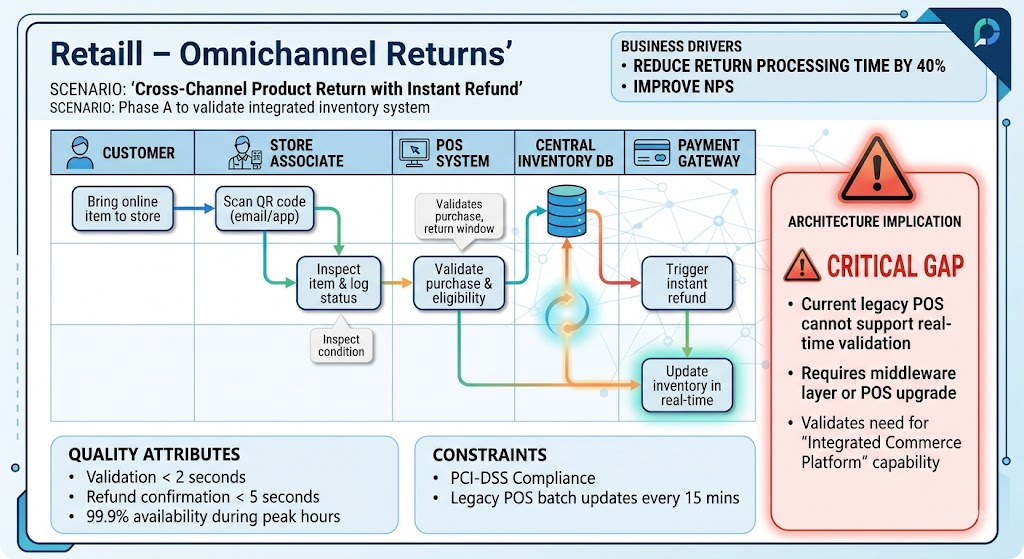
Used in Phase A to validate the need for an integrated inventory system.
-
Scenario Name: Cross-Channel Product Return with Instant Refund
-
Business Driver: Reduce return processing time by 40%; improve Net Promoter Score (NPS).
-
Actors: Customer, Store Associate, POS System, Central Inventory DB, Payment Gateway.
-
Flow:
-
Customer brings online-purchased item to physical store.
-
Associate scans QR code from customer’s email/app.
-
System validates purchase, checks return window, and verifies item eligibility.
-
Associate inspects item condition and logs status.
-
System triggers instant refund to original payment method.
-
Inventory updated in real-time across all channels.
-
-
Quality Attributes: Validation < 2 seconds; Refund confirmation < 5 seconds; 99.9% availability during peak hours.
-
Constraints: Must comply with PCI-DSS; Legacy POS only supports batch updates every 15 mins.
-
Architecture Implication: ⚠️ CRITICAL GAP. Current legacy POS cannot support real-time validation. Requires middleware layer or POS upgrade. Validates the need for the “Integrated Commerce Platform” capability.
Example 2: Healthcare – Emergency Patient Handoff
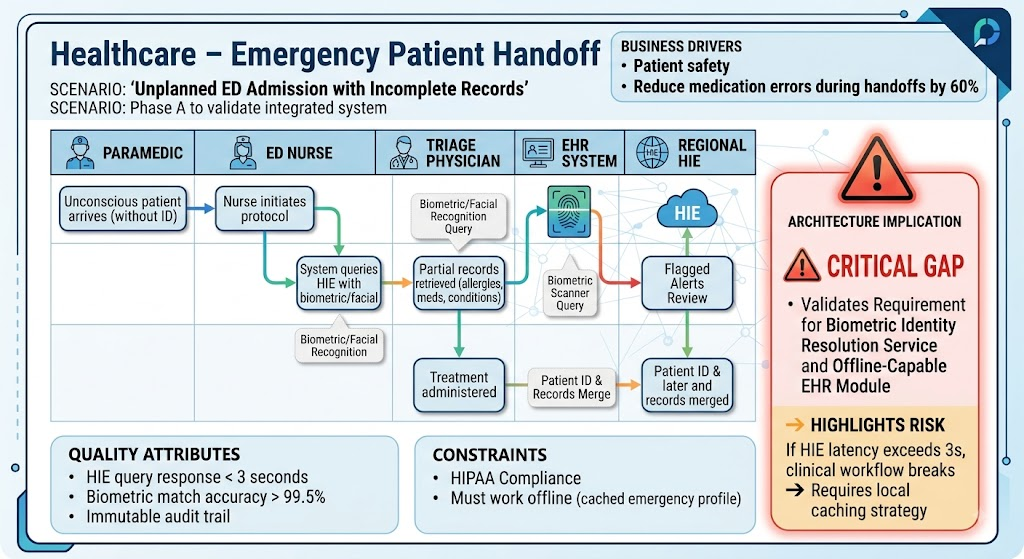
Used in Phase B/C to validate data interoperability and security.
-
Scenario Name: Unplanned ED Admission with Incomplete Records
-
Business Driver: Patient safety; Reduce medication errors during handoffs by 60%.
-
Actors: Paramedic, ED Nurse, Triage Physician, EHR System, Regional Health Information Exchange (HIE).
-
Flow:
-
Unconscious patient arrives without ID.
-
Nurse initiates “Unknown Patient” protocol.
-
System queries HIE using biometric/facial recognition.
-
Partial records retrieved (allergies, current meds, chronic conditions).
-
Physician reviews flagged alerts before administering treatment.
-
Patient identified later; records merged automatically.
-
-
Quality Attributes: HIE query response < 3 seconds; Biometric match accuracy > 99.5%; Audit trail immutable.
-
Constraints: HIPAA compliance; Must work offline if network fails (cached emergency profile).
-
Architecture Implication: Validates requirement for Biometric Identity Resolution Service and Offline-Capable EHR Module. Highlights risk: If HIE latency exceeds 3s, clinical workflow breaks → requires local caching strategy.
Example 3: Financial Services – Regulatory Reporting Automation
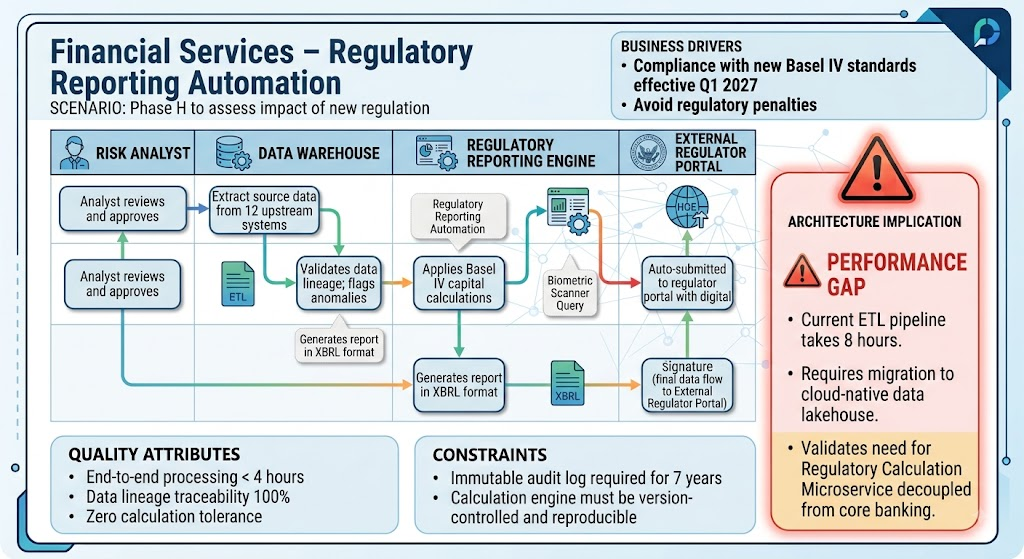
Used in Phase H to assess impact of new regulation.
-
Scenario Name: Basel IV Capital Adequacy Report Generation
-
Business Driver: Compliance with new Basel IV standards effective Q1 2027; Avoid regulatory penalties.
-
Actors: Risk Analyst, Data Warehouse, Regulatory Reporting Engine, External Regulator Portal.
-
Flow:
-
Monthly close completes; source data extracted from 12 upstream systems.
-
Data lineage validated; anomalies flagged for review.
-
Capital calculations applied per Basel IV formulas.
-
Report generated in XBRL format.
-
Analyst reviews and approves.
-
Auto-submitted to regulator portal with digital signature.
-
-
Quality Attributes: End-to-end processing < 4 hours; Data lineage traceability 100%; Zero calculation tolerance.
-
Constraints: Immutable audit log required for 7 years; Calculation engine must be version-controlled and reproducible.
-
Architecture Implication: Current ETL pipeline takes 8 hours → Performance Gap. Requires migration to cloud-native data lakehouse. Validates need for Regulatory Calculation Microservice decoupled from core banking.
5. How to Use Business Scenarios in the ADM
| ADM Phase | Application of Business Scenarios |
|---|---|
| Preliminary | Identify high-level scenarios to scope the architecture engagement. |
| Phase A: Vision | Develop detailed scenarios to validate the Architecture Vision against stakeholder concerns. Prioritize scenarios based on business value/risk. |
| Phase B: Business Arch | Map scenarios to Business Capabilities. Identify capability gaps. |
| Phase C: Info Systems | Derive data entities and application functions directly from scenario flows. |
| Phase D: Technology | Validate infrastructure can meet scenario QoS (latency, throughput, resilience). |
| Phase E/F: Opportunities & Migration | Sequence work packages based on which scenarios they enable. |
| Phase G: Implementation | Use scenarios as acceptance test criteria. |
| Phase H: Change Mgmt | New/change requests are framed as new or modified scenarios. Assess architectural impact. |
6. Best Practices & Common Pitfalls
✅ Best Practices
-
Co-create with Stakeholders: Never write scenarios in isolation. Facilitate workshops with business owners.
-
Include Negative/Exception Flows: Architectures fail at the edges. Document what happens when things go wrong.
-
Traceability Matrix: Maintain a mapping:
Strategic Goal → Business Scenario → Capability → Application → Technology. This ensures nothing is built without justification. -
Quantify Success: Avoid “fast,” “secure,” “easy.” Use “< 200ms,” “AES-256 encrypted,” “< 3 clicks.”
-
Version Control: Scenarios evolve. Track changes to understand shifting requirements.
❌ Common Pitfalls
-
Too Abstract: “User accesses system securely” is useless. Specify which user, what system, how security is enforced.
-
Solution-Biased: Describing the technology instead of the business need. Write “Customer receives notification” not “System sends SMS via Twilio API.”
-
Ignoring Constraints: Failing to capture regulatory, legacy, or budget constraints leads to architectures that look good on paper but fail in reality.
-
Scenario Sprawl: Creating hundreds of micro-scenarios. Group related flows; focus on architecturally significant scenarios.
-
No Validation Loop: Writing scenarios once and never revisiting them during Phases B-D. They must be continuously validated against emerging designs.
7. Summary Checklist for Architects
Before finalizing a Business Scenario, verify:
-
Is it tied to a specific business driver or strategic goal?
-
Are all relevant stakeholders and actors identified?
-
Are normal AND exception flows documented?
-
Are quality attributes quantified and measurable?
-
Are constraints (regulatory, technical, temporal) explicitly stated?
-
Have architecture implications/gaps been identified?
-
Has it been validated with the business stakeholder?
-
Is it mapped to relevant Business Capabilities?
-
Can it serve as an acceptance criterion in Phase G?
🔑 Key Takeaway: Business Scenarios are the litmus test of enterprise architecture. If your architecture cannot demonstrably support the validated Business Scenarios, it is not fit for purpose—regardless of how elegant the technology stack appears. Always let real-world scenarios drive architectural decisions, not the reverse.
Conclusion
Business Scenarios are the essential connective tissue between strategic intent and technical implementation within the TOGAF ADM. By rigorously defining the actors, flows, quality attributes, and constraints of real-world situations, architects move beyond speculative design to create solutions that are demonstrably fit for purpose. As illustrated through the retail, healthcare, and financial services examples, scenarios do not merely capture requirements; they actively expose gaps, validate capabilities, and serve as measurable acceptance criteria for implementation. Ultimately, the value of an enterprise architecture is not determined by the sophistication of its diagrams, but by its ability to reliably support the business scenarios that matter most. Architects who master this technique ensure their work remains grounded in reality, resilient to change, and continuously aligned with the evolving needs of the enterprise.
Visual Paradigm TOGAF References
Overview of the TOGAF® Standard, 10th Edition: A comprehensive overview of TOGAF 10’s key updates, including expanded guidance, modular structure, and its emphasis on agile and digital transformation .
What’s New in the TOGAF® Standard, 10th Edition?: A detailed look at new features like the TOGAF Fundamental Content, Series Guides, and a more configurable framework for enterprise architects .
Transforming Enterprise Architecture: A Case Study on Adopting TOGAF® Standard 10th Edition with Visual Paradigm: A case study showing how a financial services firm used Visual Paradigm to implement TOGAF 10, achieving a 45% faster time-to-value for architecture deliverables .
Comprehensive Guide to TOGAF 10 for Beginners: An introductory guide covering core EA concepts, the structure of TOGAF documentation, and steps for getting started with the framework .
TOGAF ADM: A Quick Tutorial: A practical walkthrough of the TOGAF Architecture Development Method (ADM), explaining its incremental and iterative nature across the Preliminary Phase, Phase A, and beyond .
Step-by-Step: Using AI to Generate Artifacts from Descriptions in Visual Paradigm TOGAF Guide-Through: A guide on using AI to generate TOGAF-compliant artifacts like ArchiMate diagrams and gap visualizations from natural language descriptions .
Real-World Examples & Use Cases: AI-Enhanced TOGAF in Retail & Finance Transformations: Two anonymized case studies (retail and banking) demonstrating how AI-enhanced TOGAF tools reduced ADM documentation time by 50-80% .
Case Study: Business Transformation Readiness Assessment at TechInnovate Solutions: A detailed example of using a maturity model to assess readiness factors like vision, governance, and IT capacity during business transformation planning .
Transformando la Arquitectura Empresarial: Un Estudio de Caso sobre la Implementación de TOGAF ADM Mejorada con IA: A Spanish-language case study on a global financial organization using AI-enhanced TOGAF ADM for cloud migration, highlighting automated document generation and capability heatmaps .
TOGAF 10: The Next Level of Enterprise Architecture Framework: A summary of TOGAF 10’s enhanced guidance, modular structure, and stronger emphasis on agile methodologies and digital transformation .