


Mastering the “What” vs. “How”: A Beginner’s Guide to Business Capability Modeling with TOGAF
Introduction
In the world of Enterprise Architecture, few concepts are as transformative—and as frequently misunderstood—as the distinction between “What” and “How.” According to the TOGAF Series Guide on Business Capability Modeling, this differentiation is not merely semantic; it is the foundational principle that determines whether an architecture will serve as a durable strategic asset or a fleeting technical document.
For beginners, this shift in perspective is often the most significant hurdle. We are professionally conditioned to describe our work through tasks, workflows, and tools (the “How”). However, TOGAF posits that to truly align IT with long-term business strategy, architects must first model the stable, enduring abilities of the enterprise (the “What”). This guide provides a comprehensive breakdown of Business Capability Modeling, designed specifically to help newcomers bridge the gap between operational processes and strategic capabilities.
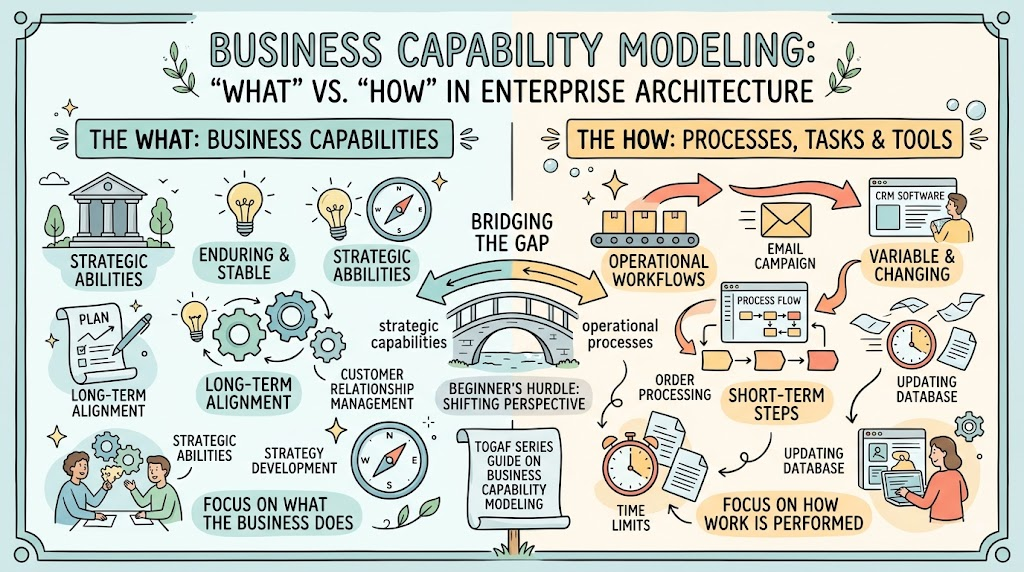
1. The Core Concept: What vs. How
At the heart of capability modeling lies a simple but profound dichotomy. Understanding this table is the first step toward effective architecture:
| Feature | “What” (Business Capability) | “How” (Process / Implementation) |
|---|---|---|
| Definition | An ability or capacity that the business possesses to achieve an outcome. | The specific steps, people, and tools used to execute the capability. |
| Stability | Stable. Changes only when the business model changes. | Volatile. Changes frequently due to tech upgrades, reorgs, or efficiency drives. |
| Focus | Outcomes and Value. | Activities and Efficiency. |
| IT Alignment | Strategic (Investment portfolios, platform planning). | Tactical (Automation, workflow optimization). |
| Naming Convention | Noun + Verb (e.g., Payment Processing) | Verb + Noun (e.g., Process Invoices) |
💡 The Golden Rule: If you can replace the underlying technology or outsource the team, but the business still needs the outcome, it is a Capability. If changing the software means the definition itself changes, you are describing a Process.
Key Concepts for Beginners
-
Abstraction Level: Capabilities exist at a higher level of abstraction than processes. They represent the “black box” of value delivery without exposing the internal wiring.
-
Technology Agnostic: A well-defined capability map should look identical whether the organization uses legacy mainframes, cloud-native microservices, or manual paper ledgers.
-
Strategic Vocabulary: Capabilities provide a common language between business executives and IT leaders, removing technical jargon from strategic planning discussions.
2. Translating “How” to “What”: Practical Examples
The best way to internalize this concept is through translation. Below are common scenarios where beginners mistakenly map volatile processes, corrected into stable capabilities.
Example Set A: Human Resources
-
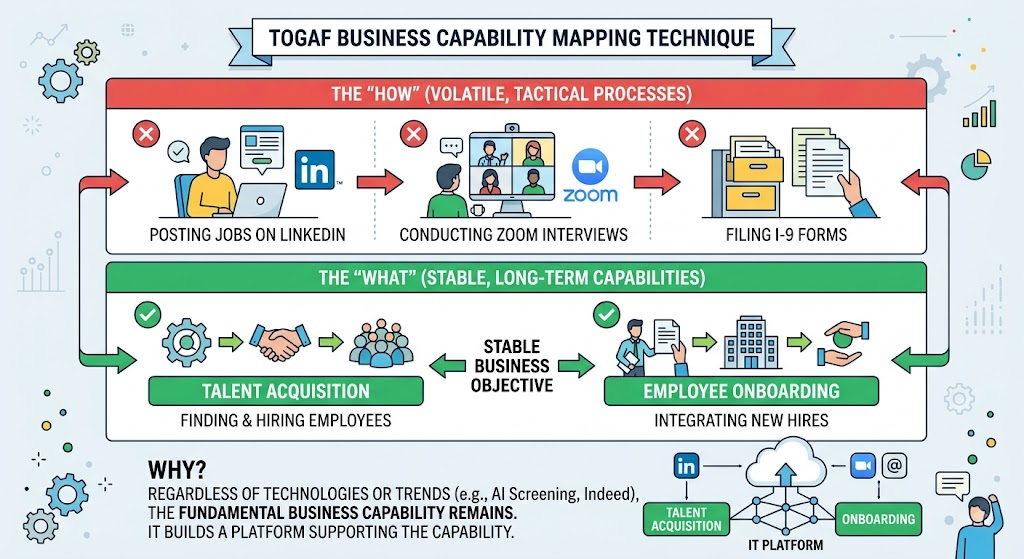
❌ The “How” (Volatile): “Posting jobs on LinkedIn,” “Conducting Zoom interviews,” “Filing I-9 forms in the cabinet.”
-
✅ The “What” (Stable): Talent Acquisition or Employee Onboarding.
-
Why? Whether you use LinkedIn, Indeed, AI screening, or face-to-face interviews, the business capability required remains “Talent Acquisition.” IT can build a platform supporting this capability regardless of the current hiring trend.
-
Example Set B: Retail / E-Commerce
-
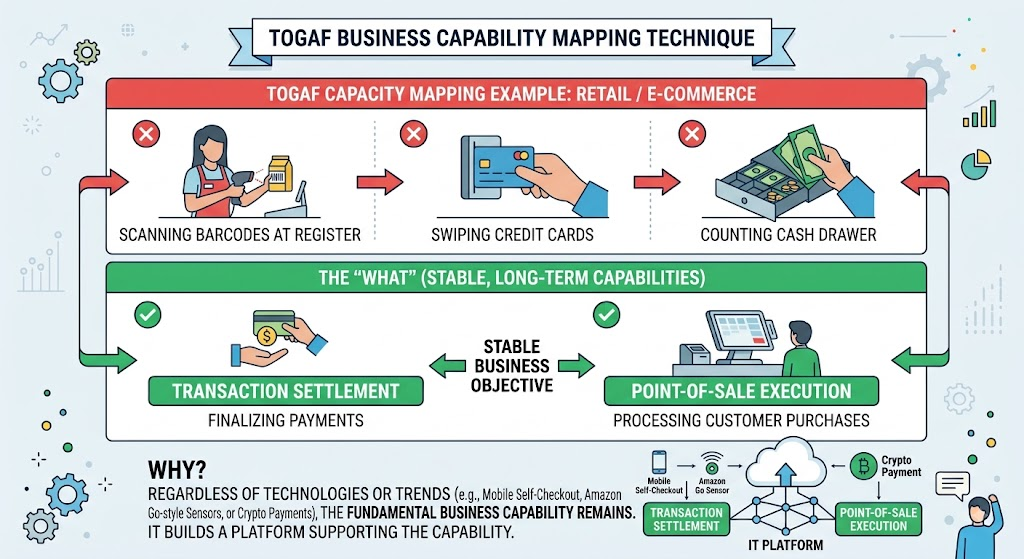
❌ The “How” (Volatile): “Scanning barcodes at register,” “Swiping credit cards,” “Counting cash drawer.”
-
✅ The “What” (Stable): Transaction Settlement or Point-of-Sale Execution.
-
Why? You might switch to mobile self-checkout, Amazon Go-style sensors, or crypto payments next year. The capability of “settling a transaction” never goes away; only the mechanism changes.
-
Example Set C: Manufacturing
-
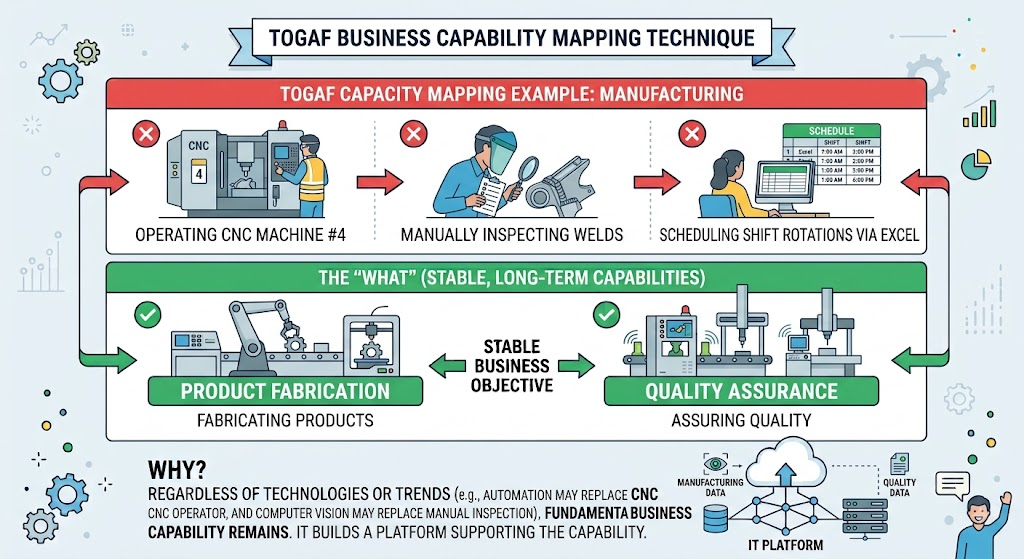
❌ The “How” (Volatile): “Operating CNC Machine #4,” “Manually inspecting welds,” “Scheduling shift rotations via Excel.”
-
✅ The “What” (Stable): Product Fabrication or Quality Assurance.
-
Why? Automation may replace the CNC operator, and computer vision may replace manual inspection. The business still requires the capability to fabricate products and assure quality.
-
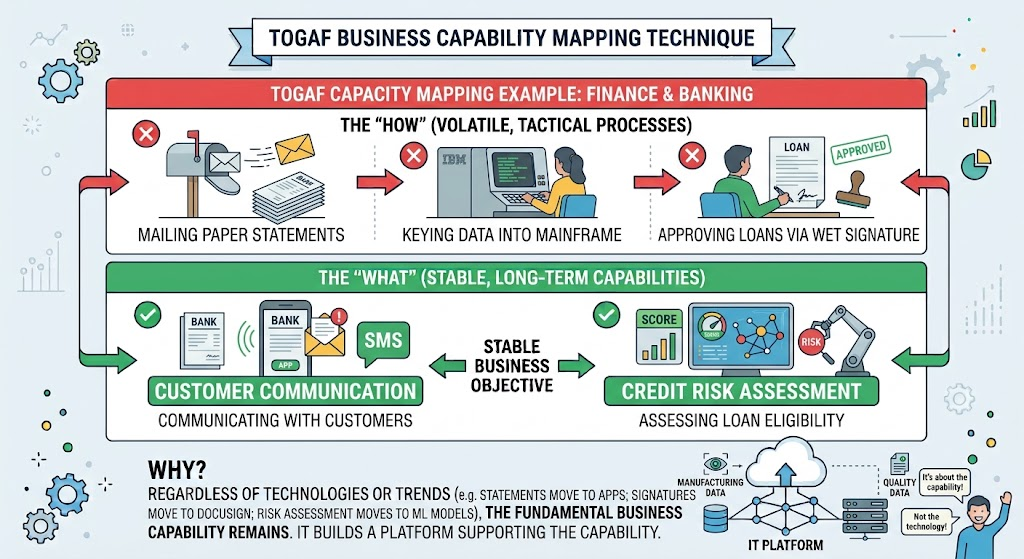
Example Set D: Finance & Banking
-
❌ The “How” (Volatile): “Mailing paper statements,” “Keying data into mainframe,” “Approving loans via wet signature.”
-
✅ The “What” (Stable): Customer Communication or Credit Risk Assessment.
-
Why? Statements move to apps; signatures move to DocuSign; risk assessment moves to ML models. The capability remains constant.
-
3. Applying Capabilities to Strategy via Business Scenarios
TOGAF uses Business Scenarios to validate that your capability map actually supports strategy. A scenario describes a business problem or opportunity, which then maps to required capabilities rather than specific technical solutions.
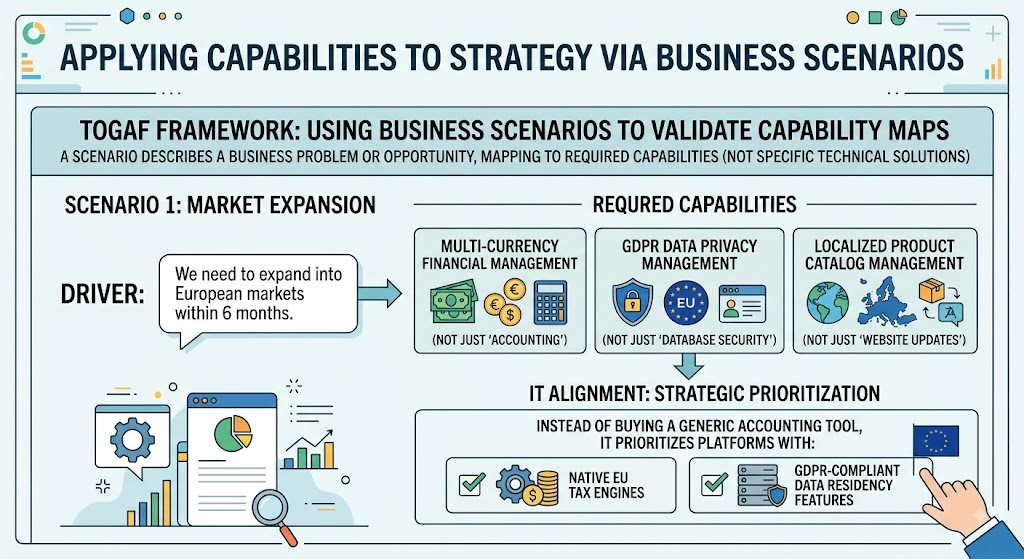
Scenario 1: Market Expansion
-
Driver: “We need to expand into European markets within 6 months.”
-
Required Capabilities:
-
Multi-Currency Financial Management (Not just “Accounting”)
-
GDPR Data Privacy Management (Not just “Database Security”)
-
Localized Product Catalog Management (Not just “Website Updates”)
-
-
IT Alignment: Instead of buying a generic accounting tool, IT prioritizes platforms with native EU tax engines and GDPR-compliant data residency features.
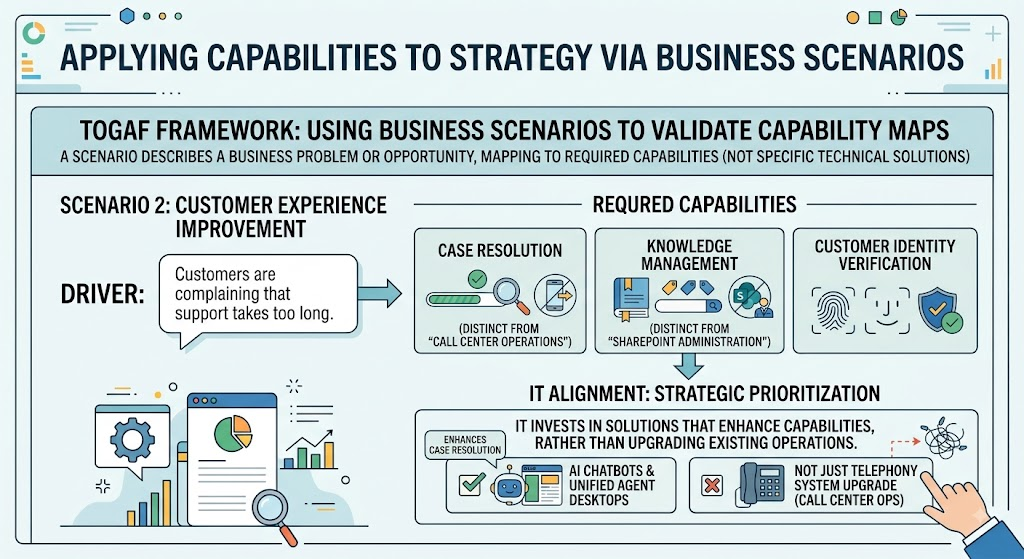
Scenario 2: Customer Experience Improvement
-
Driver: “Customers are complaining that support takes too long.”
-
Required Capabilities:
-
Case Resolution (Distinct from “Call Center Operations”)
-
Knowledge Management (Distinct from “SharePoint Administration”)
-
Customer Identity Verification
-
-
IT Alignment: IT invests in AI chatbots and unified agent desktops that enhance Case Resolution, rather than just upgrading the telephony system (Call Center Ops).
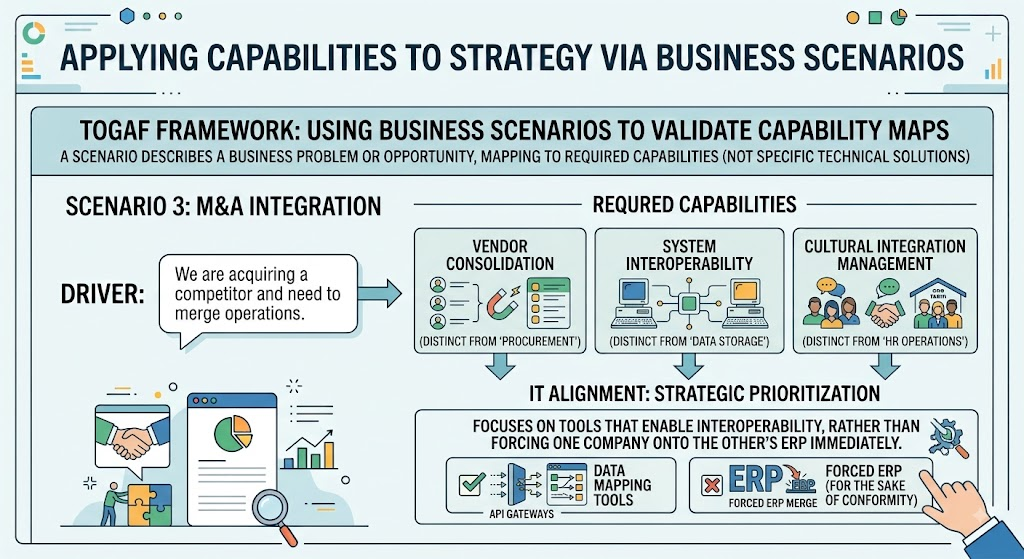
Scenario 3: M&A Integration
-
Driver: “We are acquiring a competitor and need to merge operations.”
-
Required Capabilities:
-
Vendor Consolidation
-
System Interoperability
-
Cultural Integration Management
-
-
IT Alignment: Focuses on API gateways and data mapping tools that enable Interoperability, rather than forcing one company onto the other’s ERP immediately.
4. Why This Matters for IT Alignment
Presenting a “What” model to stakeholders avoids critical architectural pitfalls:
-
Avoiding Tech Lock-In: Defining a capability as “SAP Invoice Processing” locks you into SAP forever. Defining it as “Accounts Payable Execution” allows you to swap vendors without breaking your architecture model.
-
Identifying Redundancy: You might discover three departments have “Customer Notification” capabilities built differently. Consolidating these saves money—a redundancy invisible if you only examine department-specific processes.
-
Future-Proofing Investments: Requesting budget for “Digital Channel Management” ties directly to revenue strategy. Requesting funds to “update the web server” sounds like maintenance and is easily cut during budget reviews.
5. Quick Self-Test for Beginners
Before adding any item to your Business Capability Map, apply this three-question filter:
-
Is it a noun phrase? (e.g., “Risk Management” ✅ vs. “Managing Risks” ❌)
-
Will this exist in 5 years even if we change all our software? (If no, it’s a process.)
-
Does it deliver a distinct business outcome? (If it’s just a sub-task of something larger, drill up a level.)
By anchoring your architecture in the stable “What,” you create a blueprint that survives organizational restructuring, technology refresh cycles, and market pivots—which is exactly what the TOGAF Series Guide intends.
Conclusion
Business Capability Modeling is more than a diagramming exercise; it is a discipline of strategic clarity. By rigorously distinguishing between the enduring “What” and the transient “How,” enterprise architects can transform IT from a cost center focused on keeping the lights on into a strategic partner capable of driving business evolution. For beginners, mastering this distinction is the single most important step toward building architectures that are resilient, relevant, and aligned with the future of the enterprise.
References
-
Overview of the TOGAF® Standard, 10th Edition: A comprehensive overview of TOGAF 10’s key updates, including expanded guidance, modular structure, and its emphasis on agile and digital transformation .
-
What’s New in the TOGAF® Standard, 10th Edition?: A detailed look at new features like the TOGAF Fundamental Content, Series Guides, and a more configurable framework for enterprise architects .
-
Transforming Enterprise Architecture: A Case Study on Adopting TOGAF® Standard 10th Edition with Visual Paradigm: A case study showing how a financial services firm used Visual Paradigm to implement TOGAF 10, achieving a 45% faster time-to-value for architecture deliverables .
-
Comprehensive Guide to TOGAF 10 for Beginners: An introductory guide covering core EA concepts, the structure of TOGAF documentation, and steps for getting started with the framework .
-
TOGAF ADM: A Quick Tutorial: A practical walkthrough of the TOGAF Architecture Development Method (ADM), explaining its incremental and iterative nature across the Preliminary Phase, Phase A, and beyond .
-
Step-by-Step: Using AI to Generate Artifacts from Descriptions in Visual Paradigm TOGAF Guide-Through: A guide on using AI to generate TOGAF-compliant artifacts like ArchiMate diagrams and gap visualizations from natural language descriptions .
-
Real-World Examples & Use Cases: AI-Enhanced TOGAF in Retail & Finance Transformations: Two anonymized case studies (retail and banking) demonstrating how AI-enhanced TOGAF tools reduced ADM documentation time by 50-80% .
-
Case Study: Business Transformation Readiness Assessment at TechInnovate Solutions: A detailed example of using a maturity model to assess readiness factors like vision, governance, and IT capacity during business transformation planning .
-
Transformando la Arquitectura Empresarial: Un Estudio de Caso sobre la Implementación de TOGAF ADM Mejorada con IA: A Spanish-language case study on a global financial organization using AI-enhanced TOGAF ADM for cloud migration, highlighting automated document generation and capability heatmaps .
-
TOGAF 10: The Next Level of Enterprise Architecture Framework: A summary of TOGAF 10’s enhanced guidance, modular structure, and stronger emphasis on agile methodologies and digital transformation .