


Mastering Architectural Patterns in TOGAF: A Practical Guide for Enterprise Architects
Introduction
In the complex landscape of modern enterprise architecture, organizations frequently encounter recurring structural challenges. Whether decoupling legacy monoliths, enabling real-time data processing, or scaling globally distributed systems, architects often reinvent solutions that have already been codified. This is where Architectural Patterns become indispensable.
Within the TOGAF® (The Open Group Architecture Framework) ecosystem, architectural patterns are more than just technical best practices; they are standardized, reusable assets that bridge the gap between abstract business strategy and concrete technology implementation. Unlike software design patterns that operate at the code level, architectural patterns govern high-level system structures, component relationships, and operational characteristics across Business, Data, Application, and Technology domains.
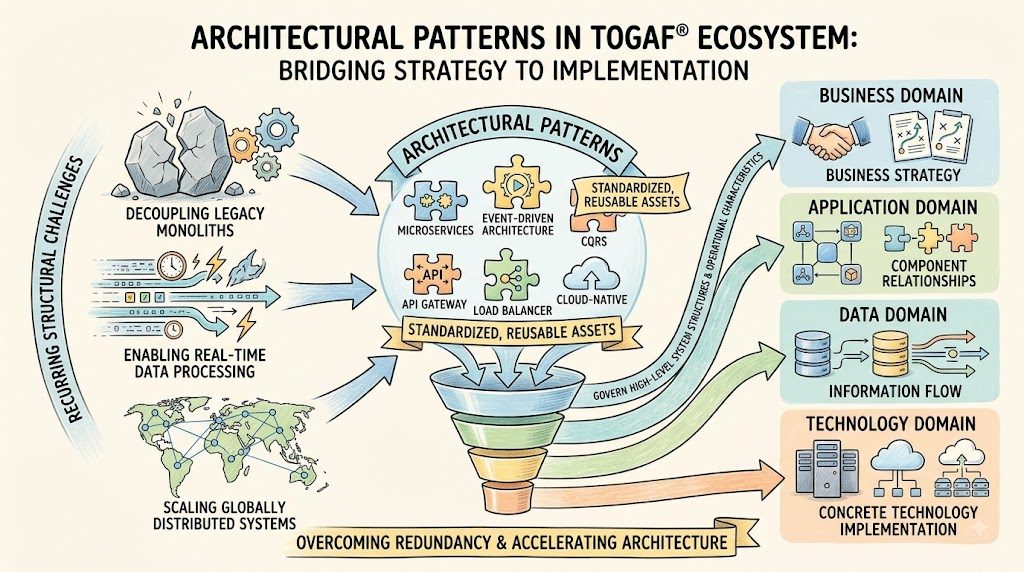
This comprehensive guide explores how to effectively identify, select, document, and instantiate architectural patterns within the TOGAF Architecture Development Method (ADM). It serves as a practical handbook for enterprise architects, solution architects, and domain leads seeking to reduce risk, accelerate delivery, and maintain architectural coherence.
Key Concepts
Before diving into the ADM integration, it is critical to understand three foundational concepts that distinguish TOGAF-based pattern usage from ad-hoc engineering.
1. ABB vs. SBB Distinction
A core tenet of TOGAF is the separation of Intent and Implementation. Patterns must be defined first as Architecture Building Blocks (ABBs) before being mapped to Solution Building Blocks (SBBs).
-
ABB: Defines what capability or structure is needed (e.g., “Asynchronous Message Broker”).
-
SBB: Defines how it is realized with specific products (e.g., “Apache Kafka Cluster on AWS MSK”).
2. The Pattern Template Standard
To ensure reuse, patterns cannot exist as vague ideas. They must be documented assets containing Context, Problem, Forces, Solution, Known Uses, and Anti-Patterns. This standardization allows governance bodies to evaluate patterns objectively rather than subjectively.
3. Patterns Across Domains
Architectural patterns are not limited to IT infrastructure. They span all four TOGAF domains:
-
Business: Capability-Based Planning, Value Stream Mapping.
-
Data: Data Mesh, Lambda/Kappa Architectures.
-
Application: Microservices, CQRS, BFF.
-
Technology: Zero-Trust, Container Orchestration, Edge Computing.
Architectural Patterns & TOGAF Building Blocks
Understanding the relationship between abstract patterns and concrete solutions is fundamental to TOGAF compliance. An architectural pattern defined at the ABB level specifies structural and behavioral constraints without mandating vendor lock-in. Only during later ADM phases are these patterns instantiated into specific technologies.
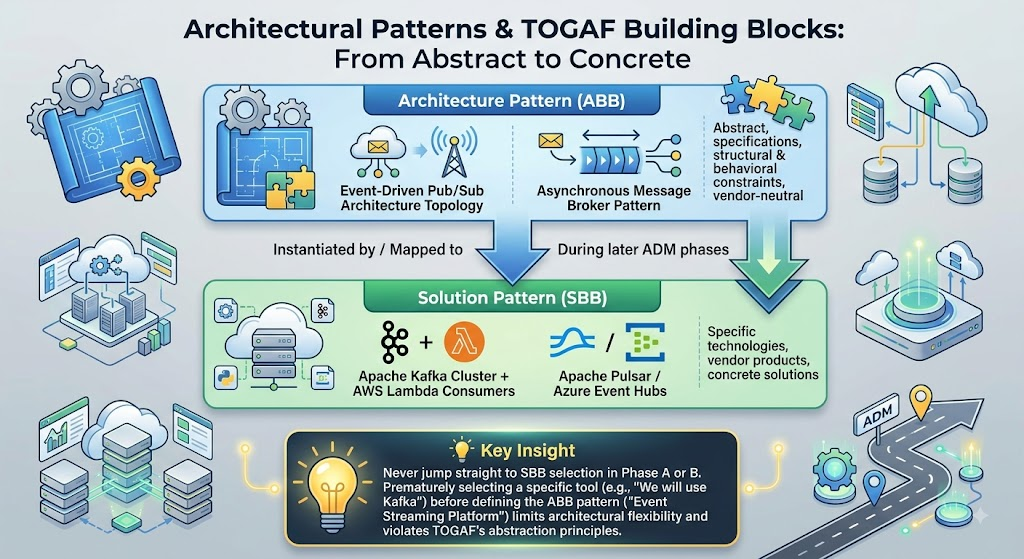
💡 Key Insight: Never jump straight to SBB selection in Phase A or B. Prematurely selecting a specific tool (e.g., “We will use Kafka”) before defining the ABB pattern (“Event Streaming Platform”) limits architectural flexibility and violates TOGAF’s abstraction principles.
Core Architectural Pattern Catalog
Architectural patterns span all four primary TOGAF architecture domains. Below is a taxonomy of essential patterns widely leveraged in modern digital enterprises, including their strategic intent and critical trade-offs.
Distributed & Application Topology Patterns
| Pattern | Strategic Intent | ADM Target Domains | Key Trade-offs |
|---|---|---|---|
| Microservices Architecture | Decomposes applications into independently deployable, domain-scoped services around business capabilities. | Application, Technology | + High agility, autonomous scaling. – Distributed system complexity, eventual consistency. |
| Event-Driven Architecture (EDA) | Decouples producers and consumers using asynchronous event streams and message brokers. | Application, Data, Technology | + Real-time responsiveness, spatial/temporal decoupling. – Complex debugging, out-of-order execution risk. |
| CQRS & Event Sourcing | Separates Read (Query) and Write (Command) paths; stores state changes as an immutable log of events. | Data, Application | + Extremely high read throughput, complete audit log. – Increased architectural complexity, eventual consistency lag. |
| Layered (N-Tier) Architecture | Groups components into horizontal layers (Presentation, Business, Data) with strict downward dependencies. | Application | + Simplicity, clear separation of concerns. – Monolithic deployment risks, layer-pass-through overhead. |
| Space-Based Architecture | Eliminates central database bottlenecks by distributing state across dynamic in-memory data grids. | Application, Data, Technology | + Near-infinite horizontal scalability, low latency. – High licensing costs, complex data synchronization. |
Examples in Practice
-
Retail E-Commerce (EDA + Microservices): A global retailer uses Event-Driven Architecture to decouple inventory management from order processing. When an order is placed, an
OrderCreatedevent triggers inventory reservation, payment processing, and shipping notification services asynchronously. This prevents a single point of failure during peak sales events like Black Friday.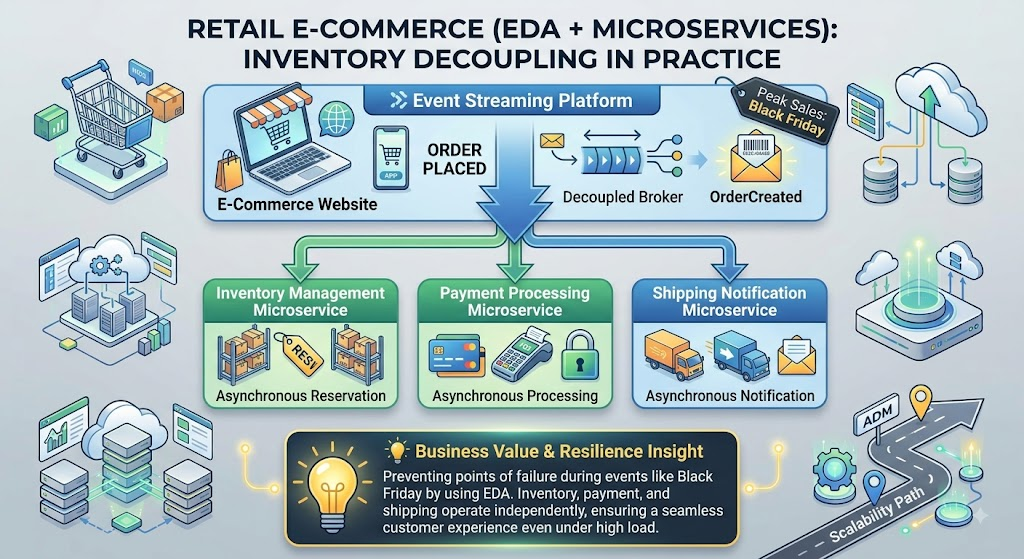
-
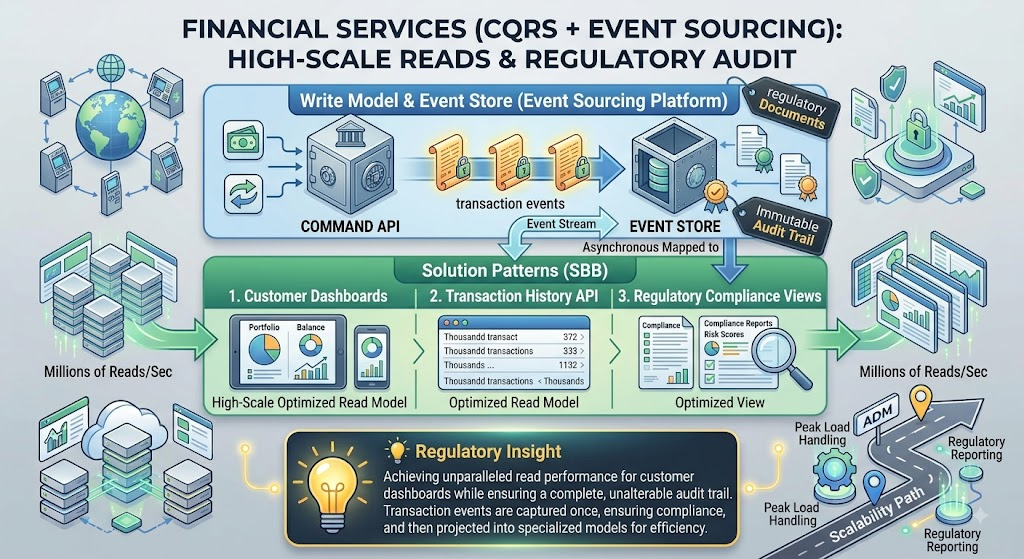
Financial Services (CQRS + Event Sourcing): A banking platform implements CQRS to handle millions of transaction reads per second while maintaining a complete, immutable audit trail of every balance change for regulatory compliance. The write model captures events, while optimized read models serve customer dashboards.
-
-
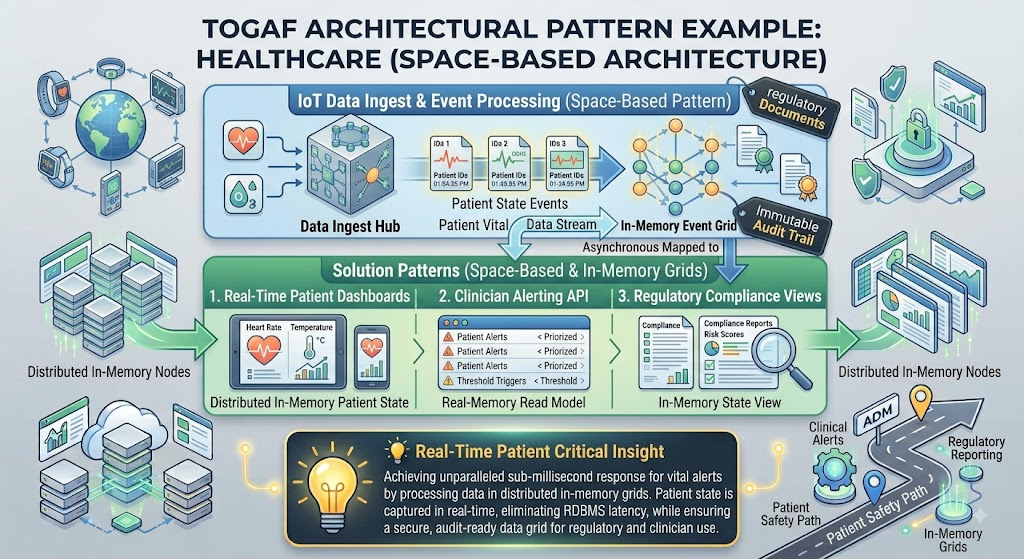
Healthcare (Space-Based Architecture): A patient monitoring system uses space-based architecture to process real-time vitals from thousands of IoT devices. By keeping patient state in distributed in-memory grids rather than a centralized RDBMS, the system achieves sub-millisecond response times critical for alerting clinicians.
Mapping Architectural Patterns to the TOGAF ADM
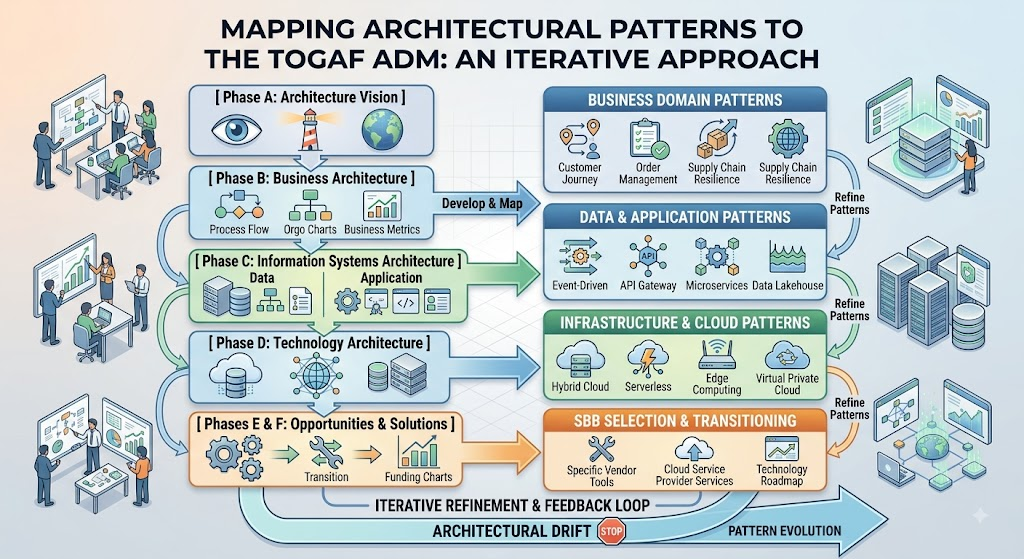
Patterns are not applied at a single point in time; they are referenced, evaluated, and specified iteratively across the ADM cycle. Treating patterns as static artifacts leads to architectural drift. Instead, they should evolve through each phase.
Phase A: Architecture Vision
-
Activity: Identify high-level pattern drivers based on business goals, principles, and strategic constraints. For example, a business requirement for “global 99.99% availability” immediately surfaces Multi-Region Active-Active or Geo-Redundancy patterns as candidates.
-
Deliverable: Initial architectural scope referencing high-level pattern candidates in the Architecture Vision document.
Phase B: Business Architecture
-
Activity: Apply business-level structural patterns. This includes Capability-Based Planning to organize architecture around what the business does rather than organizational silos, Value Stream Mapping Patterns to identify flow inefficiencies, and decisions between Process Orchestration vs. Choreography for service coordination.
-
Deliverable: Target Business Architecture defined through domain-driven boundaries (e.g., Bounded Contexts for business services).
Phase C: Information Systems Architecture
-
Data Architecture: Select patterns for data integration and storage. Common selections include Data Mesh for decentralized data ownership, Master Data Management Hub-and-Spoke for golden record consistency, or Lambda/Kappa Big Data Architectures for batch/stream processing unification.
-
Application Architecture: Formulate the target application structure using patterns such as API Gateway/BFF (Backend-For-Frontend) for client-specific aggregation, Event-Driven Pub/Sub for loose coupling, or Microservices for independent deployment.
Phase D: Technology Architecture
-
Activity: Select infrastructure patterns supporting the Phase C application and data requirements. If Phase C selected Microservices, Phase D must evaluate Container Orchestration Patterns (Kubernetes), Service Mesh Patterns for observability/security, Zero-Trust Security Patterns, and Hybrid-Cloud Edge Computing topologies.
-
Deliverable: Target Technology Architecture with infrastructure service ABBs mapped to physical technology capabilities.
Phase E & F: Opportunities & Solutions / Migration Planning
-
Activity: Map abstract ABBs to concrete SBBs. This is where “Event Broker ABB” becomes “AWS EventBridge” or “Apache Kafka.” Crucially, apply migration patterns like the Strangler Fig Pattern to incrementally modernize legacy monoliths into target pattern states without big-bang rewrites.
-
Deliverable: Implementation roadmap with phased SBB deployments and transition architectures.
Governance & Pattern Repository Management
To maximize reuse and prevent architectural drift, patterns must be governed through the Enterprise Continuum and stored in the enterprise Architecture Repository. Without governance, patterns become tribal knowledge rather than organizational assets.
Pattern Documentation Standard
Every architectural pattern entry in the enterprise repository should adhere to a standardized template to ensure consistency and evaluability:
-
Pattern Name & Identifier: Unique taxonomy ID and concise descriptor (e.g.,
PAT-APP-004: Event-Driven Publish-Subscribe). -
Context & Problem Statement: Specific operational scenarios and pain points where this pattern applies. Example: “High-volume transaction processing where synchronous calls create unacceptable latency.”
-
Architectural Forces: Competing requirements that create tension. Example: Cost vs. Latency, Consistency vs. Availability (CAP theorem), Time-to-Market vs. Operational Complexity.
-
Solution Description (ABB Specification): Component structure, interaction diagrams, sequence diagrams, and contract specifications. Must remain vendor-neutral.
-
Known Uses & Approved SBBs: Verified implementation stacks with lessons learned. Example: “Approved: AWS EventBridge, Azure Service Bus. Pilot: Confluent Cloud.”
-
Anti-Patterns & Risks: Conditions under which the pattern should NOT be used. Example: “Do NOT use Event Sourcing for simple CRUD applications with no audit requirements; the complexity overhead outweighs benefits.”
Governance Checklist
| Governance Activity | Frequency | Owner | Success Metric |
|---|---|---|---|
| Pattern Review Board | Monthly | Chief Architect | # of patterns approved/rejected |
| Pattern Usage Audit | Quarterly | EA Team | % of projects using approved patterns |
| Anti-Pattern Detection | Continuous | Automated Tooling | # of violations flagged |
| Pattern Retirement Review | Bi-Annually | Architecture Review Board | # of deprecated patterns archived |
| SBB Refresh Cycle | Annually | Technology Standards Team | % of SBBs on current supported versions |
Conclusion
Architectural patterns are the connective tissue between TOGAF’s methodological rigor and the practical realities of modern system design. By treating patterns as first-class citizens within the ADM—defining them as ABBs before selecting SBBs, documenting them against standardized templates, and governing them through the Enterprise Continuum—organizations transform architecture from an ivory-tower exercise into a repeatable, scalable engineering discipline.
The key takeaway for practitioners is this: Patterns are not prescriptions; they are structured conversations about trade-offs. The value lies not in blindly adopting Microservices or Event-Driven Architecture, but in rigorously evaluating whether the pattern’s forces align with your organization’s specific context, constraints, and strategic intent. When embedded properly within TOGAF, architectural patterns become the foundation for resilient, adaptable, and strategically aligned enterprise systems.
⚠️ Final Warning: Avoid “Pattern Worship.” Just because a pattern is popular or well-documented does not mean it fits your context. Always validate against your specific Architectural Forces and Anti-Pattern criteria before adoption. The most dangerous architecture is one built on patterns applied without understanding their trade-offs.