


Navigating Uncertainty: A Comprehensive Guide to Risk Management in TOGAF® Architecture Transformation
Introduction
Enterprise Architecture (EA) is fundamentally about change. Whether modernizing legacy systems, adopting cloud-native technologies, or merging business units after an acquisition, organizations are constantly shifting from a Baseline Architecture to a Target Architecture. However, this transition is rarely seamless. The gap between “as-is” and “to-be” is where value is created, but it is also where projects fail, budgets balloon, and operations stall.
Within the TOGAF® Standard, Risk Management is not merely a compliance checkbox; it is a core architectural discipline. It provides the structured technique necessary to identify, evaluate, and mitigate potential points of failure before they compromise strategic objectives. This guide explores how to operationalize risk management within architecture transformation, ensuring that your EA practice delivers resilient, predictable outcomes rather than costly surprises.
Key Concepts in Architecture Risk
Before applying processes, architects must understand the specific vocabulary and dimensions of risk within the TOGAF framework.
What is Architecture Risk?
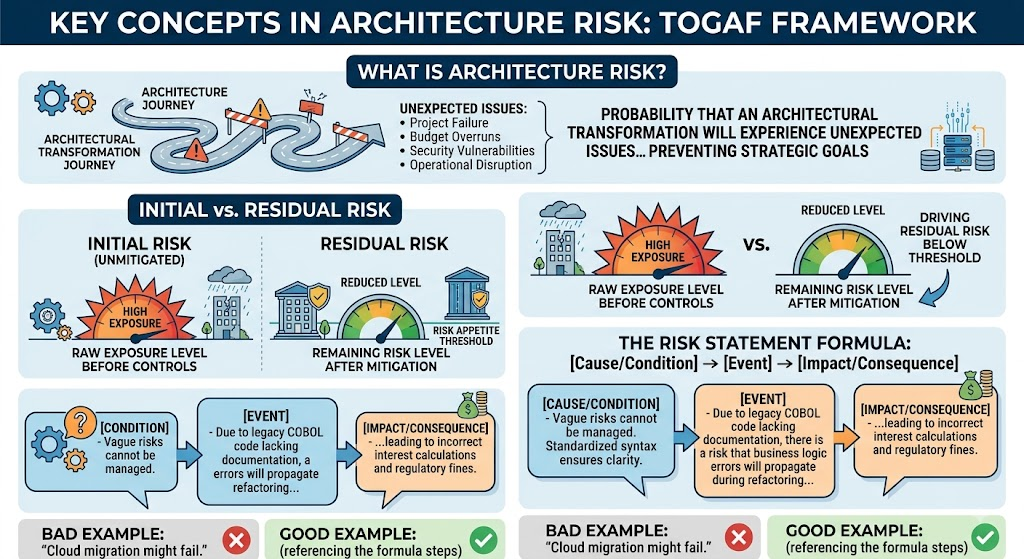
Architecture risk is defined as the probability that an architectural transformation will experience unexpected issues—such as project failure, budget overruns, security vulnerabilities, or operational disruption—that prevent the organization from achieving its strategic goals. Unlike general project risk, architecture risk specifically concerns the structural integrity, interoperability, and long-term viability of the enterprise’s technology and business landscape.
Initial vs. Residual Risk
TOGAF distinguishes between two critical states of risk assessment:
-
Initial Risk (Unmitigated Risk): The raw exposure level assessed before any controls are applied. This represents the “worst-case” scenario based on current capabilities.
-
Residual Risk: The remaining risk level after mitigation measures, architectural changes, and governance controls have been planned and implemented. The goal of EA risk management is to drive residual risk below the organization’s risk appetite threshold.
The Risk Statement Formula
Vague risks cannot be managed. TOGAF practitioners should adopt a standardized syntax to ensure clarity:
“Due to [Cause/Condition], there is a risk that [Event] may occur, leading to [Impact/Consequence].”
-
Bad Example: “Cloud migration might fail.”
-
Good Example: “Due to legacy COBOL code lacking documentation, there is a risk that business logic errors will propagate during refactoring, leading to incorrect interest calculations and regulatory fines.”
The TOGAF Risk Management Process
TOGAF outlines a continuous, four-step workflow for managing risks across the Architecture Development Method (ADM). This cycle ensures risk is treated as a dynamic attribute of the architecture, not a static artifact.
Step 1: Risk Identification
The objective is to uncover obstacles early. Risks in architecture transformation typically fall into five core domains:
-
Financial Risk: Exceeding CapEx/OpEx limits due to scope creep or licensing miscalculations.
-
Time/Schedule Risk: Delays in capability delivery impacting market readiness or regulatory deadlines.
-
Technical Risk: Architectural complexity, integration failures, unmanageable technical debt, or vendor EOL.
-
Operational Risk: System downtime, data loss, or productivity dips during cutover.
-
Cultural/Organizational Risk: User resistance, skills gaps, or change fatigue undermining adoption.
Step 2: Risk Assessment & Quantification
Risks are evaluated along two axes to prioritize treatment efforts:
-
Probability (Likelihood): How likely is the event? (Low, Medium, High)
-
Impact (Severity): What is the magnitude of damage? (Low, Medium, High, Critical)
The TOGAF Risk Matrix
| Probability \ Impact | Low Impact | Medium Impact | High Impact | Critical Impact |
|---|---|---|---|---|
| High Probability | Medium | High | Critical | Critical |
| Medium Probability | Low | Medium | High | Critical |
| Low Probability | Negligible | Low | Medium | High |
Note: Risks falling into the “Critical” quadrant require immediate architectural intervention or executive escalation.
Step 3: Risk Mitigation & Treatment Strategies
Once prioritized, architects select one of four treatment options:
-
Avoid (Eliminate): Alter the target architecture or reduce scope to remove the risk source entirely.
-
Mitigate (Reduce): Implement technical controls, prototypes, or phased rollouts to lower probability or impact.
-
Transfer (Share): Shift liability via insurance, outsourcing, or vendor SLAs.
-
Accept (Retain): Formally acknowledge the risk when mitigation costs exceed potential losses, documenting the rationale for audit trails.
Step 4: Risk Monitoring & Governance
Risk management persists throughout implementation. Architects must:
-
Track residual risks in steering committees.
-
Re-assess risks when business context or technology stacks change.
-
Validate through Phase G Architecture Contracts that risk controls are actively built into solution delivery.
Practical Example: Mainframe to Cloud Transformation
To visualize these concepts, consider a Retail Bank migrating its core transaction system from a legacy on-premises mainframe to a cloud-native microservices platform. This high-stakes transformation illustrates how abstract risk principles translate into actionable architecture decisions.
Applied Risk Register
| Risk ID | Risk Statement | Initial Level | Mitigation Strategy | Residual Level |
|---|---|---|---|---|
| R-01 | Legacy Data Incompatibility: Legacy data structures may not map directly to cloud databases, causing data loss during migration. | High | Implement a dual-write pattern and conduct three pilot shadow runs before full cutover. | Low |
| R-02 | Skill Gap: Internal developers lack experience in cloud-native microservices, causing security misconfigurations. | High | Pair staff with external consultants and mandate cloud architecture certifications before sprint execution. | Medium |
| R-03 | Vendor Lock-in: Dependence on proprietary cloud provider services limits future multi-cloud flexibility. | Medium | Standardize containerization (Kubernetes) and open-source APIs to isolate vendor-specific services. | Low |
| R-04 | Cutover Downtime: Unplanned system outage during final cutover degrades customer experience. | Critical | Design a blue/green deployment model with automated real-time rollback capabilities. | Low |
This register demonstrates that residual risk does not need to be zero; it needs to be managed. For example, R-02 remains at “Medium” because upskilling takes time, but the bank has accepted this interim state while implementing guardrails.
Mapping Risk Management to TOGAF ADM Phases
Risk management is woven into every phase of the ADM, evolving in granularity as the architecture matures.
| ADM Phase | Risk Management Activity |
|---|---|
| Phase A: Architecture Vision | Identify high-level enterprise risks; establish risk tolerance thresholds with stakeholders. |
| Phases B, C, D: Target Architectures | Identify domain-specific risks (Business, Application, Data, Technology) introduced by target designs. |
| Phase E: Opportunities & Solutions | Assess implementation risks (e.g., migration complexity, legacy co-existence). |
| Phase F: Migration Planning | Formulate risk-mitigated transition architectures and sequence work packages accordingly. |
| Phase G: Implementation Governance | Monitor residual risks and ensure implementation teams adhere to defined risk controls. |
Summary Checklist for Beginners
For architects new to TOGAF risk management, adhere to these foundational principles:
-
Start Early: Define risk appetite in Phase A. Waiting until Phase E to discuss risk results in expensive rework.
-
Be Specific: Avoid generic statements like “the system might break.” Detail the exact root cause and business consequence using the standard formula.
-
Focus on Residual Risk: The goal is not zero risk, but driving residual risk down to an acceptable level aligned with business strategy.
-
Align with Governance: Ensure architectural risk registers feed directly into corporate Enterprise Risk Management (ERM) frameworks to maintain organizational coherence.
Conclusion
Architecture transformation is inherently risky, but it is also the primary vehicle for enterprise evolution. By embedding the TOGAF Risk Management process into your ADM cycles, you shift risk from being a source of anxiety to a source of intelligence. Effective risk management allows architects to make informed trade-offs, secure stakeholder confidence through transparency, and ultimately deliver transformations that are not only innovative but sustainable. Remember: a resilient architecture is not one that avoids all risk, but one that understands and masters it.