


Navigating the TOGAF Series Guides: A Practical Handbook for Real-World Enterprise Architecture
Introduction
Enterprise Architecture (EA) has long faced a criticism: it is too theoretical, too rigid, and too disconnected from the speed of modern business. The TOGAF® Standard, 10th Edition directly addresses this challenge by fundamentally restructuring how guidance is delivered. While the TOGAF Fundamental Content provides the immutable core rules and scaffolding (such as the Architecture Development Method or ADM), the TOGAF Series Guides serve as the modular, “how-to” foundation for practical application.
The primary purpose of these Series Guides is to bridge the gap between abstract architectural principles and concrete tasks. They acknowledge that EA is not one-size-fits-all. Instead of forcing organizations into a rigid methodology, the guides provide adaptable, domain-specific best practices that allow architects to configure the standard for specific industries, organizational sizes, and delivery models. Furthermore, they address evolving trends like Agile, Digital Transformation, Cloud, and Security without requiring a rewrite of the core standard.
This comprehensive guide explores the structure, content, and practical application of the TOGAF Series Guides, providing beginners and practitioners with the roadmap needed to turn TOGAF from a textbook concept into a value-driving business capability.
Overall Structure & Organization
Understanding where the Series Guides fit within the broader ecosystem is essential for effective navigation. The TOGAF Standard, 10th Edition, is explicitly split into two major pillars to separate universal concepts from applied guidance:
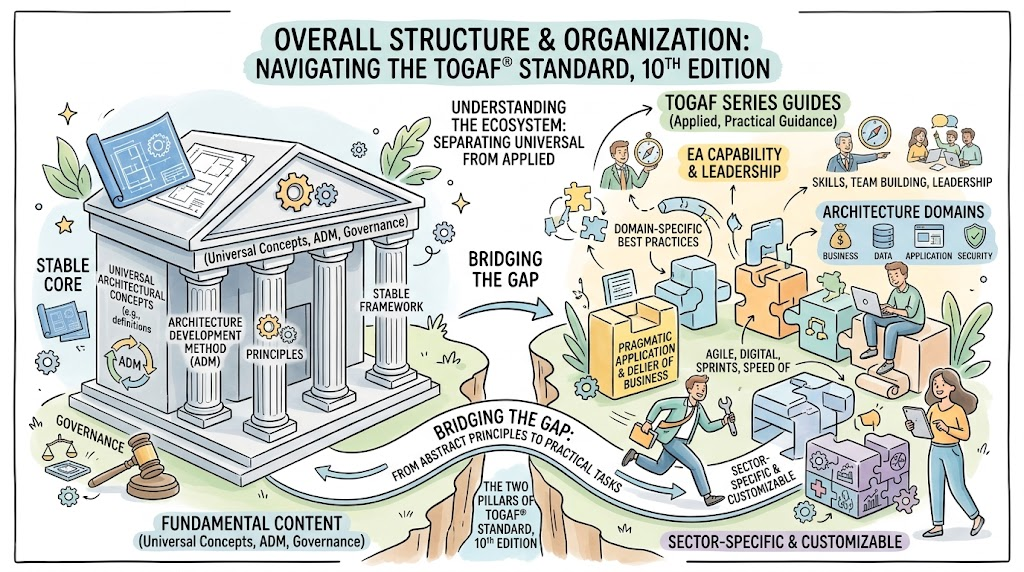
While the Fundamental Content remains stable, the Series Guides are designed to be dynamic. The core cycle used across these guides remains the Architecture Development Method (ADM), which continues to guide architects from vision to execution, but the Series Guides explain how to execute that cycle in varied contexts.
Key Topics Covered in the Series Guides
The Series Guides are grouped into major focus areas that mirror the real-world challenges enterprise architects face. Below are the key concepts and illustrative examples for each domain.
1. Establishing an EA Capability
-
Focus: How to set up, lead, and run an Enterprise Architecture team that delivers tangible value.
-
Key Guide: The TOGAF Leader’s Guide to Establishing and Evolving an EA Capability.
-
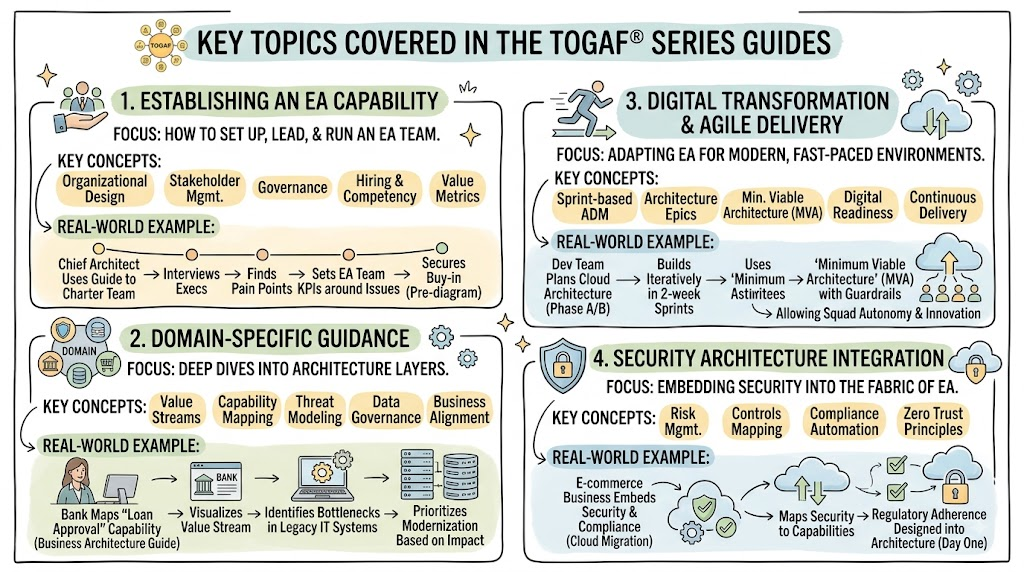
Key Concepts: Organizational design, stakeholder management, architecture governance frameworks, hiring and competency modeling, and defining business value metrics.
-
Real-World Example: A newly appointed Chief Architect uses this guide to define the EA team’s charter. Instead of starting with technology diagrams, they use the guide’s framework to interview business executives, identifying three critical pain points. They then structure the EA team’s KPIs around resolving those specific business issues, securing executive buy-in before drawing a single architecture diagram.
2. Domain-Specific Guidance
-
Focus: Deep dives into specific architecture layers to ensure rigor and alignment.
-
Key Guides: Business Architecture, Security Architecture, Data/Information Architecture.
-
Key Concepts: Value streams, business capabilities, organization mapping, threat modeling, zero trust principles, data governance, and mapping technical architecture to business strategy.
-
Real-World Example: A bank maps its “Loan Approval” capability using the Business Architecture guide. By visualizing the end-to-end value stream, they identify that three legacy IT systems are creating bottlenecks in the process. This insight allows them to prioritize modernization efforts based on business impact rather than technical debt alone.
3. Digital Transformation & Agile Delivery
-
Focus: Adapting enterprise architecture for modern, fast-paced, and iterative environments.
-
Key Guides: Enabling Enterprise Agility, Applying the TOGAF ADM using Agile Sprints, Using the TOGAF Standard in the Digital Enterprise.
-
Key Concepts: Sprint-based ADM, Architecture Epics, Minimum Viable Architecture (MVA), digital readiness assessments, microservices patterns, and continuous development pipelines.
-
Real-World Example: A development team uses TOGAF to plan high-level cloud architecture in Phase A/B, then builds it iteratively in 2-week Sprints. Rather than producing a 200-page specification upfront, they create a “Minimum Viable Architecture” that defines guardrails and integration points, allowing squads to innovate autonomously within safe boundaries.
4. Security Architecture Integration
-
Focus: Embedding security into the fabric of enterprise architecture rather than treating it as an afterthought.
-
Key Concepts: Risk management integration, security controls mapping, compliance automation, and Zero Trust architecture principles.
-
Real-World Example: An e-commerce business uses the Security Guide to embed compliance and encryption checks into every step of their cloud migration. Security requirements are mapped directly to business capabilities, ensuring that regulatory adherence is designed into the architecture from day one.
Beginners’ Summary Table & Examples
For quick reference, the following table summarizes how key topic domains translate into practical beginner scenarios:
| Topic Domain | Key Concepts Covered | Real-World Beginner Example |
|---|---|---|
| Business Architecture | Value Streams, Business Capabilities, Organization Mapping | A bank maps its “Loan Approval” capability to see which legacy IT systems are slowing down the process. |
| Agile & TOGAF | Sprint-based ADM, Architecture Epics, Minimum Viable Architecture | A dev team uses TOGAF to plan high-level cloud architecture in Phase A/B, then builds it iteratively in 2-week Sprints. |
| Security Architecture | Risk Management, Security Controls, Zero Trust Principles | An e-commerce business uses the Security Guide to embed compliance and encryption checks into every step of their cloud migration. |
| Digital Readiness | Digital Maturity, Transformation Roadmaps, Legacy Integration | A brick-and-mortar retailer evaluates if their IT culture and infrastructure can support real-time inventory tracking for an app. |
Tips & Tricks for Navigating the Guides
To maximize the value of the TOGAF Series Guides, adopt the following pragmatic strategies:
-
Don’t Read Cover-to-Cover: The Series Guides are a reference library, not a linear textbook. Jump directly to the guide that solves your current problem. If you are building capability maps, grab the Business Architecture guide immediately; ignore the others until needed.
-
Start with the Practitioner’s Approach Guide: If you are new to doing actual architecture work, start with A Practitioner’s Approach to Developing Enterprise Architecture Following the TOGAF ADM. It provides a step-by-step walk-through of a typical project and serves as the best on-ramp to the broader series.
-
Tailor, Never Copy Blindly: The #1 mistake beginners make is treating TOGAF as a mandatory checklist. Use only the artifacts, phases, and guides that add value to your stakeholders. If a specific template doesn’t serve your context, adapt or discard it.
-
Speak Business, Not EA Jargon: When presenting outputs from any Series Guide, translate architectural concepts into business outcomes. Talk about “cost reduction,” “time-to-market,” and “risk mitigation” rather than ADM phase names or metamodel terminology. Your stakeholders care about results, not methodology.
Conclusion
The TOGAF Series Guides represent a maturation of enterprise architecture as a discipline. By decoupling practical, situational guidance from the fundamental standard, The Open Group has created a framework that is both stable and adaptable. For beginners and seasoned practitioners alike, these guides transform TOGAF from a theoretical model into a versatile toolkit capable of addressing the complexities of digital transformation, agile delivery, and business-aligned architecture.
Success with TOGAF in the 10th Edition is no longer about memorizing the ADM cycle; it is about knowing which Series Guide to pull from the shelf when a specific business problem arises. By adopting a modular, tailored, and business-outcome-focused approach, architects can leverage the Series Guides to deliver genuine enterprise value in an ever-changing landscape.