


Architecting Agility: Mastering TOGAF 10 with Visual Paradigm’s AI-Powered Toolkit
Introduction
The enterprise architecture landscape is undergoing a seismic shift. As organizations grapple with the complexities of cloud-native ecosystems, artificial intelligence integration, and rapid market volatility, traditional rigid frameworks are struggling to keep pace. Enter TOGAF 10, the latest evolution of The Open Group Architecture Framework. This isn’t merely a version bump; it represents a fundamental reimagining of how enterprise architects align technology with business outcomes.
For modern architects, the challenge is no longer just about creating comprehensive documentation—it’s about delivering value faster, adapting to change, and bridging the gap between strategic vision and agile execution. This is where tooling becomes critical. By combining the structured rigor of TOGAF 10 with the dynamic capabilities of Visual Paradigm—specifically its BPMN modeling and AI-assisted features—architects can transform their practice from a bureaucratic bottleneck into a strategic accelerator.
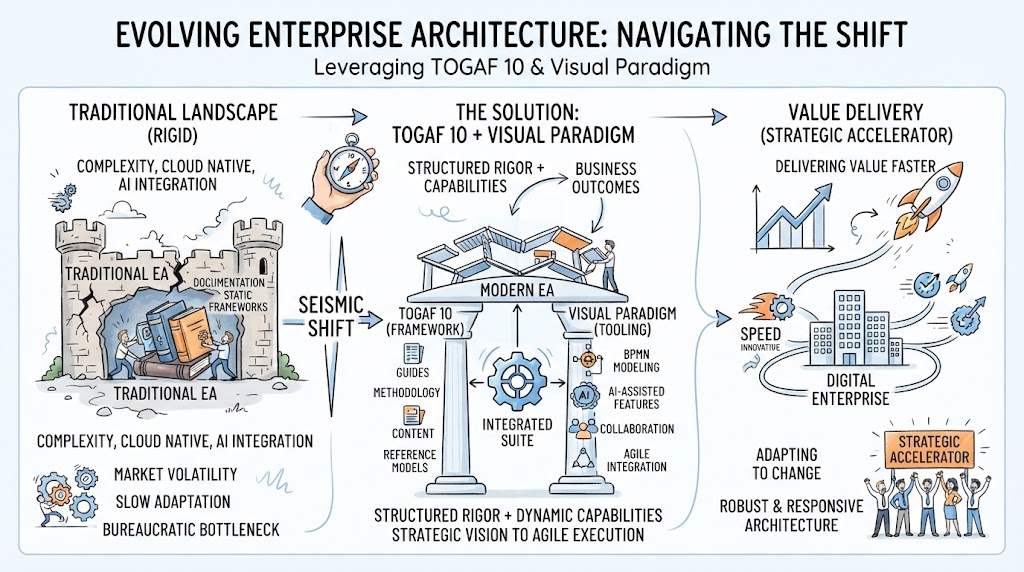
This guide explores the core innovations of TOGAF 10 and demonstrates how leveraging Visual Paradigm’s integrated suite can help you implement these concepts efficiently, ensuring your architecture is not only robust but also responsive to the needs of today’s digital enterprise.
Key Concepts in TOGAF 10
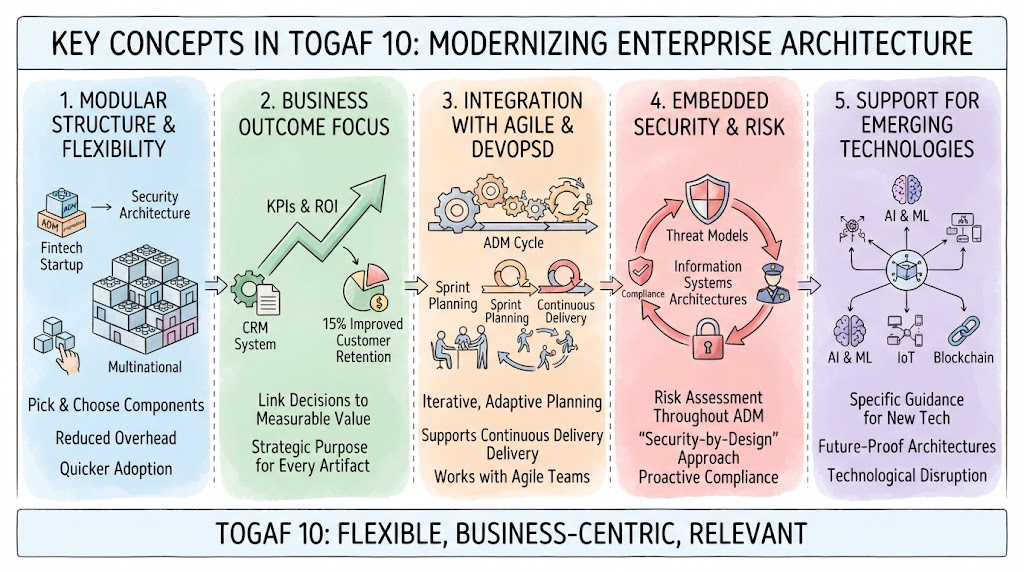
TOGAF 10 introduces several pivotal changes designed to make enterprise architecture more flexible, business-centric, and technologically relevant. Understanding these concepts is essential for any architect looking to modernize their practice.
1. Modular Structure and Flexibility
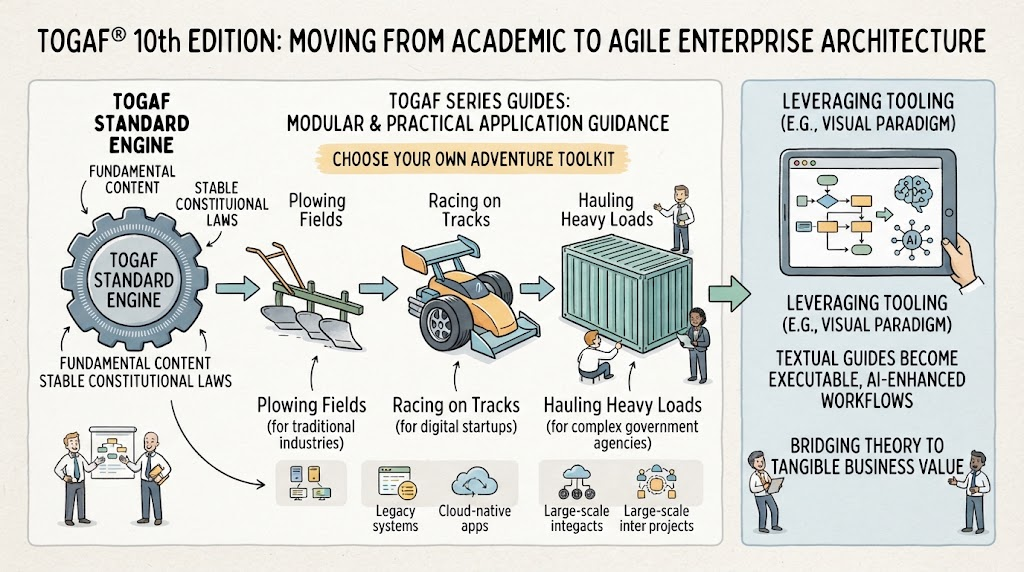
Unlike previous iterations that often felt like a monolithic mandate, TOGAF 10 adopts a modular design. Organizations can now pick and choose the specific components relevant to their maturity level and industry context. This reduces overhead and allows for quicker adoption.
-
Example: A mid-sized fintech startup might adopt only the Architecture Development Method (ADM) and Security Architecture modules, bypassing the heavier governance structures required by large multinational corporations.
2. Business Outcome Focus
There is a stronger emphasis on linking architectural decisions directly to measurable business value. TOGAF 10 provides new tools for tracking KPIs and ROI, ensuring that every architectural artifact serves a strategic purpose.
-
Example: Instead of just modeling a new CRM system, an architect uses TOGAF 10 guidelines to map how the CRM improves customer retention rates by 15%, directly tying the technical implementation to a board-level metric.
3. Integration with Agile and DevOps
TOGAF 10 explicitly addresses the need to work alongside Agile teams and DevOps pipelines. It moves away from the “big bang” upfront design toward iterative, adaptive planning that supports continuous delivery.
-
Example: An architecture team uses short ADM cycles aligned with sprint planning, allowing them to refine the target architecture based on feedback from each release rather than waiting for a multi-year roadmap to complete.
4. Embedded Security and Risk Management
With cyber threats escalating, security is no longer an afterthought. TOGAF 10 embeds risk assessment and compliance checks throughout the ADM cycle, promoting a “security-by-design” approach.
-
Example: During the Information Systems Architectures phase, architects automatically generate threat models alongside data flow diagrams, ensuring that encryption and access controls are defined before code is written.
5. Support for Emerging Technologies
The framework now includes specific guidance for integrating AI, machine learning, IoT, and blockchain. This helps future-proof architectures against technological disruption.
-
Example: An organization leveraging AI for predictive maintenance uses TOGAF 10’s emerging tech guidelines to define data governance standards for machine learning models, ensuring ethical use and data quality.
Leveraging Visual Paradigm: BPMN + AI Assistance
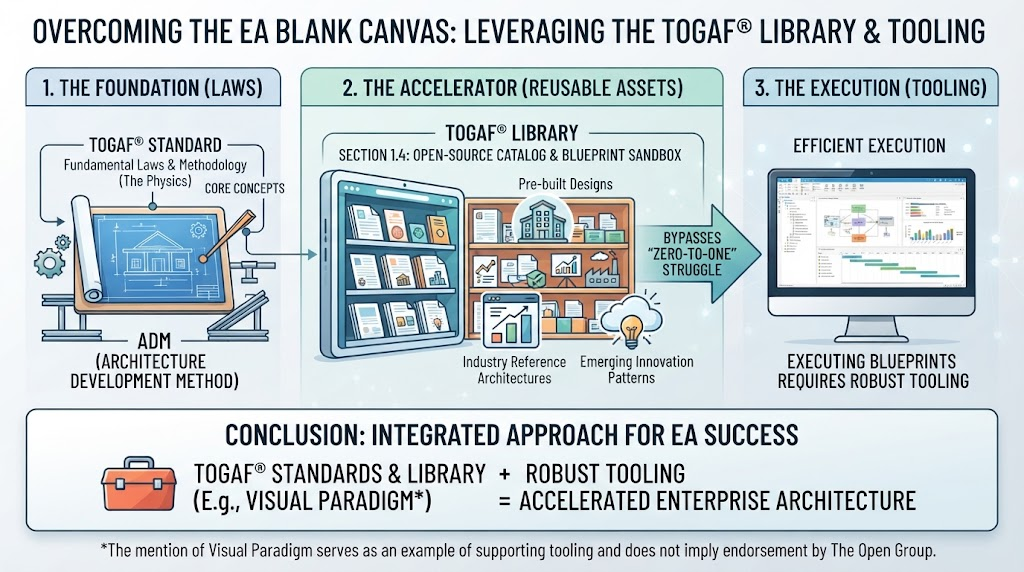
Implementing TOGAF 10 effectively requires more than just theoretical knowledge; it demands powerful tooling. Visual Paradigm offers a comprehensive suite that integrates seamlessly with TOGAF principles, particularly through its BPMN capabilities and AI-assisted features.
Streamlining Process Modeling with BPMN
Business Process Model and Notation (BPMN) is crucial for capturing the “how” of business operations. In TOGAF 10, understanding current and future state processes is vital for gap analysis.
-
How Visual Paradigm Helps: Its intuitive BPMN editor allows architects to quickly map out complex workflows. These models can be directly linked to TOGAF ADM phases, ensuring that process improvements are aligned with architectural goals.
-
Practical Application: When defining the Business Architecture phase, architects can use Visual Paradigm to model end-to-end customer journeys. These BPMN diagrams serve as living documents that can be shared with non-technical stakeholders, fostering better engagement and clarity.
Accelerating Design with AI Assistance
One of the most significant advancements in Visual Paradigm is its AI-powered TOGAF ADM Guide-Through. This feature drastically reduces the manual effort required for diagramming and documentation.
-
Automatic Diagram Generation: Instead of manually drawing ArchiMate diagrams, users can input natural language descriptions of their architecture. The AI engine interprets these descriptions and generates accurate ArchiMate models, saving up to 80-95% of diagramming time.
-
Smart Gap Analysis: The AI can analyze existing models against target architectures to identify gaps automatically. It suggests potential solutions and highlights risks, enabling architects to make data-driven decisions faster.
-
Intelligent Deliverable Composer: Creating formal TOGAF deliverables can be tedious. Visual Paradigm’s AI helps assemble these documents by pulling relevant models, charts, and descriptions into standardized templates, ensuring consistency and completeness.
Case Study: Coffee Shop Digital Evolution
Consider a regional coffee shop chain aiming to digitize its operations. Using Visual Paradigm’s AI-powered TOGAF ADM:
-
Requirement Capture: The architect inputs a description: “We need a mobile app for ordering, integrated with inventory management and loyalty programs.”
-
AI Generation: The tool automatically generates initial ArchiMate diagrams showing the application components, data flows, and business services.
-
BPMN Integration: The team models the order fulfillment process using BPMN, linking it to the backend inventory system.
-
Iterative Refinement: As the project progresses through Agile sprints, the AI updates the models based on new requirements, such as adding AI-driven personalized recommendations.
-
Outcome: The architecture team delivers a clear, visual roadmap in weeks rather than months, with full alignment between business goals and technical implementation.
Why This Combination Matters
The synergy between TOGAF 10’s flexible, outcome-focused framework and Visual Paradigm’s intelligent tooling creates a powerful advantage for enterprise architects:
-
Speed to Value: AI-assisted modeling reduces manual workload, allowing architects to focus on strategic decision-making rather than diagram maintenance.
-
Enhanced Collaboration: BPMN diagrams and AI-generated visuals are easier for non-technical stakeholders to understand, improving buy-in from executive leadership.
-
Future-Readiness: By embedding security and emerging tech considerations into the workflow, organizations can build resilient architectures that adapt to change.
-
Scalability: The modular nature of TOGAF 10, supported by Visual Paradigm’s scalable toolset, allows organizations to start small and expand their EA practice as needed.
Conclusion
TOGAF 10 represents a significant leap forward in enterprise architecture, offering the flexibility and business alignment necessary for today’s digital economy. However, its true potential is unlocked when paired with the right tools. Visual Paradigm, with its robust BPMN modeling and groundbreaking AI-assisted features, provides the practical means to implement TOGAF 10 efficiently and effectively.
By embracing this combination, enterprise architects can move beyond traditional documentation roles to become strategic partners in driving business transformation. Whether you are modernizing legacy systems, integrating AI, or navigating complex regulatory environments, TOGAF 10 and Visual Paradigm offer the structure and speed needed to succeed. The future of enterprise architecture is agile, intelligent, and outcome-driven—are you ready to lead the charge?
Recommended Reading: Visual Paradigm and TOGAF Resources
-
Visual Paradigm TOGAF ADM Tool: Empowering Your Enterprise Architecture Teams: An overview of how Visual Paradigm’s TOGAF ADM tool boosts EA team productivity with an intuitive interface, collaboration features, and reusable model elements.
-
Streamline Your Enterprise Architecture with Visual Paradigm’s TOGAF ADM Tools: Explains the visual flowchart that guides users through ADM phases and introduces the integrated toolset including ArchiMate support, radar charts, and task management.
-
Comprehensive Guide for Using TOGAF ADM with Visual Paradigm: A detailed guide covering how to apply ADM iteration strategies, architecture partitioning, and leverage Visual Paradigm’s ADM Process Navigator and Deliverable Composer.
-
Using the TOGAF ADM Guide-Through Process in Visual Paradigm: A practical walkthrough of the ADM Guide-Through process with concrete examples for phases like Business Architecture, Gap Analysis, and Migration Planning.
-
Traditional vs AI-Enhanced TOGAF Workflow Comparison: A side-by-side comparison demonstrating 50-80% time savings and 80-95% reduction in diagramming effort when using Visual Paradigm’s AI-enhanced workflow over traditional manual methods.
-
What’s New: AI-Powered TOGAF ADM in Visual Paradigm | 2026 Update: Introduces the 2026 AI enhancements to the TOGAF Guide-Through, including automatic ArchiMate diagram generation, smart radar charts, and intelligent gap analysis.
-
TOGAF ADM Guide-Through: A Case Study on AI-Powered TOGAF ADM Implementation: A real-world case study exploring AI-powered TOGAF ADM implementation with detailed coverage of features like the Deliverable Composer, Shape Legend, and Model Extractor.
-
AI-Powered TOGAF ADM Guide-Through: Coffee Shop Digital Evolution: A hands-on tutorial showing how to use AI to generate ArchiMate diagrams from natural language descriptions, moving from manual drawing to AI-assisted modeling.
-
Mastering Enterprise Architecture with ArchiMate and TOGAF: The Visual Paradigm Advantage: Explains the synergy between TOGAF and ArchiMate, and how Visual Paradigm’s seamless integration of both frameworks creates a powerful EA environment.
-
Comprehensive TOGAF ADM Tutorial: A Step-by-Step Guide: A step-by-step tutorial covering the full TOGAF ADM lifecycle, phase objectives, and the integration of ArchiMate with ADM phases.
Related posts:
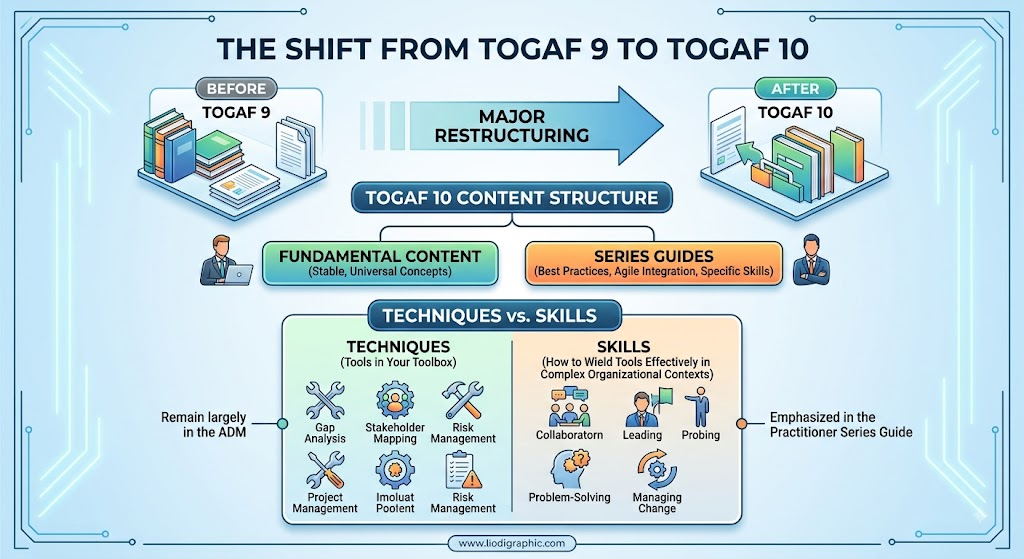 📘 Comprehensive Guide: Skills & Techniques in TOGAF 10
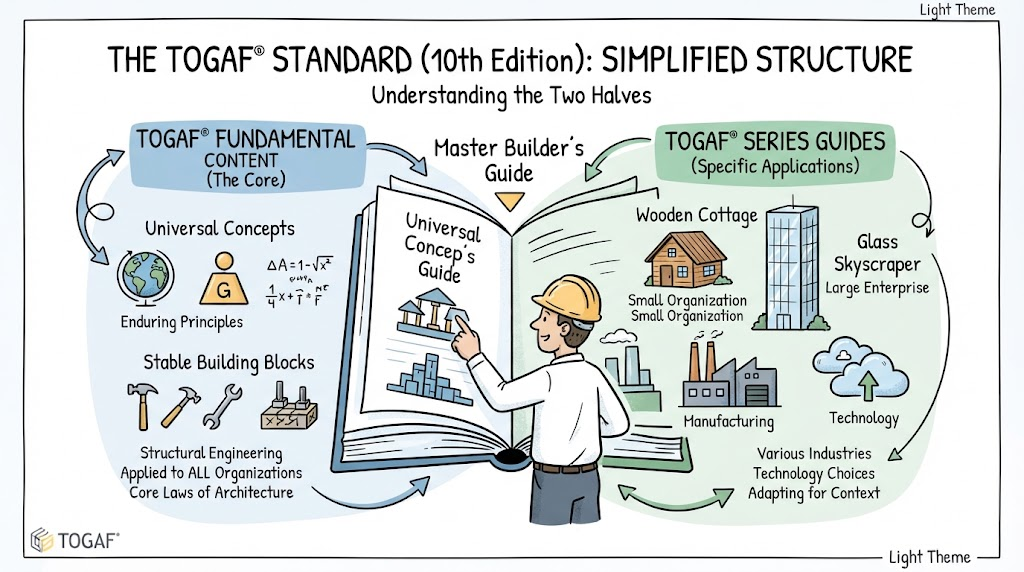 A Beginner’s Guide to the TOGAF 10 Fundamental Content
 Navigating the TOGAF® Series Guides: A Modular Blueprint for Modern Enterprise Architecture with Visual Paradigm
 From Blueprint to Reality: Leveraging the TOGAF Library and Visual Paradigm for Accelerated Enterprise Architecture