


TOGAF 10 Explained: A Practical Guide for Enterprise Architects
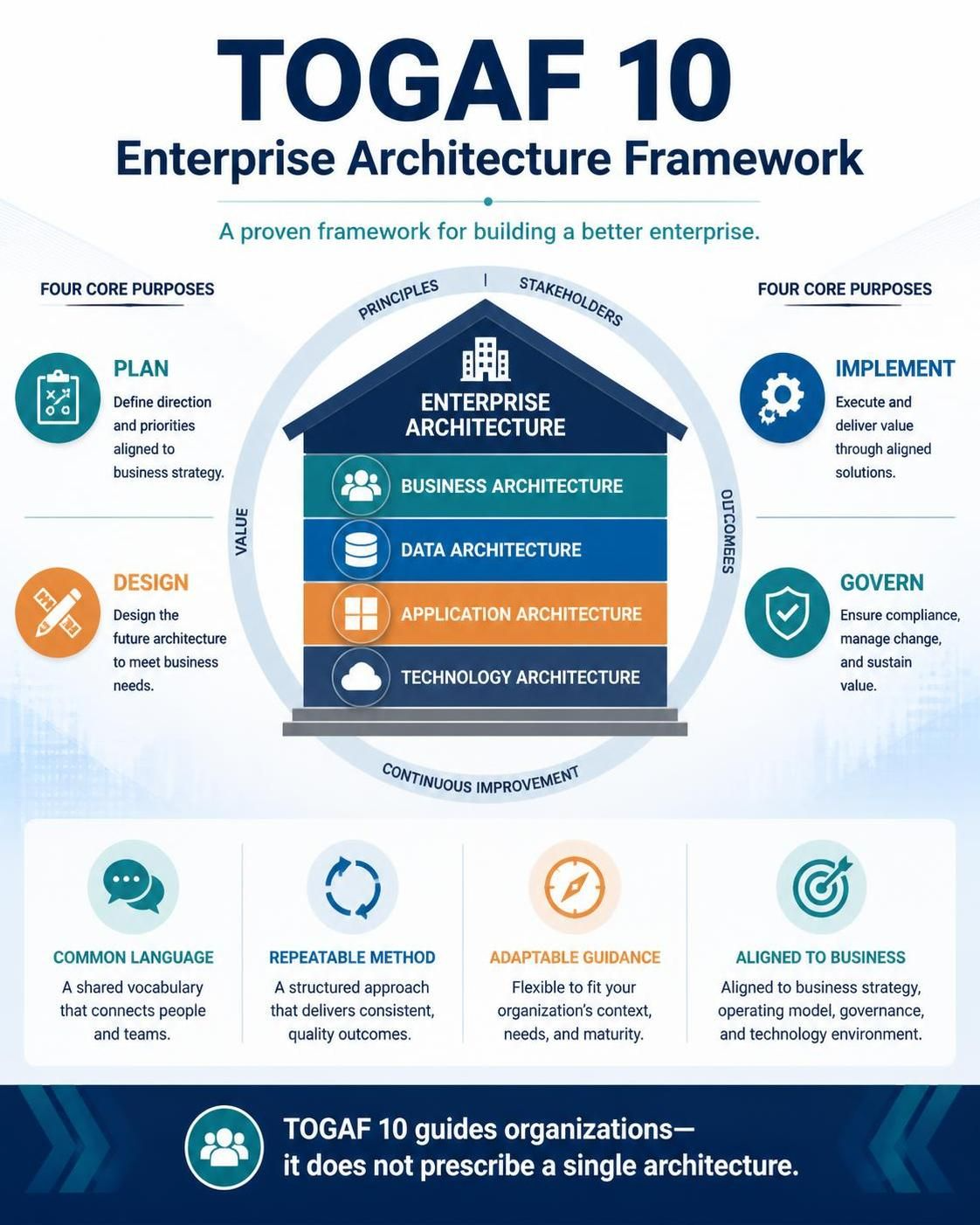
TOGAF 10 is an enterprise architecture framework designed to help organizations plan, design, implement, and govern business and technology change. It provides a common language, a repeatable method, and a collection of guidance that architects can adapt to different organizational needs.
Rather than prescribing a single architecture, TOGAF 10 helps organizations develop architectures that support their business strategy, operating model, governance requirements, and technology environment.
What Is TOGAF 10?
TOGAF stands for The Open Group Architecture Framework. The framework is maintained by The Open Group and is widely used by enterprises, government organizations, consulting firms, and technology teams.
TOGAF 10 provides guidance for developing and managing four related architecture domains:
-
Business architecture: The organization’s strategy, governance, capabilities, processes, and operating model.
-
Data architecture: The structure, management, ownership, and flow of organizational data.
-
Application architecture: The application portfolio, application interactions, and their relationship to business processes.
-
Technology architecture: The infrastructure, platforms, networks, and technical services that support applications and data.
These domains are usually developed together. For example, a new customer-service strategy may require new business capabilities, improved data sharing, redesigned applications, and updated cloud infrastructure.
Why Organizations Use TOGAF 10
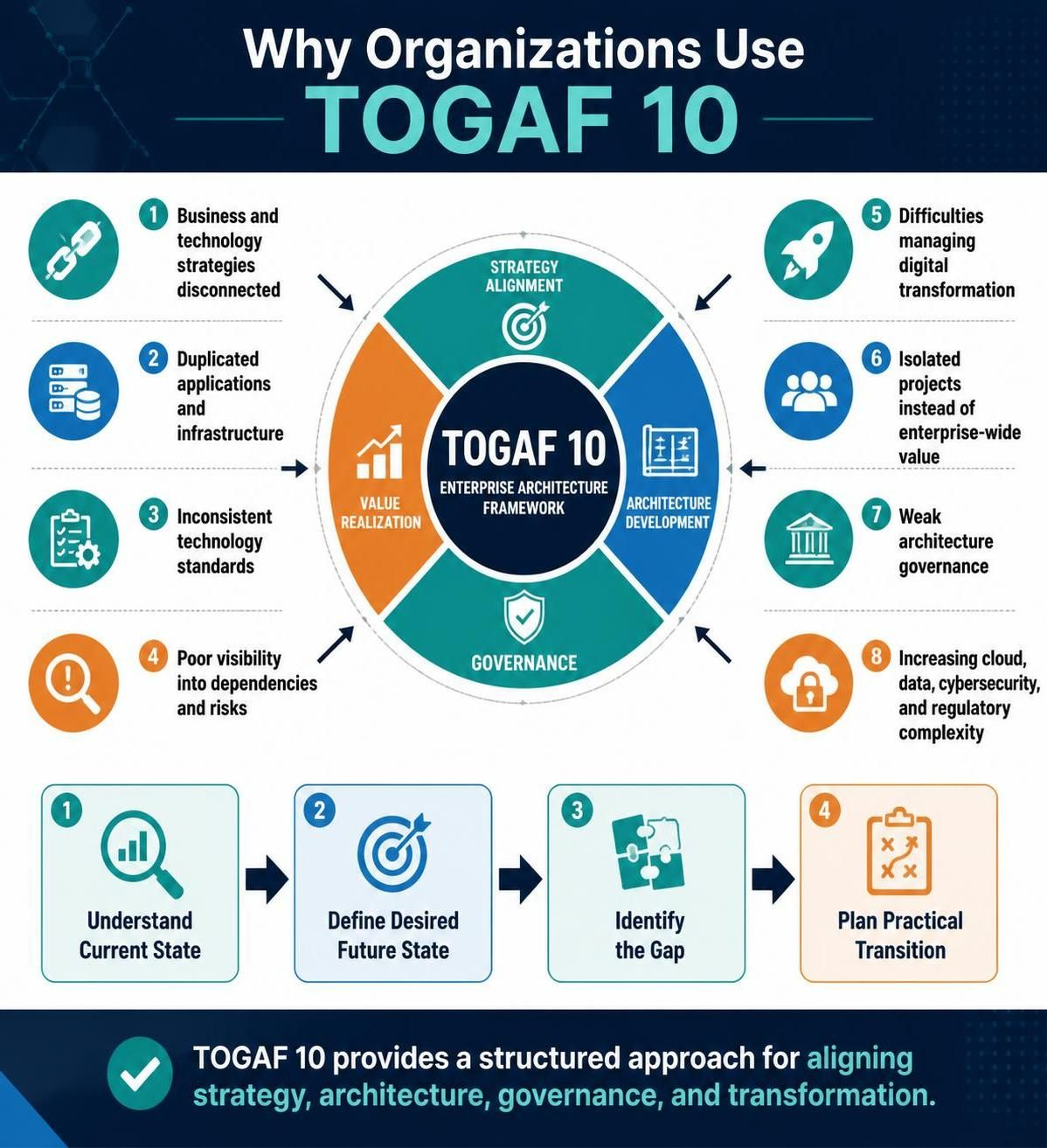
Organizations often adopt TOGAF 10 to address problems such as:
-
Business and technology strategies becoming disconnected
-
Duplicated applications and infrastructure
-
Inconsistent technology standards
-
Poor visibility into dependencies and risks
-
Difficulties managing digital transformation
-
Projects that deliver isolated solutions rather than enterprise-wide value
-
Weak architecture governance
-
Increasing cloud, data, cybersecurity, and regulatory complexity
TOGAF 10 helps create a structured approach to these challenges. It encourages stakeholders to agree on the current situation, define a desired future state, identify the gap between them, and establish a practical transition plan.
The framework can also improve communication. Executives, business leaders, architects, project managers, developers, and infrastructure teams can use common terms and artifacts when discussing change.
The Main Characteristics of TOGAF 10
TOGAF 10 builds on earlier editions but places greater emphasis on flexibility, modularity, and practical application.
A modular structure
Earlier versions were often experienced as a large, relatively unified body of material. TOGAF 10 organizes its guidance into separate components, allowing organizations to use the material that is relevant to their situation.
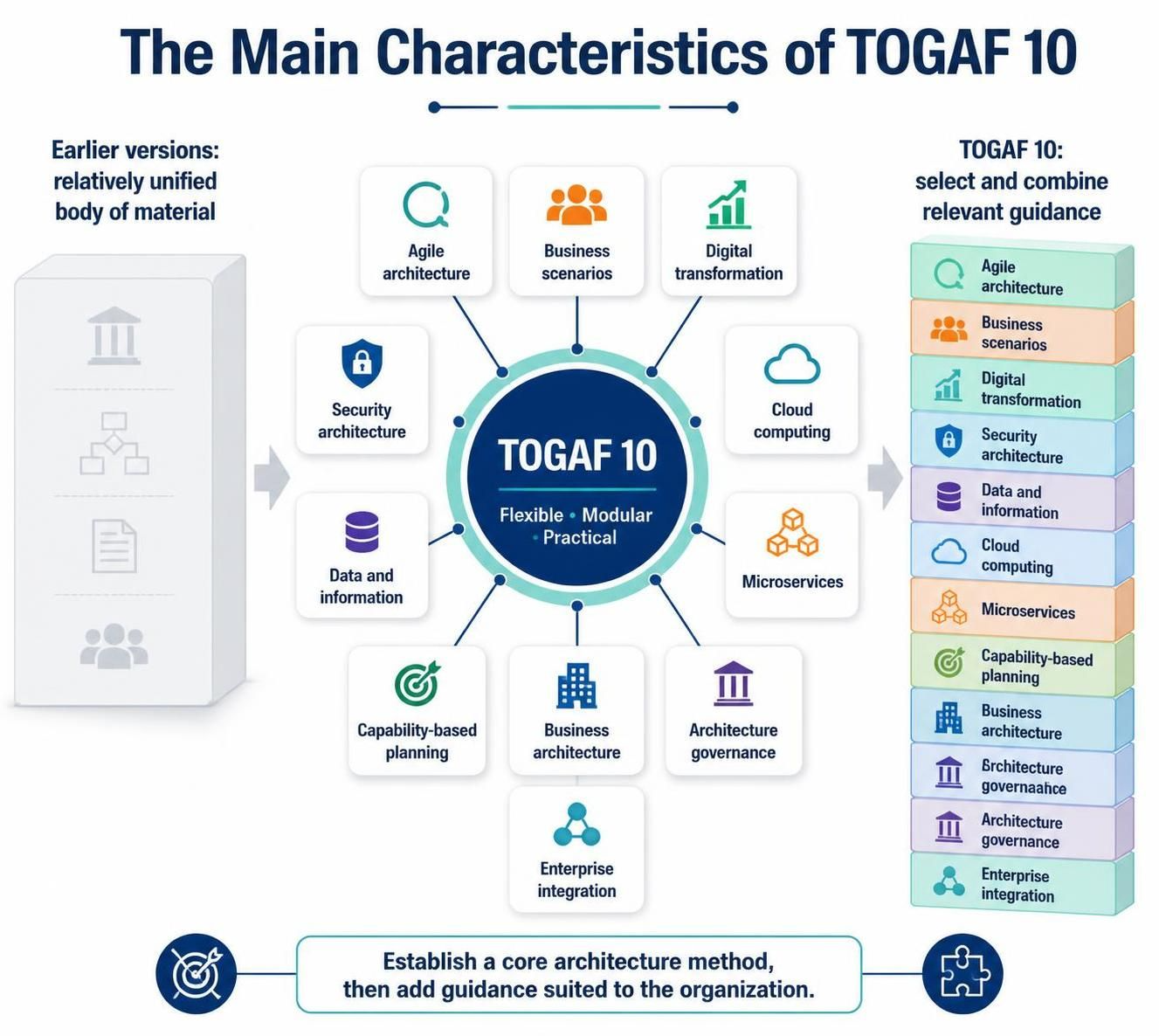
This modular approach is useful because a financial institution, government department, startup, and manufacturing company may need different architecture practices. An organization can establish a core architecture method and then add guidance for subjects such as:
-
Agile architecture
-
Business scenarios
-
Digital transformation
-
Security architecture
-
Data and information
-
Cloud computing
-
Microservices
-
Capability-based planning
-
Business architecture
-
Architecture governance
-
Enterprise integration
A core framework with supporting guidance
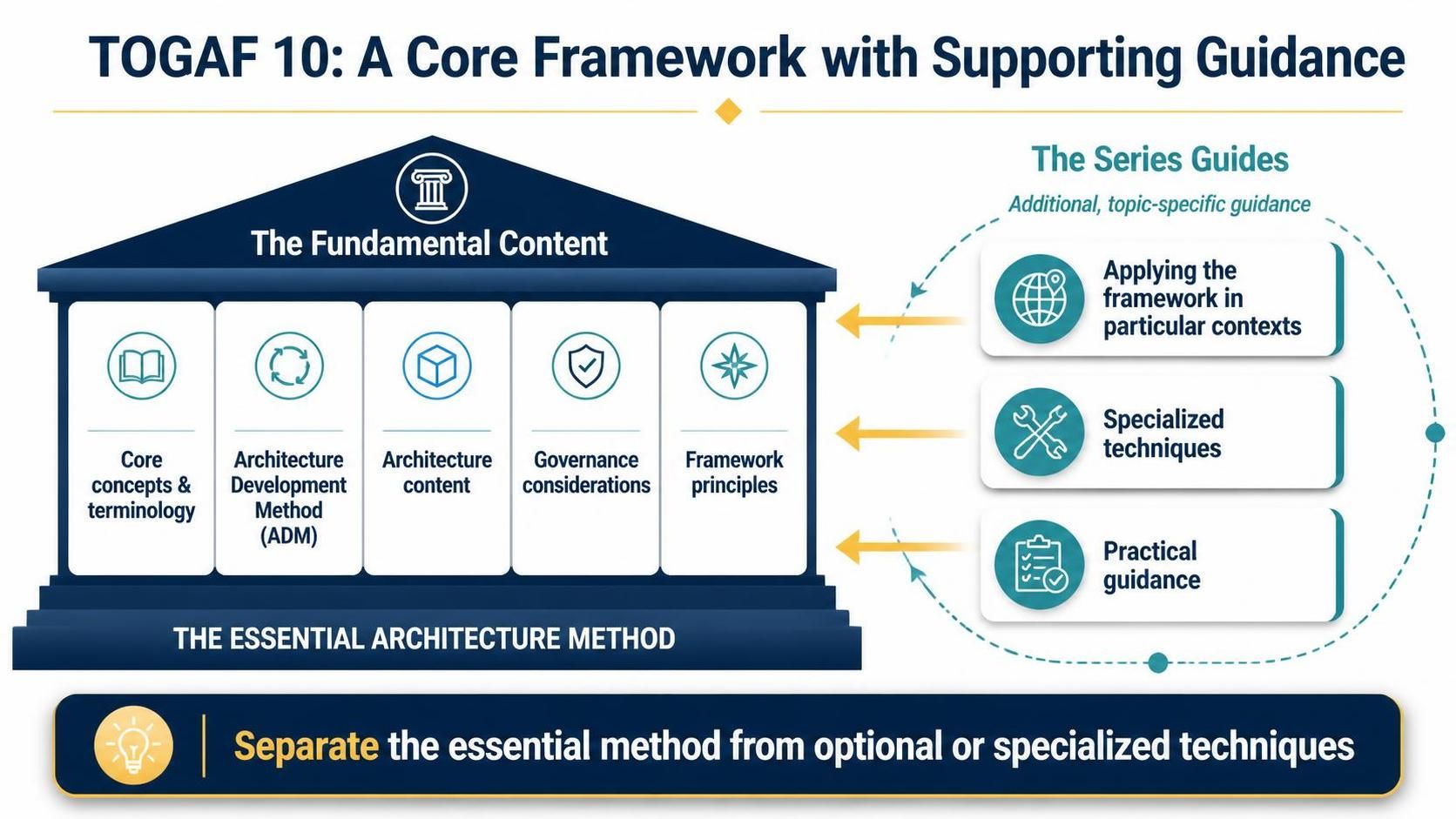
TOGAF 10 can be understood as having two broad parts:
-
The fundamental content
This contains the core concepts, terminology, Architecture Development Method, architecture content, governance considerations, and framework principles. -
The series guides
These provide additional, topic-specific guidance for applying the framework in particular contexts.
This distinction makes it easier to separate the essential architecture method from optional or specialized techniques.
Adaptability
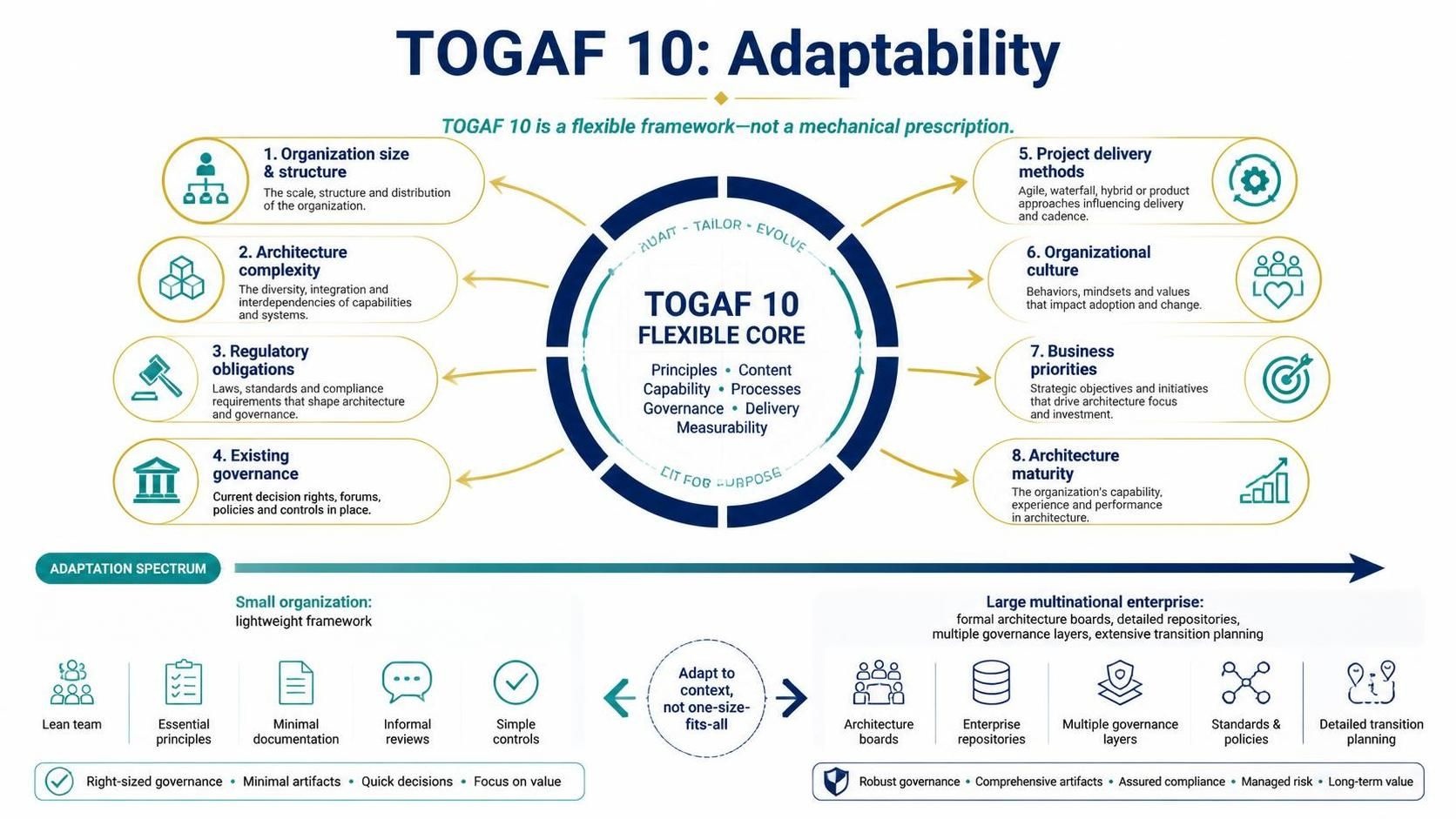
TOGAF 10 is not intended to be applied mechanically. Organizations are expected to adapt it according to:
-
Their size and structure
-
The complexity of their architecture
-
Regulatory obligations
-
Existing governance processes
-
Project delivery methods
-
Organizational culture
-
Business priorities
-
Architecture maturity
A small organization may use a lightweight version of the framework, while a large multinational enterprise may require formal architecture boards, detailed repositories, multiple governance layers, and extensive transition planning.
The Architecture Development Method
The Architecture Development Method, commonly called the ADM, is the central process in TOGAF 10.
The ADM describes how an organization can move from an initial architecture vision to implemented change and ongoing governance. It is often shown as a cycle because architecture development is iterative rather than strictly linear.
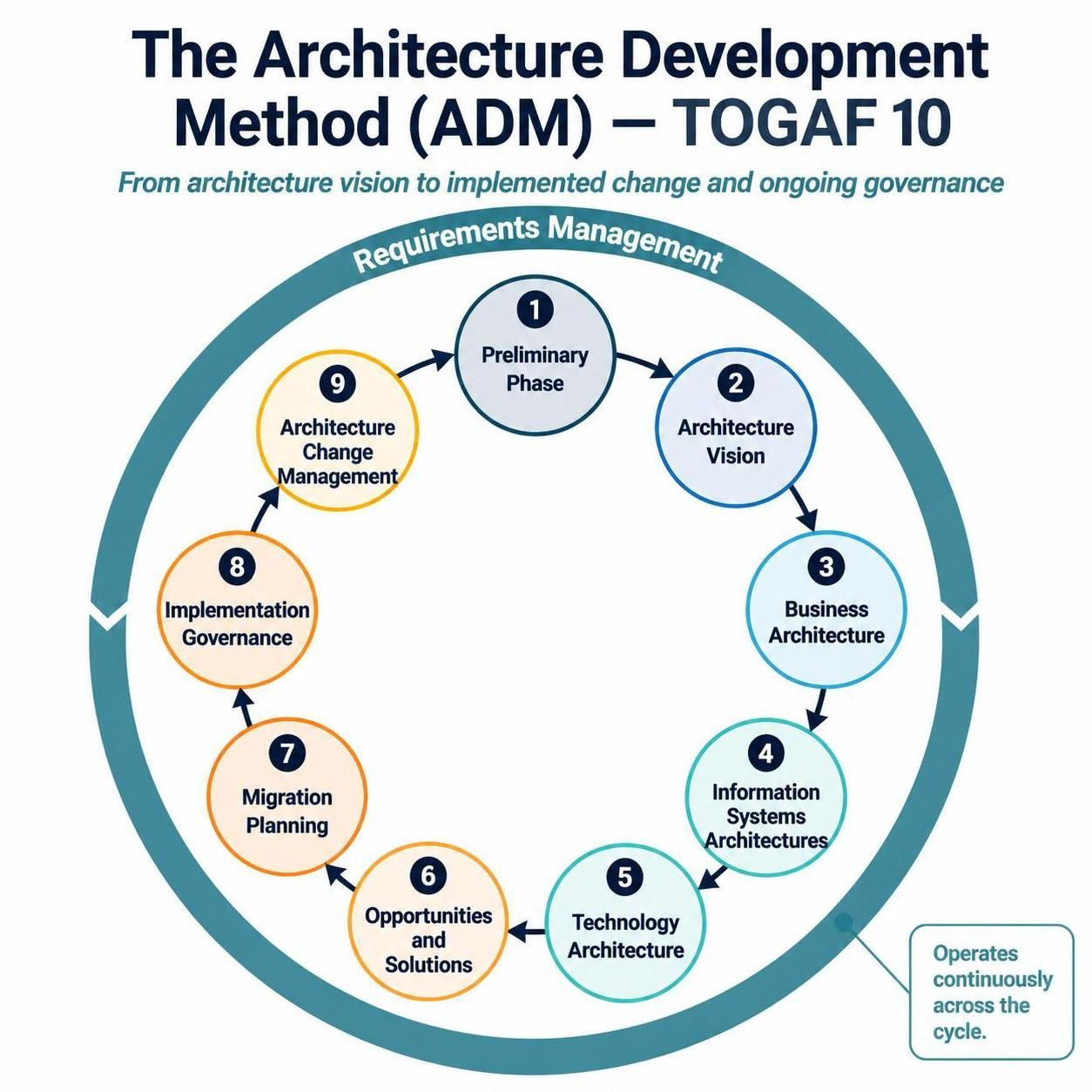
The main phases are:
-
Preliminary phase
-
Architecture Vision
-
Business Architecture
-
Information Systems Architectures
-
Technology Architecture
-
Opportunities and Solutions
-
Migration Planning
-
Implementation Governance
-
Architecture Change Management
-
Requirements Management, which operates continuously across the cycle
Preliminary Phase
The Preliminary Phase prepares the organization to perform architecture work.
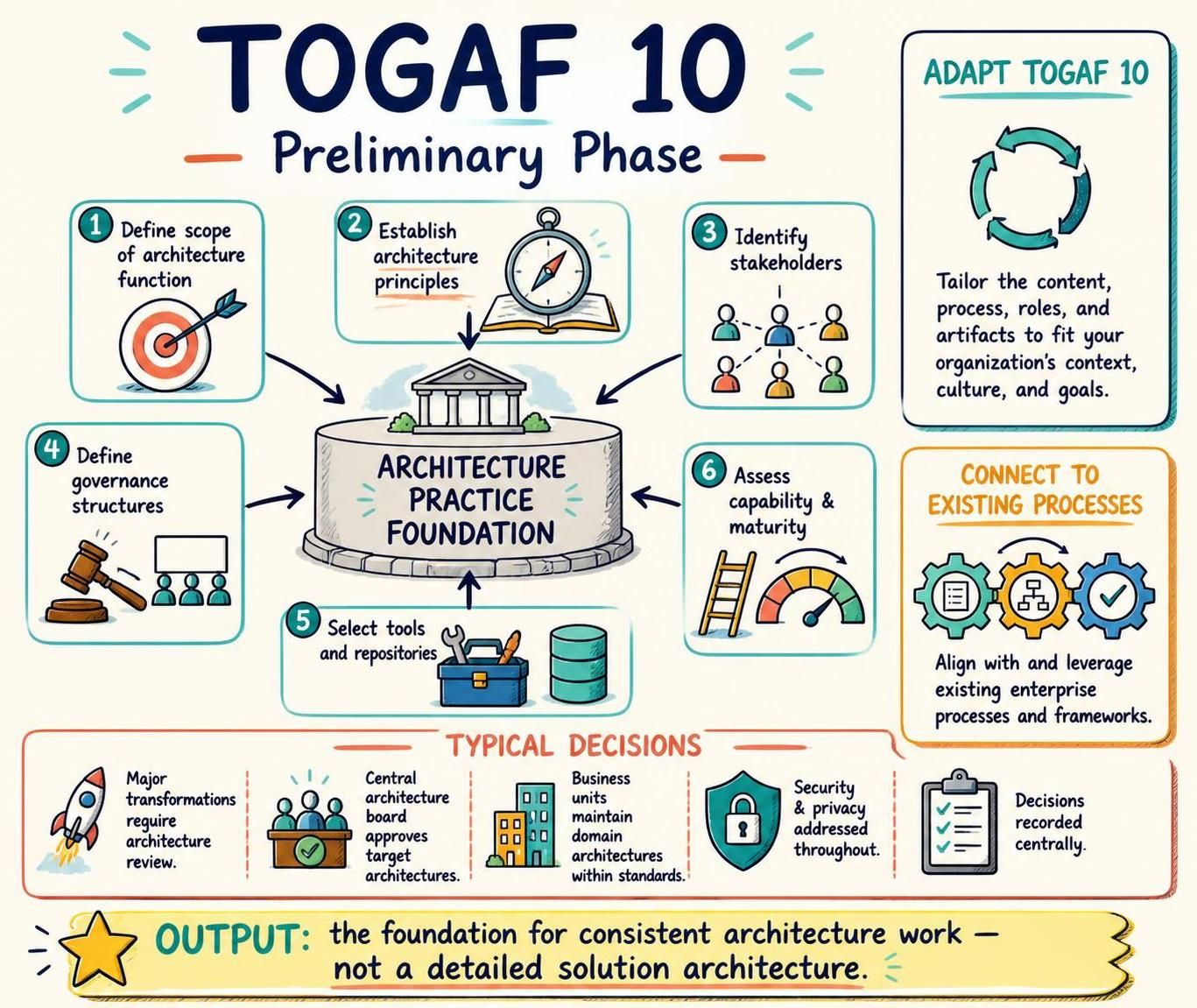
Typical activities include:
-
Defining the scope of the architecture function
-
Establishing architecture principles
-
Identifying stakeholders
-
Defining governance structures
-
Selecting tools and repositories
-
Assessing architecture capability and maturity
-
Determining how TOGAF 10 will be adapted
-
Clarifying the relationship between architecture and existing processes
This phase is particularly important when an organization is creating an architecture practice for the first time.
For example, an organization may decide that:
-
All major transformation projects require architecture review
-
A central architecture board will approve target architectures
-
Business units may maintain domain architectures within enterprise standards
-
Security and privacy requirements must be addressed during architecture development
-
Architecture decisions must be recorded in a central repository
The output is not a detailed solution architecture. Instead, it is the foundation needed to perform architecture work consistently.
Phase A: Architecture Vision
The Architecture Vision establishes the initial direction for an architecture project.
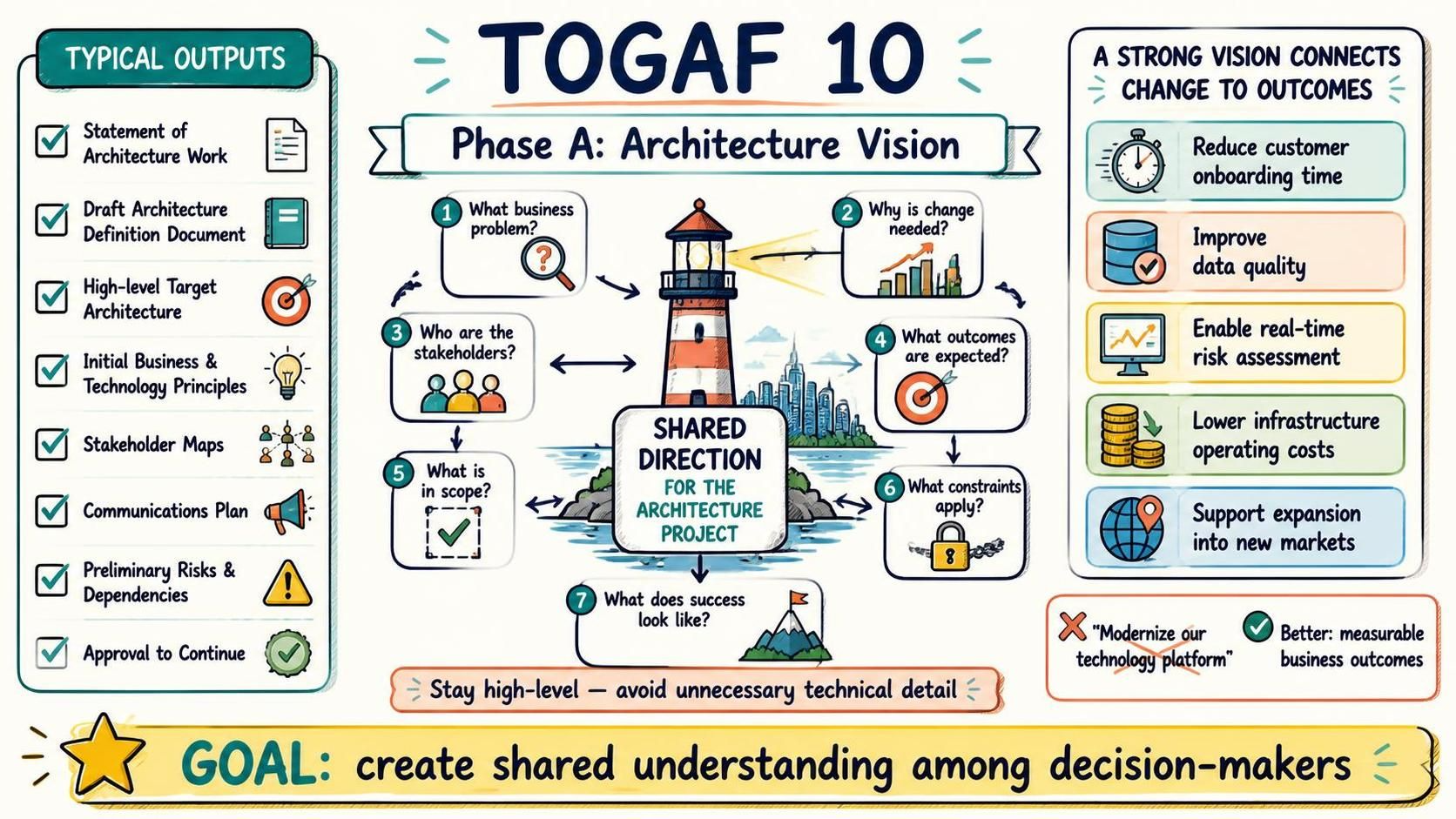
It answers questions such as:
-
What business problem are we addressing?
-
Why is the change needed?
-
Who are the stakeholders?
-
What outcomes are expected?
-
What is included in the scope?
-
What constraints must be considered?
-
What will success look like?
At this stage, architects should avoid unnecessary technical detail. The goal is to create a shared understanding among decision-makers.
Typical outputs may include:
-
A statement of architecture work
-
A draft Architecture Definition Document
-
A high-level target architecture
-
Initial business and technology principles
-
Stakeholder maps
-
A communications plan
-
Preliminary risk and dependency assessments
-
Approval to continue the architecture effort
A strong Architecture Vision connects the proposed change to measurable business outcomes. For example, instead of stating that an organization will “modernize its technology platform,” a stronger vision might aim to:
-
Reduce customer onboarding time
-
Improve data quality
-
Enable real-time risk assessment
-
Lower infrastructure operating costs
-
Support expansion into new markets
Phase B: Business Architecture
The Business Architecture phase defines how the organization operates and how it must change to achieve its goals.
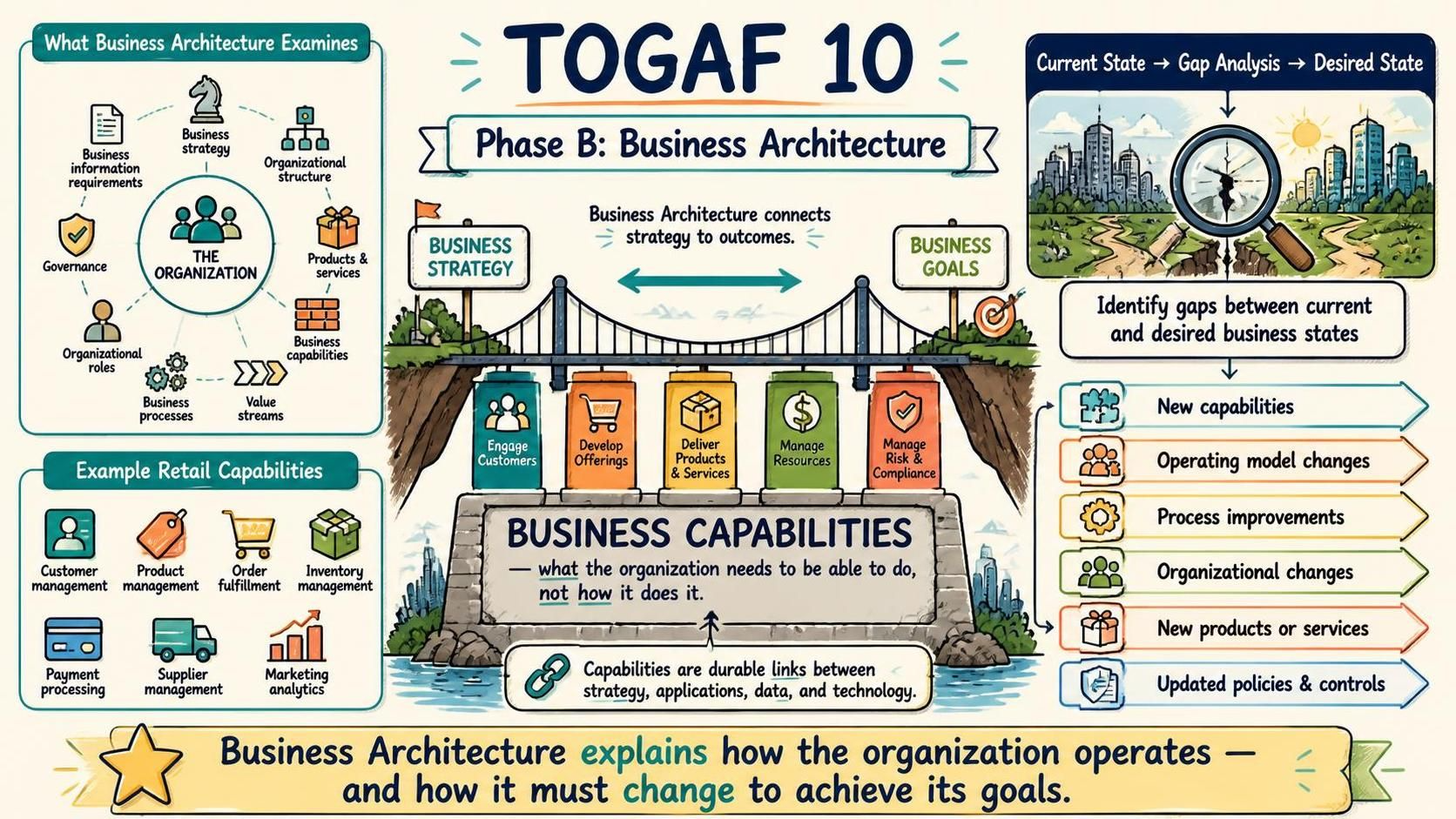
It may examine:
-
Business strategy
-
Organizational structure
-
Products and services
-
Business capabilities
-
Value streams
-
Business processes
-
Organizational roles
-
Governance
-
Performance measures
-
Business information requirements
One of the most useful concepts in business architecture is the business capability. A capability describes what an organization needs to be able to do, rather than how it performs the activity.
For example, a retail organization might identify capabilities such as:
-
Customer management
-
Product management
-
Order fulfillment
-
Inventory management
-
Payment processing
-
Supplier management
-
Marketing analytics
Capabilities provide a stable way to connect strategy with applications, data, and technology. They are often more durable than organizational structures or individual business processes.
The Business Architecture phase should identify gaps between the current and desired business states. These gaps may lead to:
-
New capabilities
-
Changes to operating models
-
Process improvements
-
Organizational changes
-
New products or services
-
Updated policies and controls
Phase C: Information Systems Architectures
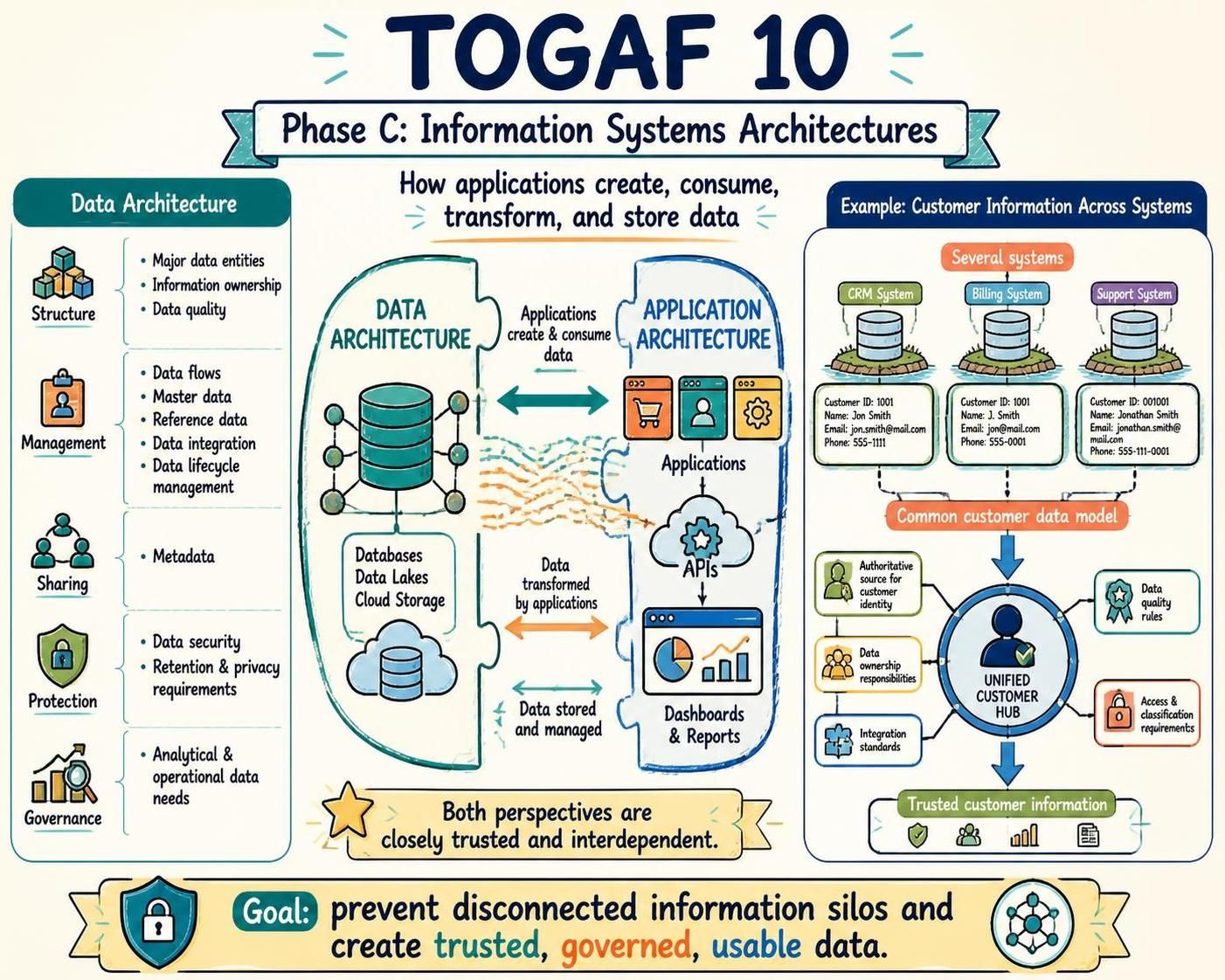
In TOGAF, the Information Systems Architectures phase typically covers both:
-
Data Architecture
-
Application Architecture
These two perspectives are closely related because applications create, consume, transform, and store data.
Data Architecture
Data Architecture defines how data is structured, managed, shared, protected, and governed.
It may address:
-
Major data entities
-
Information ownership
-
Data quality
-
Data flows
-
Master data
-
Reference data
-
Data integration
-
Data lifecycle management
-
Metadata
-
Data security
-
Retention and privacy requirements
-
Analytical and operational data needs
For example, an organization may discover that customer information is stored differently across several systems. A Data Architecture can define:
-
A common customer data model
-
The authoritative source for customer identity
-
Data ownership responsibilities
-
Integration standards
-
Data quality rules
-
Access and classification requirements
A good Data Architecture helps prevent the creation of disconnected information silos.
Application Architecture
Application Architecture describes the application portfolio and how applications support business capabilities and processes.
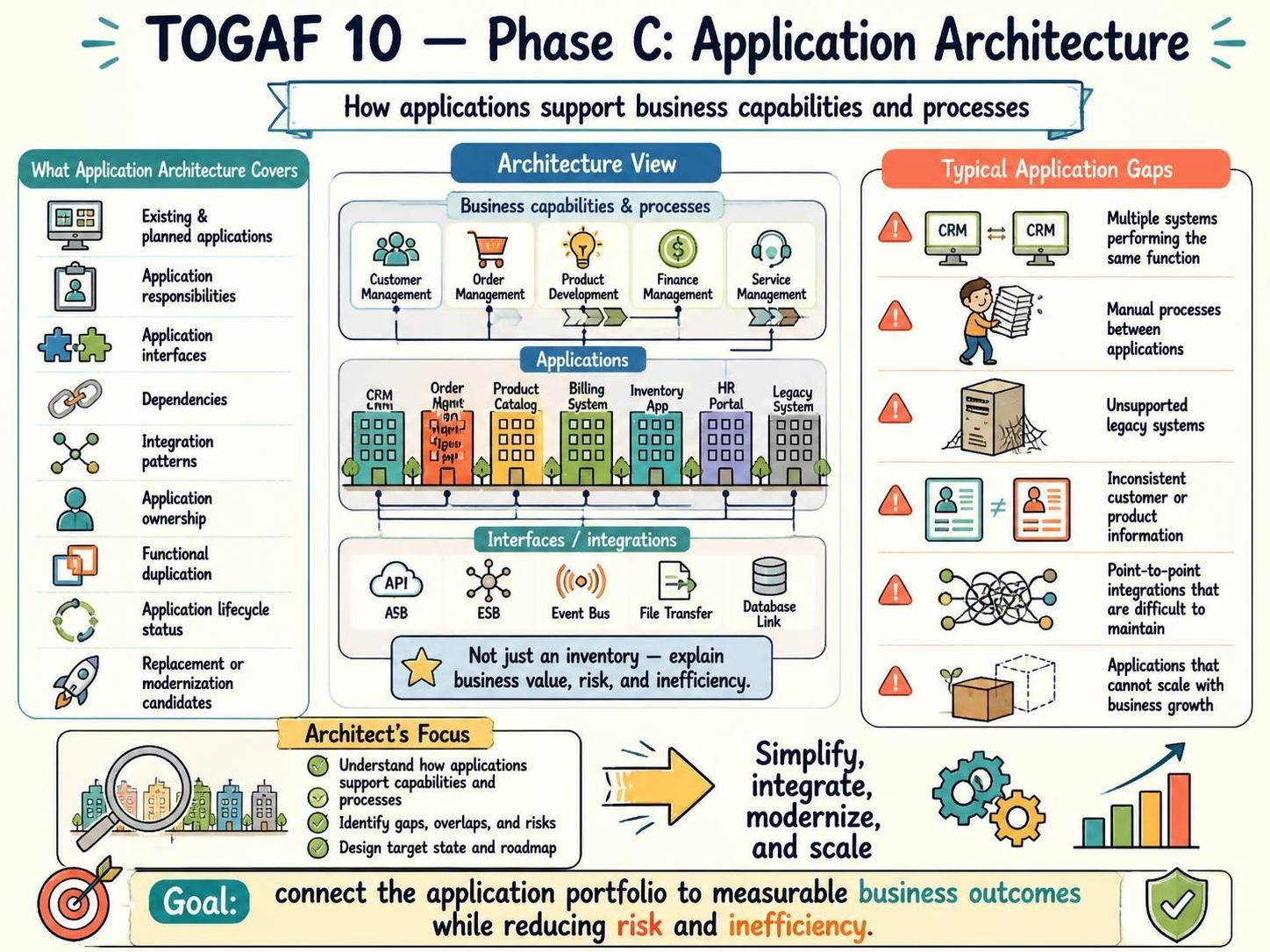
It may cover:
-
Existing and planned applications
-
Application responsibilities
-
Application interfaces
-
Dependencies
-
Integration patterns
-
Application ownership
-
Functional duplication
-
Application lifecycle status
-
Replacement or modernization candidates
The goal is not simply to create an inventory of applications. Architects should explain how applications support business outcomes and where the current portfolio creates risk or inefficiency.
Typical application gaps include:
-
Multiple systems performing the same function
-
Manual processes between applications
-
Unsupported legacy systems
-
Inconsistent customer or product information
-
Point-to-point integrations that are difficult to maintain
-
Applications that cannot scale with business growth
Phase D: Technology Architecture
Technology Architecture defines the technical environment needed to support business, data, and application requirements.
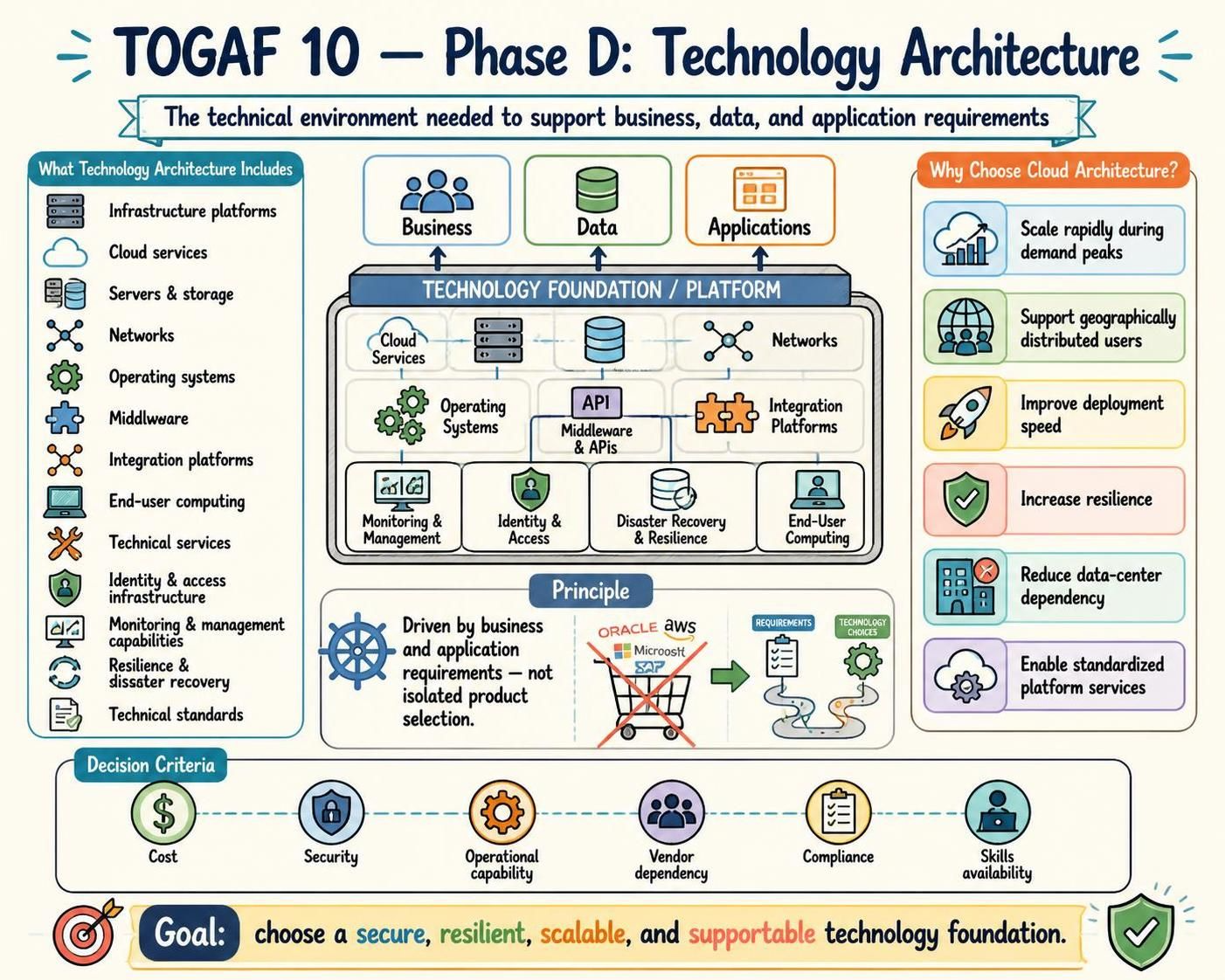
It may include:
-
Infrastructure platforms
-
Cloud services
-
Servers and storage
-
Networks
-
Operating systems
-
Middleware
-
Integration platforms
-
End-user computing
-
Technical services
-
Identity and access infrastructure
-
Monitoring and management capabilities
-
Resilience and disaster recovery
-
Technical standards
Technology Architecture should be driven by business and application requirements. It should not become an isolated exercise in selecting products.
For example, an organization may choose a cloud architecture not simply because cloud technology is popular, but because the target environment must:
-
Scale rapidly during demand peaks
-
Support geographically distributed users
-
Improve deployment speed
-
Increase resilience
-
Reduce data-center dependency
-
Enable standardized platform services
Technology decisions should also consider cost, security, operational capability, vendor dependency, compliance, and skills availability.
Phase E: Opportunities and Solutions
The Opportunities and Solutions phase identifies practical ways to achieve the target architecture.
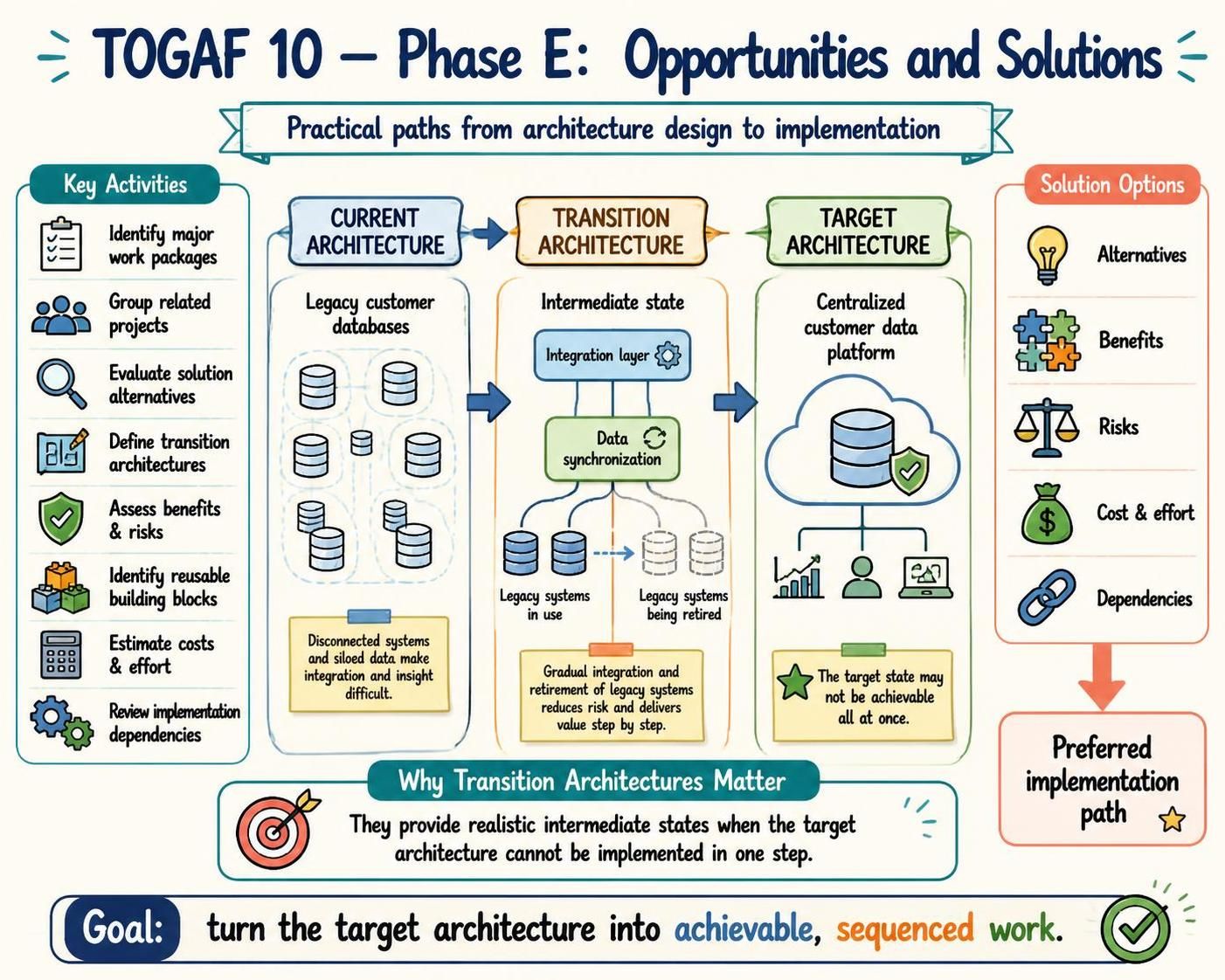
It connects architecture design with implementation options. Activities may include:
-
Identifying major work packages
-
Grouping related projects
-
Evaluating solution alternatives
-
Defining transition architectures
-
Assessing benefits and risks
-
Identifying reusable building blocks
-
Estimating costs and effort
-
Reviewing implementation dependencies
A transition architecture is an intermediate state between the current architecture and the final target architecture.
For example:
-
The current state uses multiple legacy customer databases.
-
The target state uses a centralized customer data platform.
-
A transition state may introduce an integration layer and data synchronization while legacy systems are gradually retired.
Transition architectures are useful when the target state cannot be implemented all at once.
Phase F: Migration Planning
Migration Planning turns the architecture roadmap into a prioritized implementation plan.
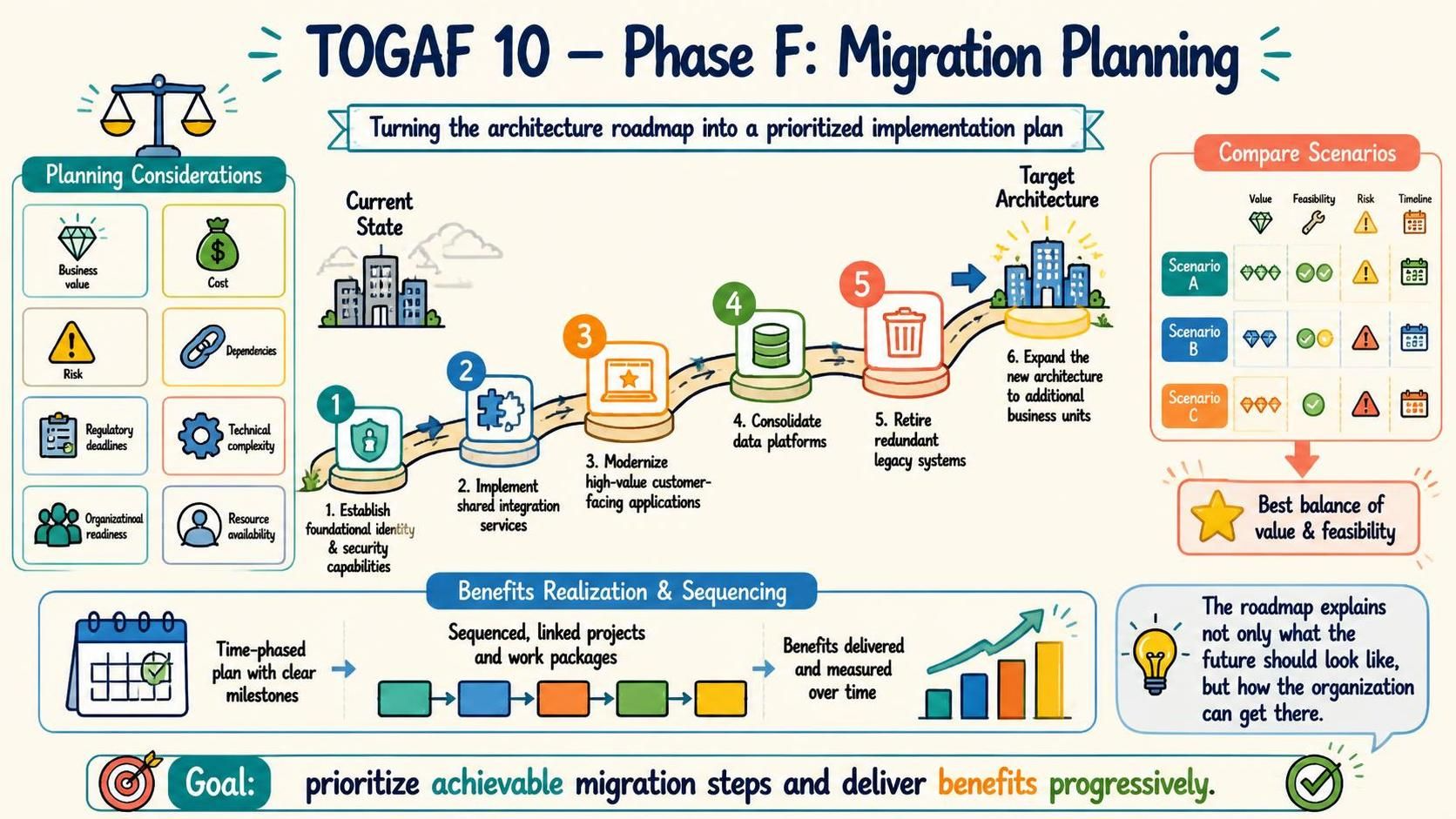
It may consider:
-
Business value
-
Cost
-
Risk
-
Dependencies
-
Regulatory deadlines
-
Technical complexity
-
Organizational readiness
-
Resource availability
-
Benefits realization
-
Project sequencing
A common technique is to compare implementation scenarios and determine which sequence provides the best balance of value and feasibility.
For example, a transformation may be organized into stages:
-
Establish foundational identity and security capabilities.
-
Implement shared integration services.
-
Modernize high-value customer-facing applications.
-
Consolidate data platforms.
-
Retire redundant legacy systems.
-
Expand the new architecture to additional business units.
The result is an architecture roadmap that explains not only what the future should look like, but also how the organization can get there.
Phase G: Implementation Governance
Implementation Governance ensures that projects build and deploy solutions consistent with the approved architecture.
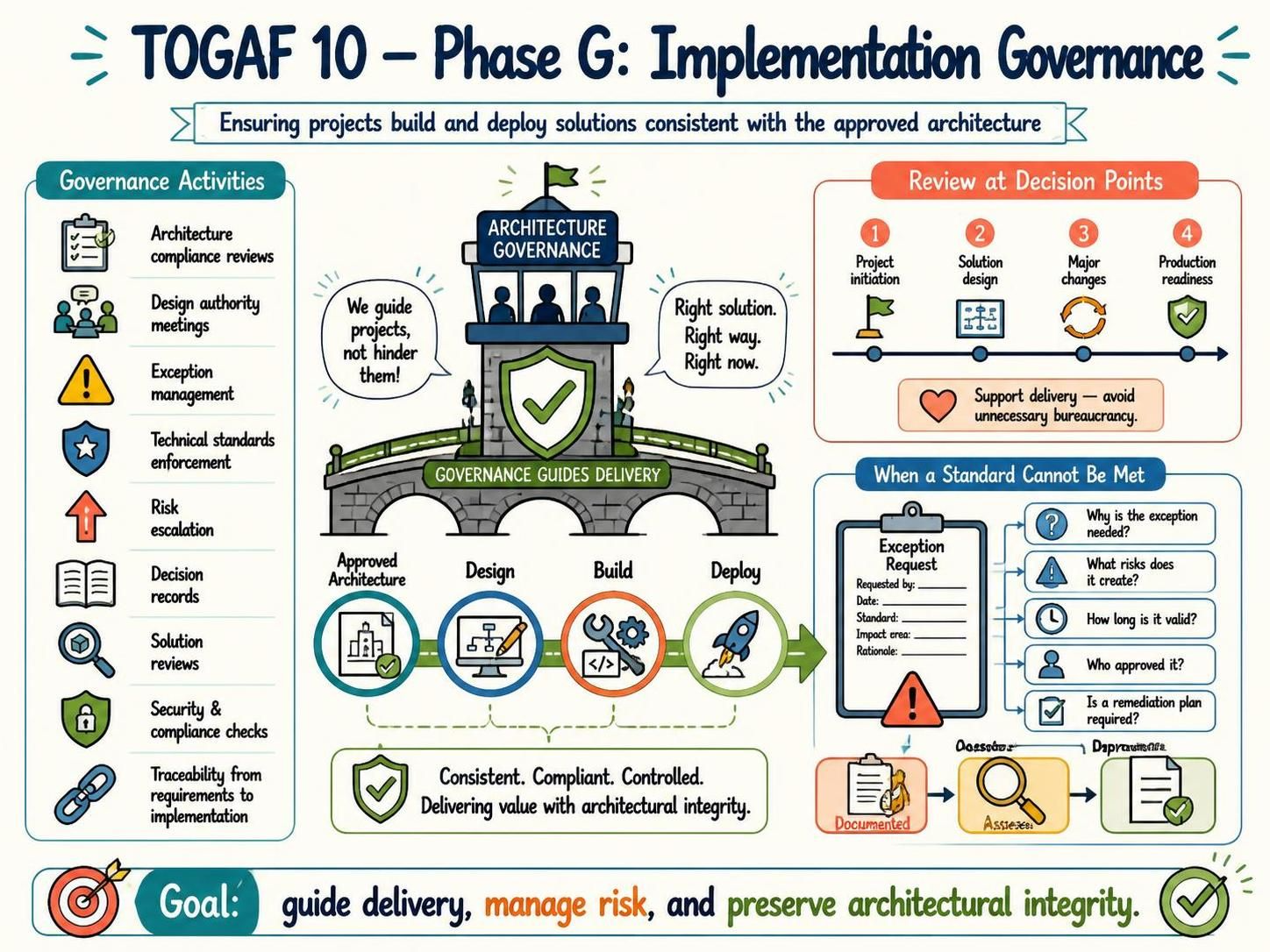
Architecture governance may include:
-
Architecture compliance reviews
-
Design authority meetings
-
Exception management
-
Technical standards enforcement
-
Risk escalation
-
Decision records
-
Solution reviews
-
Security and compliance checks
-
Traceability from requirements to implementation
Governance should support delivery rather than create unnecessary bureaucracy. Reviews should occur at points where they can influence decisions, such as during project initiation, solution design, major changes, and production readiness.
When a project cannot comply with an architecture standard, the exception should be documented. The organization can then assess:
-
Why the exception is needed
-
What risks it creates
-
How long it will remain valid
-
Who approved it
-
Whether a remediation plan is required
Phase H: Architecture Change Management
Enterprise architecture must evolve as the organization, market, regulations, and technology change.
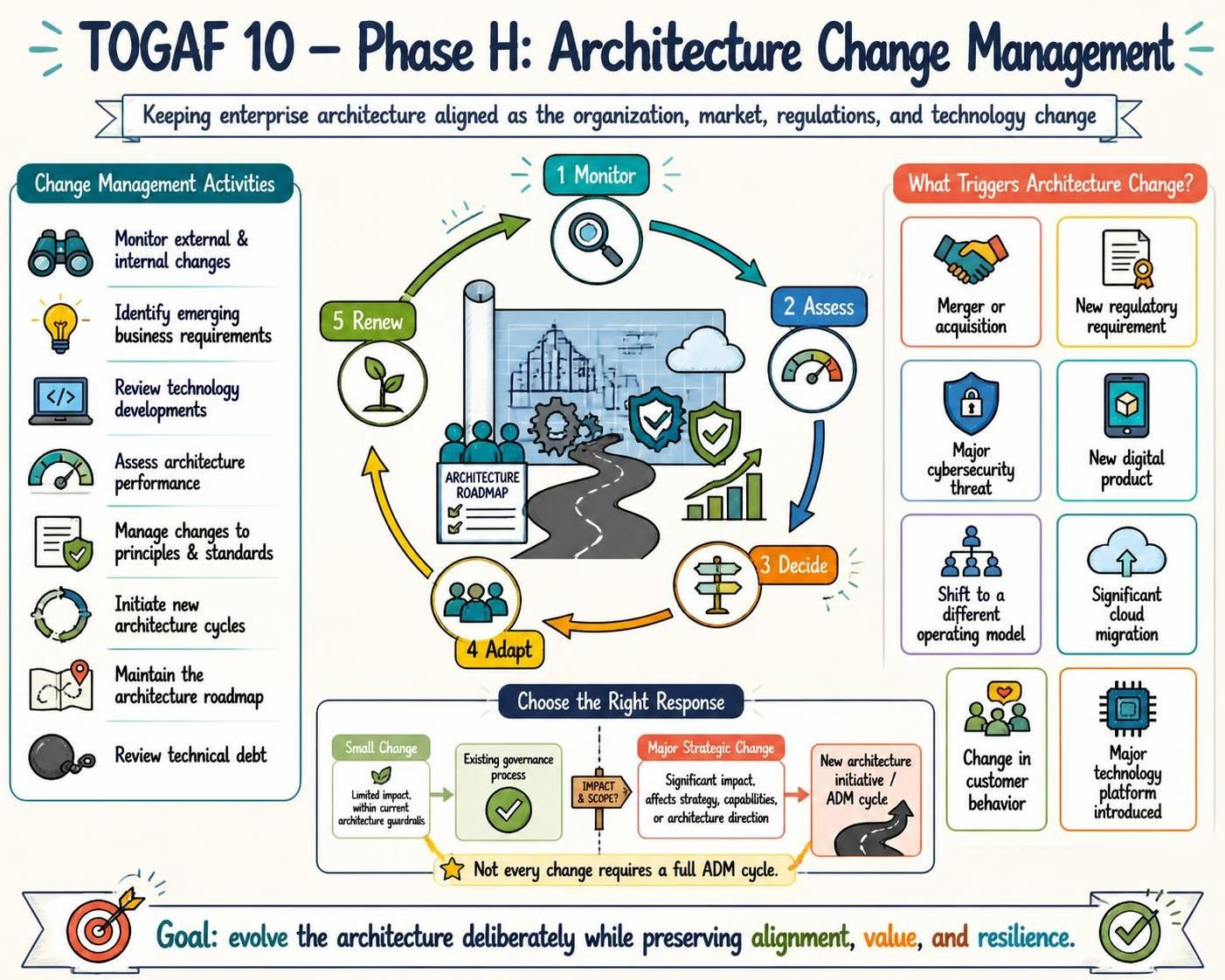
Architecture Change Management addresses:
-
Monitoring external and internal changes
-
Identifying emerging business requirements
-
Reviewing technology developments
-
Assessing architecture performance
-
Managing changes to principles and standards
-
Initiating new architecture cycles
-
Maintaining the architecture roadmap
-
Reviewing technical debt
Not every change requires a full ADM cycle. A minor adjustment may be handled through an existing governance process, while a major strategic change may require a new architecture initiative.
Examples of events that may trigger architecture change include:
-
A merger or acquisition
-
A new regulatory requirement
-
A major cybersecurity threat
-
A new digital product
-
A shift to a different operating model
-
A significant cloud migration
-
A change in customer behavior
-
The introduction of a major technology platform
Requirements Management
Requirements Management operates continuously throughout the ADM.
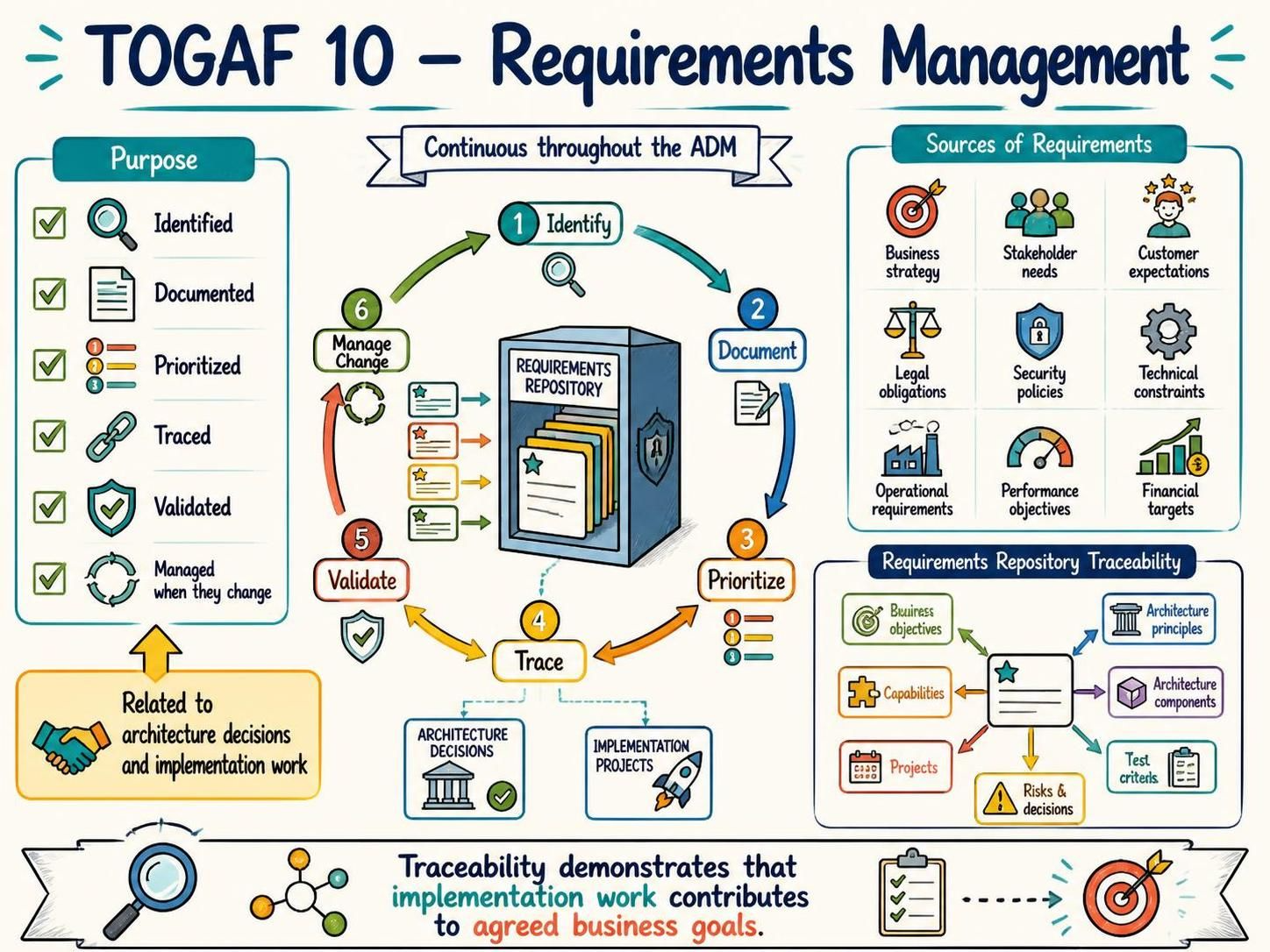
Its purpose is to ensure that architecture requirements are:
-
Identified
-
Documented
-
Prioritized
-
Traced
-
Validated
-
Managed when they change
-
Related to architecture decisions and implementation work
Requirements can come from many sources:
-
Business strategy
-
Stakeholder needs
-
Customer expectations
-
Legal obligations
-
Security policies
-
Technical constraints
-
Operational requirements
-
Performance objectives
-
Financial targets
A requirements repository can help organizations connect each requirement to:
-
Business objectives
-
Architecture principles
-
Capabilities
-
Architecture components
-
Projects
-
Test criteria
-
Risks and decisions
This traceability helps demonstrate that implementation work is contributing to agreed business goals.
TOGAF Architecture Content
TOGAF 10 distinguishes among several types of architecture work products. Understanding these distinctions helps architects communicate clearly.
Deliverables
Deliverables are formally reviewed and agreed work products that are delivered to stakeholders or used to manage an architecture project.
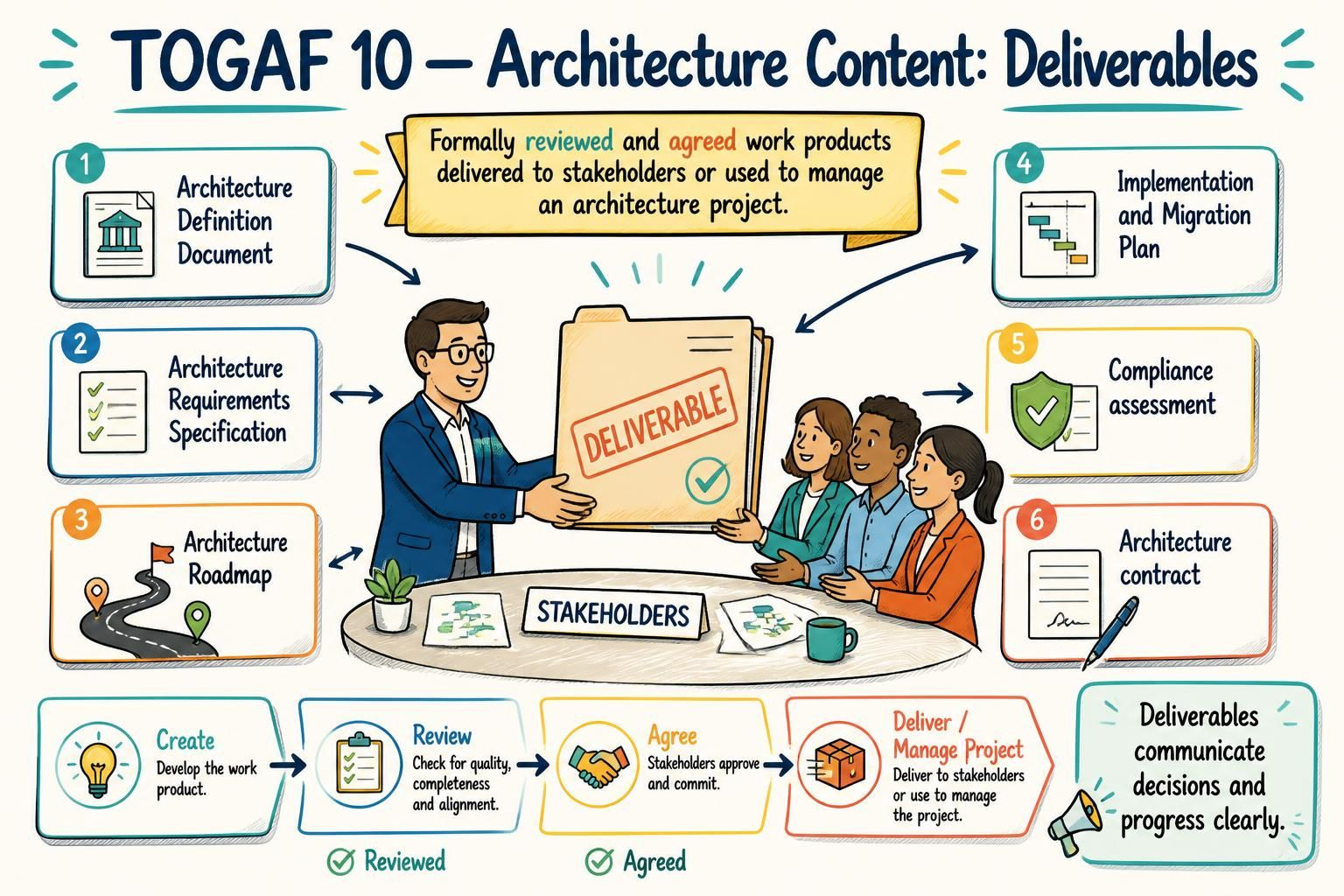
Examples may include:
-
Architecture Definition Document
-
Architecture Requirements Specification
-
Architecture Roadmap
-
Implementation and Migration Plan
-
Compliance assessment
-
Architecture contract
Artifacts
Artifacts are more detailed work products used to describe a particular aspect of an architecture.
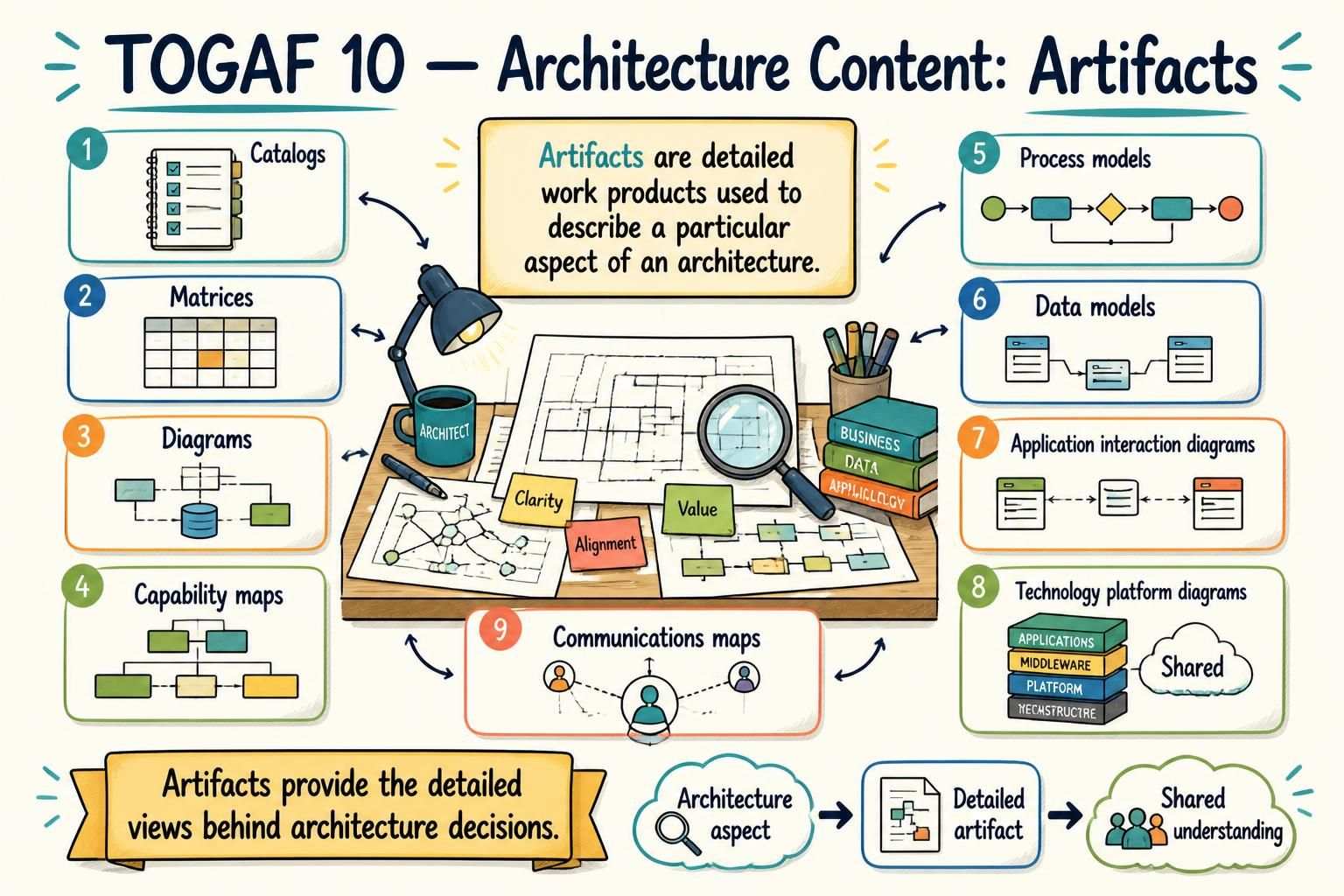
They may include:
-
Catalogs
-
Matrices
-
Diagrams
-
Capability maps
-
Process models
-
Data models
-
Application interaction diagrams
-
Technology platform diagrams
-
Communications maps
Building blocks
Building blocks represent reusable components of an architecture.
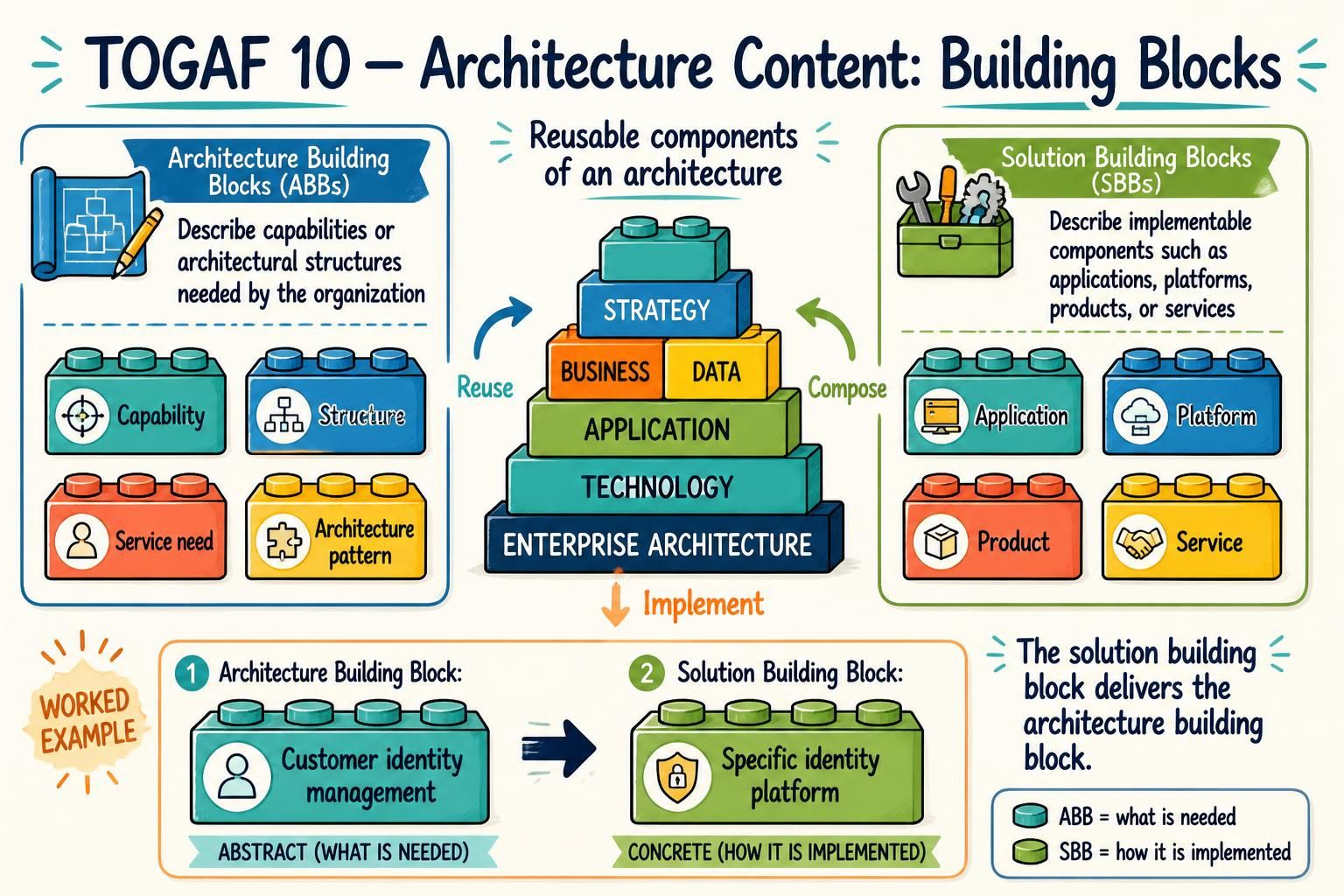
They may be:
-
Architecture Building Blocks, which describe capabilities or architectural structures needed by the organization
-
Solution Building Blocks, which describe implementable components such as applications, platforms, products, or services
For example, “customer identity management” may be an Architecture Building Block, while a specific identity platform deployed to deliver that capability may be a Solution Building Block.
Architecture Principles
Architecture principles guide decision-making. They help architects and leaders make consistent choices when evaluating alternatives.
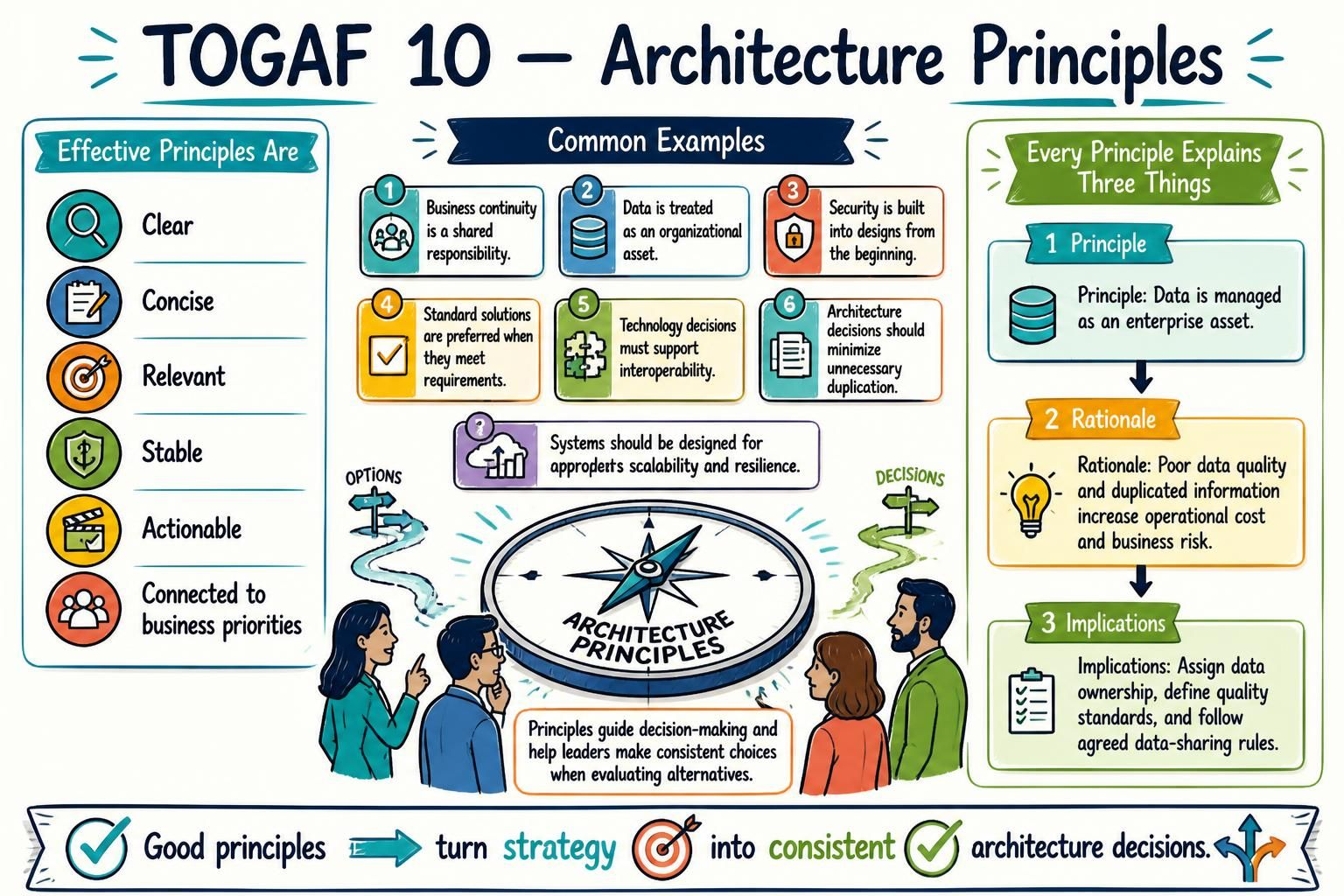
Effective principles are:
-
Clear
-
Concise
-
Relevant
-
Stable
-
Actionable
-
Connected to business priorities
Common examples include:
-
Business continuity is a shared responsibility.
-
Data is treated as an organizational asset.
-
Security is built into designs from the beginning.
-
Standard solutions are preferred when they meet requirements.
-
Technology decisions must support interoperability.
-
Architecture decisions should minimize unnecessary duplication.
-
Systems should be designed for appropriate scalability and resilience.
A principle should also have a rationale and implications. For example:
Principle: Data is managed as an enterprise asset.
Rationale: Poor data quality and duplicated information increase operational cost and business risk.
Implications: Data ownership must be assigned, quality standards must be defined, and systems must follow agreed data-sharing rules.
The Enterprise Continuum
The Enterprise Continuum helps architects classify architecture and solution assets.
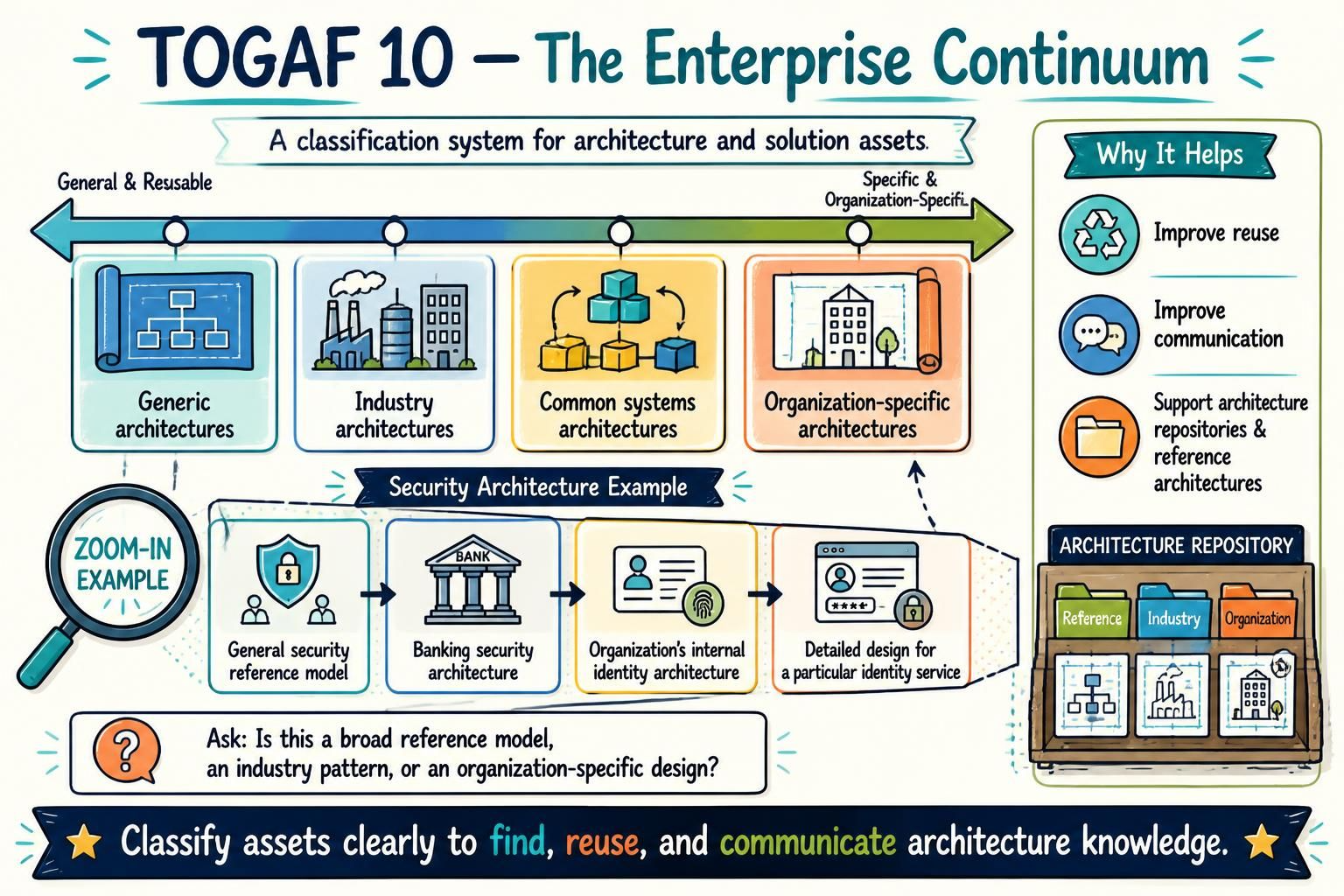
It provides a way to describe architectures from general and reusable to specific and organization-specific.
The continuum may include:
-
Generic architectures
-
Industry architectures
-
Common systems architectures
-
Organization-specific architectures
Its purpose is to improve reuse and communication. Architects can identify whether an artifact describes a broad reference model, an industry pattern, or a design created specifically for one organization.
For example:
-
A general security reference model is relatively broad.
-
A banking security architecture is more industry-specific.
-
An organization’s internal identity architecture is organization-specific.
-
A detailed design for a particular identity service is solution-specific.
The Enterprise Continuum is especially useful when building architecture repositories and reference architectures.
Architecture Governance
Architecture governance defines how architecture-related decisions are made, reviewed, monitored, and enforced.
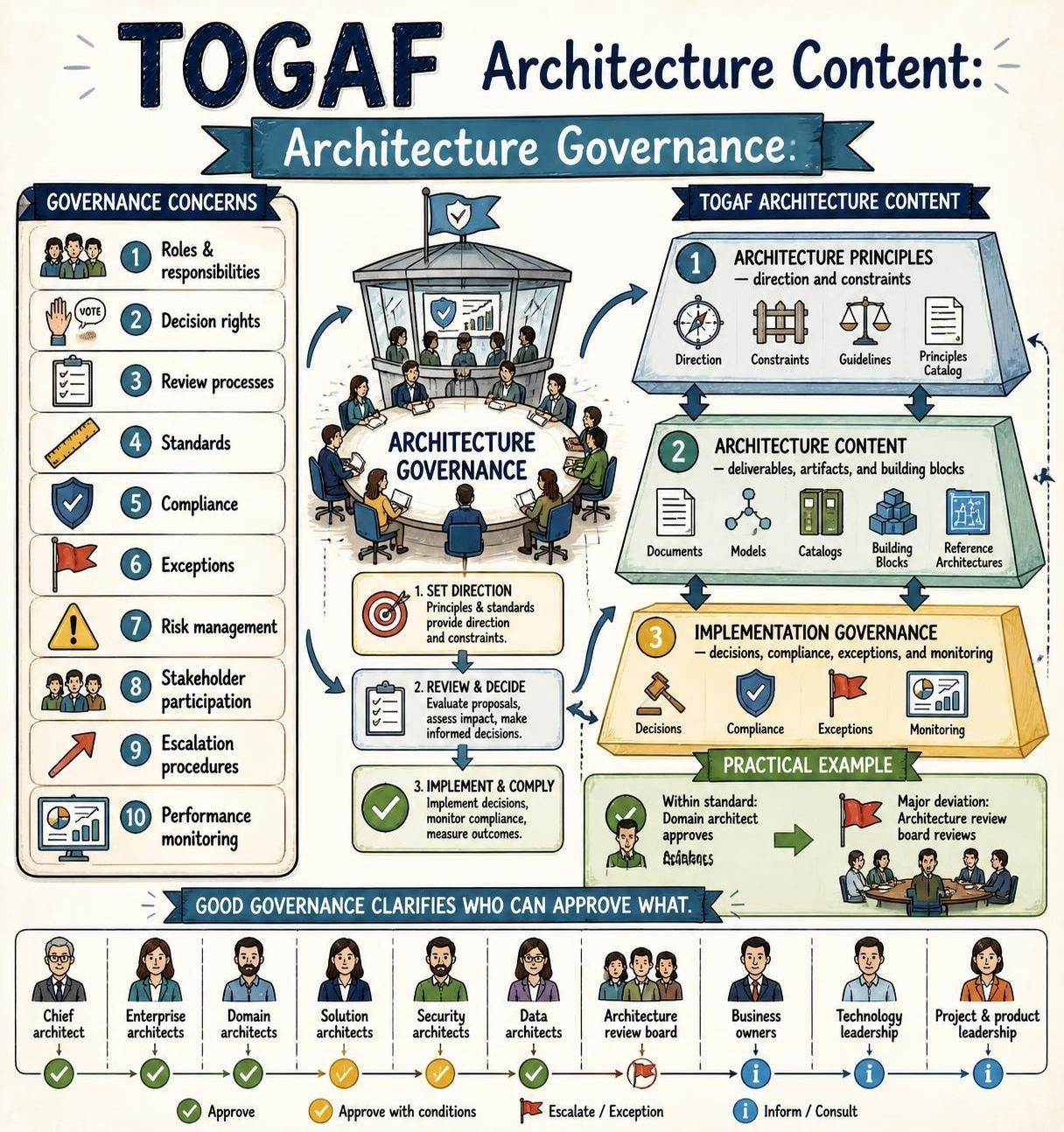
It typically addresses:
-
Roles and responsibilities
-
Decision rights
-
Review processes
-
Standards
-
Compliance
-
Exceptions
-
Risk management
-
Stakeholder participation
-
Escalation procedures
-
Performance monitoring
Typical governance roles may include:
-
Chief architect
-
Enterprise architects
-
Domain architects
-
Solution architects
-
Security architects
-
Data architects
-
Architecture review board
-
Business owners
-
Technology leadership
-
Project and product leadership
Good governance clarifies who can approve what. For example, a domain architect may approve a design within an established standard, while a major deviation from enterprise principles may require review by an architecture board.
Applying TOGAF 10 in an Organization
A practical implementation should begin with a focused problem rather than attempting to deploy the entire framework at once.
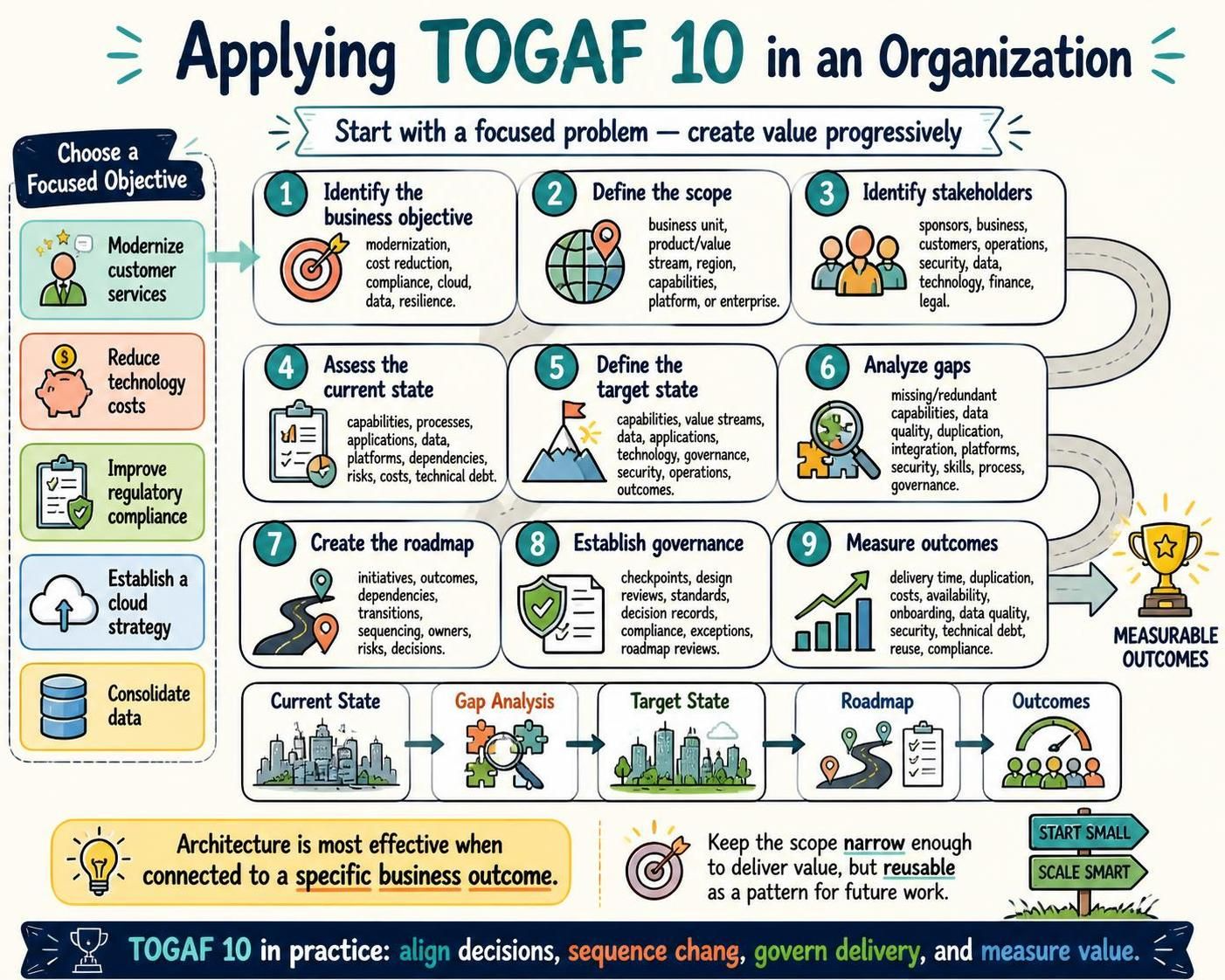
Step 1: Identify the business objective
Start with a clear business need, such as:
-
Modernizing customer services
-
Reducing technology costs
-
Improving regulatory compliance
-
Integrating acquired companies
-
Establishing a cloud strategy
-
Consolidating data
-
Improving operational resilience
Architecture is most effective when it is connected to a specific outcome.
Step 2: Define the scope
Determine whether the initiative covers:
-
One business unit
-
A product or value stream
-
A particular geographic region
-
A set of business capabilities
-
A platform or technology domain
-
The entire enterprise
An overly broad scope can make the work slow and difficult to complete. A narrowly defined scope can provide faster value and create a pattern for future work.
Step 3: Identify stakeholders
Stakeholders may include:
-
Executive sponsors
-
Business owners
-
Customers
-
Operations teams
-
Product managers
-
Security and risk teams
-
Data owners
-
Application owners
-
Infrastructure teams
-
Finance and procurement
-
Legal and compliance teams
Each stakeholder group may have different concerns. Executives may focus on outcomes and investment, while operations teams may focus on maintainability and service reliability.
Step 4: Assess the current state
Document the current architecture at an appropriate level of detail.
Focus on information that supports decisions, including:
-
Existing capabilities
-
Current processes
-
Key applications
-
Data sources and flows
-
Technology platforms
-
Integration dependencies
-
Major risks
-
Costs
-
Technical debt
-
Known pain points
Avoid documenting every technical detail unless it is relevant to the architecture decision.
Step 5: Define the target state
Describe the desired future architecture in terms of:
-
Business capabilities
-
Value streams
-
Data responsibilities
-
Application services
-
Technology platforms
-
Governance
-
Security
-
Operational requirements
-
Measurable outcomes
The target state should be ambitious enough to support strategy but realistic enough to implement.
Step 6: Analyze gaps
Compare the current and target architectures.
Typical gap categories include:
-
Missing capabilities
-
Redundant capabilities
-
Data-quality problems
-
Application duplication
-
Integration weaknesses
-
Unsupported platforms
-
Security gaps
-
Skills shortages
-
Process deficiencies
-
Governance limitations
Gap analysis should lead to action. Each significant gap should be associated with a potential work package, risk, decision, or further investigation.
Step 7: Create the roadmap
Prioritize initiatives based on value, risk, dependencies, cost, and readiness.
A roadmap should show:
-
Major initiatives
-
Expected outcomes
-
Dependencies
-
Transition architectures
-
Target dates or sequencing
-
Owners
-
Risks
-
Decision points
Roadmaps should be maintained as living documents rather than treated as fixed promises.
Step 8: Establish governance
Define how implementation teams will remain aligned with the architecture.
This may involve:
-
Architecture checkpoints
-
Design reviews
-
Standard technology catalogs
-
Architecture decision records
-
Compliance assessments
-
Exception processes
-
Regular roadmap reviews
Step 9: Measure outcomes
Architecture effectiveness should be assessed through business and operational measures.
Possible measures include:
-
Reduced delivery time
-
Reduced application duplication
-
Lower infrastructure costs
-
Improved system availability
-
Faster customer onboarding
-
Better data quality
-
Fewer security findings
-
Reduced technical debt
-
Increased reuse of shared services
-
Improved compliance
TOGAF 10 and Agile Delivery
TOGAF 10 can be adapted to agile environments. It does not require architects to create a complete, detailed enterprise design before delivery begins.
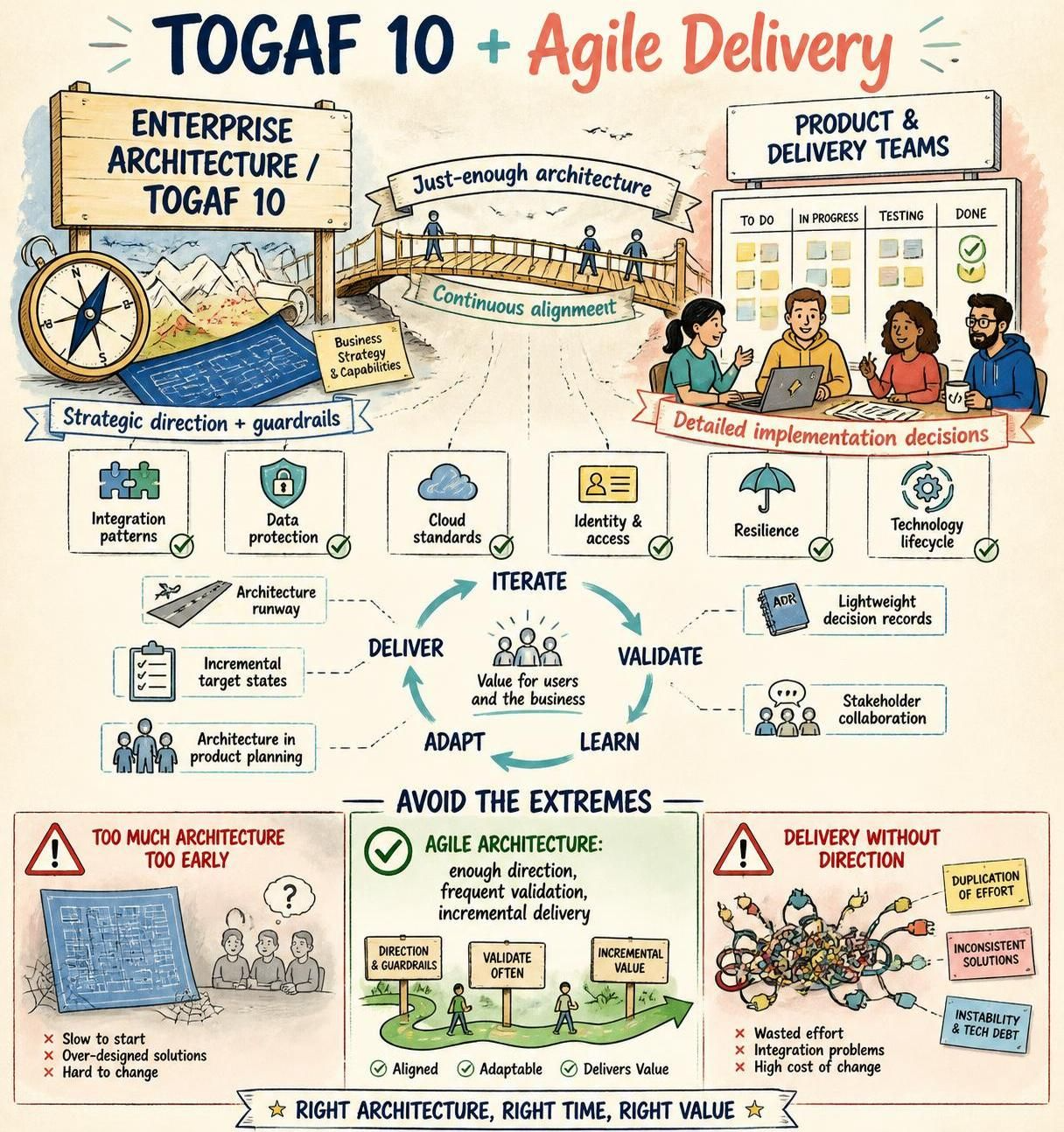
A practical agile approach may use:
-
Just-enough architecture
-
Iterative architecture development
-
Architecture runway
-
Lightweight decision records
-
Continuous stakeholder collaboration
-
Frequent validation
-
Incremental target states
-
Architecture work embedded in product planning
Enterprise architecture can establish strategic direction and guardrails, while product and delivery teams make detailed decisions within those boundaries.
For example, an enterprise architecture team may define:
-
Approved integration patterns
-
Data protection requirements
-
Cloud platform standards
-
Identity and access principles
-
Resilience expectations
-
Technology lifecycle policies
An agile delivery team can then choose the detailed implementation approach while remaining aligned with those constraints.
The key is to avoid two extremes:
-
Architecture performed so far in advance that it becomes disconnected from delivery
-
Delivery performed without enough architectural direction, causing duplication and long-term instability
TOGAF 10 and Cloud Architecture
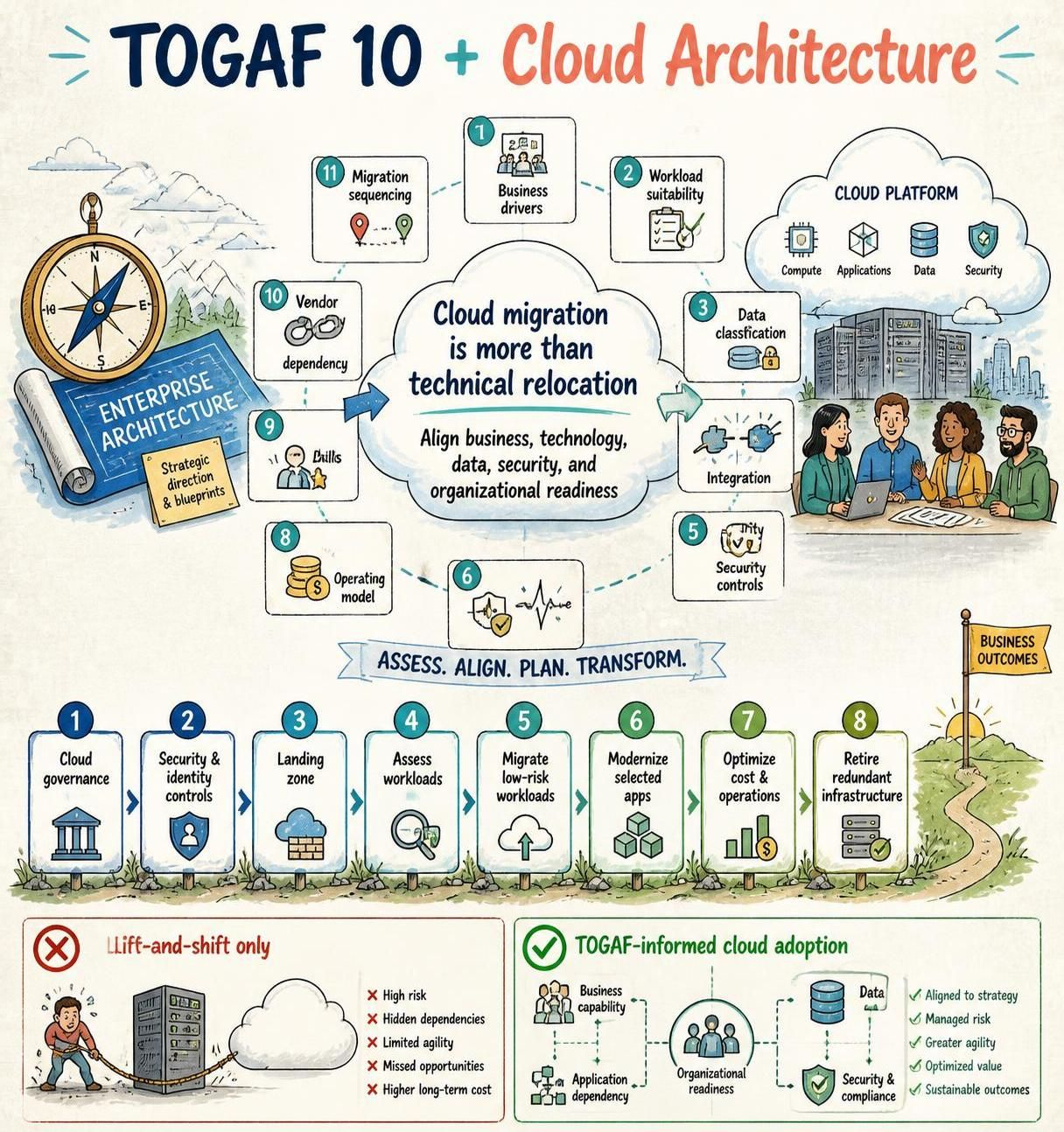
TOGAF 10 can support cloud adoption by helping organizations evaluate cloud decisions across multiple architecture domains.
A cloud architecture initiative may examine:
-
Business drivers
-
Workload suitability
-
Data classification
-
Integration requirements
-
Security controls
-
Resilience
-
Cost management
-
Operating model
-
Skills
-
Vendor dependency
-
Migration sequencing
A common mistake is to treat cloud migration as a purely technical relocation exercise. TOGAF encourages a broader analysis of business capabilities, application dependencies, data requirements, and organizational readiness.
A cloud roadmap may include:
-
Establishing cloud governance.
-
Defining security and identity controls.
-
Creating landing-zone capabilities.
-
Assessing application workloads.
-
Migrating low-risk workloads.
-
Modernizing selected applications.
-
Optimizing cost and operations.
-
Retiring redundant infrastructure.
TOGAF 10 and Security Architecture
Security should be integrated throughout architecture development rather than added at the end.
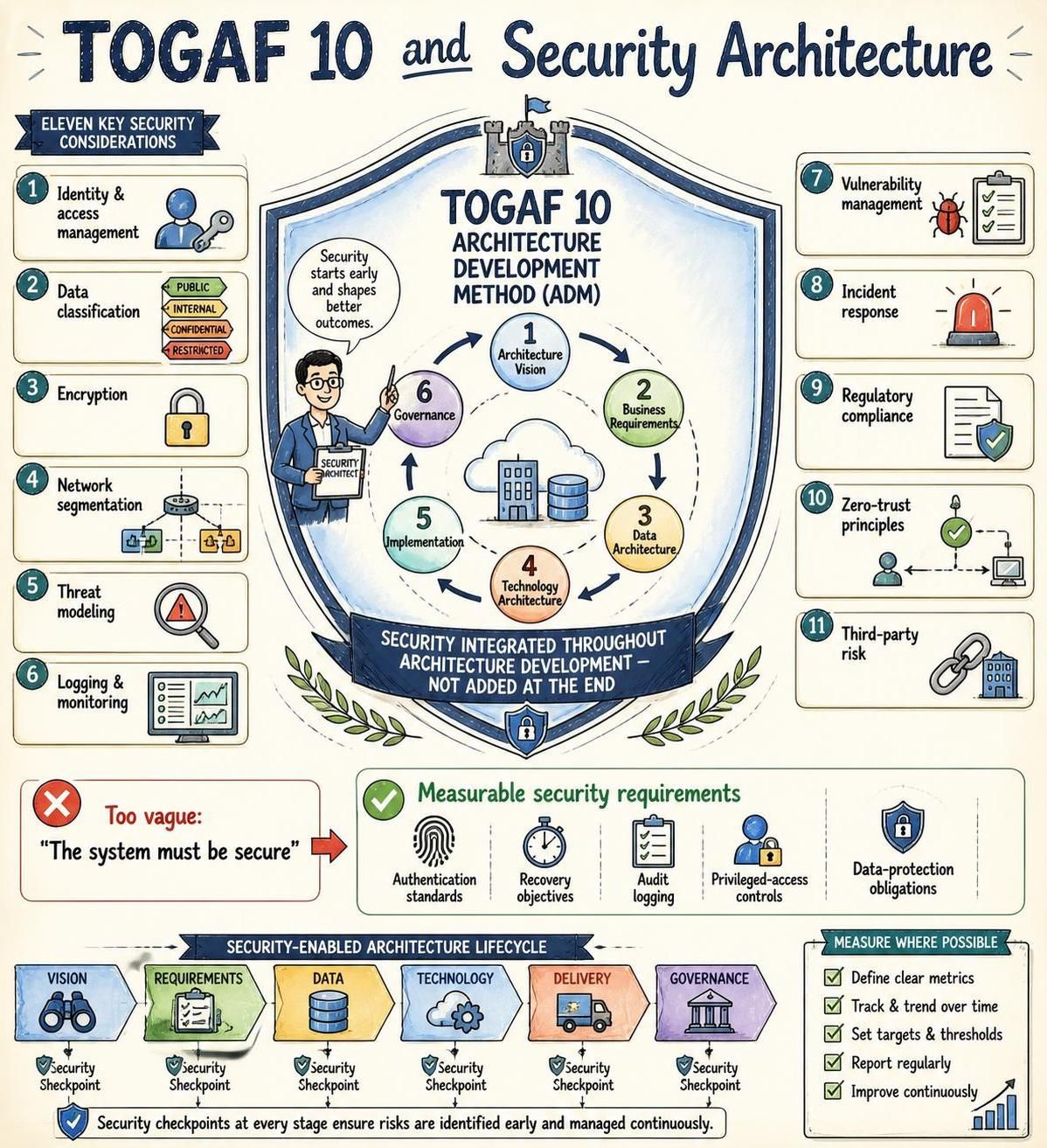
Security considerations may include:
-
Identity and access management
-
Data classification
-
Encryption
-
Network segmentation
-
Threat modeling
-
Logging and monitoring
-
Vulnerability management
-
Incident response
-
Regulatory compliance
-
Zero-trust principles
-
Third-party risk
Security architects should participate in early phases, especially when defining the Architecture Vision, business requirements, data architecture, and technology architecture.
Security requirements should be measurable where possible. For example, “the system must be secure” is too vague. A stronger requirement might specify authentication standards, recovery objectives, audit logging, privileged-access controls, or data-protection obligations.
Common TOGAF 10 Implementation Mistakes
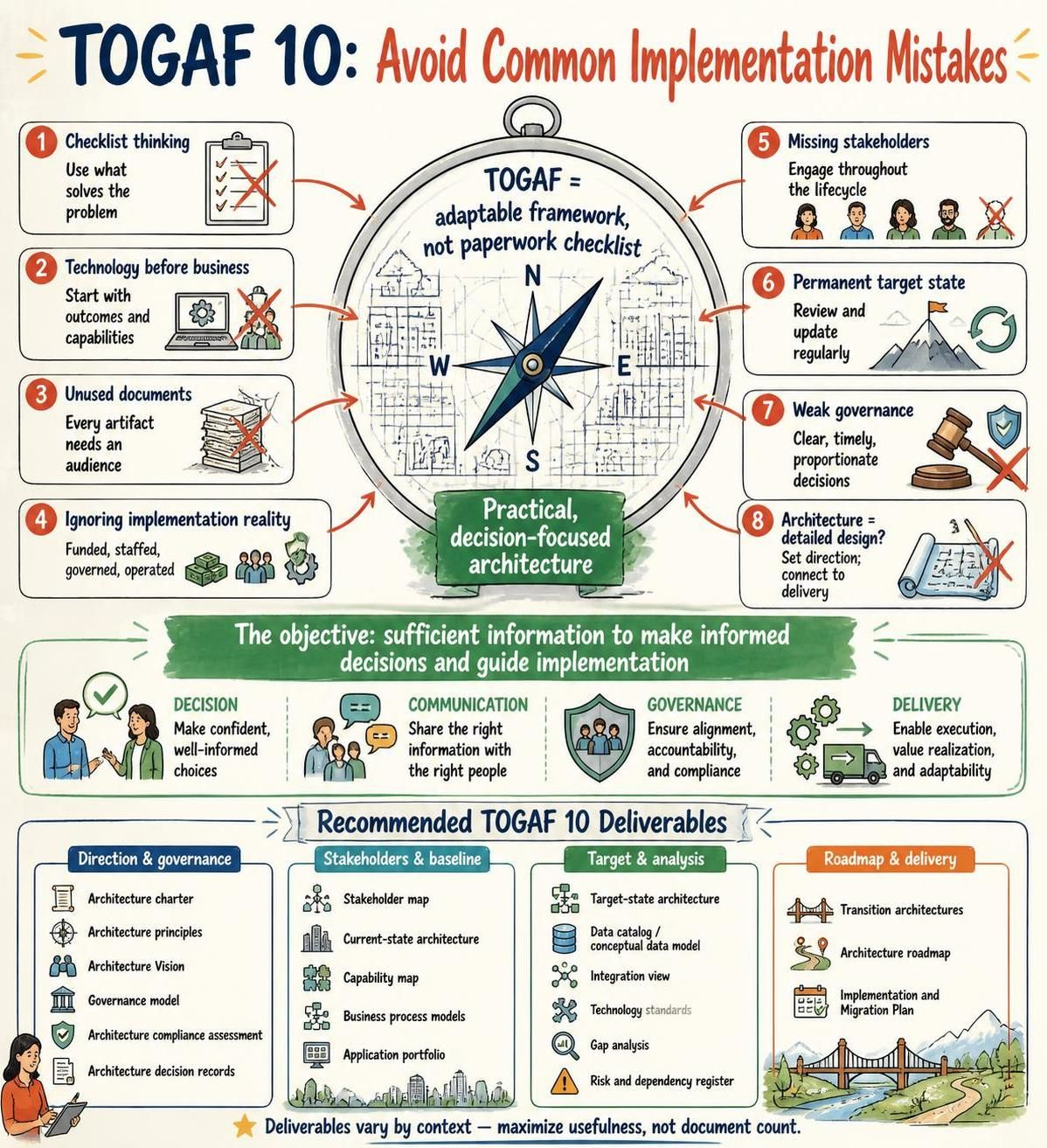
Treating TOGAF as a checklist
TOGAF is a framework, not a mandatory sequence of paperwork. Applying every activity and artifact regardless of context can create unnecessary effort.
Use the parts that help solve the organization’s problem.
Focusing on technology before business needs
Starting with a preferred platform or product can produce an architecture that does not address the actual business problem.
Begin with outcomes, capabilities, requirements, and constraints.
Producing documents that nobody uses
Architecture artifacts should support decisions, communication, governance, and implementation. If an artifact has no clear audience or purpose, it may not be necessary.
Ignoring implementation realities
A target architecture that cannot be funded, staffed, governed, or operated will not produce value.
Consider costs, skills, dependencies, organizational readiness, procurement, and operational support.
Failing to involve stakeholders
Architectures developed only by technical teams may overlook business priorities, customer needs, operational constraints, and compliance requirements.
Stakeholder engagement should continue throughout the architecture lifecycle.
Treating the target state as permanent
Business strategy, regulations, technology, and customer expectations change. Architecture must be reviewed and updated regularly.
Weak governance
Without governance, projects may deviate from the architecture, duplicate capabilities, or introduce incompatible technologies.
Governance should be clear, timely, and proportionate to risk.
Confusing architecture with detailed design
Enterprise architecture defines direction, structure, principles, boundaries, and major decisions. Detailed solution design usually belongs to solution architects and delivery teams.
The two levels should be connected without duplicating one another.
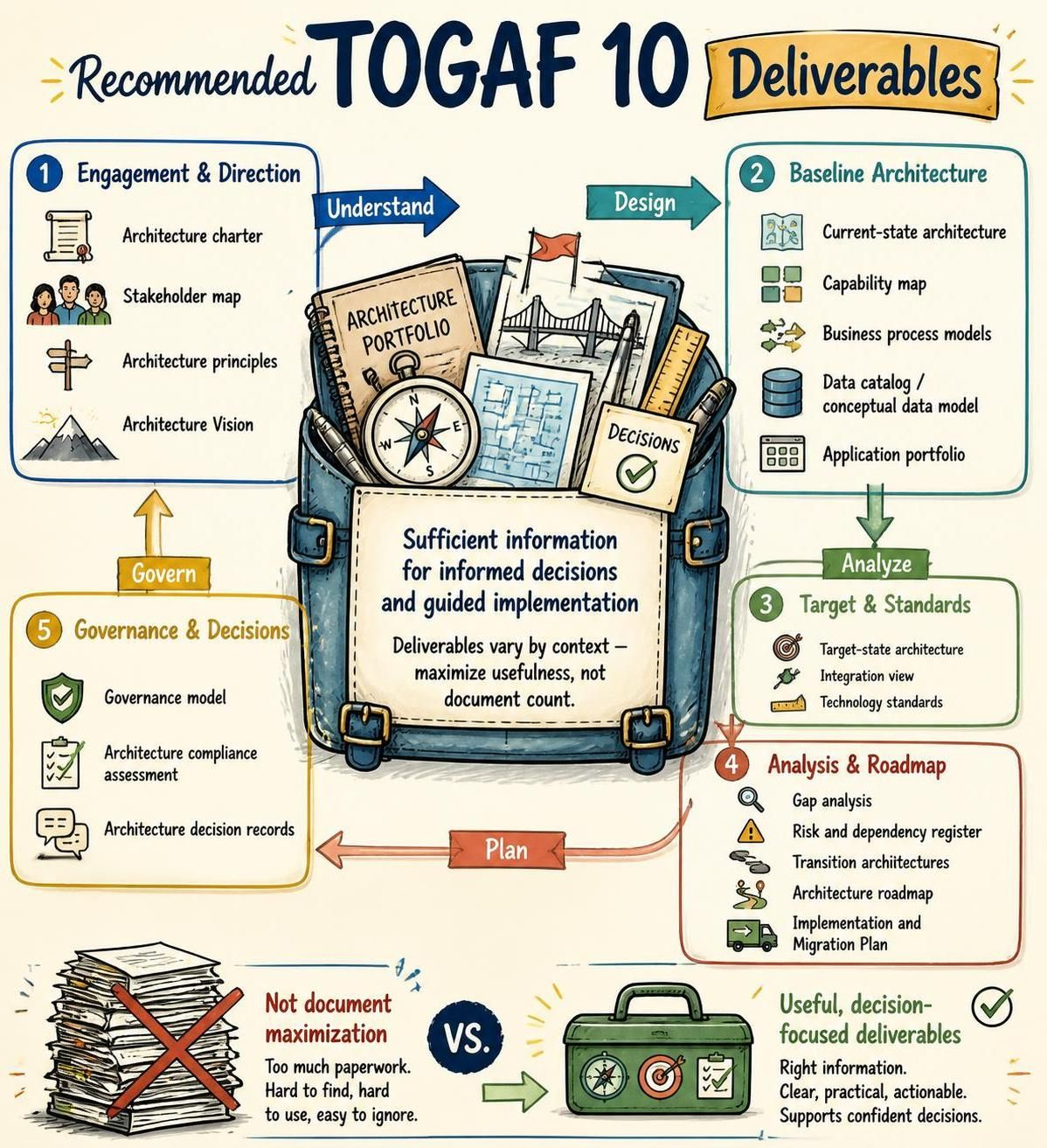
Recommended TOGAF 10 Deliverables
The exact deliverables will vary, but a practical architecture engagement may produce:
-
Architecture charter
-
Stakeholder map
-
Architecture principles
-
Architecture Vision
-
Current-state architecture
-
Target-state architecture
-
Capability map
-
Business process models
-
Data catalog or conceptual data model
-
Application portfolio
-
Integration view
-
Technology standards
-
Gap analysis
-
Risk and dependency register
-
Transition architectures
-
Architecture roadmap
-
Implementation and Migration Plan
-
Governance model
-
Architecture compliance assessment
-
Architecture decision records
The objective is not to maximize the number of documents. The objective is to create sufficient information for stakeholders to make informed decisions and guide implementation.
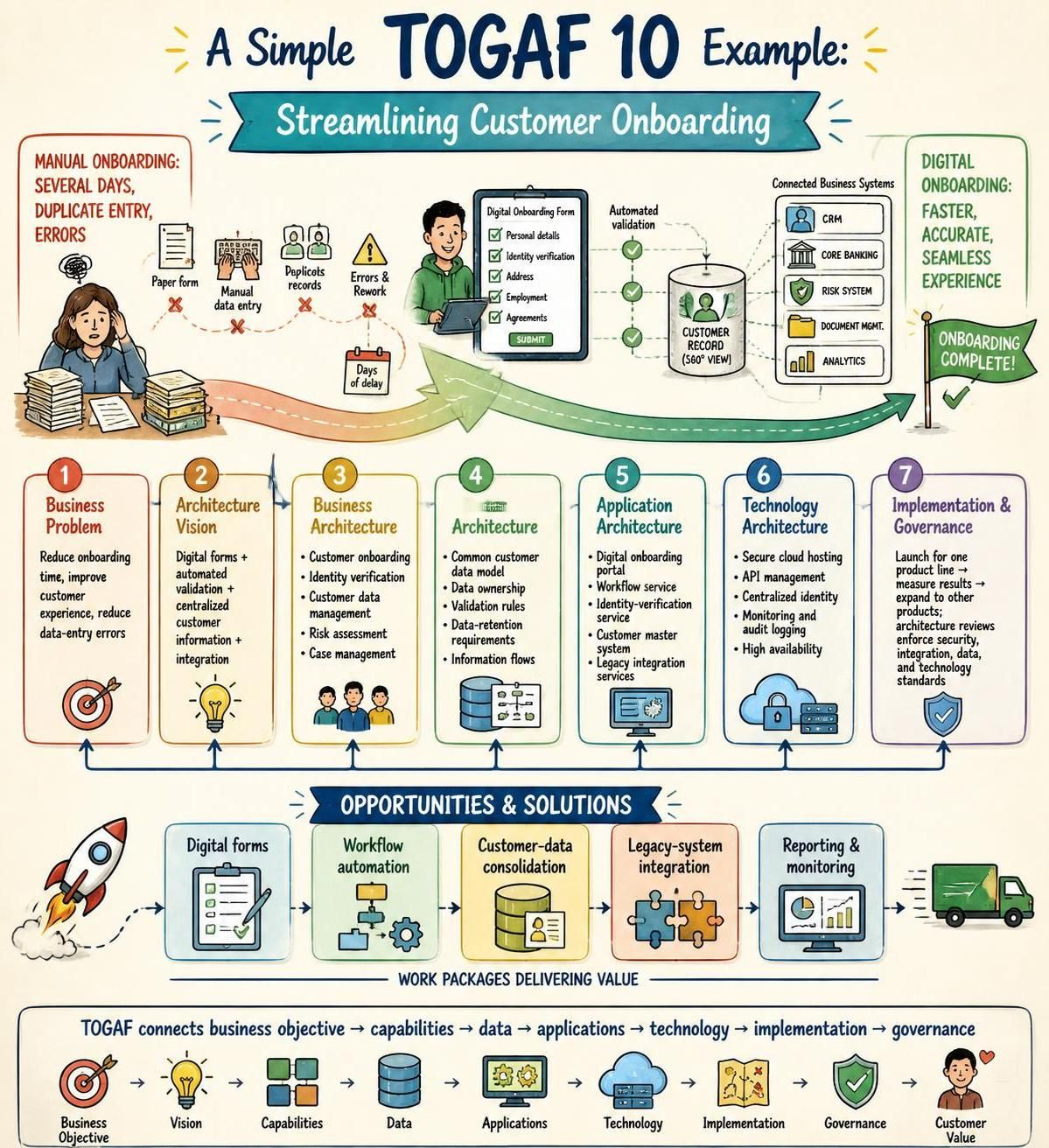
A Simple TOGAF 10 Example
Consider a company whose customer onboarding process takes several days because information is entered manually into multiple systems.
Business problem
The company wants to reduce onboarding time, improve customer experience, and reduce data-entry errors.
Architecture Vision
Create a streamlined onboarding capability with digital forms, automated validation, centralized customer information, and integration with existing business systems.
Business Architecture
The organization identifies capabilities such as:
-
Customer onboarding
-
Identity verification
-
Customer data management
-
Risk assessment
-
Case management
Data Architecture
The architecture defines:
-
A common customer data model
-
Data ownership
-
Validation rules
-
Data-retention requirements
-
Information flows between onboarding and downstream systems
Application Architecture
The target application environment includes:
-
A digital onboarding portal
-
A workflow service
-
An identity-verification service
-
A customer master system
-
Integration services for legacy applications
Technology Architecture
The technology design may require:
-
Secure cloud hosting
-
API management
-
Centralized identity services
-
Monitoring and audit logging
-
High-availability components
Opportunities and Solutions
The organization identifies work packages for:
-
Digital forms
-
Workflow automation
-
Customer-data consolidation
-
Legacy-system integration
-
Reporting and monitoring
Migration Planning
The company first launches the solution for one product line, then expands to other products after measuring results.
Implementation Governance
Architecture reviews confirm that projects follow approved security, integration, data, and technology standards.
This example demonstrates how TOGAF connects a business objective with capabilities, data, applications, technology, implementation, and governance.
TOGAF 10 Certification Overview
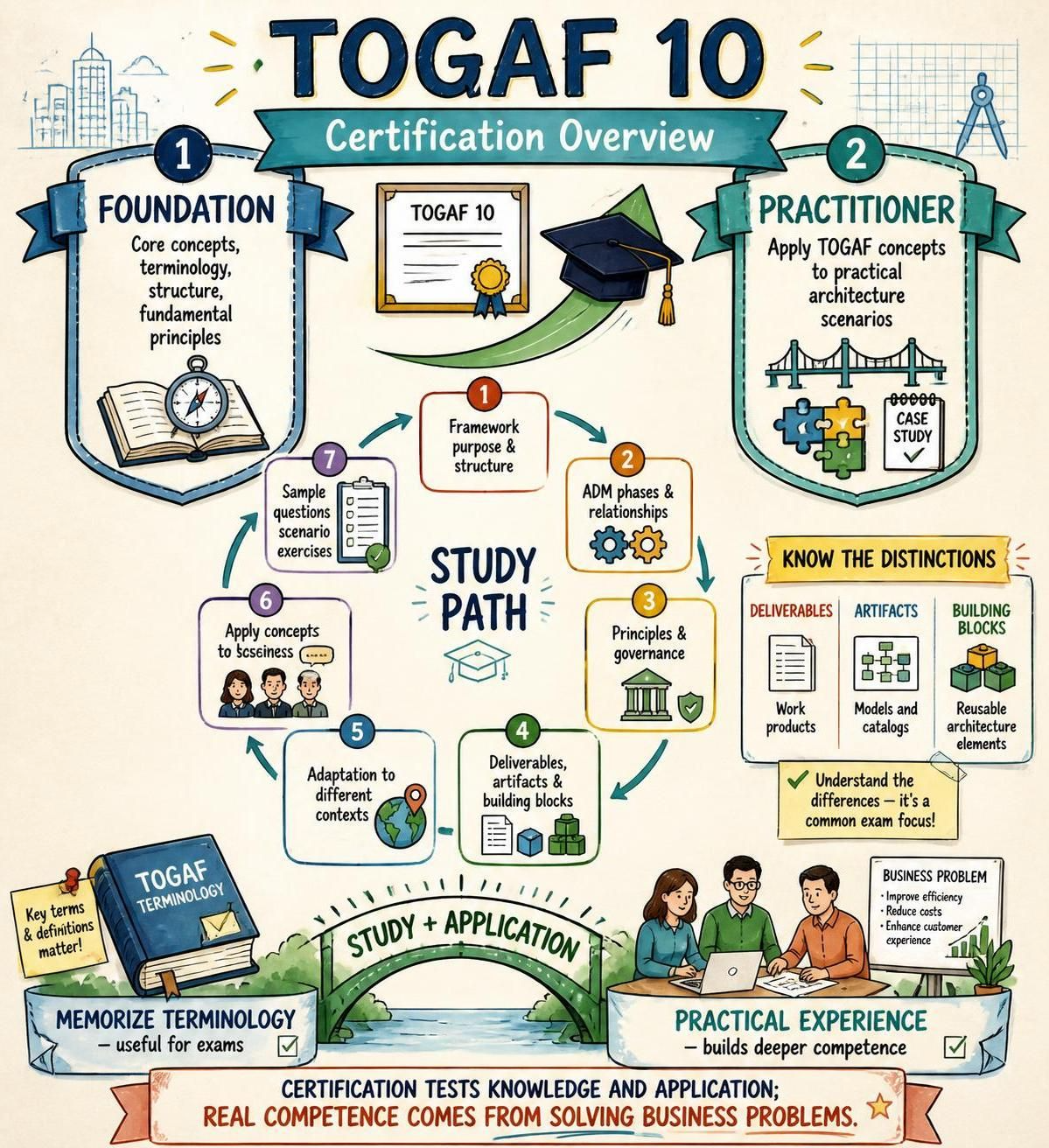
TOGAF certification is generally structured around two main levels:
-
Foundation: Tests knowledge of core concepts, terminology, structure, and fundamental principles.
-
Practitioner: Tests the ability to apply TOGAF concepts in practical architecture scenarios.
A typical study approach includes:
-
Learn the purpose and structure of the framework.
-
Understand the ADM phases and their relationships.
-
Study architecture principles and governance.
-
Review deliverables, artifacts, and building blocks.
-
Understand how the framework is adapted to different contexts.
-
Practice applying concepts to business scenarios.
-
Review sample questions and scenario-based exercises.
-
Focus on distinguishing similar concepts, such as deliverables, artifacts, and building blocks.
Certification preparation should be combined with practical experience. Memorizing terminology is useful for examinations, but applying architecture concepts to real business problems develops deeper competence.
A Practical Adoption Model
Organizations can introduce TOGAF 10 incrementally.
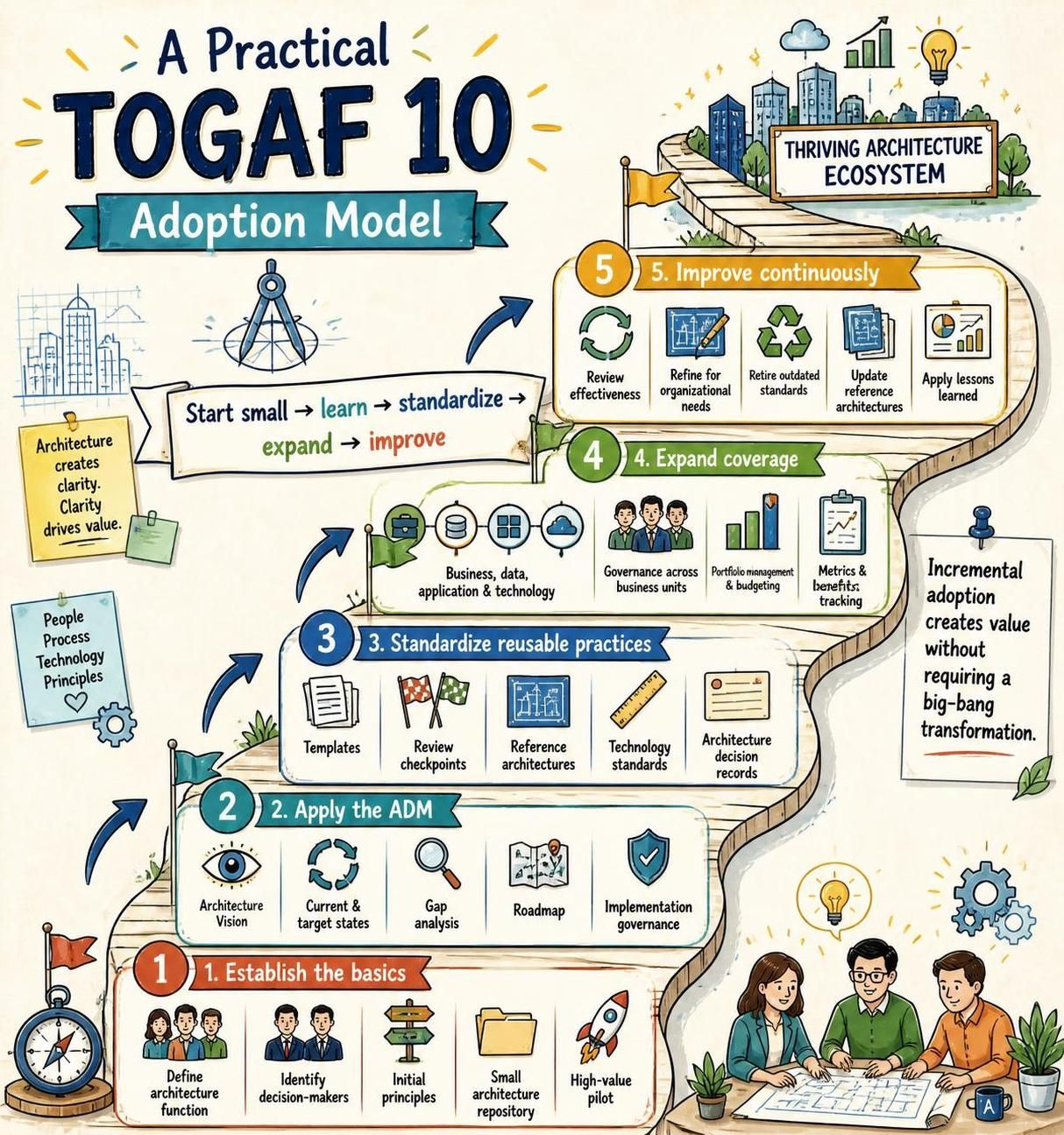
Phase 1: Establish the basics
-
Define the architecture function.
-
Identify decision-makers.
-
Create initial principles.
-
Establish a small architecture repository.
-
Select one high-value pilot.
Phase 2: Apply the ADM to a real initiative
-
Define the Architecture Vision.
-
Document current and target states.
-
Perform gap analysis.
-
Create a roadmap.
-
Establish implementation governance.
Phase 3: Standardize reusable practices
-
Create templates.
-
Define review checkpoints.
-
Establish reference architectures.
-
Develop technology standards.
-
Introduce architecture decision records.
Phase 4: Expand coverage
-
Add business, data, application, and technology architecture practices.
-
Extend architecture governance across business units.
-
Connect architecture with portfolio management and budgeting.
-
Improve metrics and benefits tracking.
Phase 5: Improve continuously
-
Review architecture effectiveness.
-
Refine the framework for organizational needs.
-
Retire outdated standards.
-
Update reference architectures.
-
Incorporate lessons from completed initiatives.
Final Takeaway
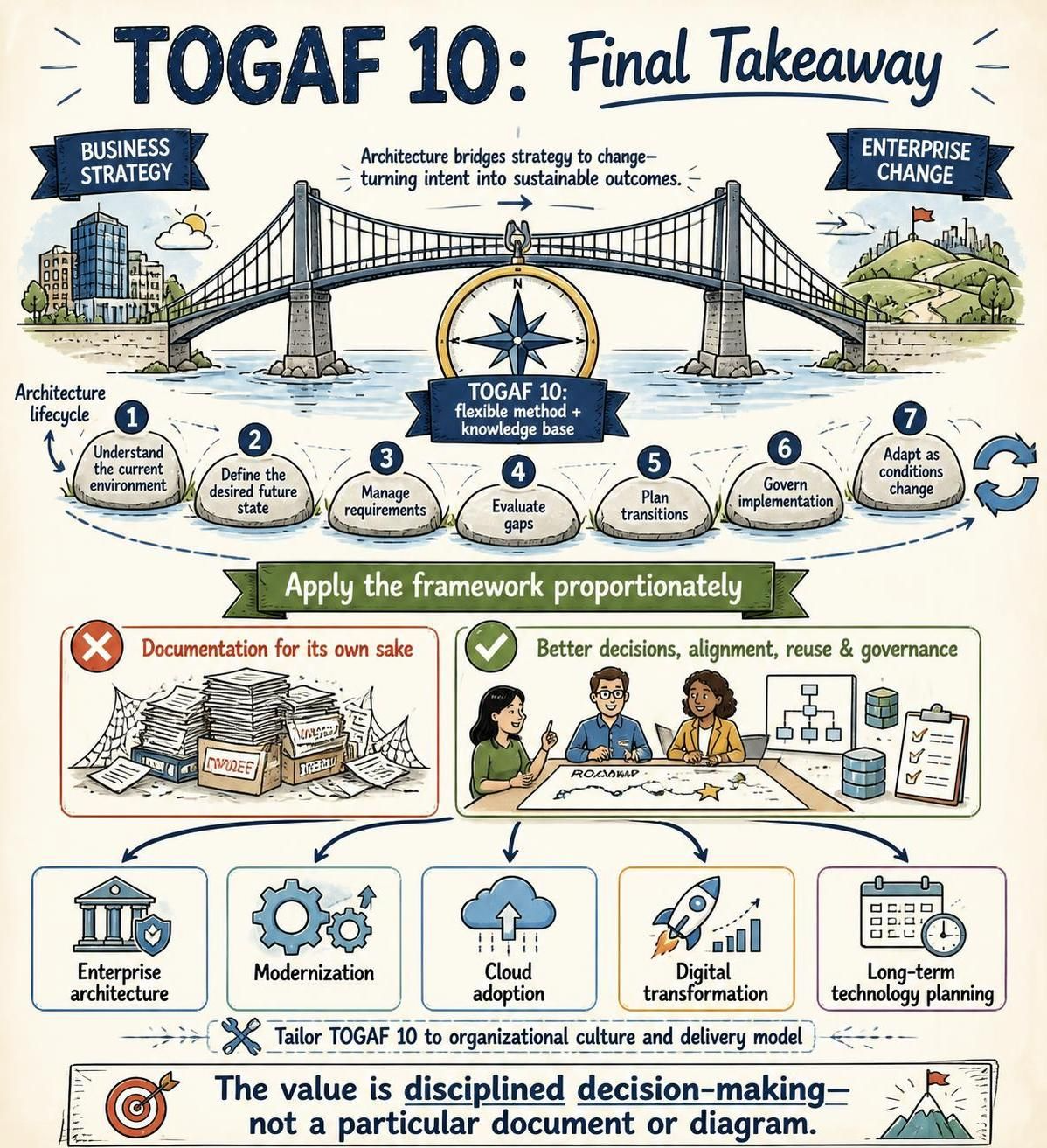
TOGAF 10 is best understood as a flexible method and knowledge base for connecting business strategy with enterprise change. Its most important contribution is not a particular document or diagram, but a disciplined way to:
-
Understand the current environment
-
Define a desired future state
-
Manage requirements
-
Evaluate gaps
-
Plan transitions
-
Govern implementation
-
Adapt architecture as conditions change
Successful adoption depends on applying the framework proportionately. Organizations should use TOGAF 10 to improve decision-making, alignment, reuse, and governance—not to create documentation for its own sake. When tailored to the organization’s culture and delivery model, it can provide a practical foundation for enterprise architecture, modernization, cloud adoption, digital transformation, and long-term technology planning.
References
-
Mastering TOGAF 10: A Modular Guide to Enterprise Architecture with Visual Paradigm: Explains TOGAF 10’s modular structure and how Visual Paradigm supports practical implementation.
-
Comprehensive Guide to TOGAF 10 for Beginners: Introduces TOGAF 10 concepts, ADM phases, architecture domains, and recommended tooling for beginners.
-
What’s New in the TOGAF Standard, 10th Edition?: Summarizes the updated TOGAF 10 structure, Fundamental Content, Series Guides, and Visual Paradigm capabilities.
-
TOGAF Resource Hub: Collection of TOGAF 10 articles covering ADM outputs, Series Guides, Fundamental Content, security, risk management, and Visual Paradigm tooling.
-
TOGAF ADM Tutorial: Provides a practical overview of the TOGAF ADM lifecycle, phases, outputs, iteration, and ArchiMate integration.
-
Step-by-Step Enterprise Architecture Tutorial with TOGAF: Demonstrates how to execute TOGAF ADM activities and create deliverables using Visual Paradigm.
-
A Comprehensive Guide to TOGAF ADM Phase C: Information Systems Architectures: Explains Data Architecture and Application Architecture within Phase C of the ADM.
-
The Engine of Change: A Deep Dive into TOGAF 10 Requirements Management: Explores continuous requirements management, traceability, changed requirements, and impact assessments.
-
TOGAF ADM Software: Describes Visual Paradigm’s ADM process navigator, ArchiMate modeling, repository management, analysis tools, and deliverable generation.
-
TOGAF and ArchiMate: Clarifies the difference between the TOGAF framework and ArchiMate modeling language and explains how they work together.