Introduction
Enterprise Architecture (EA) has long suffered from a reputation of being overly academic and disconnected from daily business realities. However, the TOGAF® 10th Edition has fundamentally shifted this paradigm by decoupling the stable “constitutional laws” of the framework (the Fundamental Content) from the practical, evolving application guidance known as the TOGAF Series Guides.
If the TOGAF Standard is the engine, the Series Guides are the specialized attachments that allow that engine to plow fields, race on tracks, or haul heavy loads. They represent a modular, “choose your own adventure” approach to EA, acknowledging that a digital startup requires a vastly different architectural toolkit than a government agency. For modern practitioners, mastering these guides is no longer optional; it is the key to delivering tangible value. Furthermore, leveraging advanced tooling like Visual Paradigm transforms these textual guides into executable, AI-enhanced workflows, bridging the gap between theoretical best practices and actual delivery.
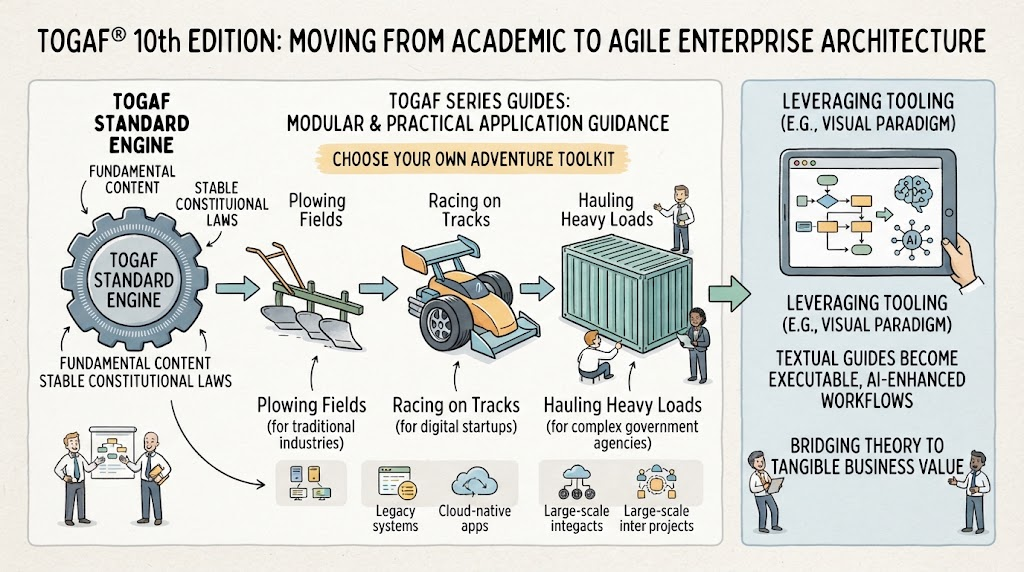
This comprehensive guide explores the structure of the TOGAF Series Guides, provides concrete application examples, and demonstrates how Visual Paradigm’s 2026 AI capabilities operationalize these standards for maximum efficiency.
Key Concepts: Understanding the Modular Ecosystem
The TOGAF Series Guides are categorized into three functional buckets designed to serve different stakeholders within the architecture ecosystem.
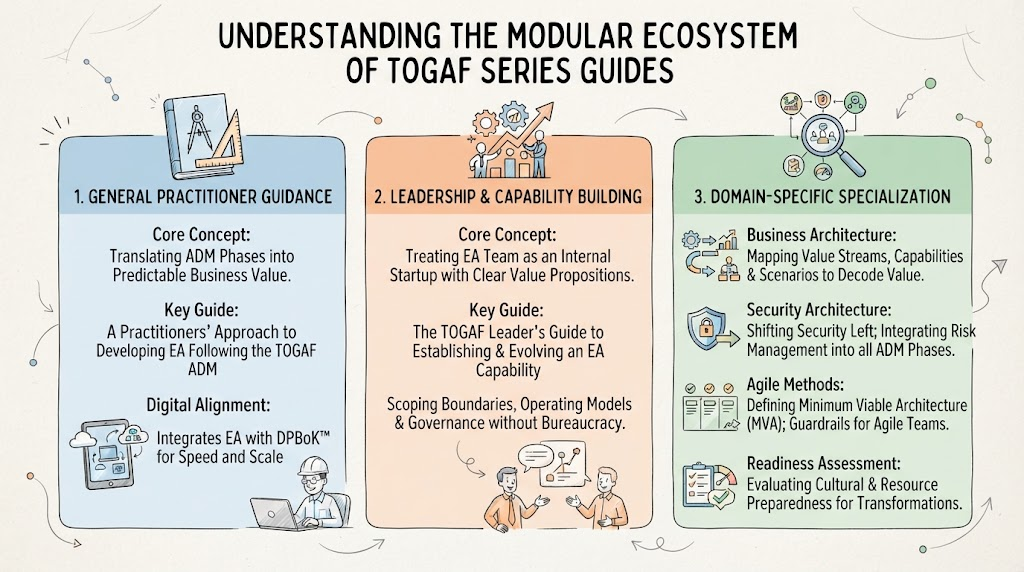
1. General Practitioner Guidance
These are the field manuals for architects executing the ADM day-to-day.
-
Core Concept: Translating abstract ADM phases into predictable business value.
-
Key Guide: A Practitioners’ Approach to Developing Enterprise Architecture Following the TOGAF ADM.
-
Digital Alignment: Using the TOGAF Standard in the Digital Enterprise integrates EA with modern digital practices (DPBoK™), ensuring architecture supports speed and scale rather than hindering it.
2. Leadership & Capability Building
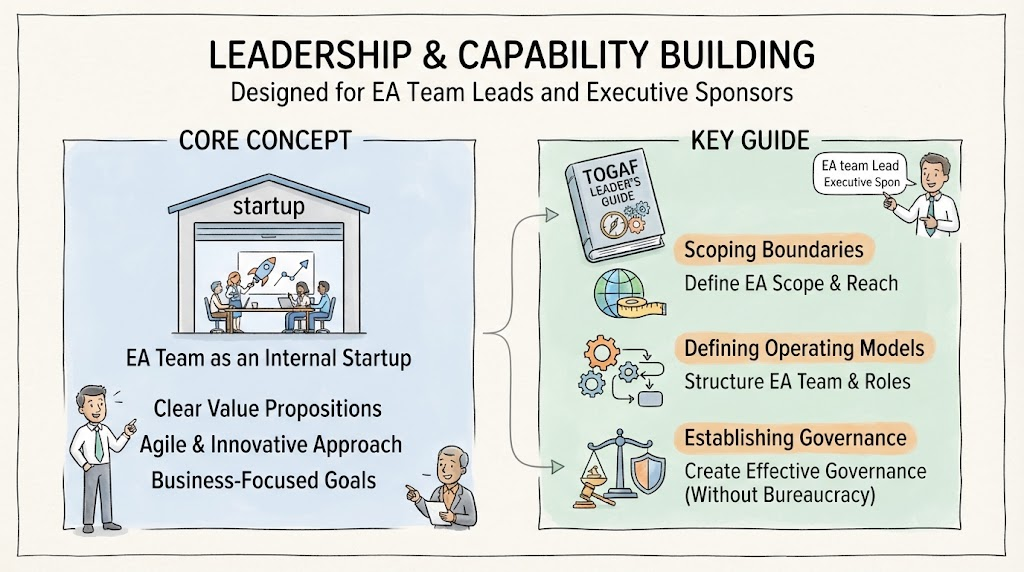
Designed for EA team leads and executive sponsors who must justify and structure the function.
-
Core Concept: Treating the EA team as an internal startup with clear value propositions.
-
Key Guide: The TOGAF Leader’s Guide to Establishing and Evolving an EA Capability. This covers scoping boundaries, defining operating models, and establishing governance without creating bureaucracy.
3. Domain-Specific Specialization
Deep-dive modules for experts in Business, Security, Data, Agile, and Reference Models.
-
Business Architecture: Mapping value streams, capabilities, and business scenarios to decode how value is created.
-
Security Architecture: Shifting security left by integrating risk management directly into every ADM phase rather than bolting it on at the end.
-
Agile Methods: Defining the Minimum Viable Architecture (MVA) to provide guardrails for Scrum/SAFe teams without resorting to “Big Design Up Front” (BDUF).
-
Readiness Assessment: Diagnostic toolkits to evaluate cultural and resource preparedness before major transformations.
Practical Examples: From Theory to Execution
Understanding the categories is only half the battle. The real power emerges when combining specific Series Guides with Visual Paradigm’s tooling to solve actual business problems.
Example A: The Healthcare Telehealth Transformation
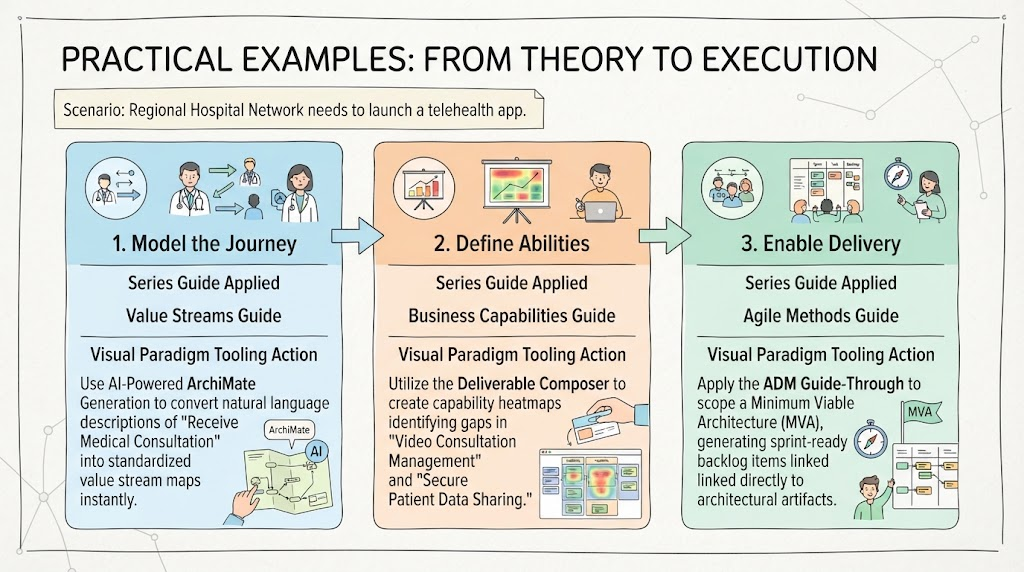
Scenario: A regional hospital network needs to launch a telehealth app. A Business Analyst must map patient journey changes without stalling development.
| Step | Series Guide Applied | Visual Paradigm Tooling Action |
|---|---|---|
| 1. Model the Journey | Value Streams Guide | Use AI-Powered ArchiMate Generation to convert natural language descriptions of “Receive Medical Consultation” into standardized value stream maps instantly. |
| 2. Define Abilities | Business Capabilities Guide | Utilize the Deliverable Composer to create capability heatmaps identifying gaps in “Video Consultation Management” and “Secure Patient Data Sharing.” |
| 3. Enable Delivery | Agile Methods Guide | Apply the ADM Guide-Through to scope a Minimum Viable Architecture (MVA), generating sprint-ready backlog items linked directly to architectural artifacts. |
Example B: Accelerating Compliance & Documentation
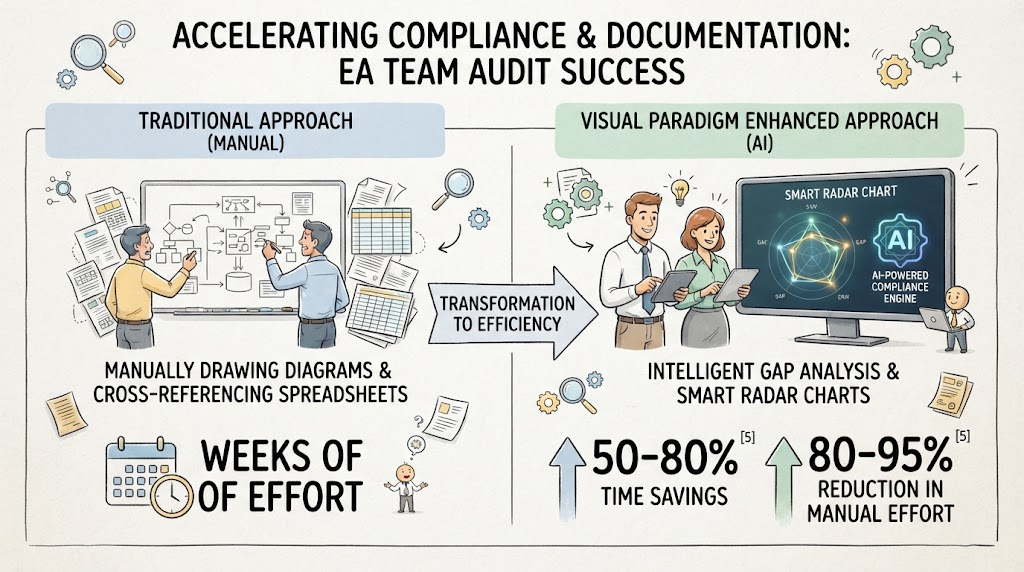
Scenario: An EA team faces a massive audit and needs to demonstrate alignment between strategy and implementation across 50+ systems.
-
Traditional Approach: Manually drawing diagrams and cross-referencing spreadsheets (Weeks of effort).
-
Visual Paradigm Enhanced Approach: Leveraging the 2026 AI Enhancements, the team uses intelligent gap analysis and smart radar charts to auto-generate compliance evidence. According to recent benchmarks, this AI-enhanced workflow delivers 50-80% time savings and an 80-95% reduction in manual diagramming effort compared to traditional methods.
Example C: Digital Evolution for Retail
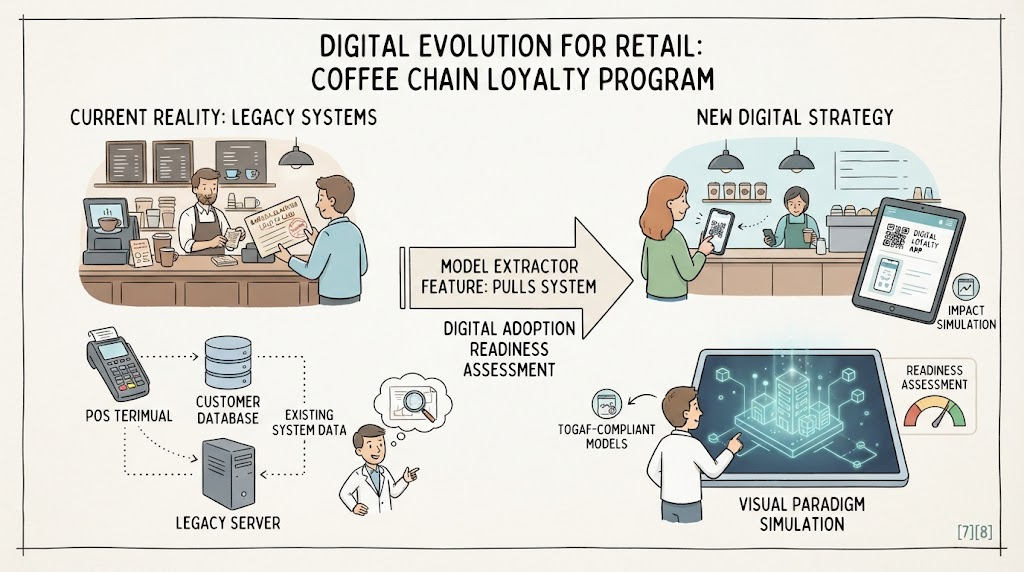
Scenario: A coffee shop chain digitizing its loyalty program.
-
Application: Using the Digital Technology Adoption Readiness Assessment guide via Visual Paradigm’s tutorial framework, architects can simulate the impact of new tech stacks. The Model Extractor feature allows teams to pull existing system data into TOGAF-compliant models, ensuring the new digital strategy is grounded in current reality rather than aspirational fiction.
Tooling Spotlight: Visual Paradigm as the Execution Engine
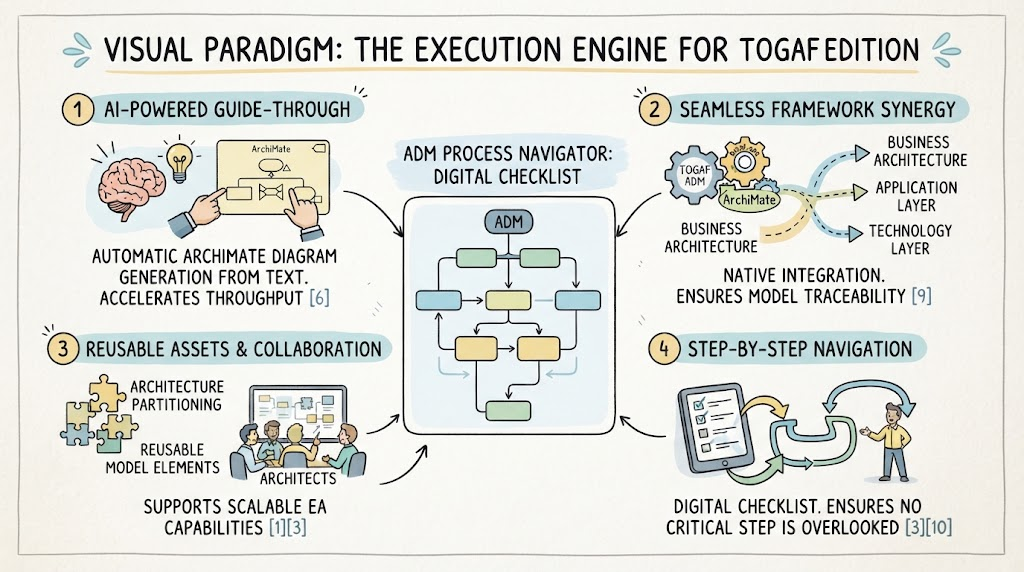
The TOGAF Series Guides provide the what and the why; Visual Paradigm provides the how. Its integration with the 10th Edition standards offers distinct advantages:
-
AI-Powered Guide-Through: The 2026 update introduces automatic ArchiMate diagram generation from text, lowering the barrier to entry for non-specialists and accelerating senior architect throughput.
-
Seamless Framework Synergy: Native integration of TOGAF ADM and ArchiMate ensures that models created for Business Architecture automatically link to Application and Technology layers, maintaining traceability required by the Practitioners’ Approach guide.
-
Reusable Assets & Collaboration: The tool supports architecture partitioning and reusable model elements, directly supporting the Leader’s Guide mandate for scalable EA capabilities.
-
Step-by-Step Navigation: The ADM Process Navigator acts as a digital checklist, ensuring no critical step from the Series Guides is overlooked during complex iterations.
Conclusion
The TOGAF Series Guides represent the maturation of enterprise architecture from a rigid academic discipline to a flexible, value-driven practice. By adopting a modular approach, organizations can tailor their EA efforts to their specific industry, maturity level, and strategic goals—whether that involves securing cloud infrastructure, enabling agile sprints, or mapping healthcare value streams.
However, guidance alone is insufficient in the age of AI and rapid digital change. Integrating these guides with advanced platforms like Visual Paradigm transforms static documentation into dynamic, intelligent workflows. With 2026 AI enhancements reducing diagramming effort by up to 95%, architects are finally free to focus on what matters most: strategic insight, stakeholder alignment, and delivering measurable business outcomes. Embrace the modularity of the Series Guides, arm yourself with intelligent tooling, and turn enterprise architecture into your organization’s competitive advantage.
References
- Visual Paradigm TOGAF ADM Tool: Empowering Your Enterprise Architecture Teams: An overview of how Visual Paradigm’s TOGAF ADM tool boosts EA team productivity with an intuitive interface, collaboration features, and reusable model elements .
- Streamline Your Enterprise Architecture with Visual Paradigm’s TOGAF ADM Tools: Explains the visual flowchart that guides users through ADM phases and introduces the integrated toolset including ArchiMate support, radar charts, and task management .
- Comprehensive Guide for Using TOGAF ADM with Visual Paradigm: A detailed guide covering how to apply ADM iteration strategies, architecture partitioning, and leverage Visual Paradigm’s ADM Process Navigator and Deliverable Composer .
- Using the TOGAF ADM Guide-Through Process in Visual Paradigm: A practical walkthrough of the ADM Guide-Through process with concrete examples for phases like Business Architecture, Gap Analysis, and Migration Planning .
- Traditional vs AI-Enhanced TOGAF Workflow Comparison: A side-by-side comparison demonstrating 50-80% time savings and 80-95% reduction in diagramming effort when using Visual Paradigm’s AI-enhanced workflow over traditional manual methods .
- What’s New: AI-Powered TOGAF ADM in Visual Paradigm | 2026 Update: Introduces the 2026 AI enhancements to the TOGAF Guide-Through, including automatic ArchiMate diagram generation, smart radar charts, and intelligent gap analysis .
- TOGAF ADM Guide-Through: A Case Study on AI-Powered TOGAF ADM Implementation: A real-world case study exploring AI-powered TOGAF ADM implementation with detailed coverage of features like the Deliverable Composer, Shape Legend, and Model Extractor .
- AI-Powered TOGAF ADM Guide-Through: Coffee Shop Digital Evolution: A hands-on tutorial showing how to use AI to generate ArchiMate diagrams from natural language descriptions, moving from manual drawing to AI-assisted modeling .
- Mastering Enterprise Architecture with ArchiMate and TOGAF: The Visual Paradigm Advantage: Explains the synergy between TOGAF and ArchiMate, and how Visual Paradigm’s seamless integration of both frameworks creates a powerful EA environment .
- Comprehensive TOGAF ADM Tutorial: A Step-by-Step Guide: A step-by-step tutorial covering the full TOGAF ADM lifecycle, phase objectives, and the integration of ArchiMate with ADM phases .