

A Beginner’s Guide to the TOGAF 10 Fundamental Content
Introduction
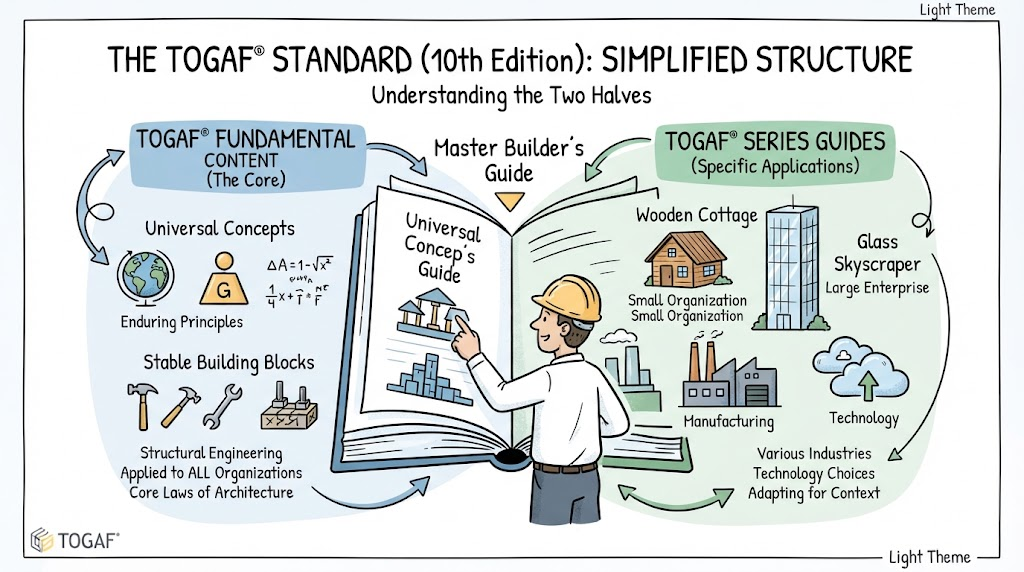
When you first open the TOGAF Standard (10th Edition), the sheer volume of documents can feel overwhelming. The key to mastering the standard is understanding that it is split into two halves: the TOGAF Fundamental Content and the TOGAF Series Guides.
To use a simple analogy, if the standard were a master builder’s guide, the Fundamental Content represents the core laws of physics, structural engineering, and standard tool definitions. Gravity acts the same way whether you are building a wooden cottage or a massive glass skyscraper—and in the exact same way, the concepts in the Fundamental Content are stable, enduring, and universally applicable to all organizations, regardless of their size, industry, or technology choices.
The Six Core Pillars of Fundamental Content
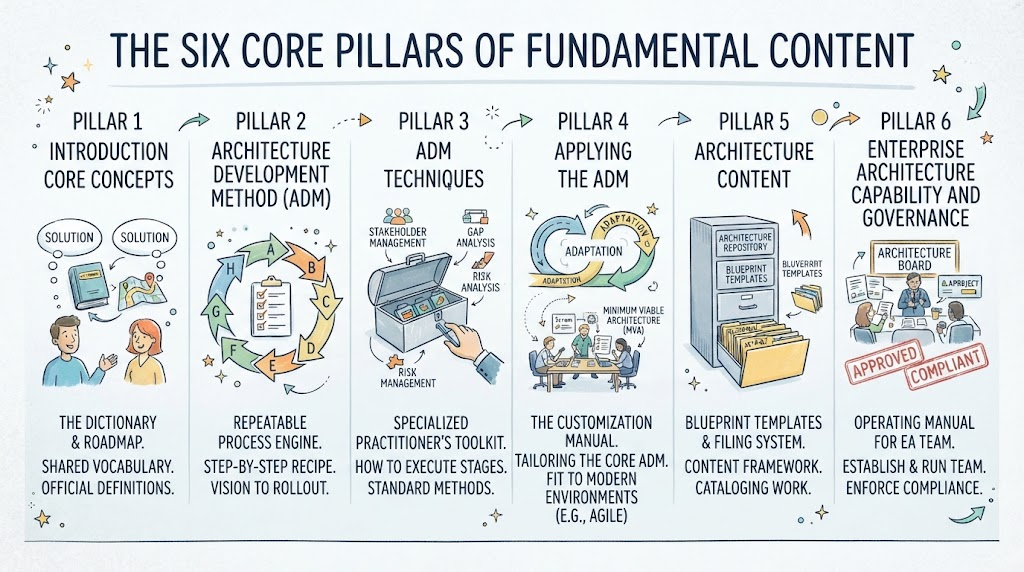
The TOGAF Fundamental Content is comprised of six core documents. Here is what they are, translated into plain English, alongside realistic scenarios of how you would use them:
1. Introduction and Core Concepts
-
What it is: The dictionary and the high-level roadmap.
-
In Plain English: This document establishes a shared vocabulary. It makes sure that when someone says “Capability,” “Stakeholder,” “Deliverable,” or “Building Block,” everyone in the room understands the exact same thing.
-
Beginner Scenario: Imagine starting an enterprise architecture project where team members from London, Tokyo, and New York are arguing about what a “solution” actually means. You use this document to point to official definitions (like the glossary terms) to establish an immediate, aligned language.
2. Architecture Development Method (ADM)
-
What it is: The repeatable process engine.
-
In Plain English: This is your step-by-step “recipe” or problem-solving loop. It guides you from Phase A (establishing a vision) through design, migration planning, and final rollout governance (Phase H).
-
Beginner Scenario: Your company needs to shift from physical retail checkout registers to a unified mobile checkout app. Instead of panic-buying random software, you follow the ADM cycle: you align on a vision (Phase A), design the business processes (Phase B), structure the data and applications (Phase C), select the hardware/network technology (Phase D), evaluate vendors (Phase E), and plan the migration rollout (Phase F).
3. ADM Techniques
-
What it is: The specialized practitioner’s toolkit.
-
In Plain English: While the ADM tells you what stages to go through, the Techniques tell you how to execute them. This is where you find standard methods for Stakeholder Management, Gap Analysis, Migration Planning, and Risk Management.
-
Beginner Scenario: During Phase B (Business Architecture), you must identify what needs to change to support mobile checkout. You pull the Gap Analysis technique from this toolkit to create a matrix, systematically identifying which business processes are “new,” “eliminated,” or “retained” so that nothing is forgotten.
4. Applying the ADM
-
What it is: The customization manual.
-
In Plain English: The standard is intentionally flexible. This document teaches you how to tailor the core ADM loop to fit different modern environments, such as Agile Sprints or specific architectural styles.
-
Beginner Scenario: Your software engineering team works in fast-paced, 2-week Scrum sprints. You look to this guide to apply Minimum Viable Architecture (MVA)—creating “just enough” architectural guardrails to ensure the software team can sprint safely without hitting an accidental dead end.
5. Architecture Content
-
What it is: The blueprint templates and organizational filing system.
-
In Plain English: It defines the Content Framework (what your final architecture blueprints should contain) and the Architecture Repository (how to store and catalog your work for future reuse). It also clarifies the difference between a Deliverable (a signed-off contract), an Artifact (a single catalog, matrix, or diagram), and a Building Block (a reusable piece of capability).
-
Beginner Scenario: A vice president asks for a picture of how customer data flows across your systems. Rather than drawing a messy diagram on a napkin, you refer to the Content Framework to use standardized data diagrams, and then catalog the customer data structure as a reusable Architecture Building Block (ABB) in your repository so future projects don’t have to design it from scratch.
6. Enterprise Architecture Capability and Governance
-
What it is: The operating manual for your actual Enterprise Architecture team.
-
In Plain English: Great designs are useless if projects ignore them. This document teaches you how to establish, staff, and run a sustainable architecture team, set up an Architecture Board, and enforce compliance using Architecture Contracts.
-
Beginner Scenario: You have spent six months architecting the perfect mobile checkout platform, but a rogue development team goes out and purchases an incompatible system anyway. This document teaches your organization how to establish proper Architecture Governance to monitor and review project designs, ensuring all IT purchases legally comply with your blueprints.
Summary Checklist: How to Start as a Beginner
-
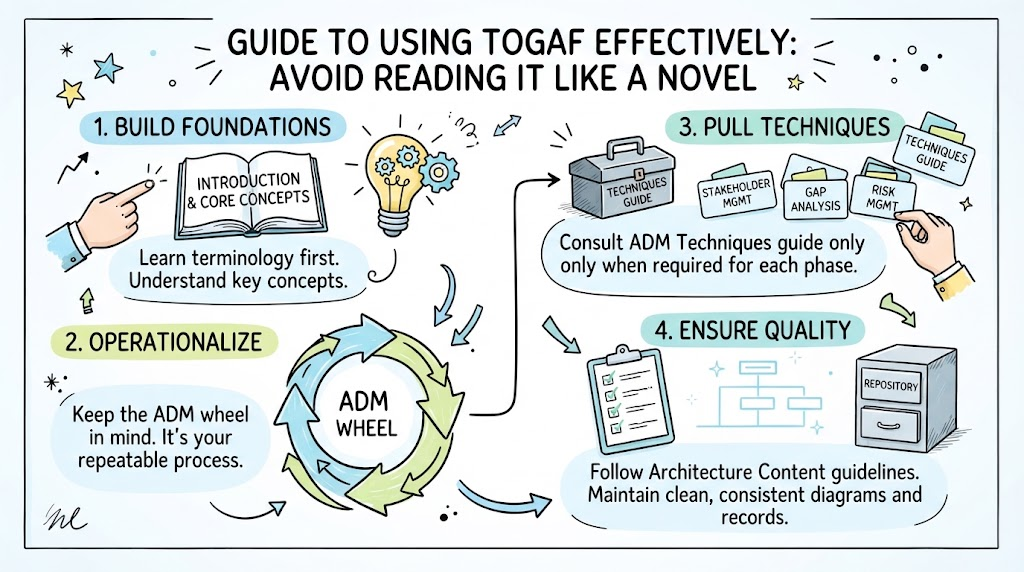
Never read the standard straight through like a novel. Learn the core terminology in Introduction and Core Concepts first.
-
Always keep the ADM wheel in mind as your repeatable process engine.
-
Pull techniques (like Stakeholder Management or Gap Analysis) from the ADM Techniques guide only when you reach the phase that requires them.
-
Rely on the Architecture Content guidelines to keep your final diagrams and repository records clean and consistent.
TOGAF Modeling Tooling with Visual Paradigm
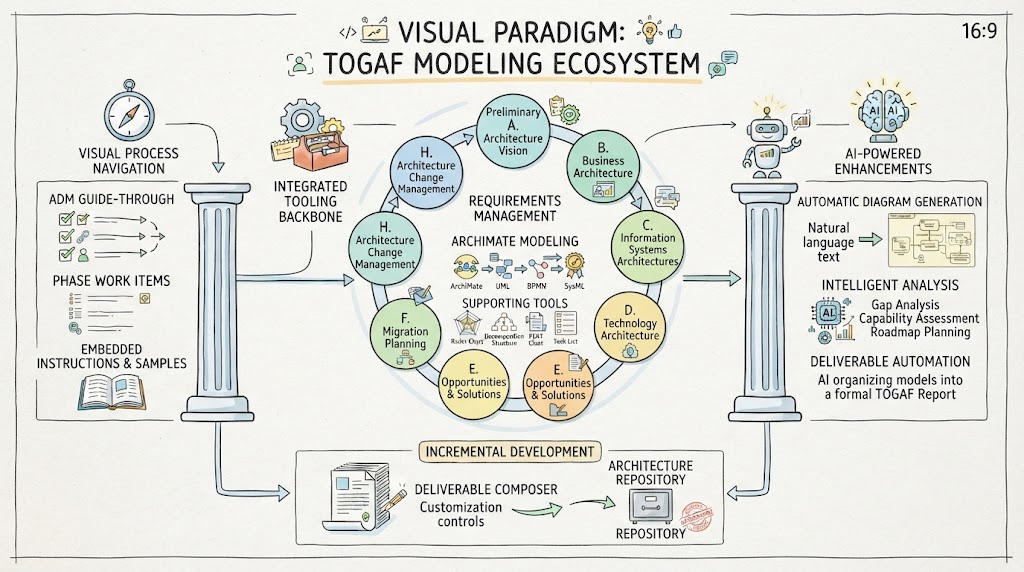
Visual Paradigm provides a comprehensive and integrated environment for Enterprise Architecture (EA) modeling with TOGAF. It distinguishes itself through a suite of tools that bridge high-level strategy with technical implementation, offering support that spans the entire Architecture Development Method (ADM) lifecycle.
Visual Process Navigation and Tool Integration
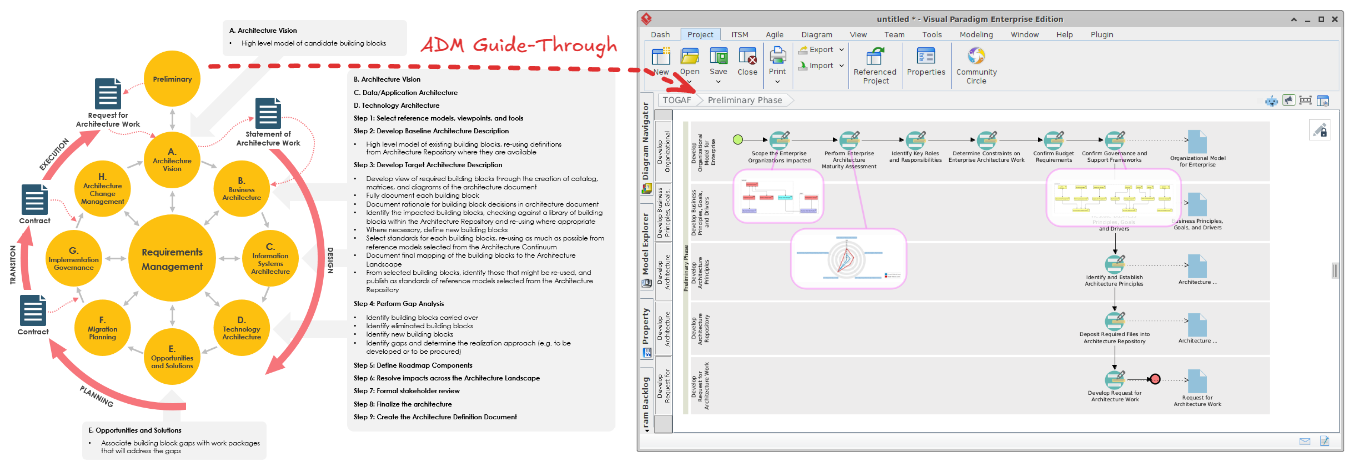
The platform features a TOGAF ADM Guide-Through Process Navigator, which breaks down the ADM into visual, actionable work items from the Preliminary Phase through to Requirements Management. This navigator is not just a checklist; it is an integrated workflow where each phase provides embedded instructions, samples, and direct access to a suite of modeling tools:
-
ArchiMate Modeling: Certified by The Open Group, Visual Paradigm supports ArchiMate 3.1/3.2 as a core component, allowing architects to create standardized business, application, and technology layer diagrams.
-
Cross-Standard Traceability: The platform functions as a centralized backbone, enabling connections between ArchiMate models and other standards like UML, BPMN, and SysML for detailed systems engineering and software design traceability.
-
Supporting Tools: A complete toolkit is included for ADM activities, featuring radar charts for maturity analysis, decomposition structures for project organization, PERT charts for scheduling, and integrated task management.
AI-Powered TOGAF ADM Enhancements
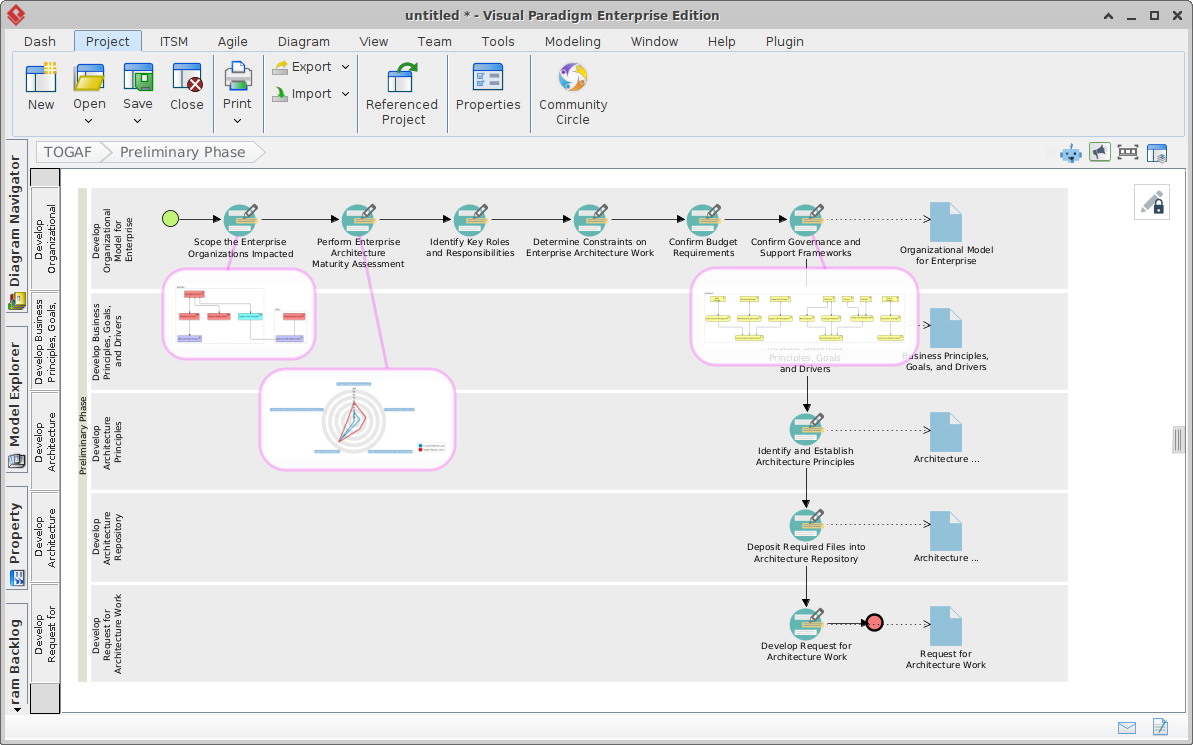
In 2026, Visual Paradigm introduced deep AI integration to accelerate and simplify TOGAF ADM execution. Acting as a virtual co-architect trained on standards like ArchiMate 3, these features transform complex tasks into guided steps:
-
Automatic Diagram Generation: The AI can generate ArchiMate diagrams directly from natural language descriptions, enabling rapid creation of baseline and target architectures.
-
Intelligent Analysis: AI capabilities automate Gap Analysis visualizations, create smart radar charts for capability assessments, and help draft migration roadmaps by structuring work packages and plateaus.
-
Deliverable Automation: The AI assists in the extraction and organization of modeling elements into formal, standards-compliant TOGAF deliverables, which are automatically archived in the Architecture Repository.
Incremental Development and Automated Deliverables
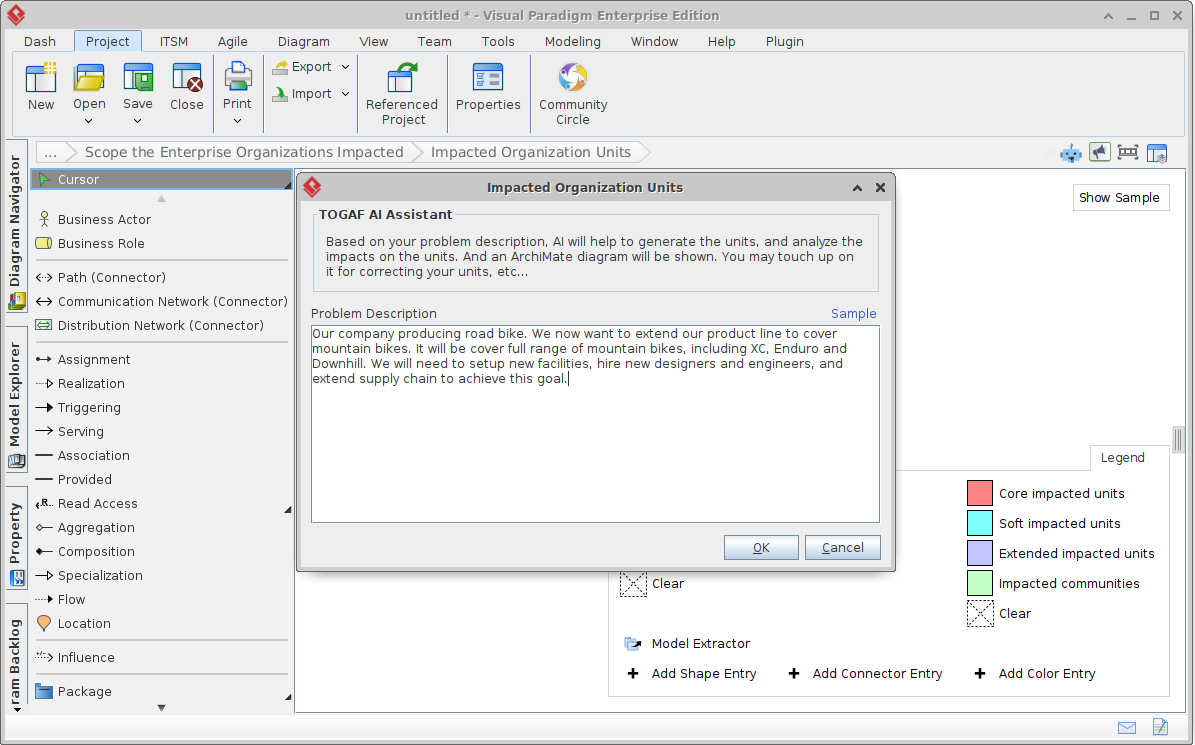
A key design principle of the tooling is incremental artifact development. As work progresses through the ADM phases, artifacts are continuously enriched, and work from early stages can populate subsequent activities without rework. At the end of each phase, a single click generates a comprehensive deliverable, such as a detailed report, using the built-in deliverable composer for any necessary customizations. The centralized Architecture Repository manages these artifacts, ensuring rigorous governance and easy access.
References
-
Visual Paradigm TOGAF ADM Tool: Empowering Your Enterprise Architecture Teams: An overview of how Visual Paradigm’s TOGAF ADM tool boosts EA team productivity with an intuitive interface, collaboration features, and reusable model elements .
-
Streamline Your Enterprise Architecture with Visual Paradigm’s TOGAF ADM Tools: Explains the visual flowchart that guides users through ADM phases and introduces the integrated toolset including ArchiMate support, radar charts, and task management .
-
Comprehensive Guide for Using TOGAF ADM with Visual Paradigm: A detailed guide covering how to apply ADM iteration strategies, architecture partitioning, and leverage Visual Paradigm’s ADM Process Navigator and Deliverable Composer .
-
Using the TOGAF ADM Guide-Through Process in Visual Paradigm: A practical walkthrough of the ADM Guide-Through process with concrete examples for phases like Business Architecture, Gap Analysis, and Migration Planning .
-
Traditional vs AI-Enhanced TOGAF Workflow Comparison: A side-by-side comparison demonstrating 50-80% time savings and 80-95% reduction in diagramming effort when using Visual Paradigm’s AI-enhanced workflow over traditional manual methods .
-
What’s New: AI-Powered TOGAF ADM in Visual Paradigm | 2026 Update: Introduces the 2026 AI enhancements to the TOGAF Guide-Through, including automatic ArchiMate diagram generation, smart radar charts, and intelligent gap analysis .
-
TOGAF ADM Guide-Through: A Case Study on AI-Powered TOGAF ADM Implementation: A real-world case study exploring AI-powered TOGAF ADM implementation with detailed coverage of features like the Deliverable Composer, Shape Legend, and Model Extractor .
-
AI-Powered TOGAF ADM Guide-Through: Coffee Shop Digital Evolution: A hands-on tutorial showing how to use AI to generate ArchiMate diagrams from natural language descriptions, moving from manual drawing to AI-assisted modeling .
-
Mastering Enterprise Architecture with ArchiMate and TOGAF: The Visual Paradigm Advantage: Explains the synergy between TOGAF and ArchiMate, and how Visual Paradigm’s seamless integration of both frameworks creates a powerful EA environment .
-
Comprehensive TOGAF ADM Tutorial: A Step-by-Step Guide: A step-by-step tutorial covering the full TOGAF ADM lifecycle, phase objectives, and the integration of ArchiMate with ADM phases .