TOGAF ADM: A Comprehensive Guide
1. Introduction to TOGAF ADM
The TOGAF Architecture Development Method (ADM) is a structured, iterative process for developing and managing enterprise architecture. It enables organizations to address performance shortfalls, mitigate risks, and align IT and business strategies. At its core, TOGAF ADM emphasizes key concepts such as the Enterprise Continuum (a virtual repository classifying architecture assets from foundation architectures to industry-specific models) and Architecture Building Blocks (ABBs) (reusable components of business, data, application, or technology architecture) versus Solution Building Blocks (SBBs) (implementation-specific components).
Key Features:
- Iterative and Incremental: ADM is not a linear waterfall; phases can be revisited as needed. For example, during a merger, an organization might iterate between Phase B (Business Architecture) and Phase C (Information Systems Architectures) to refine integration strategies.
- Knowledge-Driven: Each phase focuses on creating specific knowledge to inform decision-making, such as using viewpoints (perspectives tailored to stakeholders) to capture concerns.
- Adaptable: Applicable across industries and use cases (e.g., digital transformation in retail, where a company like Amazon uses similar frameworks for supply chain optimization, or IT modernization in healthcare for electronic health records systems).
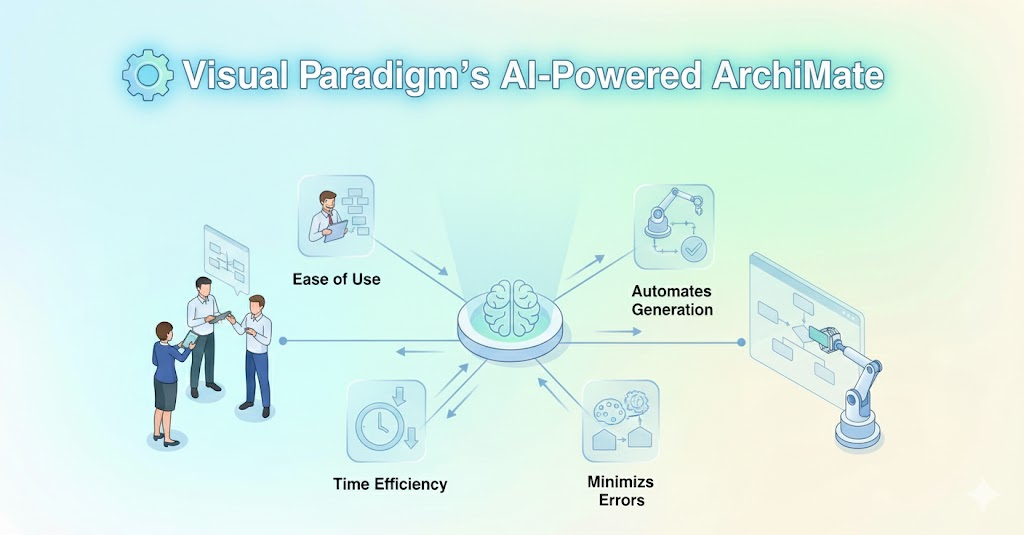
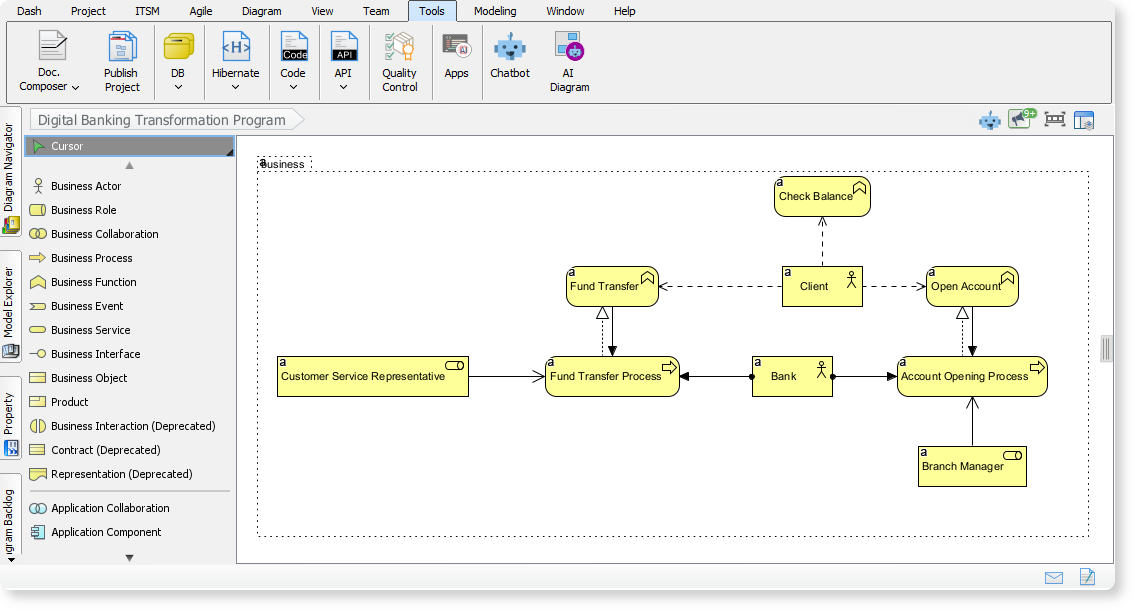
To boost productivity throughout the ADM process, tools like Visual Paradigm’s AI diagram generator can automate the creation of complex diagrams, such as capability maps or process flows, allowing architects to focus on strategic analysis rather than manual drawing.
2. TOGAF ADM Phases Explained
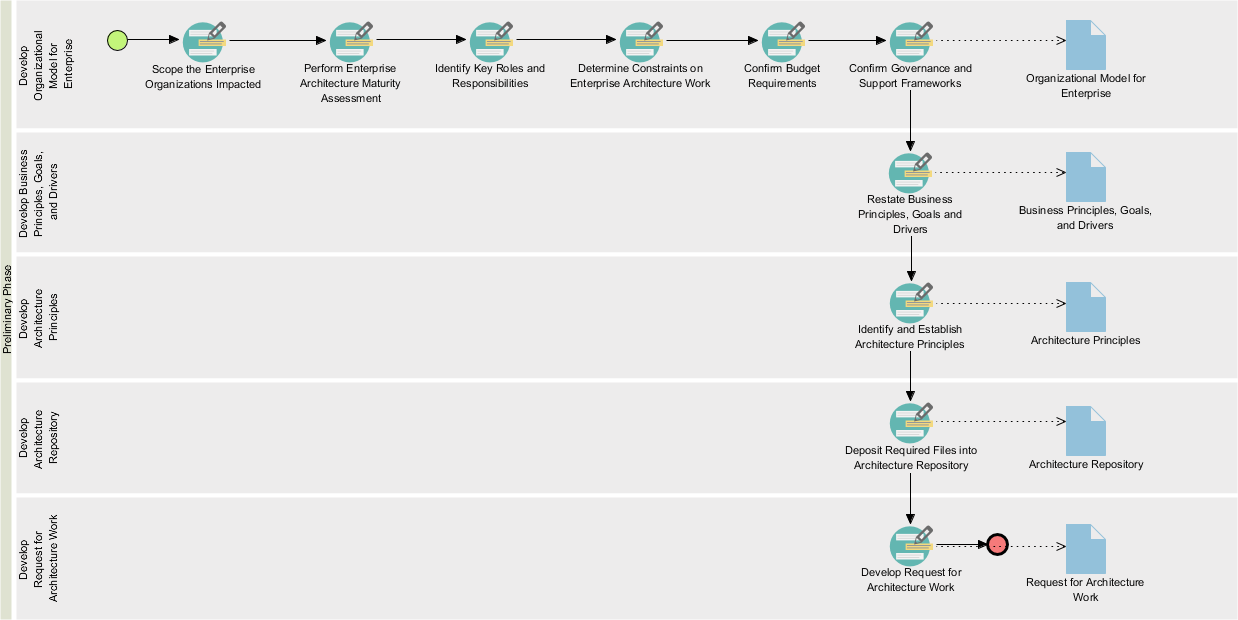
Preliminary Phase: Framework and Principles
Purpose: Establish the foundation for enterprise architecture work by defining governance and tailoring the framework.
Key Activities:
- Define the organization’s scope and boundaries, incorporating the Architecture Repository (a store for all architecture artifacts).
- Identify stakeholders, concerns, and critical drivers, using techniques like RACI matrices (Responsible, Accountable, Consulted, Informed) to map roles.
- Develop architecture principles (e.g., “Data is an asset” or “Maximize reuse”) and select a framework, often integrating with standards like ITIL or COBIT.
- Assess the maturity of the enterprise architecture team via models like the TOGAF Architecture Maturity Model.
Examples: In a financial services firm, this phase might involve scoping regulatory compliance boundaries under GDPR and identifying stakeholders like CIOs and compliance officers. For a manufacturing company, principles could prioritize “Sustainability-first” to align with green initiatives.
Outputs:
- Architecture principles
- Tailored framework
- Stakeholder map
Visual Paradigm’s AI diagram generator can streamline this by quickly producing stakeholder maps or maturity assessment visuals based on input descriptions.
Phase A: Architecture Vision
Purpose: Define the scope, stakeholders, and high-level vision for the architecture project, establishing a baseline for transformation.
Key Activities:
- Confirm the project scope and convert the “ask” into a problem statement, using Business Scenario techniques to describe challenges.
- Identify stakeholders and their concerns via stakeholder analysis.
- Develop a high-level Architecture Vision and candidate target architectures, incorporating value chain diagrams.
- Create a Statement of Architecture Work (SoW), outlining objectives, deliverables, and risks.
Examples: For a telecom company undergoing 5G rollout, the vision might include a target state with edge computing integration. In e-commerce, like a startup similar to Shopify, this phase could define a vision for omnichannel customer experiences, addressing concerns like scalability and user privacy.
Outputs:
- Architecture Vision document
- Statement of Architecture Work
- Candidate target architectures
Enhance visualization here with Visual Paradigm’s AI diagram generator to create high-level vision diagrams, such as mind maps or SWOT analyses, accelerating stakeholder buy-in.
Phase B: Business Architecture
Purpose: Develop the Business Architecture to address performance gaps, focusing on how the business operates.
Key Activities:
- Analyze business capabilities (e.g., using capability maps), processes (via BPMN diagrams), and organizational structure.
- Identify gaps between current (baseline) and target states, applying gap analysis techniques.
- Develop business architecture models, including value streams (end-to-end flows delivering value to customers).
Examples: In banking, this might reveal gaps in “Customer Onboarding” capabilities, leading to process redesign for faster digital approvals. For a retail chain like Walmart, analyzing supply chain processes could highlight inefficiencies in inventory management, suggesting AI-driven forecasting.
Outputs:
- Business architecture views
- Gap analysis
- Candidate work products for change
Key Concept: Business Capabilities are what the organization does (e.g., “Order Fulfillment”), distinct from processes (how it’s done). Use Visual Paradigm’s AI diagram generator to auto-generate capability maps from textual descriptions, boosting modeling efficiency.
Phase C: Information Systems Architectures
Purpose: Develop Data and Application Architectures to support business needs, ensuring data flows and applications align.
Key Activities:
- Design data models (e.g., entity-relationship diagrams) and application architectures (using UML class diagrams).
- Align with business architecture and identify integration points, such as APIs or middleware.
- Evaluate build vs. buy decisions, considering factors like total cost of ownership (TCO).
Examples: In healthcare, data architecture might involve designing a patient data model compliant with HIPAA, while application architecture could integrate EHR systems. For a logistics firm like FedEx, this phase could focus on application portfolios for real-time tracking apps.
Outputs:
- Data and application architecture views
- Integration and migration strategies
Key Concept: Data Architecture includes master data management (MDM) to ensure consistency. Visual Paradigm’s AI diagram generator excels at creating ER diagrams or integration flows, reducing manual effort in this data-intensive phase.
Phase D: Technology Architecture
Purpose: Define the Technology Architecture to enable information systems, covering hardware, software, and networks.
Key Activities:
- Design infrastructure, IT services, and deployment models (e.g., cloud vs. on-premise, using TOGAF‘s Technology Reference Model).
- Ensure alignment with business and information systems architectures, incorporating standards like ISO/IEC 42010 for viewpoints.
Examples: A tech startup might opt for AWS cloud deployment for scalability in Phase D. In energy sectors, like oil and gas, technology architecture could include IoT sensors for predictive maintenance.
Outputs:
- Technology architecture views
- Infrastructure and deployment plans
Leverage Visual Paradigm’s AI diagram generator for network topology diagrams or deployment models to visualize complex tech stacks efficiently.
Phase E: Opportunities and Solutions
Purpose: Identify implementation opportunities and develop an Architecture Roadmap.
Key Activities:
- Prioritize projects and work packages using benefit/risk analysis.
- Define terms of reference for governance and risk management, including Architecture Compliance Reviews.
Examples: In automotive, opportunities might include EV transition projects prioritized by ROI. For government agencies, this could roadmap digital citizen services.
Outputs:
- Architecture Roadmap
- Implementation strategy
Visual Paradigm’s AI diagram generator can produce roadmap timelines or prioritization matrices to clarify opportunities.
Phase F: Migration Planning
Purpose: Create a detailed Migration Plan to transition from current to target architecture.
Key Activities:
- Develop project plans, dependencies, and resource requirements via Gantt charts.
- Establish governance frameworks, such as Architecture Contracts binding projects to standards.
Examples: During a cloud migration for a bank, plans might sequence data center shutdowns. In media, like Netflix, migration could involve shifting to microservices.
Outputs:
- Implementation and Migration Plan
- Architecture Contract
Use Visual Paradigm’s AI diagram generator for migration flowcharts to enhance planning productivity.
Phase G: Implementation Governance
Purpose: Ensure projects deliver expected value and adhere to constraints.
Key Activities:
- Monitor project performance, risks, and compliance using key performance indicators (KPIs).
- Provide recommendations for course correction, like agile adjustments.
Examples: In software firms, governance might track DevOps pipeline compliance. For nonprofits, it ensures budget alignment in IT upgrades.
Outputs:
- Governance reports
- Get-well recommendations
Phase H: Architecture Change Management
Purpose: Ensure the architecture remains relevant and delivers value amid changes.
Key Activities:
- Assess implemented changes for value delivery using post-implementation reviews.
- Identify new opportunities or threats (e.g., via PESTLE analysis – Political, Economic, Social, Technological, Legal, Environmental).
Examples: Post-pandemic, a travel company might update architecture for contactless bookings. In fintech, regulatory changes like PSD2 could trigger updates.
Outputs:
- Architecture Change Requests
- Value assessment reports
3. Key Takeaways
- Iterative Process: Phases are revisited as needed; ADM is not linear, allowing for agile adaptations.
- Stakeholder-Centric: Focus on addressing stakeholder concerns and delivering value through tailored viewpoints.
- Flexible Framework: Adapt ADM to your organization’s needs and context, incorporating concepts like the Architecture Content Framework for standardized artifacts.
- Core Concepts: Emphasize ABBs/SBBs for reuse, the Metamodel for consistent modeling, and Governance for ongoing alignment.
4. Practical Tips
- Start Small: Focus on high-impact areas first, like piloting in one department before enterprise-wide rollout.
- Leverage Reference Architectures: Use industry standards (e.g., BIAN for banking) to accelerate development.
- Governance is Critical: Ensure alignment with business goals and compliance with constraints through regular reviews.
- Boost Productivity with Tools: To enhance the entire ADM development process, recommend using Visual Paradigm’s AI diagram generator. It automates diagram creation for models like BPMN processes, UML diagrams, and roadmaps, significantly reducing time and errors while improving collaboration.
5. Resources for Further Learning
- TOGAF® Standard, 10th Edition: Official documentation for in-depth guidance on all phases and concepts.
- Capability-Based Planning Guides: Align architecture with business capabilities using resources from The Open Group.
- Enterprise Architecture Governance Guides: Best practices for effective governance, including case studies from industries like finance and healthcare.
- Visual Paradigm Tutorials: Explore how their AI diagram generator integrates with TOGAF for practical diagramming.
Final Thought
The TOGAF ADM provides a structured yet flexible approach to enterprise architecture. By focusing on knowledge creation, stakeholder alignment, and incorporating real-world examples and key concepts, organizations can drive meaningful change and achieve strategic goals. Integrating tools like Visual Paradigm’s AI diagram generator can further amplify productivity, making complex architecture development more accessible and efficient.
Resources and Articles on Visual Paradigm Enterprise Architecture (EA) Visual Modeling Features
Visual Paradigm is a powerful tool for enterprise architecture modeling, supporting standards like ArchiMate, TOGAF, BPMN, and UML. Below is a curated list of resources, including official guides, tutorials, and articles highlighting its visual modeling capabilities such as diagram creation, ArchiMate integration, TOGAF ADM workflows, and general EA visualization techniques. These cover features like intuitive diagramming, relationship mapping, and stakeholder views.
- Learning Guides Overview Comprehensive hub for tutorials on visual modeling, including EA with TOGAF and ArchiMate. Covers diagram layout, element selection, and pinning for precise visualizations. URL: https://www.visual-paradigm.com/guide/
- Comprehensive Guide to Adopting Visual Paradigm for Enterprise Architecture (EA) Modeling Detailed article on key ArchiMate features in Visual Paradigm, benefits for EA adoption, and practical implementation steps for visual modeling. URL: https://archimate.visual-paradigm.com/2025/02/04/comprehensive-guide-to-adopting-visual-paradigm-for-enterprise-architecture-ea-modeling/
- Step-by-Step Enterprise Architecture Tutorial with TOGAF ADM Hands-on tutorial demonstrating Visual Paradigm’s visual modeling for TOGAF phases, including business, data, and technology architecture diagrams. URL: https://www.visual-paradigm.com/guide/enterprise-architecture/step-by-step-enterprise-architecture-tutorial-with-togaf-adm/
- ArchiMate Resources for FREE Free resources on using ArchiMate as a visual language in Visual Paradigm for capturing EA relationships and visualizations. URL: https://archimate.visual-paradigm.com/
- Visualizing Enterprise Architecture: A Practical Guide to ArchiMate and TOGAF Practical guide focusing on Visual Paradigm’s user-friendly interface for ArchiMate diagrams, stakeholder presentations, and EA visualization examples. URL: https://archimate.visual-paradigm.com/2025/02/18/visualizing-enterprise-architecture-a-practical-guide-to-archimate-and-togaf/
- Free UML, BPMN, and Agile Tutorials Collection of step-by-step tutorials on visual modeling techniques, including BPMN for business processes and UML for EA components in Visual Paradigm. URL: https://www.visual-paradigm.com/tutorials/
- General Modeling Techniques in Visual Paradigm Official user guide on core visual modeling features like diagram layout, element selection, and connector management for EA models. URL: https://www.visual-paradigm.com/support/documents/vpuserguide/1283/28_generalmodel.html
- Visual Paradigm Guides Hub Centralized site with guides on AI-assisted diagram generation and advanced EA modeling features in Visual Paradigm. URL: https://guides.visual-paradigm.com/
- Simplify Business Process Modeling with Visual Paradigm’s BPMN Tools Article exploring BPMN visual modeling for EA, including analysis and refinement tools in Visual Paradigm. URL: https://www.cybermedian.com/simplify-business-process-modeling-with-visual-paradigms-bpmn-tools/
These resources are up-to-date as of December 2025 and focus on practical, visual aspects of EA modeling. For hands-on practice, start with the free tutorials on the Visual Paradigm site.