TOGAF 10: Essential ADM Outputs
At the very heart of the TOGAF framework sits the Architecture Development Method (ADM)—a tested, repeatable process engine designed to help organizations manage change effectively.
However, as a beginner, it is easy to view the ADM as a giant, academic wheel of phases. To make it highly practical, the standard focuses on creating useful, real-world information rather than piles of theoretical documents.
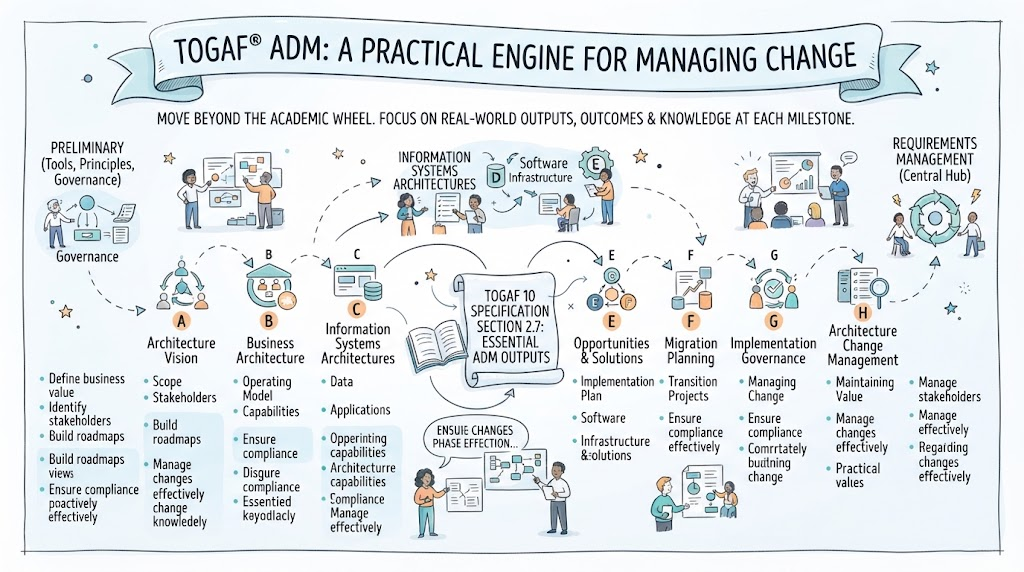
Each phase of the ADM is described in isolation to provide crystal-clear clarity on its inputs, steps, and outputs (even though, in practice, you do not have to perform them in a rigid, linear sequence). To navigate this successfully, you must understand TOGAF 10 Specification Section 2.7 (Essential ADM Outputs), which outlines the core outputs, outcomes, and essential knowledge you must master at each major milestone.
The Master Builder’s Blueprint Analogy
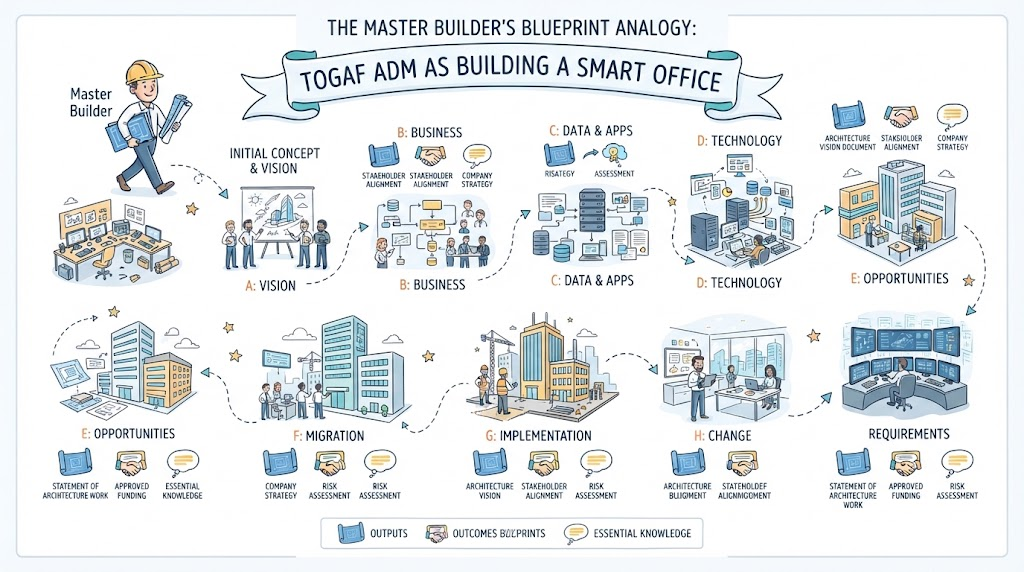
Think of the ADM cycle as a journey to build a state-of-the-art smart office building for a company:
-
The Outputs: These are the tangible blueprints, agreements, and schedules you draw up.
-
The Outcomes: These are the real-world results, such as getting legal permits, aligning stakeholders, or successfully launching the building.
-
The Essential Knowledge: This is the underlying understanding of the site’s geology, budget, stakeholder needs, and lessons learned along the way.
Let’s walk through the essential deliverables and outcomes of each phase using this easy-to-understand lens:
1. Phase A: Architecture Vision (The “Dream & Handshake”)
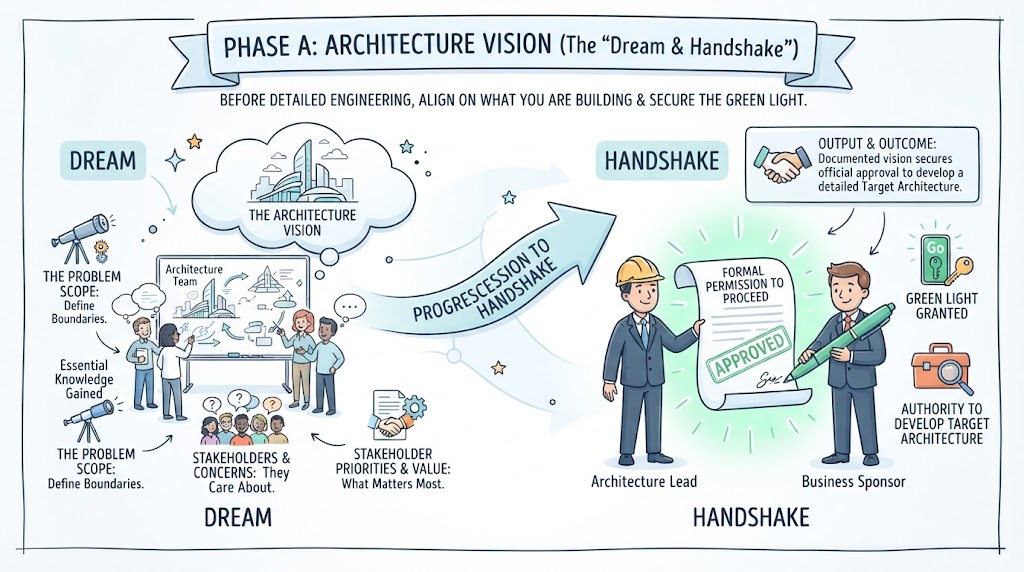
Before you spend millions on detailed engineering, you must align on what you are building and secure the green light to proceed.
-
Output & Outcome: You must produce sufficient documentation to get formal permission to proceed. This grants the architecture team the official approval to develop a detailed Target Architecture to prove out a summarized target.
-
Essential Knowledge Gained:
-
The Problem Scope: A deep, clear understanding of the exact boundary of the business problem you are trying to solve.
-
Stakeholders & Concerns: Knowing exactly who has fundamental interests in this problem and what they care about most.
-
The Architecture Vision: Establishing a summary answer to the problem that is fully acceptable to your stakeholders.
-
Stakeholder Priorities & Value: Understanding what the stakeholders prefer, what they prioritize, and the business value your proposed vision delivers.
-
2. Phases B, C, & D: Domain Architectures (The “Detailed Blueprints”)
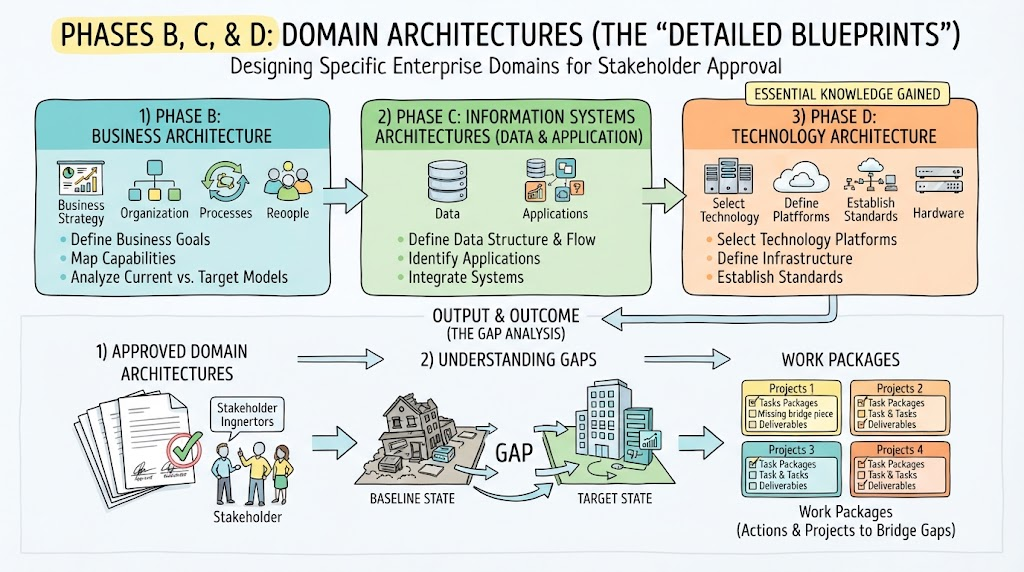
Here, you design the specific domains of your enterprise: Business Architecture (Phase B), Information Systems Architectures (Phase C – Data & Application), and Technology Architecture (Phase D).
-
Output & Outcome: A set of domain architectures approved by your stakeholders, alongside a clear understanding of the gaps (what is missing) and the work required to clear those gaps.
-
Essential Knowledge Gained:
-
The Current Failure: Knowing exactly how your current (baseline) enterprise fails to meet the current preferences of your stakeholders.
-
The Gaps: Pinpointing exactly what must change to bridge the baseline state and target state.
-
Work Packages: Grouping the necessary changes into cohesive “work packages” (sets of actions to achieve objectives, like standalone projects or programs) that deliver actual value.
-
Requirement Trade-offs: Learning how your stakeholders adjust their priorities and preferences as they learn about the value, effort, and risks involved.
-
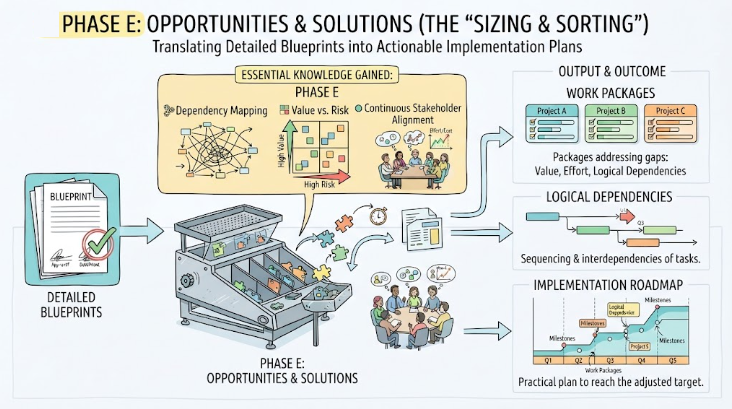
3. Phase E: Opportunities & Solutions (The “Sizing & Sorting”)
Now that you have detailed blueprints, it is time to figure out the best practical way to construct the solution. This is the very first phase that is directly concerned with implementation.
-
Output & Outcome: A set of work packages that address all identified gaps. This package indicates the expected value produced, the effort required, and the logical dependencies between different tasks to reach the adjusted target.
-
Essential Knowledge Gained:
-
Dependency Mapping: Understanding the technical and business dependencies between your work packages and gaps.
-
Value vs. Risk: Knowing the specific value, required effort, and risk profile associated with every proposed change and work package.
-
Continuous Stakeholder Alignment: Observing how stakeholder priorities adjust as real-world constraints of risk, effort, and cost are introduced.
-
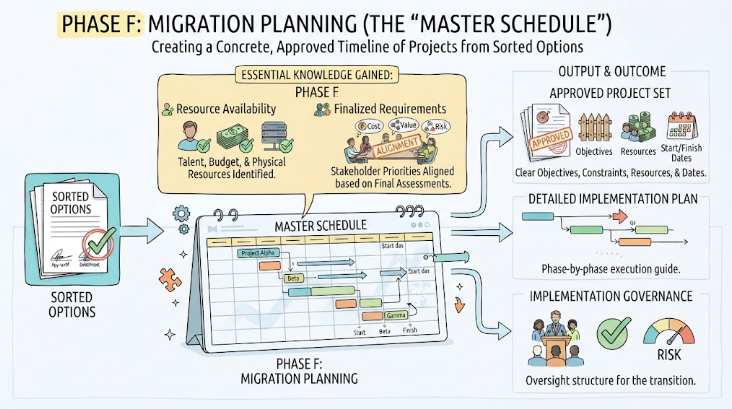
4. Phase F: Migration Planning (The “Master Schedule”)
With your options sorted, you must create a concrete, approved timeline of projects.
-
Output & Outcome: An approved set of projects, detailing clear objectives, necessary constraints, required resources, and explicit start and finish dates.
-
Essential Knowledge Gained:
-
Resource Availability: Knowing exactly what talent, budget, and physical resources are available to actually execute the transition.
-
Finalized Requirements: Achieving final alignment on how stakeholder priorities and preferences adjust in response to final cost, value, and risk assessments.
-
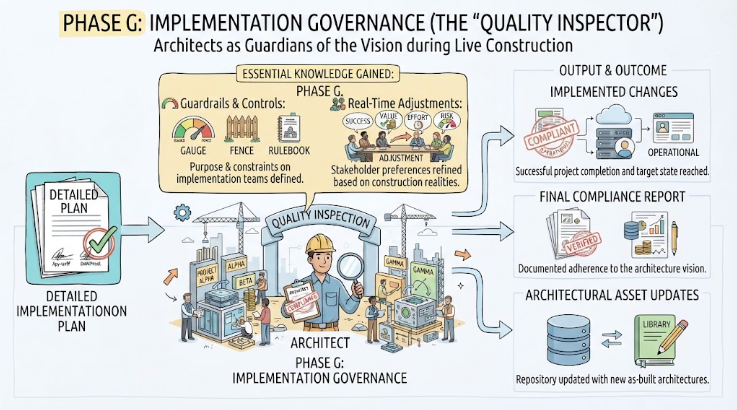
5. Phase G: Implementation Governance (The “Quality Inspector”)
As the implementation team actually builds the technology, the architects act as guardians of the vision to ensure everything complies with the blueprint.
-
Output & Outcome: The successful completion of projects to implement the changes necessary to reach your target state.
-
Essential Knowledge Gained:
-
Guardrails & Controls: Understanding the exact purpose and constraints on the implementation team (drawn from Gaps, Controls, and the Architecture Requirements Specification).
-
Real-Time Adjustments: Learning how stakeholders adjust their preferences as they face the realities of success, value, effort, and risk during live construction.
-
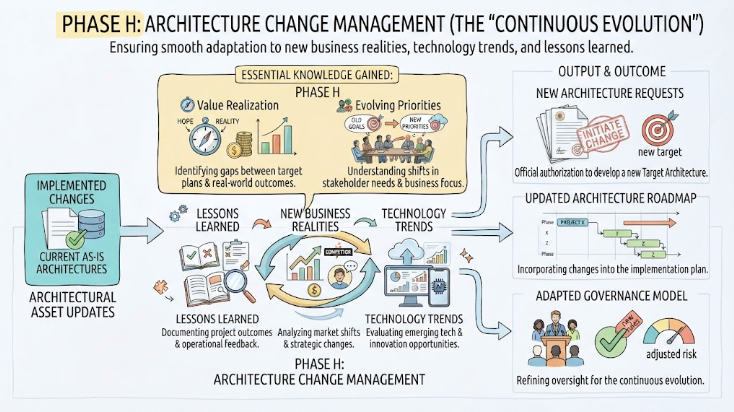
6. Phase H: Architecture Change Management (The “Continuous Evolution”)
No business stands still. Phase H ensures that the architecture adapts smoothly to new business realities, technology trends, and lessons learned.
-
Output & Outcome: Official direction to proceed with developing a new Target Architecture to address perceived, real, or anticipated shortfalls in the enterprise relative to stakeholder preferences.
-
Essential Knowledge Gained:
-
Value Realization: Identifying the actual gaps between your approved target (what you hoped to build) and the real-world realization from prior work.
-
Evolving Priorities: Understanding new shifts in stakeholder preferences or business priorities.
-
Section 2.7 Quick Reference Summary Table
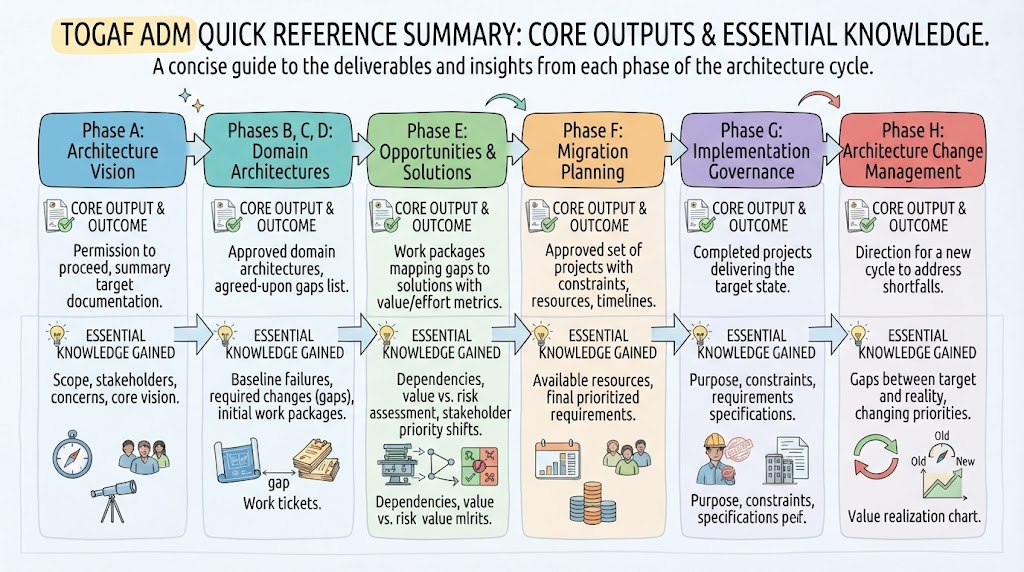
| ADM Phase | Core Output & Outcome (What You Deliver) | Essential Knowledge Gained (What You Must Understand) |
|---|---|---|
| Phase A | Permission to proceed and sufficient documentation to prove out a summary target. | The scope of the problem, key stakeholders, their concerns, and the core vision. |
| Phases B, C, D | Approved domain architectures and an agreed-upon list of gaps. | Baseline failures, what must change (Gaps), and initial work packages to fix them. |
| Phase E | A set of work packages mapping gaps to solutions with value and effort metrics. | Dependencies between work packages, value/risk assessments, and stakeholder priority adjustments. |
| Phase F | An approved set of projects with clear constraints, resources, and timelines. | Available resources and final, prioritized stakeholder requirements. |
| Phase G | Completed projects that successfully deliver the target state. | Purpose, constraints, and requirements specifications guiding the build team. |
| Phase H | Direction to proceed with a new cycle of architecture to address shortfalls. | Gaps between target design and actual value realization; changes in stakeholder priorities. |
Recommended Reading: Visual Paradigm and TOGAF Resources
-
Visual Paradigm TOGAF ADM Tool: Empowering Your Enterprise Architecture Teams: An overview of how Visual Paradigm’s TOGAF ADM tool boosts EA team productivity with an intuitive interface, collaboration features, and reusable model elements.
-
Streamline Your Enterprise Architecture with Visual Paradigm’s TOGAF ADM Tools: Explains the visual flowchart that guides users through ADM phases and introduces the integrated toolset including ArchiMate support, radar charts, and task management.
-
Comprehensive Guide for Using TOGAF ADM with Visual Paradigm: A detailed guide covering how to apply ADM iteration strategies, architecture partitioning, and leverage Visual Paradigm’s ADM Process Navigator and Deliverable Composer.
-
Using the TOGAF ADM Guide-Through Process in Visual Paradigm: A practical walkthrough of the ADM Guide-Through process with concrete examples for phases like Business Architecture, Gap Analysis, and Migration Planning.
-
Traditional vs AI-Enhanced TOGAF Workflow Comparison: A side-by-side comparison demonstrating 50-80% time savings and 80-95% reduction in diagramming effort when using Visual Paradigm’s AI-enhanced workflow over traditional manual methods.
-
What’s New: AI-Powered TOGAF ADM in Visual Paradigm | 2026 Update: Introduces the 2026 AI enhancements to the TOGAF Guide-Through, including automatic ArchiMate diagram generation, smart radar charts, and intelligent gap analysis.
-
TOGAF ADM Guide-Through: A Case Study on AI-Powered TOGAF ADM Implementation: A real-world case study exploring AI-powered TOGAF ADM implementation with detailed coverage of features like the Deliverable Composer, Shape Legend, and Model Extractor.
-
AI-Powered TOGAF ADM Guide-Through: Coffee Shop Digital Evolution: A hands-on tutorial showing how to use AI to generate ArchiMate diagrams from natural language descriptions, moving from manual drawing to AI-assisted modeling.
-
Mastering Enterprise Architecture with ArchiMate and TOGAF: The Visual Paradigm Advantage: Explains the synergy between TOGAF and ArchiMate, and how Visual Paradigm’s seamless integration of both frameworks creates a powerful EA environment.
-
Comprehensive TOGAF ADM Tutorial: A Step-by-Step Guide: A step-by-step tutorial covering the full TOGAF ADM lifecycle, phase objectives, and the integration of ArchiMate with ADM phases.