Introduction
The release of the TOGAF Standard, 10th Edition marks a significant shift in how Enterprise Architecture (EA) is documented and consumed. Moving away from the monolithic “textbook” approach of previous versions, the 10th Edition introduces a modular documentation set. This structure allows professionals to navigate the vast library based on their specific experience levels and professional roles rather than reading cover-to-cover.
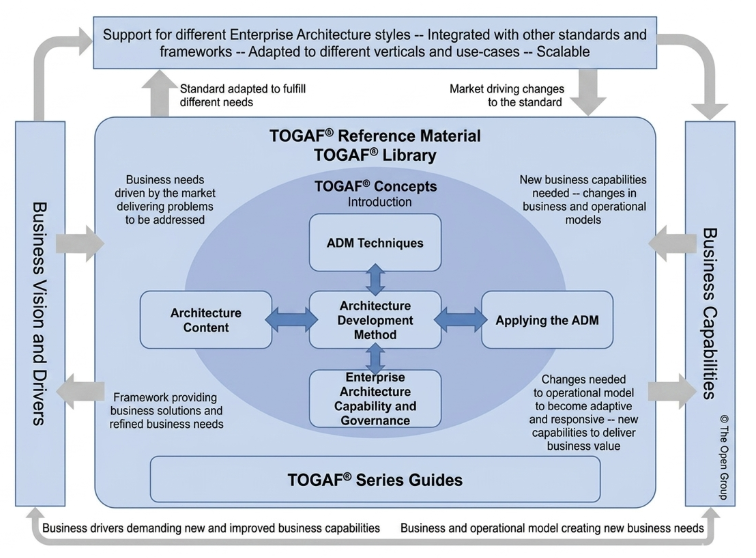
For practitioners using modern tooling like Visual Paradigm, understanding this modular structure is critical. It enables teams to quickly access relevant guidance—whether they are executing daily architecture tasks, managing EA capabilities, or sponsoring strategic initiatives. This guide provides a personalized navigation path through the TOGAF Standard, integrating practical examples and leveraging Visual Paradigm’s AI-enhanced tools to streamline implementation.
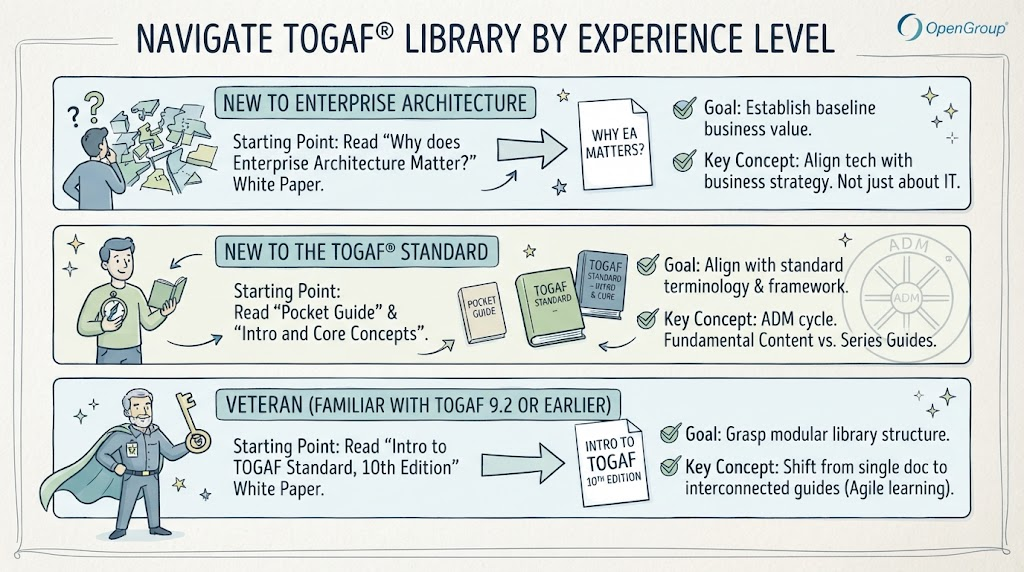
Step 1: Navigate by Experience Level
Before diving into specialized domain manuals, identify your starting point based on your familiarity with Enterprise Architecture.
1. New to Enterprise Architecture
-
Starting Point: Read the White Paper “Why does Enterprise Architecture Matter?”
-
Goal: Establish the baseline business value of EA before engaging with formal processes.
-
Key Concept: EA is not just about IT; it is about aligning technology with business strategy to reduce uncertainty and drive value.
2. New to the TOGAF Standard
-
Starting Point: Read the Pocket Guide alongside the TOGAF Standard – Introduction and Core Concepts.
-
Goal: Align with standard terminology and understand the basic framework structure.
-
Key Concept: Familiarize yourself with the Architecture Development Method (ADM) cycle and the concept of Fundamental Content vs. Series Guides.
3. Veteran (Familiar with TOGAF 9.2 or earlier)
-
Starting Point: Read the White Paper “An Introduction to the TOGAF Standard, 10th Edition”.
-
Goal: Quickly grasp how the modular library and series guides restructure existing knowledge.
-
Key Concept: Understand the shift from a single document to a library of interconnected guides, allowing for more agile and targeted learning.
Step 2: Navigate by Your Professional Role
Once you have established your baseline, follow the audience-specific guidance tailored to your role.
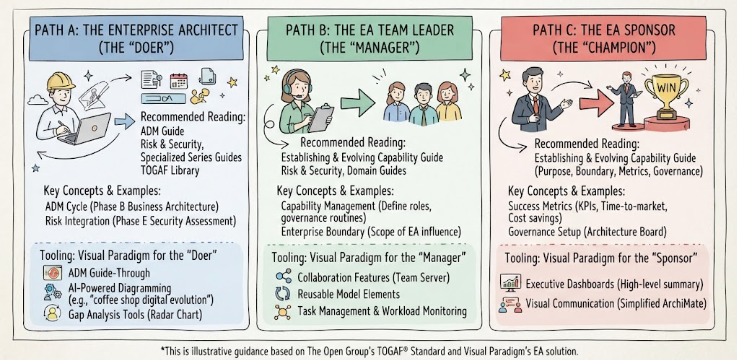
Path A: The Enterprise Architect (The “Doer”)
Primary Concern: Developing, approving, and using architectures day-to-day.
Recommended Reading Sequence:
-
A Practitioners’ Approach to Developing Enterprise Architecture Following the TOGAF ADM: Focus on Chapters 3 and 6 to understand applying the ADM and Fundamental Content.
-
Integrating Risk and Security within a TOGAF Enterprise Architecture: Essential for reducing uncertainty and meeting accountability standards.
-
Specialized Series Guides: Select based on immediate assignments:
-
Digital Initiatives: Digital Enterprise guides.
-
Agile Environments: Agile integration guides.
-
Business Architecture: Business Architecture guides.
-
Data/Information: Information Architecture and C-MDM guides.
-
-
TOGAF Library: Use for templates and reference models, keeping Fundamental Content as your stable framework.
Key Concepts & Examples:
-
ADM Cycle Application: Use Phase B (Business Architecture) to map current business capabilities to future goals.
-
Risk Integration: In Phase E (Opportunities and Solutions), use security guides to assess risks associated with new digital platforms.
Tooling: Visual Paradigm for the “Doer”
-
ADM Guide-Through Process: Visual Paradigm’s interface guides architects through each ADM phase with contextual help and deliverable templates.
-
AI-Powered Diagramming: Use natural language prompts to generate ArchiMate diagrams for Business Architecture (Phase B) or Application Architecture (Phase C). For example, describing a “coffee shop digital evolution” can automatically generate stakeholder maps and process flows.
-
Gap Analysis Tools: Leverage smart radar charts to visually compare baseline and target architectures, identifying gaps in capabilities or services.
Path B: The EA Team Leader (The “Manager”)
Primary Concern: Setting up, optimizing, and evolving an EA department while mentoring practitioners.
Recommended Reading Sequence:
-
The TOGAF Leader’s Guide to Establishing and Evolving an EA Capability: Focus on defining team purpose and enterprise boundaries.
-
Integrating Risk and Security & Using the TOGAF Standard in the Digital Enterprise: Address capability gaps in security and digital transformation readiness.
-
Specialized Domain Guides: Distribute relevant guides to practitioners based on current projects.
Key Concepts & Examples:
-
Capability Management: Define clear roles within the EA team (e.g., Business Architect, Data Architect) and establish governance routines.
-
Enterprise Boundary: Clearly define what is inside and outside the scope of EA influence to avoid scope creep.
Tooling: Visual Paradigm for the “Manager”
-
Collaboration Features: Use Visual Paradigm’s team server to manage access controls, review models, and track progress across multiple architecture projects.
-
Reusable Model Elements: Create a library of standardized ArchiMate components that practitioners can reuse, ensuring consistency across the organization.
-
Task Management: Integrate ADM phases with task tracking to monitor team workload and deliverable completion.
Path C: The EA Sponsor (The “Champion”)
Primary Concern: Championing the EA team to help the business make better change decisions.
Recommended Reading Sequence:
-
The TOGAF Leader’s Guide to Establishing and Evolving an EA Capability.
-
Focus Areas:
-
Core purpose of the EA team.
-
Boundary of the enterprise.
-
Success Metrics for architecture outcomes.
-
Governance Structure for change decisions.
-
Key Concepts & Examples:
-
Success Metrics: Define KPIs such as reduced time-to-market, improved compliance rates, or cost savings from reusable services.
-
Governance Setup: Establish an Architecture Board that reviews major changes against strategic goals.
Tooling: Visual Paradigm for the “Sponsor”
-
Executive Dashboards: Use Visual Paradigm’s reporting features to generate high-level summaries of architecture health, risk exposure, and project status.
-
Visual Communication: Leverage simplified ArchiMate views to communicate complex architectural changes to non-technical stakeholders during governance meetings.
Conclusion
The TOGAF Standard, 10th Edition’s modular approach empowers professionals to learn and apply EA principles more efficiently. By navigating based on experience level and professional role, architects, leaders, and sponsors can focus on what matters most to their responsibilities.
\
When combined with powerful tooling like Visual Paradigm, particularly its AI-enhanced features, teams can significantly reduce manual effort in diagramming and analysis. From AI-generated ArchiMate models to smart gap analysis and collaborative governance, Visual Paradigm transforms the theoretical guidance of TOGAF into actionable, visual, and measurable outcomes. Whether you are a “Doer” executing phases, a “Manager” building capability, or a “Sponsor” driving strategy, this structured approach ensures you leverage the full potential of the TOGAF Standard.
Recommended Reading: Visual Paradigm and TOGAF Resources
- Visual Paradigm TOGAF ADM Tool: Empowering Your Enterprise Architecture Teams: An overview of how Visual Paradigm’s TOGAF ADM tool boosts EA team productivity with an intuitive interface, collaboration features, and reusable model elements.
- Streamline Your Enterprise Architecture with Visual Paradigm’s TOGAF ADM Tools: Explains the visual flowchart that guides users through ADM phases and introduces the integrated toolset including ArchiMate support, radar charts, and task management.
- Comprehensive Guide for Using TOGAF ADM with Visual Paradigm: A detailed guide covering how to apply ADM iteration strategies, architecture partitioning, and leverage Visual Paradigm’s ADM Process Navigator and Deliverable Composer.
- Using the TOGAF ADM Guide-Through Process in Visual Paradigm: A practical walkthrough of the ADM Guide-Through process with concrete examples for phases like Business Architecture, Gap Analysis, and Migration Planning.
- Traditional vs AI-Enhanced TOGAF Workflow Comparison: A side-by-side comparison demonstrating 50-80% time savings and 80-95% reduction in diagramming effort when using Visual Paradigm’s AI-enhanced workflow over traditional manual methods.
- What’s New: AI-Powered TOGAF ADM in Visual Paradigm | 2026 Update: Introduces the 2026 AI enhancements to the TOGAF Guide-Through, including automatic ArchiMate diagram generation, smart radar charts, and intelligent gap analysis.
- TOGAF ADM Guide-Through: A Case Study on AI-Powered TOGAF ADM Implementation: A real-world case study exploring AI-powered TOGAF ADM implementation with detailed coverage of features like the Deliverable Composer, Shape Legend, and Model Extractor.
- AI-Powered TOGAF ADM Guide-Through: Coffee Shop Digital Evolution: A hands-on tutorial showing how to use AI to generate ArchiMate diagrams from natural language descriptions, moving from manual drawing to AI-assisted modeling.
- Mastering Enterprise Architecture with ArchiMate and TOGAF: The Visual Paradigm Advantage: Explains the synergy between TOGAF and ArchiMate, and how Visual Paradigm’s seamless integration of both frameworks creates a powerful EA environment.
- Comprehensive TOGAF ADM Tutorial: A Step-by-Step Guide: A step-by-step tutorial covering the full TOGAF ADM lifecycle, phase objectives, and the integration of ArchiMate with ADM phases.