

Blueprint for Change: A Practical Guide to Enterprise Architecture with TOGAF
Introduction
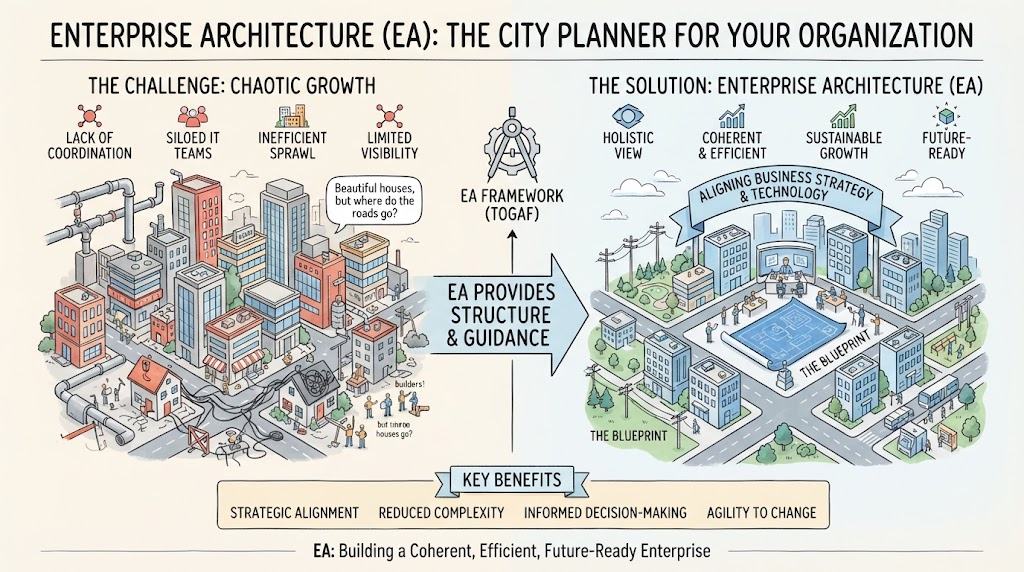
Imagine a bustling metropolis. Without city planners, zoning laws, or infrastructure blueprints, individual builders might construct beautiful houses, but they’d likely ignore sewage lines, block major thoroughfares, and create a chaotic, inefficient sprawl. Enterprises face the same challenge. While individual IT teams and business units (“bricklayers”) excel at solving immediate problems, they often lack the holistic view needed for long-term sustainability and agility.
This is where Enterprise Architecture (EA) steps in. EA acts as the “city planning” department for your organization. It provides the structured blueprint that aligns technology investments with business strategy, ensuring that every new system, process, or capability contributes to a coherent, efficient, and future-ready enterprise.
In this guide, we will demystify Enterprise Architecture using the TOGAF Standard (The Open Group Architecture Framework), the world’s most widely used EA framework. We’ll move beyond jargon to explore how TOGAF helps organizations navigate change, from high-level strategy down to agile solution delivery, using practical analogies and real-world examples. Whether you are a product manager, IT leader, or business strategist, understanding these principles will empower you to drive deliberate, value-driven change.
Section 1: The “City Planning” Analogy – What is Enterprise Architecture?
The Core Question
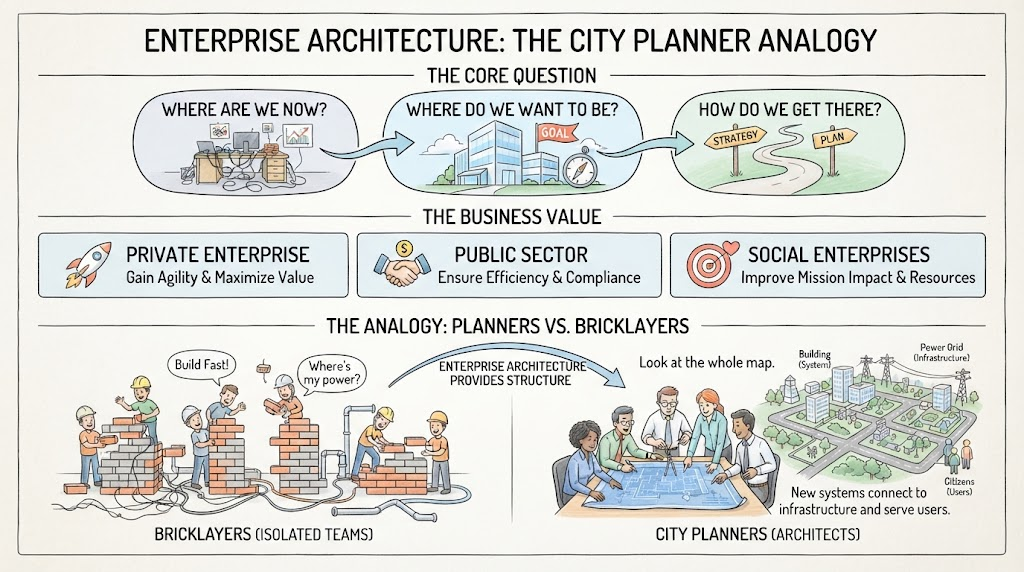
At its simplest, Enterprise Architecture is the practice of describing the future state of an enterprise to guide effective change. It answers critical questions: Where are we now? Where do we want to be? And how do we get there efficiently?
The Business Value
Why invest in structured architecture? The benefits vary by sector but always center on reducing risk and increasing value:
-
Private Enterprises: Gain agility to pivot quickly in competitive markets and maximize shareholder value by eliminating redundant systems.
-
Public Sector: Achieve efficiency in taxpayer spending and comply with complex regulatory mandates.
-
Social Enterprises: Improve mission impact by ensuring resources are directed toward core goals rather than wasted on fragmented initiatives.
The Analogy: Planners vs. Bricklayers
Without EA, organizations often suffer from “silos.” One team builds a customer database; another builds a separate sales platform. They don’t talk. Data doesn’t flow. Costs skyrocket.
-
Bricklayers (Isolated Teams): Focus on immediate tasks. They build fast but may create technical debt or integration nightmares.
-
City Planners (Architects): Look at the whole map. They ensure that when a new “building” (system) goes up, it connects to the “power grid” (infrastructure) and serves the “citizens” (users) effectively.
Section 2: Demystifying the TOGAF Standard
What is TOGAF?
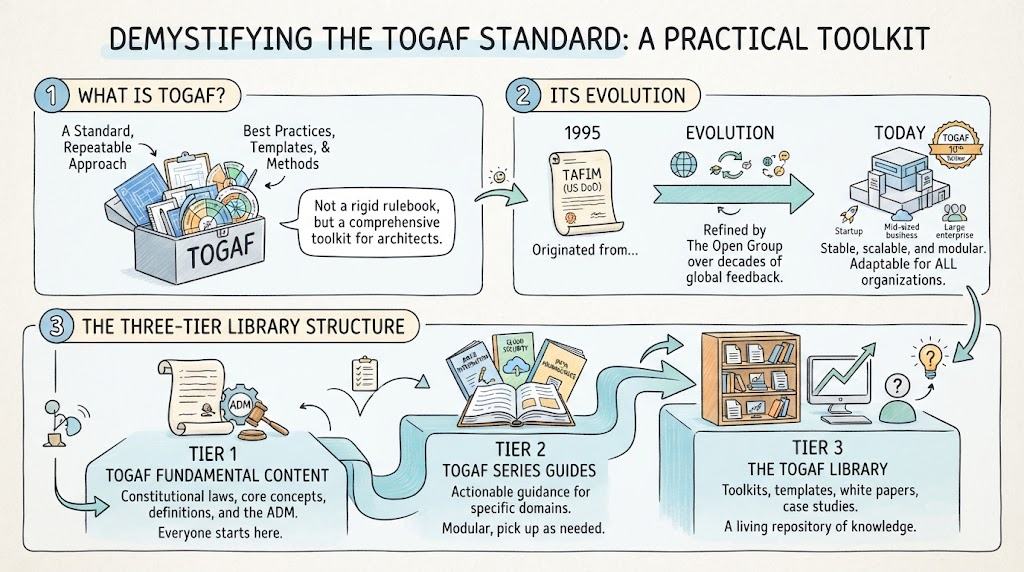
TOGAF is not a rigid rulebook but a standard, repeatable approach for developing, using, and maintaining Enterprise Architectures. Think of it as a comprehensive toolkit that provides best practices, templates, and methods to help architects do their job consistently.
Its Evolution
TOGAF has a rich history rooted in practicality:
-
1995: Originated from the US Department of Defense’s TAFIM (Technical Architecture Framework for Information Management).
-
Evolution: Over decades, it was refined by The Open Group, incorporating feedback from thousands of global organizations.
-
Today: The TOGAF Standard, 10th Edition represents a stable, scalable, and modular set of best practices. It’s no longer just for massive governments; it’s adaptable for digital-native startups and mid-sized enterprises alike.
The Three-Tier Library Structure
To avoid overwhelm, TOGAF 10 is organized into three accessible tiers:
-
TOGAF Fundamental Content: The “constitutional laws.” These are universally applicable core concepts, definitions, and the Architecture Development Method (ADM). Everyone starts here.
-
TOGAF Series Guides: Actionable guidance for specific domains. Need to integrate Agile? Secure your cloud? Manage data? There’s a guide for that. These are modular and can be picked up as needed.
-
The TOGAF Library: The “toolkits.” This includes templates, white papers, case studies, and emerging trends. It’s a living repository of community knowledge.
Section 3: Key Concepts Explained in Plain English
The ADM (Architecture Development Method)
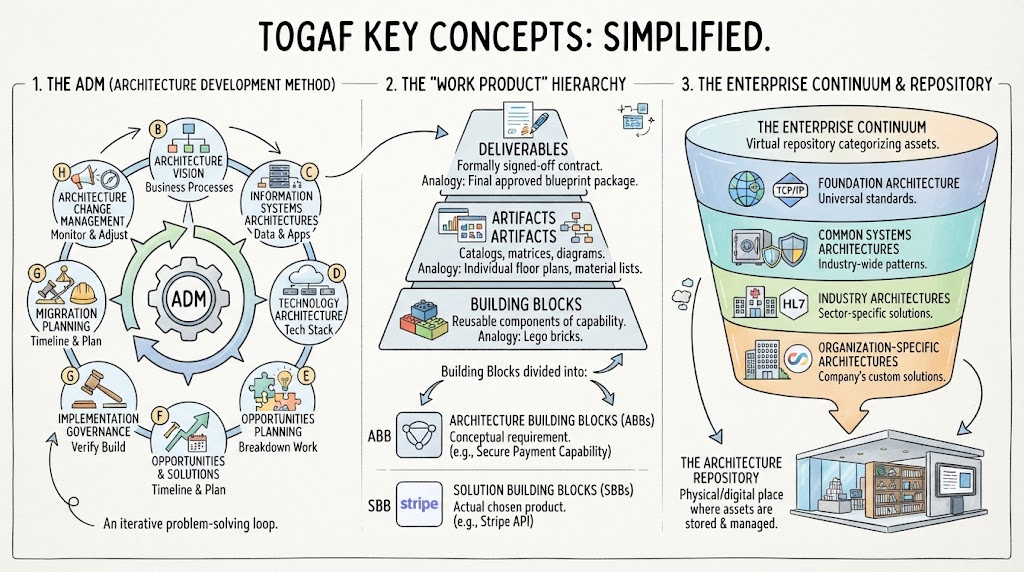
The ADM is the heart of TOGAF—a repeatable, iterative process loop for developing and governing change. Think of it as a problem-solving loop:
-
Phase A: Architecture Vision: Define the scope, stakeholders, and high-level goals. (“What problem are we solving?”)
-
Phase B: Business Architecture: Map out business processes, capabilities, and organization. (“How does the business work?”)
-
Phase C: Information Systems Architectures: Design Data and Application architectures. (“What data and apps do we need?”)
-
Phase D: Technology Architecture: Define the hardware, software, and network infrastructure. (“What tech stack supports this?”)
-
Phase E: Opportunities & Solutions: Identify potential solutions and group them into work packages. (“How do we break this down?”)
-
Phase F: Migration Planning: Create a detailed roadmap and transition plan. (“When do we do what?”)
-
Phase G: Implementation Governance: Ensure the built solution matches the design. (“Are we building it right?”)
-
Phase H: Architecture Change Management: Monitor changes and trigger new cycles if needed. (“Do we need to adjust?”)
Note: The ADM is iterative. You don’t have to go linearly from A to H. You can cycle back or skip phases based on context.
The “Work Product” Hierarchy
Beginners often confuse deliverables, artifacts, and building blocks. Here’s the breakdown:
| Term | Definition | Analogy |
|---|---|---|
| Deliverables | Formally signed-off contract results. Specified by stakeholders. | The final approved blueprint package handed to the construction crew. |
| Artifacts | The catalogs, matrices, and diagrams inside deliverables. | The individual floor plans, electrical diagrams, and material lists within the blueprint. |
| Building Blocks | Reusable components of capability. | Lego bricks. You reuse them across different projects. |
Building Blocks are further divided:
-
Architecture Building Blocks (ABBs): The conceptual requirement. (“We need a secure payment processing capability.”)
-
Solution Building Blocks (SBBs): The actual chosen product or service. (“We will use Stripe API v3.”)
The Enterprise Continuum & Repository
How do you store and reuse all this knowledge?
-
The Enterprise Continuum: A virtual repository that categorizes architectural assets from generic to specific.
-
Foundation Architecture: Universal standards (e.g., TCP/IP).
-
Common Systems Architectures: Industry-wide patterns (e.g., Banking security models).
-
Industry Architectures: Sector-specific solutions (e.g., Healthcare HL7 standards).
-
Organization-Specific Architectures: Your company’s custom-fit solutions.
-
-
The Architecture Repository: The physical or digital place where these assets (models, patterns, standards) are stored and managed for easy retrieval.
Section 4: The Four EA Purposes & Practical Usage Cases
Enterprise Architecture isn’t one-size-fits-all. It serves four distinct purposes, each with different timeframes and scopes.
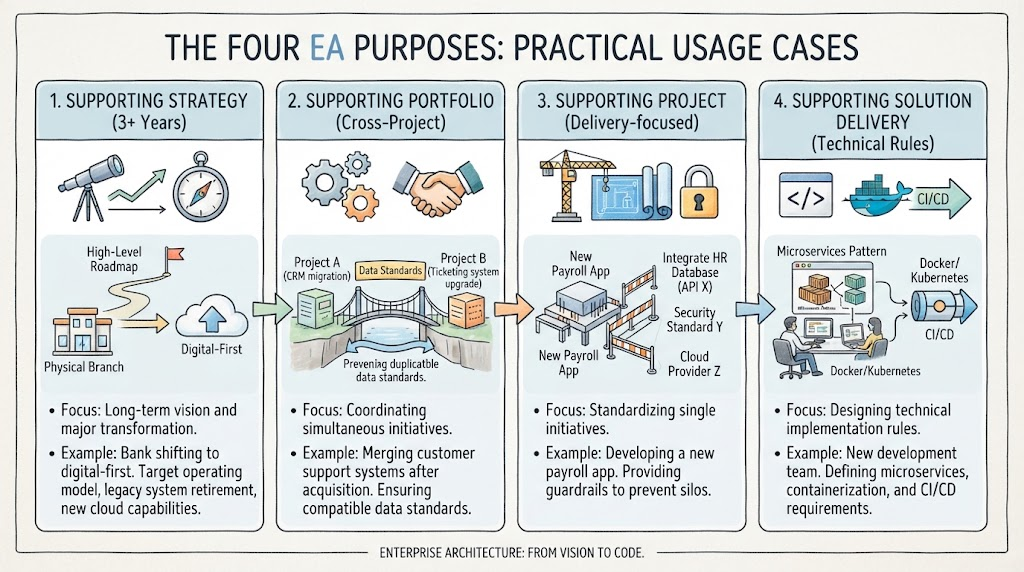
1. Supporting Strategy (3+ Years)
-
Focus: Long-term vision and major transformation.
-
Example: A major bank plans to shift from physical branches to a fully digital-first model over five years. EA defines the target operating model, identifies which legacy systems to retire, and outlines the new cloud-native capabilities needed.
2. Supporting Portfolio (Cross-Project)
-
Focus: Coordinating multiple simultaneous initiatives to avoid conflict and redundancy.
-
Example: During an acquisition, two companies must merge their customer support systems. EA ensures that Project A (CRM migration) and Project B (Ticketing system upgrade) use compatible data standards and don’t duplicate efforts.
3. Supporting Project (Delivery-focused)
-
Focus: Standardizing single initiatives to ensure they fit the enterprise.
-
Example: A new payroll app is being developed. EA provides the guardrails: it must integrate with the existing HR database via API X, adhere to security standard Y, and run on cloud provider Z. This prevents the project from creating a siloed, incompatible system.
4. Supporting Solution Delivery
-
Focus: Designing specific technical implementation rules and guardrails for developers.
-
Example: Defining the microservices architecture pattern, containerization standards (Docker/Kubernetes), and CI/CD pipeline requirements for a new development team.
Section 5: Modern Agility and Digital Emergences
Minimum Viable Architecture (MVA)
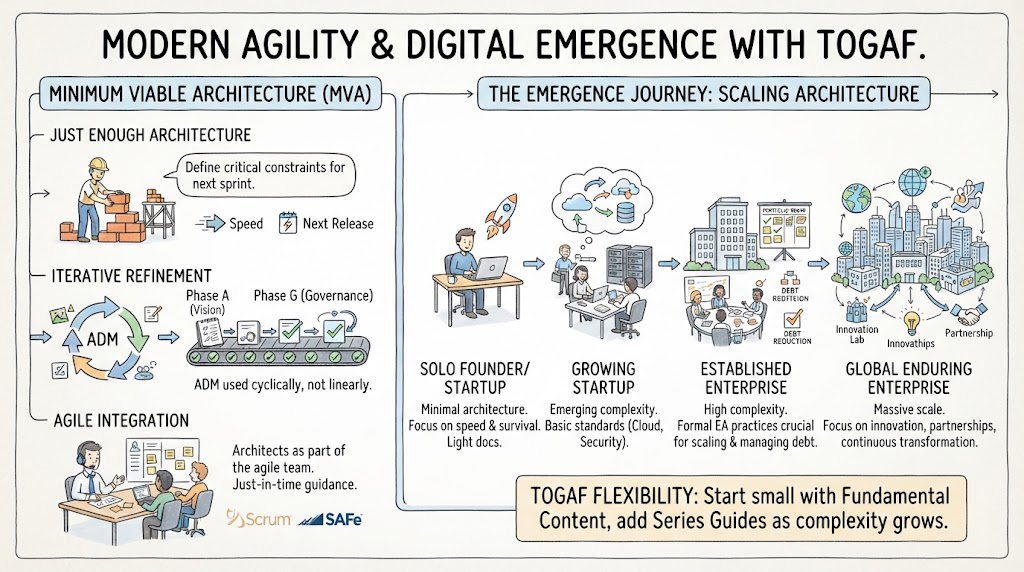
A common myth is that TOGAF requires “Big Design Up Front” (BDUF), which clashes with Agile. Not true. TOGAF supports Minimum Viable Architecture (MVA):
-
Just Enough Architecture: Define only the critical constraints and interfaces needed for the next sprint or release.
-
Iterative Refinement: Use the ADM cyclically. Phase A (Vision) might take a week, not a month. Phase G (Governance) happens continuously via automated tests and code reviews.
-
Agile Integration: TOGAF Series Guides provide specific advice for integrating with Scrum, SAFe, and other Agile frameworks. Architects become part of the agile team, providing just-in-time guidance rather than upfront dictates.
The Emergence Journey
Digital enterprises evolve through four contexts, and architecture scales naturally with them:
-
Solo Founder/Startup: Minimal architecture. Focus on speed and survival. Documentation is light.
-
Growing Startup: Emerging complexity. Need for basic standards (e.g., cloud provider choice, data security basics).
-
Established Enterprise: High complexity. Formal EA practices become crucial to manage portfolios, reduce debt, and enable scaling.
-
Global Enduring Enterprise: Massive scale. EA focuses on innovation, ecosystem partnerships, and continuous transformation.
TOGAF is flexible enough to support you at any stage. You don’t need all 10th Edition guides on day one. Start with the Fundamental Content and add Series Guides as your complexity grows.
Tooling: Visual Paradigm
While TOGAF provides the method, tools like Visual Paradigm provide the mechanism. Visual Paradigm is a comprehensive modeling tool that supports TOGAF ADM directly.
-
ADM Process Support: It offers built-in templates and wizards for each ADM phase, guiding architects through the steps.
-
Artifact Generation: Automatically generates catalogs, matrices, and diagrams (e.g., Business Process Diagrams, Application Communication Diagrams) from your models.
-
Repository Integration: Helps manage the Enterprise Continuum by storing and versioning ABBs and SBBs.
-
Collaboration: Enables stakeholders to review deliverables and provide feedback within the tool, bridging the gap between architects and business users.
Using Visual Paradigm doesn’t replace architectural thinking, but it accelerates the creation of consistent, high-quality work products, allowing architects to focus on value rather than formatting.
Conclusion
Enterprise Architecture is not about creating ivory-tower documents that gather dust. It’s about enabling deliberate, structured change that delivers real business value. By adopting the TOGAF Standard, organizations gain a proven, flexible framework to align technology with strategy, reduce risk, and increase agility.
Whether you’re planning a multi-year digital transformation or guiding a single agile sprint, TOGAF provides the lenses to see the bigger picture. Remember the city planner: their job isn’t to lay every brick, but to ensure that every brick contributes to a livable, sustainable, and thriving city. Start small, think big, and let architecture guide your journey.
Key Concepts Recap
-
Enterprise Architecture (EA): Describing the future state to guide change.
-
TOGAF: A modular, repeatable standard for EA.
-
ADM: The iterative process loop (Phases A-H) for developing architecture.
-
ABBs vs. SBBs: Conceptual requirements vs. actual solutions.
-
MVA: Just-enough architecture for Agile environments.
-
Four Purposes: Strategy, Portfolio, Project, and Solution Delivery.
References
-
Visual Paradigm TOGAF ADM Tool Tutorial: Official step-by-step guide covering the entire Architecture Development Method cycle with Visual Paradigm.
-
TOGAF ADM with Visual Paradigm – Getting Started: Introductory article on setting up TOGAF ADM projects and navigating the tool’s specific deliverables.
-
Visual Paradigm for Enterprise Architecture – TOGAF Features: Overview of key tooling features, including gap analysis, artifact generation, and stakeholder management.
-
How to Create TOGAF Architecture Deliverables using Visual Paradigm: Practical guide on producing ADM-compliant catalogs, matrices, and diagrams within the software.
-
Visual Paradigm TOGAF ADM Phase-by-Phase Walkthrough: Detailed breakdown of each ADM phase (Preliminary to Requirements Management) with tool-specific actions.
-
TOGAF Tool Comparison: Visual Paradigm vs. Others: Article justifying Visual Paradigm’s capabilities for ADM implementation against competitors like Sparx or Archi.
-
Using Visual Paradigm for TOGAF 9.2 Certification Preparation: Resource linking tool usage to learning ADM concepts for certification exams.
-
Visual Paradigm Enterprise Architecture – TOGAF ADM Repository: Article on using the tool’s repository to manage architecture building blocks and deliverables across ADM iterations.
-
TOGAF ADM Iteration Management with Visual Paradigm: Explanation of how to handle multiple ADM cycles and transition planning within the tool.
-
Visual Paradigm TOGAF Documentation Generation: Description of auto-generating TOGAF-compliant architecture documents from your ADM models.