
Introduction
In today’s rapidly evolving business landscape, is critical for organizational success. is the world’s leading enterprise architecture (EA) standard, providing a structured approach to designing, planning, implementing, and governing enterprise IT architectures.
At the heart of TOGAF is the , a proven methodology for developing and managing enterprise architectures. This tutorial will walk you through the TOGAF ADM lifecycle, its phases, deliverables, and how it integrates with ArchiMate—a modeling language for visualizing enterprise architectures. We’ll also explore how Visual Paradigm’s AI-powered ArchiMate diagram generation can streamline the process and accelerate project initiation.
Why TOGAF?
Key Benefits of Adopting TOGAF ADM
- Comprehensive Methodology: Provides a structured, step-by-step approach to enterprise architecture.
- Vendor-Neutral: Avoids lock-in to proprietary methods, ensuring flexibility.
- Widely Adopted: Used by leading organizations globally, enhancing industry credibility.
- Tailorable: Can be customized to fit organizational and industry-specific needs.
- Best Practices: Based on proven techniques for aligning IT with business goals.
- Cost-Effective: Reduces redundant efforts and maximizes ROI.

TOGAF vs. Other Frameworks
TOGAF is complementary to other frameworks (e.g., Zachman, FEAF) rather than competitive. It provides a practical, actionable method for developing architectures, while other frameworks may focus on classification or governance.
What is TOGAF ADM?
The TOGAF Architecture Development Method (ADM) is a cyclical, iterative process for developing and managing enterprise architectures. It consists of 10 phases (including the Preliminary Phase and Requirements Management) and supports :
- Cycling around the ADM: Continuous improvement and refinement.
- Iterating between phases: Revisiting earlier phases as needed.
- Cycling within a phase: Repeating steps to elaborate architectural content.
TOGAF ADM Phases Overview
| Phase | Objective |
|---|---|
| Preliminary Phase | Prepares the organization for successful architecture projects. |
| A. Architecture Vision | Defines scope, stakeholders, and high-level vision. |
| B. Business Architecture | Develops the baseline (as-is) and target (to-be) business architecture. |
| C. Information Systems | Develops data and application architectures. |
| D. Technology Architecture | Develops the technology infrastructure architecture. |
| E. Opportunities & Solutions | Identifies implementation projects and delivery vehicles. |
| F. Migration Planning | Creates a detailed roadmap for transitioning from baseline to target. |
| G. Implementation Governance | Ensures compliance with the architecture during implementation. |
| H. Architecture Change Management | Manages ongoing changes to the architecture. |
| Requirements Management | Ensures all phases are aligned with business requirements. |
TOGAF and ArchiMate: A Powerful Combination
What is ArchiMate?
ArchiMate is a visual modeling language for enterprise architecture, maintained by The Open Group. It provides a standardized notation for describing, analyzing, and visualizing architecture across Business, Application, and Technology layers.
How TOGAF and ArchiMate Work Together
- TOGAF ADM provides the methodology for developing architectures.
- ArchiMate provides the visual language to model and document architectures.

ArchiMate Layers and TOGAF ADM Phases
| ArchiMate Layer | TOGAF ADM Phase | Purpose |
|---|---|---|
| Business Layer | B. Business Architecture | Models business processes, roles, and goals. |
| Application Layer | C. Information Systems Architectures | Models software applications and data flows. |
| Technology Layer | D. Technology Architecture | Models hardware, networks, and infrastructure. |
| Strategy & Motivation | A. Architecture Vision, Requirements Mgmt. | Models stakeholders, goals, and requirements. |
| Implementation & Migration | E. Opportunities & Solutions, F. Migration Planning | Models projects, gaps, and migration paths. |
TOGAF ADM Lifecycle in Detail

1. Preliminary Phase
Objective: Establish the architecture capability and customize TOGAF for the organization. Key Deliverables:
- Architecture principles
- Tailored TOGAF framework
- Request for Architecture Work
2. Phase A: Architecture Vision
Objective: Define the scope, stakeholders, and high-level vision. Key Deliverables:
- Architecture Vision document
- Statement of Architecture Work
- Capability Assessment
3. Phase B: Business Architecture
Objective: Develop the baseline (as-is) and target (to-be) business architecture. Key Deliverables:
- Business Architecture Definition
- Gap Analysis
4. Phase C: Information Systems Architectures
Objective: Develop data and application architectures. Key Deliverables:
- Information Systems Architecture Definition
- Application and Data Models
5. Phase D: Technology Architecture
Objective: Develop the technology infrastructure architecture. Key Deliverables:
- Technology Architecture Definition
- Infrastructure Models
6. Phase E: Opportunities & Solutions
Objective: Identify implementation projects and delivery vehicles. Key Deliverables:
- Implementation and Migration Plan
- Project Portfolio
7. Phase F: Migration Planning
Objective: Finalize the Implementation and Migration Plan. Key Deliverables:
- Detailed Migration Roadmap
- Risk and Cost-Benefit Analysis
8. Phase G: Implementation Governance
Objective: Ensure compliance with the architecture during implementation. Key Deliverables:
- Compliance Assessments
- Solution Building Blocks
9. Phase H: Architecture Change Management
Objective: Manage ongoing changes to the architecture. Key Deliverables:
- Change Requests
- Updated Architecture Documents
10. Requirements Management
Objective: Ensure all phases align with business requirements. Key Deliverables:
- Requirements Traceability Matrix
- Updated Business Goals

How Streamlines TOGAF ADM
https://updates.visual-paradigm.com/wp-content/uploads/2025/12/ArchiMate-Diagrams-example.png
Challenges in TOGAF ADM Implementation
- Complexity: Managing multiple phases, deliverables, and stakeholders.
- Time-Consuming: Creating and updating ArchiMate diagrams manually.
- Consistency: Ensuring all models align with TOGAF standards.
How Visual Paradigm Helps
-
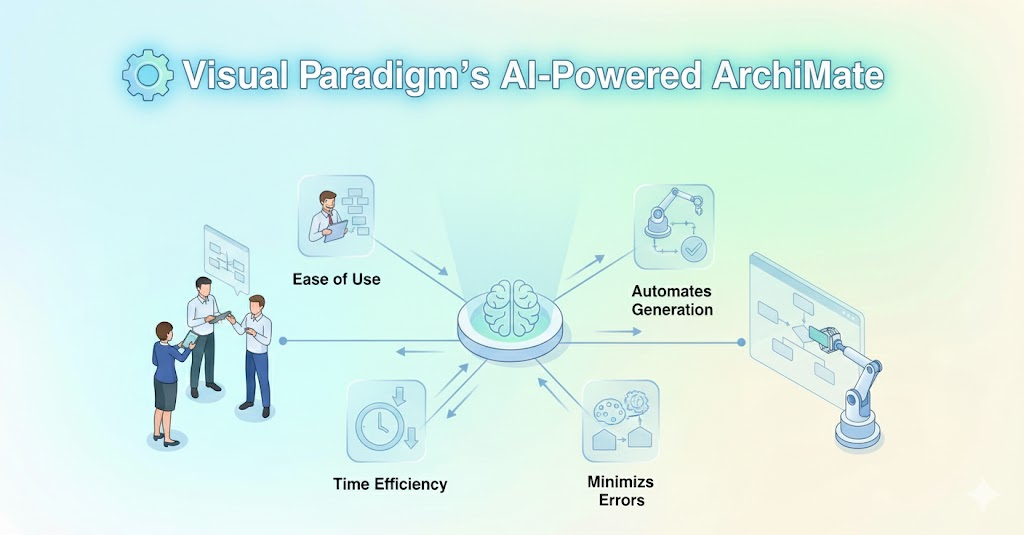
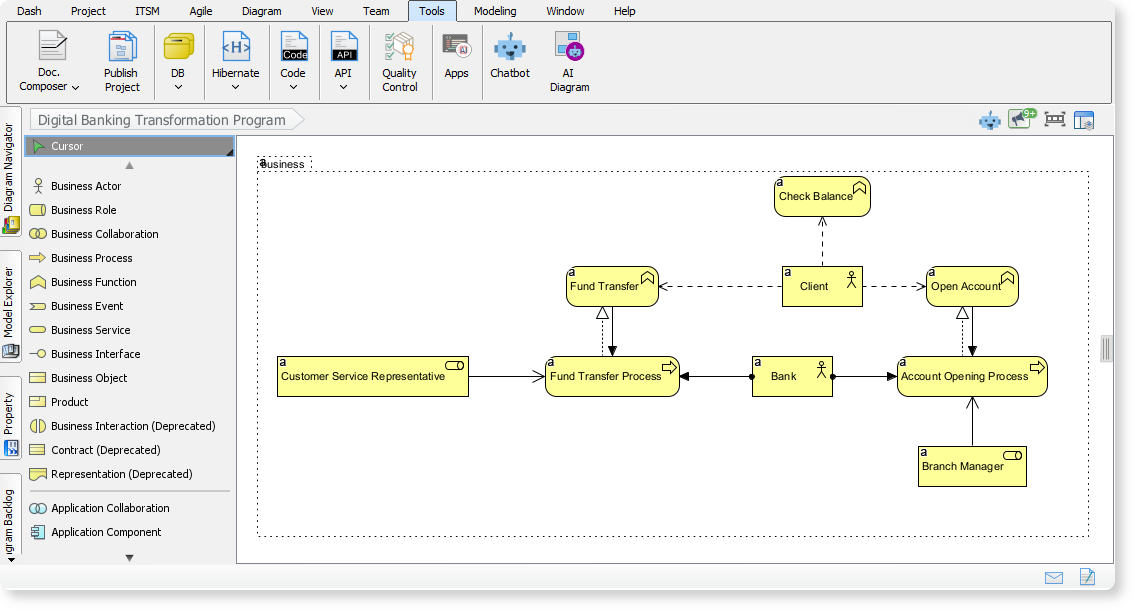
AI-Powered Diagram Generation:
- Automatically generates ArchiMate diagrams from textual descriptions or existing data.
- Reduces manual effort and accelerates project initiation.
-
:
- Provides Just-in-Time TOGAF templates for each ADM phase.
- Ensures compliance with TOGAF standards.
-
:
- Supports real-time collaboration among teams.
- Tracks changes and maintains version history.
-
:
- Integrates with requirements management tools and project management platforms.
- Exports diagrams to TOGAF-compliant documentation.
Example: Kickstarting a New Project with Visual Paradigm
- Define the Architecture Vision (Phase A):
- Use AI to generate an ArchiMate Strategy Map from business goals.
- Develop Business Architecture (Phase B):
- Auto-generate Business Process Diagrams from stakeholder inputs.
- Create Information Systems Architecture (Phase C):
- Generate Application and Data Models using AI-assisted modeling.
- Plan Migration (Phase F):
- Use AI to create Migration Roadmaps and Gap Analysis Diagrams.
Summary and Review
Key Takeaways
- TOGAF ADM is a proven, iterative methodology for enterprise architecture.
- ArchiMate complements TOGAF by providing a standardized visual language.
- Visual Paradigm’s AI tools accelerate diagram creation, ensuring consistency and compliance.
Best Practices for Success
- Tailor TOGAF to your organization’s needs.
- Use ArchiMate for clear, standardized visualizations.
- Leverage AI tools like Visual Paradigm to reduce manual effort and improve accuracy.
Conclusion
TOGAF ADM is the gold standard for enterprise architecture, offering a structured, flexible, and iterative approach to aligning IT with business strategy. By integrating ArchiMate for visualization and Visual Paradigm’s AI tools for automation, organizations can streamline the ADM process, reduce errors, and accelerate project delivery.
- Explore Visual Paradigm’s TOGAF ADM templates to jumpstart your projects.
- Experiment with AI-generated ArchiMate diagrams to visualize your architecture.
- Join TOGAF communities to stay updated on best practices and innovations.
Related Links: